Last updated: July 5, 2026
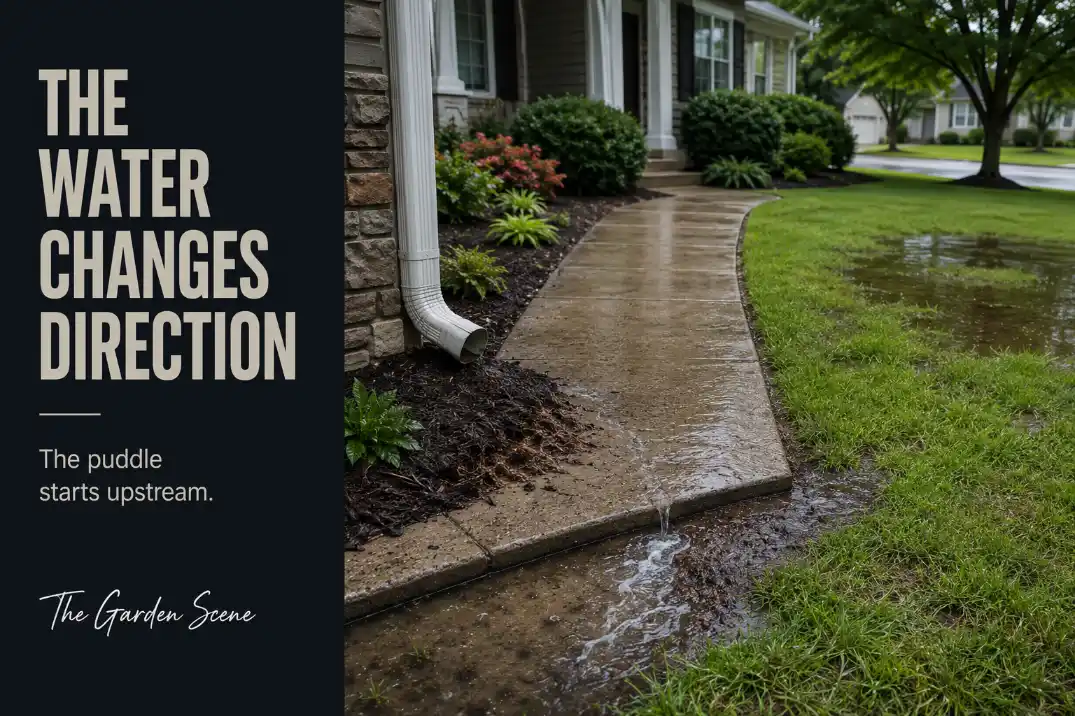
Water beside a front walkway can look like a soil problem, a walkway problem, or a bad low spot in the lawn. When a downspout is nearby, though, the wettest place is often only the ending.
The real failure usually starts upstream, where roof water leaves the downspout, hits the ground hard, meets the walkway edge, and gets redirected into the same strip of lawn or planting bed every time it rains.
That is why this problem gets misfixed. Extending the downspout might help. It might also send the same water into a new hard edge, bed corner, or walkway crossing.
The useful diagnosis is not “what product moves the water?” It is: where does the water first arrive, where does it turn, and where does it finally stop?
Why Downspouts and Walkways Create Front Yard Drainage Problems
A downspout turns roof runoff into a concentrated release point. A walkway then decides whether that water spreads, crosses, follows an edge, or gets trapped.
That combination is what makes the problem different from a normal wet lawn. Rain falling across turf is scattered. Water leaving a downspout is focused. Once that focused water reaches concrete, pavers, brick, edging, or compacted soil beside a path, the front yard starts behaving like a small drainage channel.
You may see a wet strip along the walkway edge, mulch pushed out of a front bed, muddy turf below the outlet, or water crossing the entry route. The visible puddle may sit in the lawn, but the cause may be the first place where roof water hit the walkway zone and changed direction.
This is also why the yard can look almost fine in dry weather. The walkway is stable. The downspout is attached. The bed edge looks clean. Then rain exposes the route: water leaves the downspout, follows the easiest hard edge, collects speed along the path, and slows down in the same low area.
A broader drainage problem may involve slope, soil, and runoff together. If the whole front yard pattern is unclear, step back and separate soil, slope, and runoff before choosing a fix.
For this specific page, keep the focus narrower: roof water meets walkway edge, changes direction, then damages the nearest weak receiving area.
The First Contact Point Matters More Than the Final Puddle
The first contact point is the highest-value clue because water still has energy there. The final puddle only shows where that energy ran out.

Start at the downspout outlet. Is it aimed toward the walkway, toward a bed corner, or into a narrow strip between the house and path? A discharge point that looks harmless in dry weather can become a concentrated stream during rain.
Then check the splash zone. Bare soil, small gravel pushed aside, mulch washed into a fan shape, or flattened grass below the outlet means the water is landing with enough force to move material. If the splash zone points toward the walkway, the path may become the next control point.
A walkway edge can catch that water in several ways. If the walkway is slightly higher than the lawn, water may run along the edge instead of spreading across the grass. If the soil beside the walkway has settled, the edge can become a shallow gutter. If the path slopes across the yard, water may follow the walkway until it finds a lower bed opening or lawn dip.
The bed edge matters too. Mulch and planting soil often sit lower than the walkway after a few seasons of washout, foot traffic, and settling. Once the bed becomes the easier channel, downspout water can carve through mulch even if the downspout itself is not inside the bed.
Field Check:
The wettest spot is often not the control point. Find the first hit, then follow the flow line to the last-to-dry area. That order usually gives a cleaner diagnosis than starting at the puddle.
How to Trace the Water Path After Rain
The useful test is not a dry-weather inspection. It is a short after-rain trace that separates active flow from leftover wetness.
Check during light to moderate rain if it is safe, or soon after rain ends. Avoid inspecting during lightning, heavy runoff, icy conditions, or any situation where the walkway is slick enough to be unsafe.
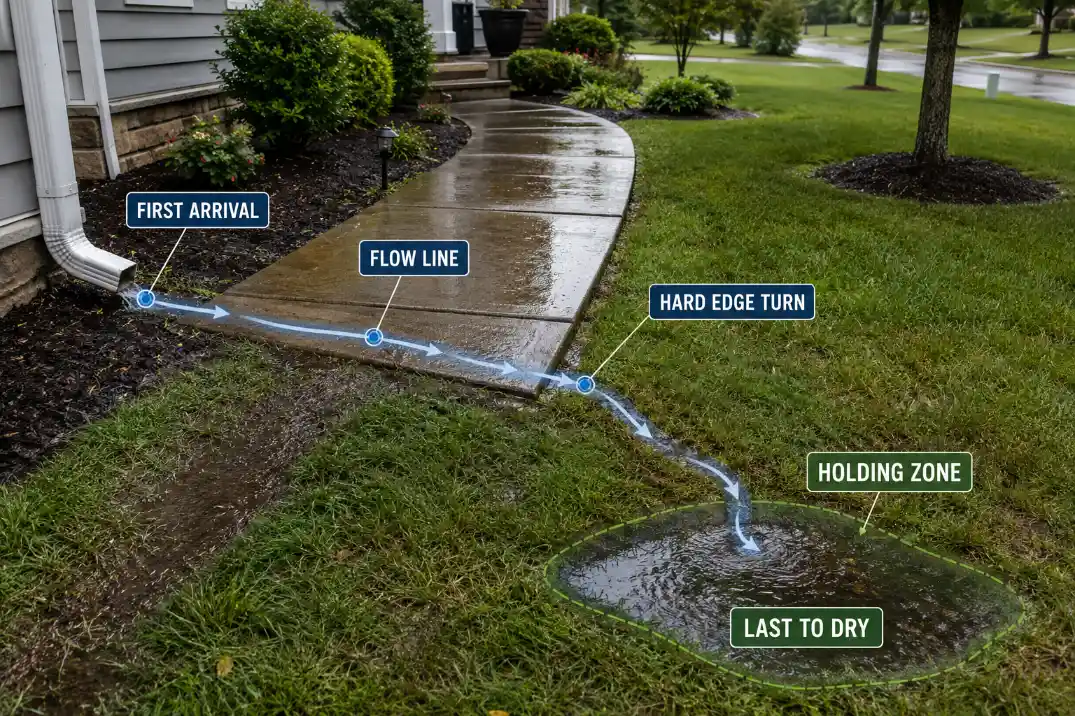
Start where the water leaves the downspout. You are looking for movement, not just dampness. A damp area tells you water was present. A sediment line, mulch trail, grass laid flat in one direction, or clean strip through debris tells you water moved.
Check the yard in three moments if possible: while rain is still falling safely, 30–60 minutes after rain, and the next morning. During rain, you see the active route. After rain, you see the sediment and mulch pattern. The next morning, you see the area that stayed wet longest.
Use this compact field check:
- Find the first arrival point where downspout water touches the ground.
- Look for the first turn: walkway edge, bed edge, path joint, edging strip, or compacted soil line.
- Check whether water crosses the walkway, follows the walkway edge, or disappears under mulch.
- Look for moved mulch, exposed soil, sediment lines, flattened turf, or a clean washed strip.
- Compare the first-wet area with the last-to-dry area.
- Note whether water remains near the house, porch, or entry wall after the active flow stops.
That last check changes the priority. A puddle in open lawn is one issue. Water pooling near the house deserves a more cautious drainage read.
Do not diagnose only from a single photo taken after everything has stopped moving. By then, the water may have already crossed the path, dropped sediment, and settled somewhere else.
Match the Symptom to the Real Cause
The symptom should point to the failing part of the route, not to a product category. That is the difference between a useful diagnosis and a fix that only moves the puddle.
| Symptom | What it usually means | What to check next | Likely fix direction |
|---|---|---|---|
| Mulch washed out beside walkway | Fast water is entering the bed or using the bed edge as a channel | Look upstream at the downspout outlet and first hard-edge turn | Slow or spread water before it reaches mulch |
| Wet strip along walkway edge | The walkway edge is acting like a shallow gutter | Check whether the walkway sits higher than lawn or bed soil | Open, reshape, or redirect the edge condition |
| Water crossing the path | Downspout discharge is aimed across the entry route or being pushed across it | Watch the crossing point during safe rainfall | Move the release point or route water before the path |
| Thin turf below downspout | Concentrated water is landing too hard or too often in one lawn strip | Look for splash damage and flattened grass | Move the outlet farther from the vulnerable turf |
| Puddle in low lawn after the walkway | The lawn is the holding zone, not necessarily the source | Trace back to the first hit and flow line | Route excess beyond the low area or improve receiving capacity |
A wet walkway edge and a washed-out bed can both come from the same downspout, but they fail in different places. One is a hard-edge routing problem. The other is a receiving-zone problem.
If you fix only the place that looks worst, the water may simply move one step farther down the same path.
When the Walkway Is the Barrier, Not the Source
Do not assume the walkway is creating the water just because the damage sits beside it. Sometimes the walkway is the barrier that prevents roof runoff from spreading or leaving.
A raised walkway edge can trap water in a narrow strip of lawn. The downspout sends water into the area, but the walkway keeps it from moving across the yard. Over time, the strip beside the path becomes soft, thin, and muddy while the walkway itself looks normal.
A settled planting bed can do the same thing. If the bed soil has dropped below the walkway surface, water can slide along the concrete or paver edge and spill into the lowest mulch pocket. The mulch washout then looks like a bed problem, even though the bed is only receiving water that the walkway edge collected.
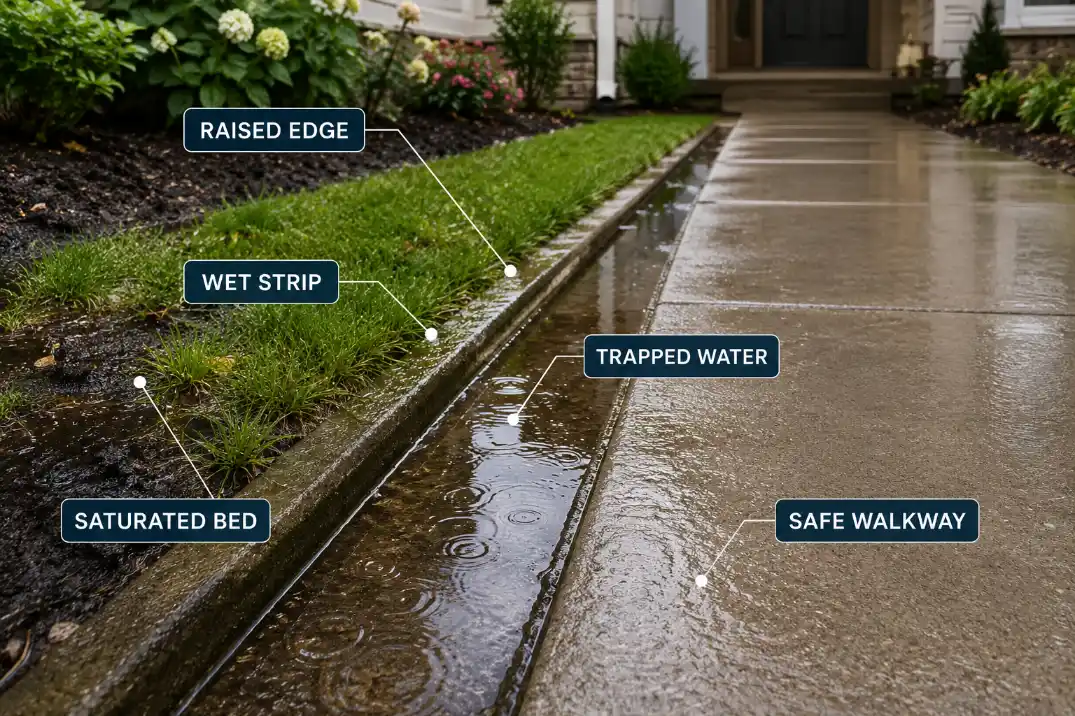
Compacted soil beside a walkway can also create a narrow gutter. This often happens where people step off the path, where delivery traffic cuts a corner, or where edging has been pressed into the soil for years. Water follows the compacted line because it is smoother and lower than the surrounding lawn.
The entry route adds another concern. A walkway that stays wet after every rain can become slick, muddy at the edges, or uncomfortable for visitors. This does not mean the walkway itself is defective. It means the drainage route is using the entry zone as part of the water path.
If the right receiving area is nearby, the fix may involve guiding water into a place designed to handle it. For example, placing a rain garden near patios or walkways only makes sense when the receiving area can collect water without undermining the path or sending it back toward the house.
The key is to keep the walkway readable and usable while giving water a better place to go.
Choose the Fix Path Without Turning It Into a Product Project
Choose the correction by the failure point, not by the most familiar drainage product. A downspout problem can still need an edge correction, and a walkway problem can still begin at the roof outlet.
If downspout water lands too close to the walkway, move the release point before changing the bed or lawn. The discharge may need to land farther from the path, away from the entry crossing, or beyond the narrow strip that keeps getting saturated.
If the walkway edge channels water, the problem is not just the downspout. The edge condition may need to be opened, reshaped, lowered beside the lawn, or interrupted so water does not keep running along the same hard line.
If the planting bed receives too much fast water, protect the receiving surface before replacing mulch again. Fast roof runoff can cut through fresh mulch in the next storm if the first hit and flow line are still aimed into the bed.
If the low lawn is the holding zone, the fix needs to move excess water beyond that low area or improve the area’s ability to receive water. That may mean a shallow surface route, a better receiving zone, or a more deliberate outlet path.

If soil stays wet long after visible flow stops, treat soil or compaction as a secondary issue. That does not erase the downspout problem. It means the water path and the receiving soil both matter.
Fix Boundary:
Fix the first wrong turn before fixing the final wet spot. Otherwise, new mulch, edging, plants, or drains go into the same failure path.
For downspout-led problems, the next decision may be whether the water should be released on the surface, carried farther away, or stored in a more controlled location. That is where choosing between a downspout extension, pop-up emitter, or dry well becomes useful, but only after the walkway interaction is understood.
Do not let that next decision pull this diagnosis into a product project too early. The route still comes first.
What Not to Blame Too Early
Misdiagnosis usually happens when one visible clue gets treated as the whole problem. In this pattern, the downspout, walkway, soil, and low lawn can all be involved, but they do not all deserve equal blame.
Do not blame the downspout too quickly if the whole lawn stays wet evenly. That pattern points more toward soil structure, compaction, or a broad grading issue than a single discharge point.
Do not blame the walkway if water is arriving from the driveway before the downspout contributes. A wet path edge near a driveway can be caused by pavement runoff using the walkway zone as a secondary route.
If water enters from the street, an uphill lawn, or the neighbor-side slope, the downspout may only add to a larger flow. The first arrival point will be outside the downspout zone, and the walkway may simply reveal where the incoming water slows down.
A driveway source is especially easy to confuse with a downspout source because both can leave water near the front walk. If the pavement sends water into the same low strip before roof runoff gets there, diagnose driveway runoff entering the front yard as its own pattern instead of overbuilding the downspout fix.
Do not treat water near the house as a routine lawn puddle. If the walkway edge, bed slope, or downspout route holds water against the foundation side of the entry, the drainage priority becomes more serious than keeping mulch in place.
A Better Fix Starts With the Water Path
Downspout and walkway drainage problems are usually path problems. The roof water starts concentrated, the walkway changes its direction, and the lawn or bed shows the damage later.
That is why the final puddle should not choose the fix by itself. The better read is source, first hit, hard-edge turn, flow line, and holding zone. Once those are clear, the next step becomes much easier to choose.
Check the yard after rain before replacing mulch, adding edging, changing plants, or installing a drain. The right fix should interrupt the first wrong turn, not just dress up the last wet spot.
For broader stormwater context, the EPA explains how redirecting downspouts can help move roof runoff toward lawn or garden areas where water can soak in instead of rushing across hard surfaces: EPA Soak Up the Rain: Disconnect / Redirect Downspouts