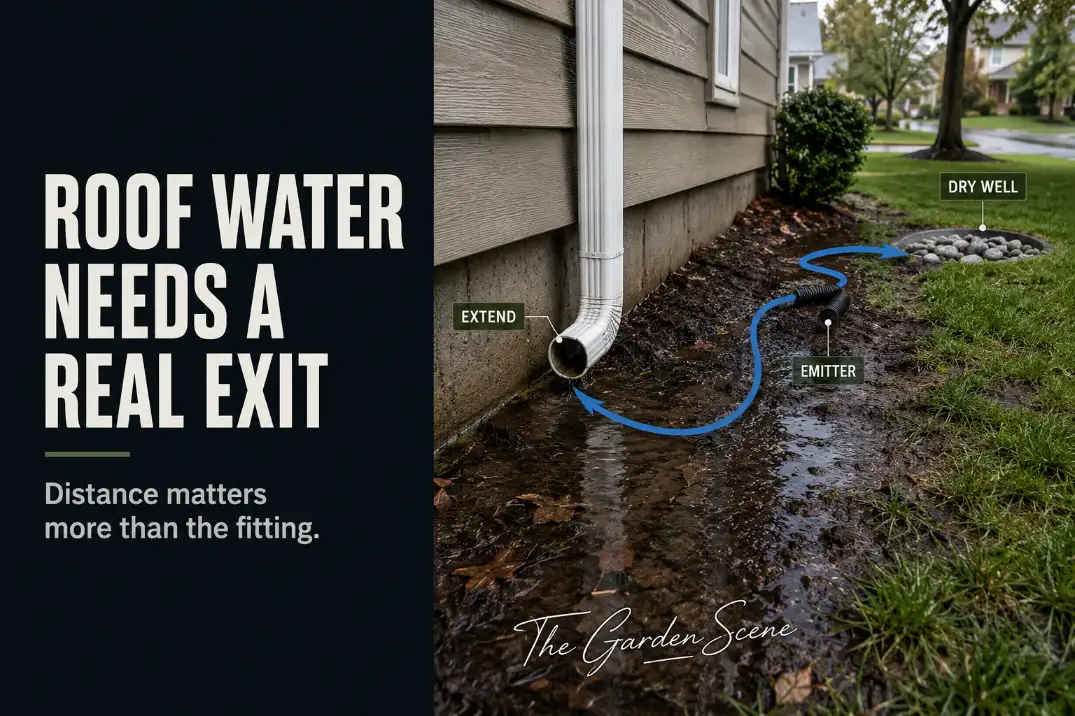
Roof runoff problems usually start with distance, slope, and soil, not with the name of the drainage part. A downspout extension, pop-up emitter, and dry well can all work, but they solve different problems.
Start with a downspout extension when the yard already gives water a safe path away. Use a pop-up emitter when the pipe needs to disappear underground before releasing water at a lower point. Treat a dry well as a soil-dependent storage system, not as the default upgrade.
As a practical target, many roof-runoff fixes should move water 6–10 feet from the foundation, especially where the yard is flat, soil drains slowly, or grade slopes back toward the house.
If soil near the outlet stays wet for more than 24–48 hours after rain, the issue is not just the fitting. It is the outlet location, the grade, or the soil’s ability to accept water.
Downspout Water Needs Distance
The fitting is not the fix
The common mistake is treating the visible end piece as the solution. A green pop-up cap looks more permanent than a plastic extension, and a dry well sounds more engineered, but neither one solves the problem if the water still exits into a slow, low, or compacted area.
The real job is simple: move roof water away from the foundation, across a safe route, and to a place where it can spread, drain, or leave without creating a new wet zone.
If the downspout is the only source of water and the yard already slopes away, compare a simple extension or solid pipe kit before pricing a buried emitter or dry well; Best Drainage and Erosion Control Products to Buy First for Backyards is the better next step for that product decision.
The first 10 feet matter most
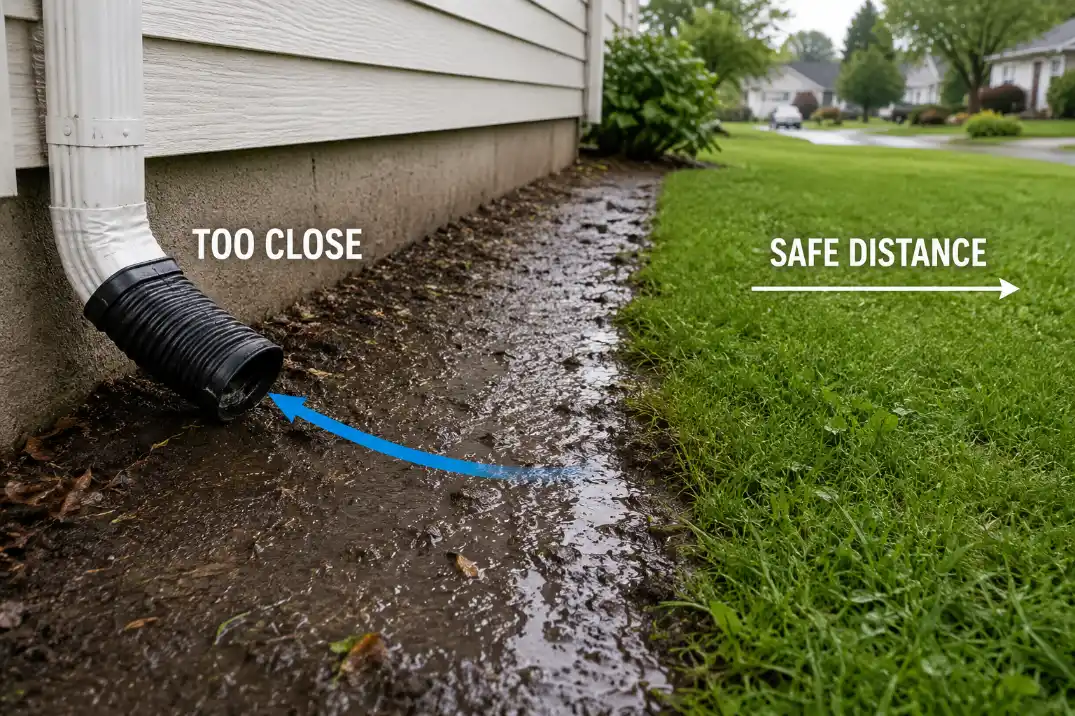
Water released 2–3 feet from the foundation often looks improved because it no longer splashes directly against the wall. That can still be a failure if the grade carries water back toward the house. The stronger test is where the water sits 30–60 minutes after a normal rain.
If the ground between the outlet and the house stays wet, the discharge point is still part of the foundation drainage problem. If water reaches a lawn area that drains and dries within a day, a simple extension may be enough.
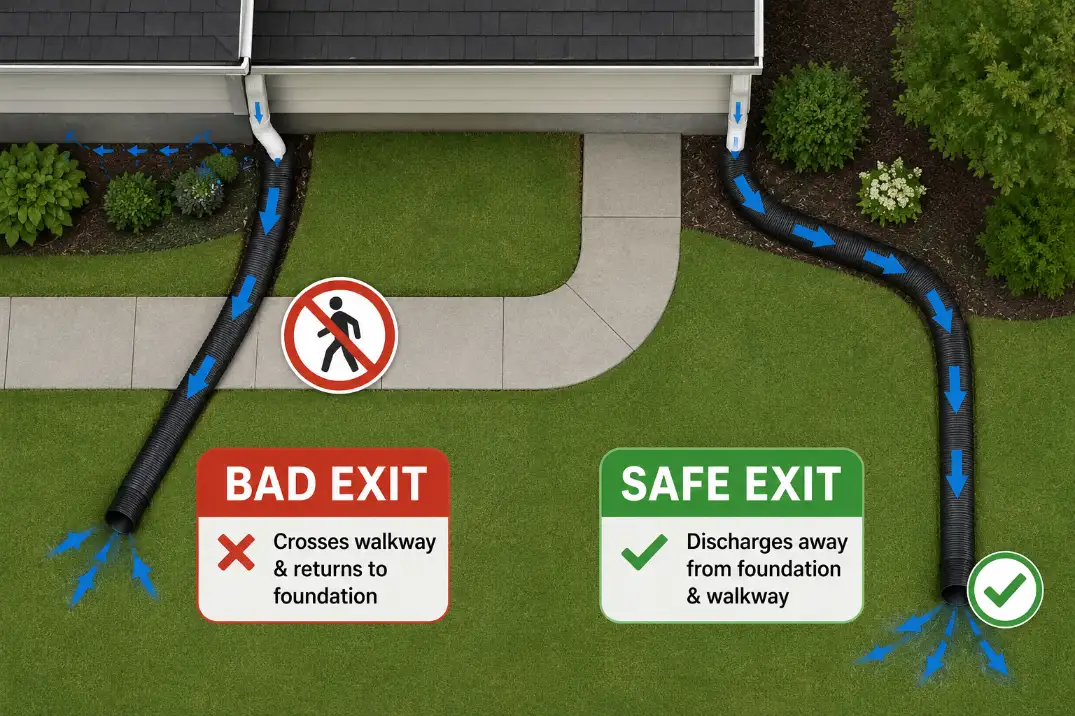
If it crosses a walkway, dives into a planting bed, or heads toward a neighbor’s lot, the outlet location needs more thought than the outlet product.
When Extensions Are Enough
Use an extension when the yard already helps you
A downspout extension is the best first move when the surrounding grade is already working. That usually means the soil slopes away from the house, the outlet can land on lawn or mulch without crossing a main path, and the water does not collect in a visible low spot after ordinary rain.
For many homes, a 4–6 foot hinged or flexible extension is enough to stop splashback and reduce wet foundation soil. On tighter lots, a solid drain pipe routed 8–12 feet to daylight can look cleaner and stay in place better than a loose plastic extension that gets kicked aside by mowing, kids, pets, or winter cleanup.
The weak point is not length alone
Longer is not automatically better. A 12-foot extension that dumps water into a sunken side yard can fail harder than a 6-foot extension that reaches a clear downslope. The better question is whether the outlet lands on a surface that can accept the flow.
This is where homeowners often overestimate “more distance” and underestimate grade. A slight 1–2 inch drop over several feet can decide whether water keeps moving or stalls.
If you already see downspouts overwhelming planting beds, Downspouts Flood Backyard Planting Beds is the more specific problem pattern to check before adding more pipe.
Pro Tip: Test an extension with a garden hose before burying anything. Run water for 10–15 minutes and watch the outlet area, not just the downspout.
When Emitters Make Sense
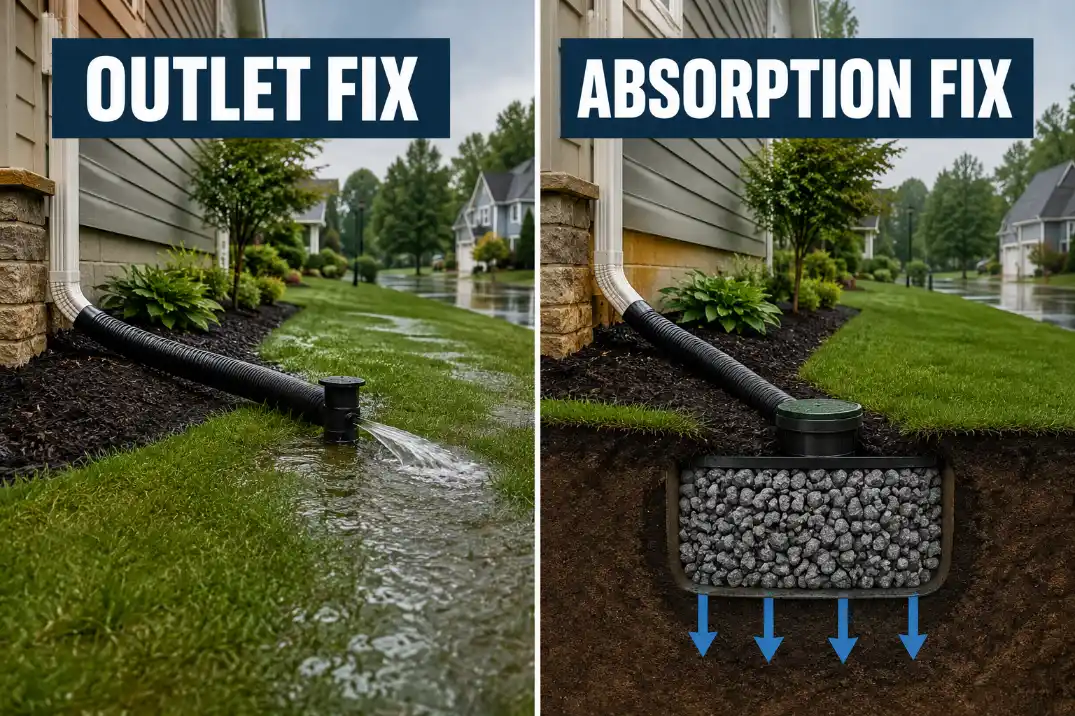
A pop-up emitter is for hidden routing
A pop-up emitter is useful when you need to carry water underground from the downspout to a lower lawn edge, swale, curbside-safe area, or other legal discharge point.
It keeps the route clean on the surface and opens only when enough water pressure builds inside the pipe.
That makes it a good fit for front yards where visible extensions look messy, side yards where loose pipe blocks access, or lawns where mowing around a surface extension is annoying.
The emitter should be the end of a route that already has somewhere to drain, not a shortcut for sending water into a flat wet pocket.
The pipe still needs pitch
A buried downspout pipe should generally fall at least 1/8 inch per foot, and 1/4 inch per foot is better where the site allows it. Without pitch, debris settles, water sits in the pipe, and freeze-thaw cycles in northern states can make the outlet unreliable.
Pop-up emitters also need a small gravel pocket or drainage area below the cap so leftover water can drain after the main flow stops. If the emitter sits in heavy clay and stays submerged after rain, it becomes a wet plug instead of a clean outlet.
The cap has to stay clear
A pop-up emitter is easy to forget once the grass grows around it. That is exactly when it starts to fail. If turf, leaves, mulch, or sediment covers the cap, the pipe may still carry water, but the release point becomes restricted.
Keep a small clear ring around the cap and check it after heavy leaf drop, spring cleanup, and major storms. Two or three quick checks per year are usually enough for a simple downspout line, but low emitters near mulch beds may need more attention.
| Option | Best use | Common failure | Better sign |
|---|---|---|---|
| Downspout extension | Short, visible route on good grade | Dumping water into a low strip | Outlet dries within 24 hours |
| Solid buried pipe | Cleaner route to daylight | Too little pitch or crushed pipe | Water exits freely during hose test |
| Pop-up emitter | Hidden route to lower release point | Cap buried by turf or debris | Cap opens and drains back down |
| Dry well | Infiltration where soil drains | Installed in clay or high water table | Test hole drains within 24 hours |
| Splash block only | Minor splash control | Pretending it moves water far enough | Used only with good slope |
Dry Wells Need the Right Soil
A dry well is an absorption system
A dry well is different from an extension or emitter because it does not simply move water to an outlet. It stores roof runoff temporarily and lets it soak into surrounding soil. That makes soil performance the deciding factor.
Sandy or loamy soil can make a dry well useful. Dense clay, compacted fill, high water tables, or areas that already stay wet after storms are poor candidates. A dry well is not automatically the “stronger” option. In the wrong soil, it is just a buried wet spot.
A failed test hole should stop the dry well idea
Before choosing a dry well, dig a test hole in the intended area and fill it with water. If a 12-inch-deep test hole still has standing water after 24 hours, the dry well should not be the main solution in that location.
This is where readers often overestimate storage and underestimate reset time. A dry well has to empty between storms. If it cannot recover before the next rain, a bigger dry well may only delay the same failure.
In that case, a routed outlet, swale, or daylight discharge is usually more reliable than deeper storage.
Roof area changes the load fast
A single downspout may be draining 300–600 square feet of roof. One inch of rain on 500 square feet of roof produces roughly 300 gallons of water. That amount does not disappear just because the system is buried.
A dry well that seems large during installation can be undersized during a heavy summer thunderstorm in the Midwest or a multi-day coastal rain pattern.
If the dry well fills faster than the soil can absorb water, the system needs an overflow route or it will push water back up, saturate the surrounding lawn, or send water toward the foundation.
A dry well without an overflow route is not a complete drainage plan. It is a storage gamble, especially when the roof area is large, the soil drains slowly, or storms arrive before the system has emptied.
Where These Fixes Backfire
The obvious fix fails when it creates a new low spot
The most wasteful fix is burying pipe just to hide the problem. If the pipe ends in another low area, the yard may look cleaner while drainage gets worse.
Water that used to be visible beside the downspout now appears as soggy lawn, mulch washout, mosquito-prone wet soil, or a soft edge near a walkway.
The same logic applies to emitters. A pop-up emitter placed beside a patio, driveway, or walkway can make the hardscape feel like the problem even when the real mechanism is roof water being delivered to the wrong edge.
If you are already seeing water pool near the house, Front Yard Water Pooling Near the House gives a better diagnostic frame before choosing a discharge point.
Clay soil changes the decision
Clay soil does not automatically rule out every drainage fix, but it does reduce the usefulness of absorption-based solutions. In heavy clay, a dry well may work briefly after light rain and fail during back-to-back storms because the surrounding soil cannot reset fast enough.
That is why the more likely cause is not always “the dry well is too small.” Often, the site is asking for a surface route or a real outlet instead of deeper storage.
The distinction matters because adding more underground volume does not fix soil that cannot absorb water fast enough.
Freezing climates need clean emptying
In northern states, any buried line that holds water can become unreliable in freeze-thaw weather. The outlet may freeze, the pipe may stay partly full, or the pop-up cap may sit blocked by ice and debris.
A route that drains empty after each storm is healthier than one that depends on standing water slowly disappearing.
In warmer humid regions such as Florida, the concern is different. The risk is less about ice and more about saturated soil, mosquitoes, and discharge points that never dry between storms. The product can be the same, but the failure pattern changes by climate.
Where These Systems Should Not Discharge
Walkways reveal bad outlets quickly
Paths, patios, and driveway edges are useful because they show where water is really going. If a new extension sends water across a walkway, the drainage fix has created a usability problem.
If a pop-up emitter releases at the edge of a path, the outlet may leave sediment, algae, or a slick film after repeated storms.
A safe outlet should avoid main walking routes and should not discharge onto a neighbor’s property, public sidewalk, or driveway apron.
Where water must cross hardscape, the fix often shifts away from a simple downspout route and toward a channel, basin, swale, or broader grading solution.
Point water is different from sheet flow
Downspout water is point water. It comes from one source, so it can often be extended, piped, or released at a controlled outlet. Sheet flow is different. It spreads across a driveway, patio, or walkway edge, and a downspout part will not intercept it well.
That distinction prevents a common wrong repair. If runoff is crossing a long hardscape edge, the question may no longer be pop-up emitter versus extension.
It may be whether the water needs a catch basin, channel drain, or surface route, which is where Catch Basin vs Channel Drain for Runoff becomes the more useful comparison.
Quick Decision Guide
Choose by route, not by product name
If the water only needs to clear the foundation and the yard already slopes away, start with an extension. If the extension would be ugly, easy to trip over, or constantly moved, use a solid pipe route or pop-up emitter to reach the same safe outlet more cleanly.
If the yard has no good outlet and the soil drains well, a dry well may be worth considering. But a dry well should not be the default answer for clay soil, small side yards, high water table areas, or places where water already stands after storms.
Know when the standard fix stops working
A routine extension stops making sense when it blocks access, crosses a path, or still leaves wet soil near the foundation after rain. A pop-up emitter stops making sense when there is no lower place to release water. A dry well stops making sense when the soil cannot absorb water fast enough to reset between storms.
Use the smallest fix that reaches a real exit:
- Use a downspout extension when 4–10 feet of surface routing reaches ground that drains away from the house.
- Use a buried solid pipe or pop-up emitter when the water needs to travel farther without blocking mowing, access, or front-yard appearance.
- Use a dry well only when the soil passes a drainage test and there is room for overflow.
- Avoid any option that moves water from a visible problem into a hidden low spot.
If water remains inside the first 10 feet of the foundation after rain, the fix has not really exited the foundation zone yet. The strongest roof-runoff solution is not always the most engineered one.
It is the one that moves water far enough, releases it cleanly, and does not create the next drainage problem three steps away.
For broader official guidance on redirecting roof runoff and keeping moisture away from foundations, see the University of Minnesota Extension.