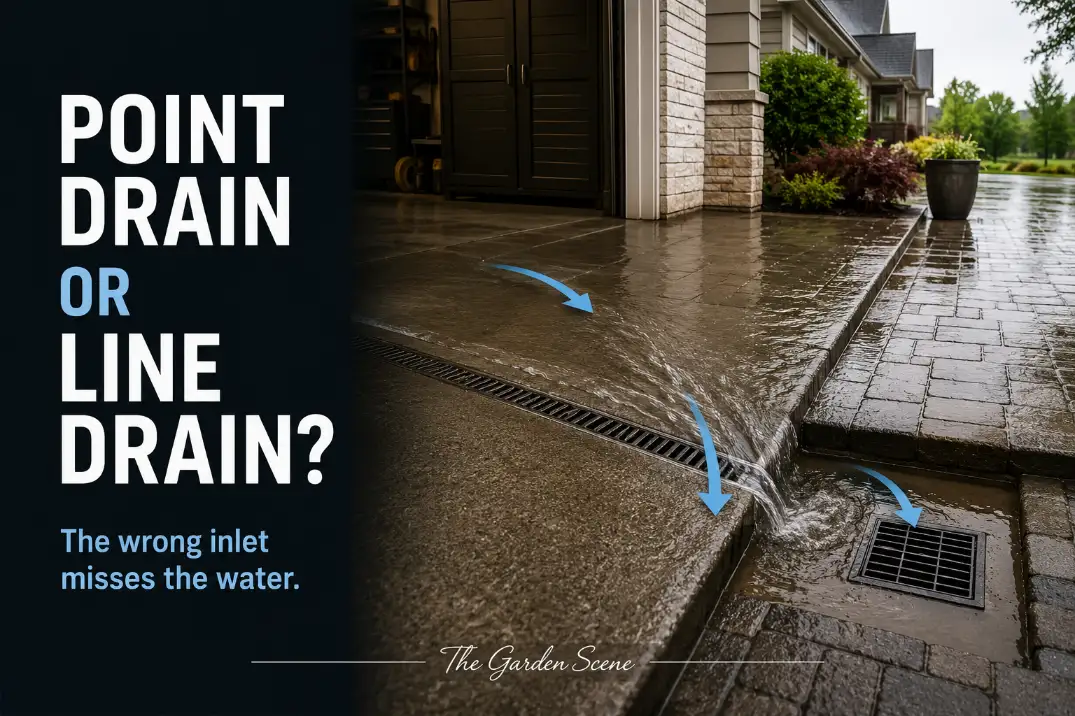
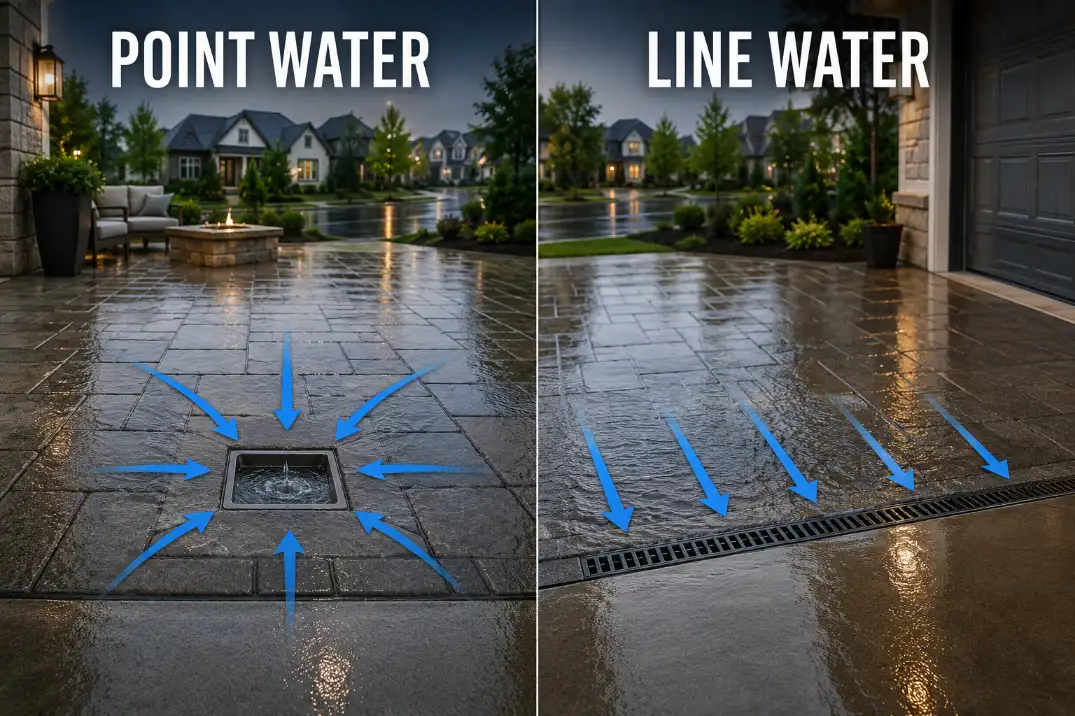
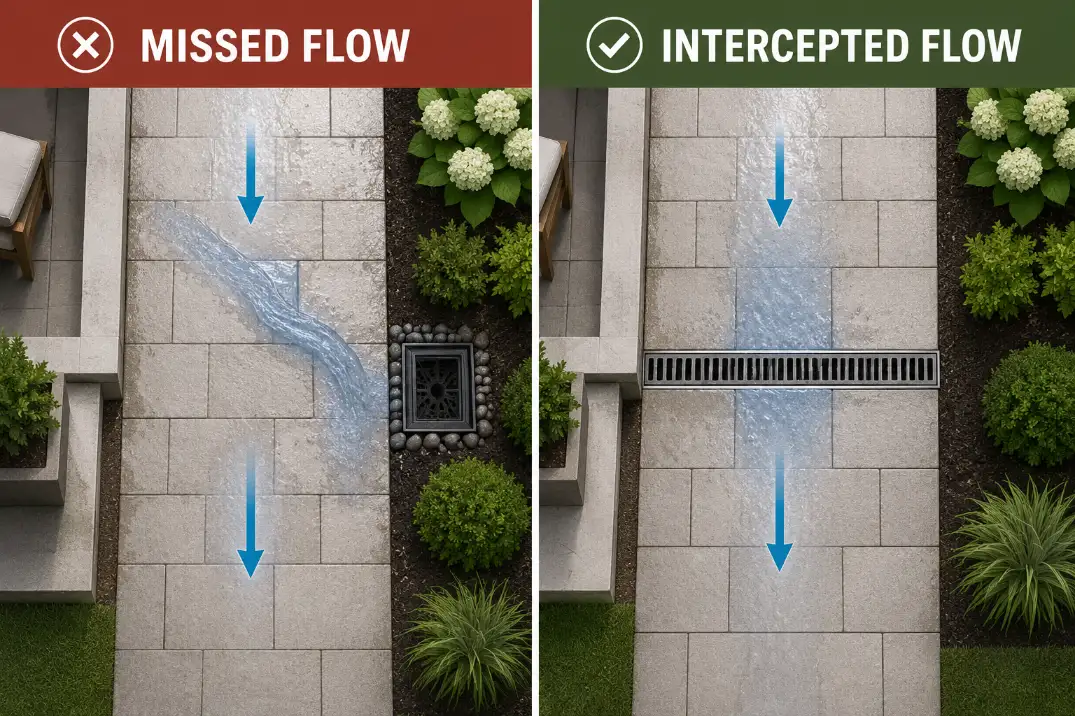
A catch basin collects point water. A channel drain collects line water. Choose the wrong one and the drain may still look useful while missing the water that matters.
Use a catch basin where runoff naturally gathers into one low pocket, such as a patio corner, lawn depression, or downspout collection point. Use a channel drain where water crosses a long edge, such as a patio door, garage apron, driveway lip, or walkway.
If water stands for more than 24–48 hours after normal rain, or a hose test sends water across a full edge in 10–15 minutes, the issue is no longer just a puddle. It is a drainage interception problem.
The first decision is not grate style. It is water shape. The second decision is outlet logic. If there is no lower, legal, maintainable place for the water to go, neither drain is the real fix.
Point Water or Line Water
Start with the path, not the product
Watch the surface during the first 5–10 minutes of steady rain. That early movement tells you more than the puddle left behind after everything has already filled.
If runoff narrows into one obvious target, that is point water. A square or round catch basin can work because the site is already delivering water to one collection point.
This often happens at a patio corner, a downspout discharge point, a low lawn pocket beside paving, or the bottom of a short surface route.
If water moves as a thin sheet across a long edge, that is line water. A channel drain works better because it intercepts the water across its width before it reaches the vulnerable edge.
This is why a narrow channel can outperform a larger basin at a garage apron or patio door. The channel is not better because it looks more substantial. It is better because it crosses the water path.
The mistake is assuming the bigger-looking drain is the safer choice. A large basin placed beside line flow still misses the edges. A long channel placed in a small point puddle may be more cutting, framing, and maintenance than the site needs.
For larger site decisions, the inlet also has to fit the whole water route, not just the wet spot. A local drain should still connect to a sensible exit, which is why the broader logic in the Yard Drainage Solution Guide matters before cutting into hardscape.
Check the outlet before choosing the inlet
A drain inlet does not solve water by itself. It only collects water. The pipe moves it. The outlet releases it. Maintenance access keeps it usable after storms.
That order matters. If the outlet is too high, too flat, blocked by roots, aimed into a neighbor’s yard, or routed into another low area, the catch basin or channel drain becomes an expensive holding point.
In many residential systems, the pipe leaving the inlet should maintain at least about 1% fall where possible, or roughly 1 inch of drop over 8 feet. The exact route matters more than the product name.
This is where many drainage projects fail. The homeowner chooses an inlet because the puddle is visible, but the hidden failure is the outlet. The symptom is water sitting at the surface. The mechanism is that the collected water has nowhere useful to go.
Do not confuse surface water with saturated soil
Catch basins and channel drains are surface-water tools. They collect visible runoff moving across paving, gravel, soil, or lawn. They do not fix every soggy-yard condition.
If the ground stays spongy for two days or more with no clear surface route, the issue may be soil saturation, clay compaction, poor grading, or subsurface water.
In that case, a French drain, swale, dry creek route, or regrading plan may matter more than either inlet style. A basin placed in wet soil without a real surface flow path often becomes a mud collector, not a solution.
The useful distinction is simple: if you can see water crossing a surface, choose the drain that intercepts that shape. If the soil is wet from below or slow to dry without a visible route, diagnose the soil, slope, and outlet before choosing an inlet.
Patio Door Low Spots
Use a channel drain when the threshold is fed across its width
Patio doors usually need line interception when water approaches across a broad hard surface. A sliding door, French door, or basement walkout can fail long before the deepest puddle looks dramatic. The real risk is the wet edge feeding the threshold.
A channel drain belongs slightly downhill from the door path, where it can intercept flow before water reaches the track or sill. The surrounding patio still needs fall.
A practical target is about 1/8 to 1/4 inch of slope per foot away from the house where the site allows it. The drain should support that slope, not replace it.
This is where a catch basin often disappoints. A basin in one corner may remove the deepest puddle while leaving a thin sheet of water along the door. That looks like partial success after a storm, but the vulnerable edge is still being fed.
When water is already pooling against the foundation or door wall, the issue may be broader than grate selection.
That situation is better diagnosed through Patio Water Pooling Against the House, because the wrong fix can move water closer to the structure instead of away from it.
Use a catch basin only when the patio already drains to one pocket
A catch basin can still be right near a patio, but it needs a real collection point. It works where water already falls into a corner, planting gap, gravel pocket, or low paved area. It is less convincing in front of a door unless the paving is intentionally shaped to feed the basin from multiple directions.
The fix that wastes time is adding a basin beside a flat patio. Water does not turn sideways just because a drain is nearby. If the surface has no pitch toward the basin, the basin becomes a low accessory instead of a working inlet.
Pro Tip: Before cutting pavement, run a hose for 10 minutes and mark where water first crosses the danger line, not just where the deepest puddle appears later.
Driveway Edge Runoff
Channel drains solve width, but only if the grate is built for traffic
Driveways often create line water because they are wide, smooth, and sloped. At a garage, sidewalk, or lower driveway edge, runoff may arrive across 8–16 feet of surface rather than one neat point.
A channel drain is usually the cleaner choice when water crosses a garage threshold, spills across a sidewalk, or dumps into a planting bed along a long edge.
But driveway channel drains are less forgiving than patio drains. The grate and frame must match the load. A light pedestrian grate may be acceptable near a garden path, but a drain crossing a tire path needs a vehicle-rated product with stable bedding.
If the channel rocks, settles, or sits low, the surrounding concrete or pavers can start to chip, hold water, or break along the edge.
This is the practical cost difference many comparison articles underplay. A catch basin is usually a more local excavation. A channel drain often requires a longer cut, more exact elevation control, and a cleaner transition into the surrounding surface.
That extra work is worth it when the water crosses a wide edge. It is wasteful when the water already collects in one small low point.
Where driveway runoff is being sent into the front yard instead of controlled at the edge, the better next step is the runoff pattern itself, not just the inlet. That is the issue covered in Driveway Runoff Front Yard Drainage.
Catch basins work below concentrated driveway flow
A catch basin makes more sense below a concentrated driveway flow, such as a low corner where runoff already leaves the paving and drops into lawn. It can also work where a side slope, downspout extension, or short swale delivers water to one target.
The important boundary is debris. If roof grit, leaves, mulch, and driveway sediment all reach one inlet, a small 9-by-9-inch basin may clog quickly. A 12-by-12-inch basin is often easier to clean and more forgiving for light residential runoff.
Larger boxes may be needed where several flows combine, but bigger is not a substitute for a clean outlet.
A catch basin is the wrong shortcut when the driveway edge itself is the problem. If water is entering the garage across the full apron, a basin near one side may reduce the visible puddle while leaving the threshold wet.
Walkway Water Crossing
Use a channel drain when the walking route is being crossed
A wet walkway is not always a drainage emergency, but repeated water crossing the walking route is different. It creates algae in humid climates, slick ice in northern states, and dirty splash marks where water carries soil or mulch across the surface.
If water crosses the walkway as a stripe, a channel drain or narrow surface drain at the crossing point usually makes more sense than a basin off to one side.
The drain should interrupt the water path without becoming a trip edge. Keep the grate flush with the surrounding surface, and choose narrow, heel-safe grate openings instead of wide slot patterns on high-use walking routes.
If the issue appeared after a patio or walkway was added, the hardscape may have changed the drainage pattern rather than simply revealing it. That kind of failure is often closer to Backyard Drainage After a Patio or Walkway than to a simple product-choice problem.
A basin works when the walkway sheds water to one side
A catch basin can be the better choice when the walkway has a clean cross slope and water already exits toward one side. In that case, the basin is not trying to catch the whole walking surface. It is catching the low-side collection point.
The mistake is installing a basin in the walkway itself when the water is actually moving across the full width. That leaves the walkway wet before the water ever reaches the basin. It also creates a maintenance point in the exact place people walk.
Cleaning and Clogs
The first clog usually reveals the wrong upstream condition
Both drains clog, but they do not clog the same way. A channel drain usually clogs along the grate first. Leaves, pine needles, grass clippings, and grit bridge across the long opening. A catch basin usually clogs in the basket or sump, especially when mulch, soil, and roof grit wash into one point.
For most residential drains, inspect after the first major storm of the season and then every 3–6 months during heavy leaf or rain periods. In Florida or coastal California, algae and organic film may be the bigger nuisance. In dry Arizona conditions, windblown grit can collect even when rain is infrequent.
A drain that needs cleaning once or twice a season is normal. A drain that fills with sediment every 2–4 weeks is usually not a maintenance problem. It is an upstream erosion, mulch washout, or grading problem.
When cleaning stops making sense
Routine cleaning stops making sense when sediment fills more than about 25% of the basin sump after one moderate storm, or when a channel drain clogs before water can enter during normal rainfall. At that point, a larger drain may only delay the same failure.
Fix the source first. Stabilize bare soil, keep mulch out of flow paths, redirect downspouts, or adjust the slope feeding the inlet. The drain should collect water, not serve as a trash trap for a failing landscape edge.
This is where homeowners often overestimate maintenance and underestimate grading. Cleaning is normal. Repeatedly cleaning the same mud, mulch, or grit after every storm is a signal that the drain is receiving material it should not be asked to handle.
Choose by Water Shape
Sometimes the right answer is both
Catch basins and channel drains are not always competitors. Sometimes they belong in the same system with different jobs.
A channel drain can intercept the long sheet of water at a driveway edge, while a downstream catch basin or debris box catches leaves and grit before they move into the pipe.
This setup makes sense where line water meets heavy debris: a driveway under trees, a garage apron near mulch beds, or a patio edge receiving both roof runoff and leaf litter.
The channel solves interception. The basin solves sediment and maintenance access. Neither solves a bad outlet.
Pro Tip: If the system has more than one inlet, include a cleanout or accessible basin before the longest pipe run. The easiest drain to clean is the one you planned to open.
The stronger decision table
| Water pattern | Use this | Do not use this | Failure sign |
|---|---|---|---|
| Water gathers in one low pocket | Catch basin | Long channel drain by default | Basin sits dry because surface does not slope toward it |
| Water crosses a patio door or garage edge | Channel drain | Single basin off to one side | Ends stay wet after the center drains |
| Runoff exits a walkway to one side | Catch basin | Drain placed in the walking path | Walkway stays wet before water reaches the inlet |
| Sheet flow runs across a driveway apron | Vehicle-rated channel drain | Light-duty grate or small side basin | Water bypasses both ends or grate shifts under traffic |
| Line water carries leaves and grit | Channel drain plus accessible basin | Pipe with no debris access | Drain works once, then clogs after every storm |
| Soil stays wet without visible flow | Diagnose soil, slope, and outlet first | Surface inlet as the first fix | Ground stays spongy even when the drain is clear |
The healthiest setup usually dries within a few hours after ordinary rain once the storm has passed. A failing setup leaves slick edges, standing puddles, or soggy soil into the next day. That drying difference is more useful than simply asking whether the drain “takes water.”
If the water is not entering from a patio, driveway, or walkway edge at all, the better fix may be a swale, dry creek bed, or French drain rather than either inlet style. The comparison in French Drain vs Swale and Dry Creek Bed helps separate those broader yard-drainage choices.
A quick field checklist before buying
- Mark whether the water arrives as one point, one edge, or several competing paths.
- Confirm the outlet is lower, legal, and not sending water into another problem area.
- Check whether the surface has enough fall toward the proposed inlet.
- Choose a vehicle-rated grate if the drain crosses a driveway or tire path.
- Avoid small basins where mulch, leaves, roof grit, and driveway sediment all combine.
- Decide whether debris control requires both a channel and a basin.
- Recheck the site after one real rain, not only with a hose.
A catch basin is the better choice when the site already gives you one water target. A channel drain is the better choice when the site gives you a wet line.
The wrong drain does not fail because it cannot collect water. It fails because it collects the wrong part of the water.
For broader official guidance on reducing stormwater runoff around homes, see EPA Soak Up the Rain.