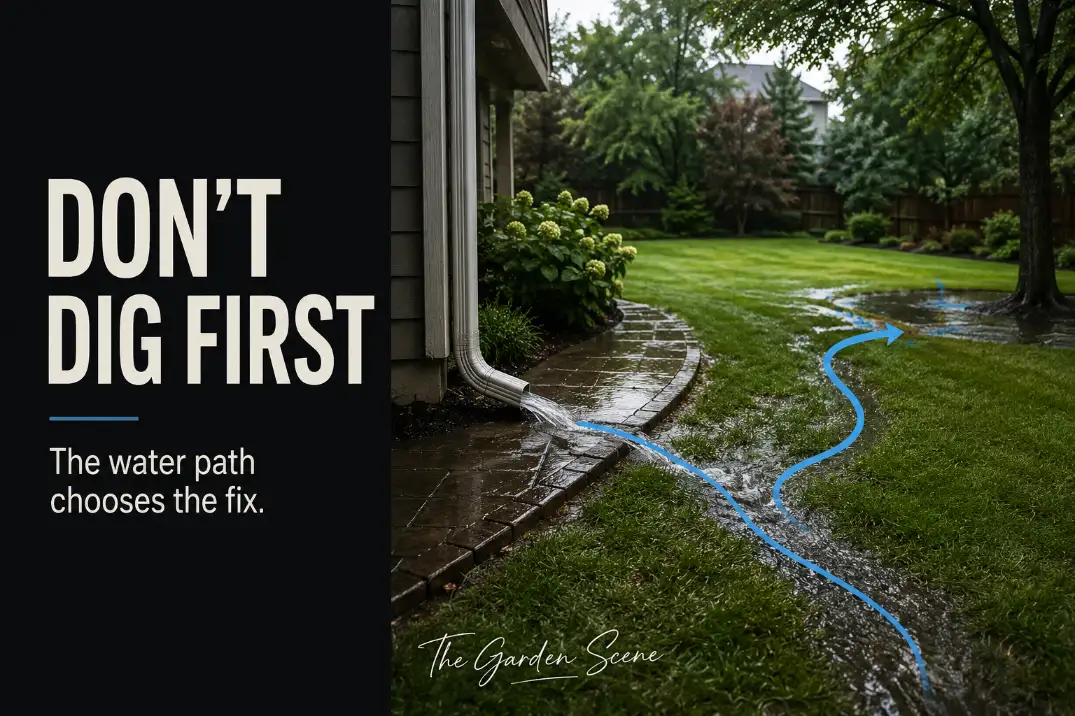
A good yard drainage solution starts with one decision: are you trying to move water, absorb water, or stop water from being sent to the wrong place? Those are different failures.
A lawn that stays soft for 48 hours after normal rain points toward soil, compaction, low grade, or a missing outlet. Water that appears within 30 minutes of a storm usually points to runoff from a roof, patio, driveway, or uphill slope.
Water sitting within 6 to 10 feet of the foundation is more urgent than a soggy back corner because it can affect the house, not just the lawn.
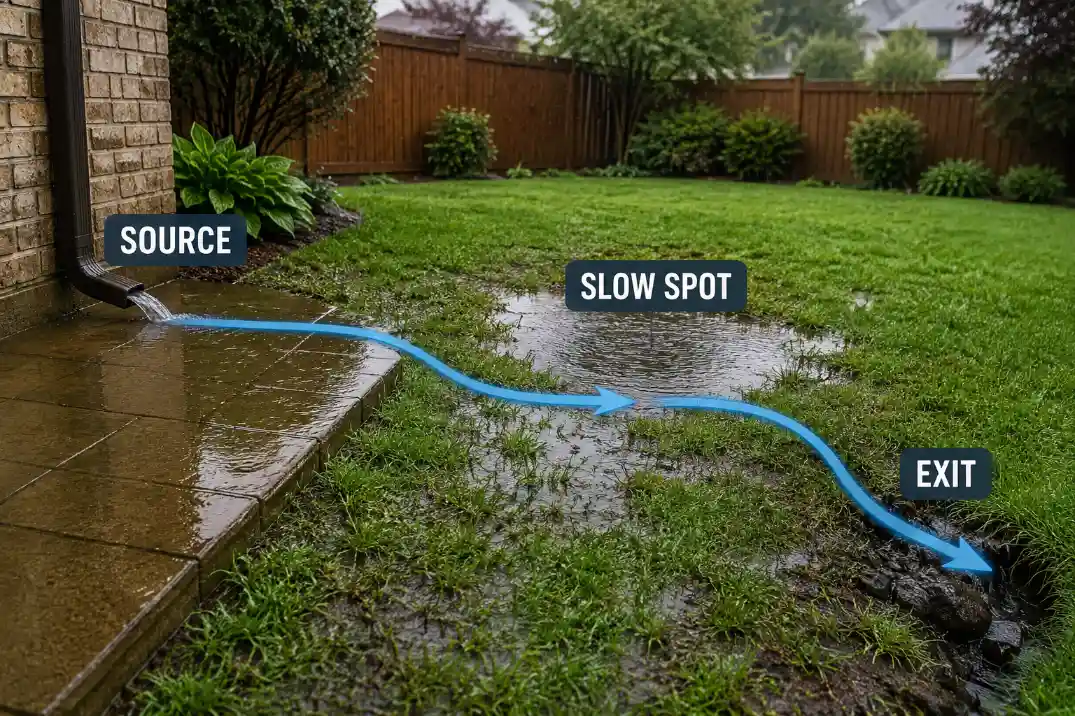
The first checks are simple: watch where water enters, where it slows, where it collects, and where it can legally leave. Do not start by buying gravel, drain pipe, or a French drain kit. Start by reading the water path.
Start With Water Movement
Find the source before choosing the fix
Most yard drainage mistakes happen because the visible puddle gets blamed instead of the source. The puddle is the symptom. The mechanism is usually water arriving faster than the yard can move, absorb, or release it.
Look at the yard during rain, not two days later. If water sheets across a patio, driveway, or compacted lawn, the surface is the problem. If water gathers where a downspout discharges, the roof is feeding the wet zone. If water seeps from an uphill side long after the rain slows, the soil may already be saturated.
This is where homeowners often overestimate absorption and underestimate volume. A small roof section can send hundreds of gallons toward one corner during a strong storm. A soggy 6-by-8-foot patch may look like a lawn problem when the real issue is a downspout, side-yard slope, or hardscape edge feeding it.
If roof runoff is the obvious source, solve that path before pricing a buried drain. A simple extension, splash block adjustment, or redirected outlet can sometimes remove most of the load.
For a more specific version of that failure, Downspouts Flood Backyard Planting Beds explains why roof water can overwhelm soil that would otherwise drain acceptably.
Know where the water can legally exit
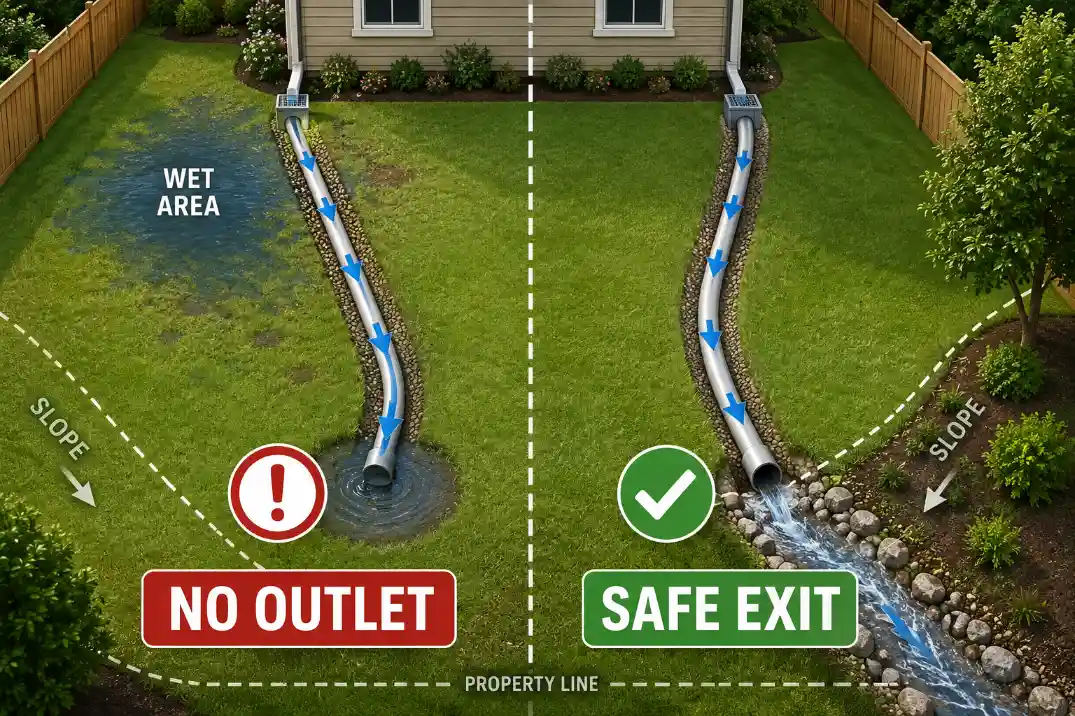
A drainage system is incomplete until the outlet is clear. A French drain, catch basin, or buried pipe does not solve anything if it sends water into another low spot, across a sidewalk where it can freeze, toward a neighbor’s yard, or back toward the house.
Before digging, identify the safe discharge point. That may be a lower lawn area, a street-approved storm connection where local rules allow it, a dry well suited to the soil, or a rain garden designed to receive runoff.
If there is no legal downhill outlet, the solution may need to slow, spread, and absorb water on site instead of simply piping it away.
This is one of the most common points where a routine fix stops making sense. A drain without an outlet is not a drainage solution. It is a hidden puddle.
Separate normal wetness from a drainage failure
Not every wet lawn needs a drain. After a heavy storm, low turf may stay damp for 24 hours. That can be normal in clay soil, shaded yards, and humid regions.
It becomes a drainage problem when standing water remains after 48 hours, the soil stays soft underfoot for several days, mulch floats repeatedly, or water moves toward the house instead of away from it.
A healthier yard usually has a visible exit path, even if it drains slowly. A failing yard has no clear exit, or the exit path sends water through a patio, planting bed, walkway, or foundation zone.
Soil, Slope, or Surface
Soil problems drain slowly from below
If water lingers evenly across a lawn, the issue may be soil structure. Clay soil can hold water long after sandy soil has dried, especially when it has been compacted by foot traffic, pets, construction, or repeated mowing while wet.
A screwdriver test is useful: if a screwdriver or soil probe struggles to enter the top 3 to 4 inches after rain, compaction may be limiting infiltration.
A basic infiltration check helps too. Dig a small 6-inch-deep test hole, fill it with water, let it drain once, then fill it again. If the second fill still has water after 4 to 6 hours, soil absorption is slow enough that surface drainage alone may not solve the whole problem.
This is the condition people often underestimate. They see grass, assume the yard should absorb water, and miss that the top layer has become a sealed surface.
Slope problems move water to the wrong place
Slope failures are more direct. Water moves, but it moves through the wrong route. It may cut across a patio, wash mulch from a bed, run along a fence line, or collect at the bottom of a hill. Even a 2% slope, about 2 inches of fall over 8 feet, can move water if the surface is smooth or compacted.
If the yard slopes toward the house, grading matters before drains. A buried pipe can move some water, but it should not be asked to correct a bad grade by itself.
For a deeper order-of-operations problem, Fix Slope Drainage and Erosion in the Right Order explains why erosion control and drainage sequencing matter more than adding materials in the wettest spot.
Surface problems come from hard edges
Patios, walkways, driveways, compacted paths, and rooftops change drainage faster than soil does. They collect water and release it in concentrated lines. A patio that sheds water into one lawn edge can overwhelm a strip that would otherwise drain fine.
This is why a small hardscape change can create a new wet spot. The yard did not suddenly become worse; the water was redirected.
When Grading Comes First
Grade is the first fix near the house
When water sits within a few feet of the foundation, grading usually comes before French drains, gravel trenches, or planting changes. The goal is to move surface water away before it becomes a buried drainage problem.
A common practical target is at least 6 inches of fall across the first 10 feet away from the house where site conditions allow.
If water is touching the foundation wall, pooling near basement windows, or flowing back across a patio toward the door, do not treat it as a lawn issue.
It is a routing issue. A drain may still be part of the solution, but the first decision is whether the surface is sending water away from the structure.
For patio-specific failures, Patio Water Pooling Against the House is the more focused problem to study before choosing a drain.
Where grading stops making sense
Grading stops being the cleanest answer when there is nowhere safe to send water, when property lines block the outlet, or when changing grade would bury siding, vents, tree roots, or existing hardscape.
It also becomes less practical when the yard has a very flat profile and only 1 or 2 inches of available fall across a long distance.
That is the point where swales, area drains, dry creek beds, catch basins, rain gardens, or subsurface drains become more realistic. The mistake is pretending one method is universally superior.
Pro Tip: If the repair would move water toward a neighbor, sidewalk, driveway ice zone, or public right-of-way, stop and check local rules before building the outlet.
French Drain or Swale
Use a swale when surface water needs direction
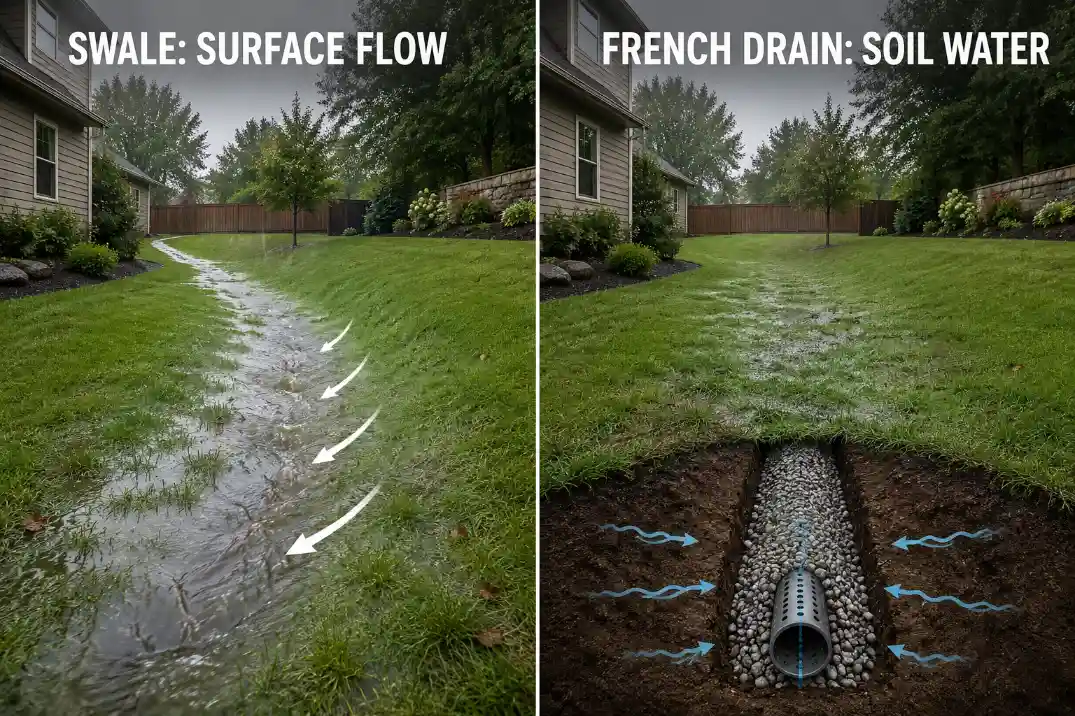
A swale is usually better than a French drain when water is visibly moving across the surface. It is a shallow shaped channel that slows and redirects runoff. In many yards, a subtle grass or planted swale does more good than a hidden pipe because it manages water before it sinks.
Swales need space and fall. They should not be carved so steep that they become erosion channels. A gentle, broad form is usually more useful than a narrow trench. In clay-heavy Midwest yards or humid Southeast landscapes, a swale can also buy time by spreading water out instead of forcing it into one overwhelmed point.
Use a French drain when subsurface water is the issue
A French drain makes more sense when the soil stays saturated, water seeps from an uphill side, or a wet strip remains soft even after surface water has moved away. It is not magic gravel. It is a pipe-and-stone system that collects water below the surface and carries it to a legal outlet.
French drains are often overused because they sound serious. They can be the right fix, but they are rarely the first fix for roof runoff, patio pitch problems, or water sitting against a foundation. If the visible surface is wrong, fix the surface first.
Other Drainage Fixes That Only Work in the Right Situation
Rain gardens fit low spots that can still drain
A rain garden can be useful where runoff can spread into a planted basin and soak in gradually. It is not just a flower bed in a puddle. It needs soil that drains within a reasonable window, usually within 24 to 48 hours, and it needs plants that tolerate both wet and dry swings.
Rain gardens work best when they receive controlled runoff from a roof, lawn, or hardscape edge. They are weaker choices where water stands for several days, where the soil is sealed clay, or where the wet area is too close to the house.
Dry creek beds fit visible runoff paths
A dry creek bed is useful when water repeatedly follows the same visible route and needs to be slowed, armored, and guided. It can protect mulch, soil, and planting beds from washout. It is not a substitute for grade correction if water is moving toward the house.
The strongest dry creek designs have a clear beginning and end. Decorative stone placed randomly in a wet area rarely changes the drainage pattern.
Dry wells need soil that can absorb water
A dry well can hold runoff underground and release it slowly into the surrounding soil. It only works when the surrounding soil can absorb that stored water. In heavy clay, high water table areas, or compacted fill, a dry well may fill up and stay full after repeated storms.
This is where the infiltration test matters. If water barely leaves a small test hole after several hours, a larger underground storage pit may not perform well without a better outlet or engineered design.
Dry wells should also stay well away from the foundation unless they are part of a professionally designed drainage plan.
Hardscape Drain Choices
Area drains solve collection points
Area drains and catch basins work best where water reliably collects on a hard surface or at a low point. They are useful near patios, driveway edges, outdoor steps, and enclosed courtyards where surface shaping alone cannot move water away fast enough.
The key is capacity and maintenance. Leaves, mulch, and sediment can block grates within one storm season if the drain sits below trees or next to loose beds.
A drain that needs clearing after every heavy rainfall may still be useful, but it should be placed where maintenance is easy, not hidden under furniture or shrubs.
If the drainage problem began after installing a patio or walkway, Backyard Drainage After a Patio or Walkway is a stronger match than a general lawn repair approach.
Permeable surfaces help only when the base works
Gravel, permeable pavers, and open-joint surfaces can reduce runoff, but only if the base below them can store and release water. A thin gravel layer over compacted clay is not a drainage system. It may look drier on top while water still sits underneath.
This is a common wasted fix. People replace wet grass with gravel, then discover the gravel migrates, weeds grow, and the low area still feels unstable. Surface material helps when the water has somewhere to go. It disappoints when it is used to decorate a drainage failure.
For surface decisions where drainage is part of the material choice, Pavers vs Gravel for Backyard Drainage gives a more specific comparison.
Match the Fix to the Failure
| Drainage failure | Most likely mechanism | Better first fix | Fix that often wastes time |
|---|---|---|---|
| Water sits near foundation | Surface grade sends water back | Regrade away from house | Gravel strip against wall |
| Lawn stays soft for 48+ hours | Slow infiltration or compaction | Soil aeration, grading, or subsurface drain | More plants in wet turf |
| Runoff cuts across yard | Slope concentrates flow | Swale, dry creek, or redirected outlet | Random drain pipe with no grading |
| Patio edge floods lawn | Hardscape sheds water into one strip | Correct pitch or add collection drain | Replacing grass only |
| Mulch washes out repeatedly | Water velocity is too high | Slow and redirect flow | Heavier mulch alone |
| Low spot fills after storms | No exit or overwhelmed outlet | Create safe outlet path | Filling low spot without routing water |
| Drain pipe has no outlet | Water is collected but not discharged | Find a legal downhill outlet first | Burying more pipe |
Start with the least buried correction
The best drainage fix is usually the one that changes water behavior before it disappears underground. Downspout extensions, surface grading, swales, and clean outlet paths are easier to inspect than buried systems.
If those solve the route, you avoid digging a complex drain for a simple movement problem.
When the choice is between fixing drainage or redesigning the yard layout, the drainage decision usually comes first. A seating area, planting bed, or walkway placed on top of unresolved water only becomes harder to correct later.
That is why Fix Drainage or Layout First is worth considering before investing in finish materials.
Know when the standard fix stops working
A downspout extension is useful when roof water is the main source and there is a safe downslope outlet. It stops making sense when it sends water onto a neighbor’s property, across a sidewalk, into a driveway ice zone, or back toward another low area.
A French drain is useful when water is moving through or sitting in the soil. It stops making sense when the problem is a patio pitched the wrong way.
A swale is useful when the yard has enough space and fall. It stops making sense when the route is too narrow, too flat, or blocked by structures.
The lowest-maintenance fix is not always the least visible one. A shallow swale that can be mowed or cleaned may be easier to live with than a hidden drain that slowly clogs with sediment. A catch basin near a patio may be exactly right, but only if the grate can be cleared quickly after leaf drop or heavy storms.
Quick Diagnostic Checklist
- Water appears during the first 30 minutes of rain: look for runoff source and surface routing.
- Water remains after 48 hours: check soil compaction, low grade, or subsurface saturation.
- Water sits within 6 to 10 feet of the house: prioritize grading and foundation safety.
- Mulch, gravel, or soil keeps moving: treat water speed, not just the material.
- A wet spot began after new hardscape: inspect patio, walkway, or driveway pitch.
- A pipe has no clear discharge point: solve the outlet before digging more trench.
- The yard is flat with no clear outlet: consider slowing, spreading, or absorbing water on site.
Questions People Usually Ask
Is a French drain the best yard drainage solution?
Only when the problem is subsurface water or saturated soil. If water is visibly running across the lawn, a swale, grading adjustment, downspout correction, or surface drain may be the better first move.
Can I just fill a low spot with topsoil?
Only if the low spot is minor and water already has another path out. Filling a low spot without changing the route often pushes water somewhere worse, such as toward a patio, fence, or foundation.
Should I use gravel to dry out a wet yard?
Gravel can help in a designed drainage layer, dry creek, or permeable surface system. Loose gravel spread over wet soil is usually cosmetic. It hides mud briefly but does not fix water movement, soil compaction, or missing slope.
How long should a yard stay wet after rain?
After a normal storm, damp soil for 24 hours can be normal. Standing water or soft, unusable turf after 48 hours is a more useful threshold for deciding that the yard has a drainage problem worth correcting.
A yard drainage solution is not about choosing the most technical product. It is about redirecting moving water, loosening or bypassing slow soil, correcting bad grade, and collecting hardscape runoff only where collection is actually needed.
Do not buy the most aggressive drainage system first. Choose the fix that matches the water path.
For broader official guidance on reducing stormwater runoff around homes, see EPA Soak Up the Rain.