Last updated: May 31, 2026
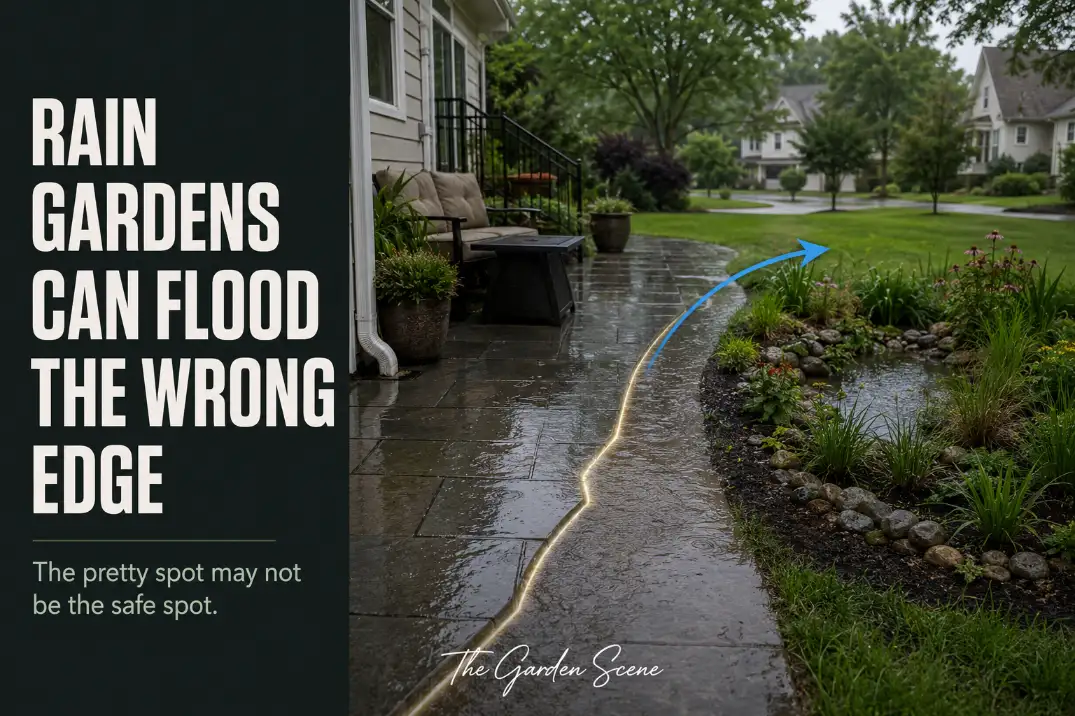
A rain garden fails near a patio or walkway when it is treated like a pretty planting pocket instead of a water-handling feature.
The mistake is usually not the plant choice; it is asking a decorative basin to handle roof, patio, or walkway runoff without a safe entry, enough soil absorption, and a controlled overflow.
Start with three checks: keep water at least 10 feet from the house, watch whether runoff actually enters the basin, and confirm where excess water goes during a larger storm. A rain garden that still holds standing water after 24 to 48 hours is not simply “working slowly.”
It may be overloaded, sitting in slow soil, or sending water back toward the patio edge. That is different from a normal wet planting bed. A working rain garden fills briefly, spreads water across the basin, drains down, and leaves the hardscape usable.
Too Close to the House
Ten feet is a minimum, not permission
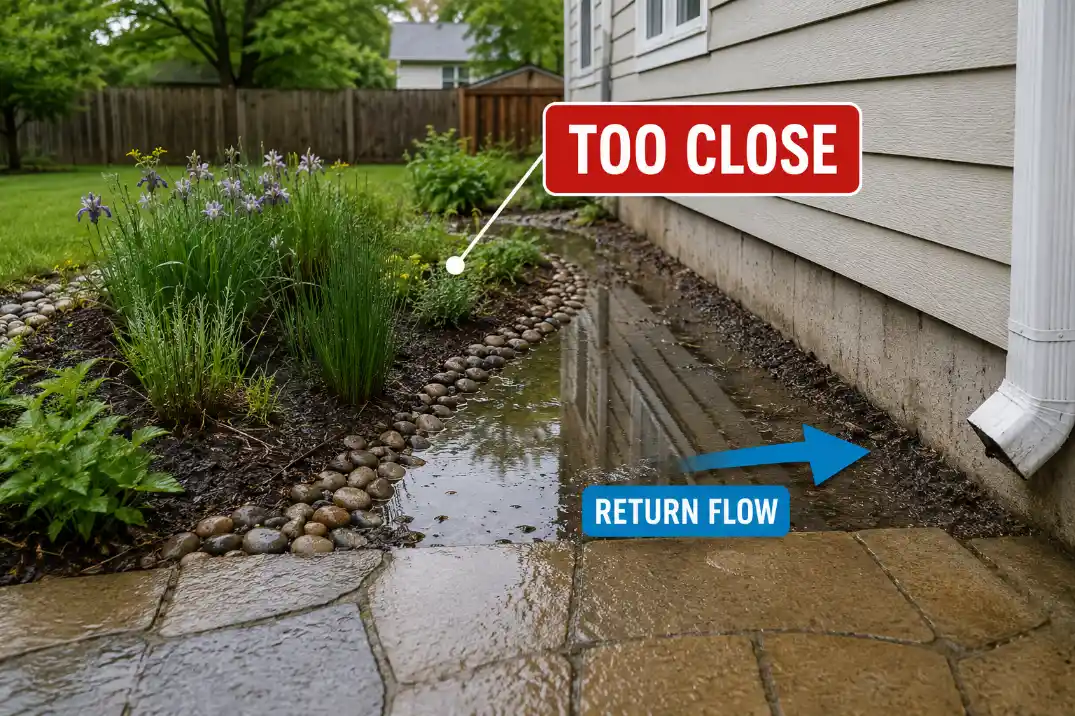
The most serious rain garden placement mistake is putting the basin close to the house because the wall, patio curve, or walkway makes the spot look natural. A rain garden is designed to collect runoff. That means it should not sit where extra water can soak toward the foundation, basement wall, crawl space, patio slab base, or house-side walkway.
A practical starting rule is to keep a rain garden at least 10 feet from the foundation when it receives roof or patio runoff. But 10 feet is not automatic approval.
If the grade falls back toward the house, or if overflow from the basin would return to the wall, the location is still wrong. A rain garden 12 feet away can be riskier than one farther downslope with a clean exit.
This is where homeowners often overestimate planting. Deep-rooted rain garden plants help soil structure over time, but they do not cancel poor grading. If water is already pooling near the home, solve that drainage pattern before adding a basin.
The same logic applies to hardscape edges that stay wet after storms; Patio Water Pooling Against the House is a foundation-side warning, not just a patio comfort problem.
The symptom is puddling; the mechanism is return flow
The visible symptom is a wet edge near the patio, wall, or walkway. The underlying mechanism is return flow: water enters or overfills the rain garden, then moves back toward the hardscape or house because that is the lower route.
That distinction matters. Adding more mulch, stones, edging, or moisture-loving plants may hide the surface for a season, but it does not change the direction of water.
If soil near the foundation remains soft 48 hours after ordinary rain, or if the patio edge stays damp while the basin is still holding water, the placement is not behaving safely.
Pro Tip: Before digging, watch one real storm. Mark where water first appears, where it gathers after 15 minutes, and where it remains the next morning.
Water Needs a Safe Entry
A rain garden should intercept water, not chase it
Good placement starts where water naturally wants to enter. That may be below a downspout extension, beside a low lawn edge, or near the lower side of a walkway. The common mistake is placing the rain garden where it looks balanced while the real runoff line passes 2 or 3 feet away.
Water does not move toward the best-looking planting shape. It follows slope, compacted soil, hardscape edges, downspout discharge, and low seams. If runoff crosses the patio as a thin sheet, a round basin beside the path may miss most of it. If a downspout sends water as a concentrated stream, a shallow ornamental depression may erode at the entry point.
Entry design often matters more than basin size. A 6-inch-deep basin with a broad, stable entry can outperform a larger basin that receives water through one narrow cut.
Near patios and walkways, the entry should slow water before it drops into the planted area. A small stone apron, grassed swale, or shallow curb cut can spread the flow and reduce washout.
Hard surface area can overload a small basin
The other hidden issue is volume. One inch of rain on 100 square feet of roof, patio, or walkway produces roughly 62 gallons of water. A small basin that looks generous as a planting bed can be undersized if it receives runoff from a roof section, a patio slab, and a walkway edge together.
This is why rain gardens near hardscape fail faster than rain gardens in open lawn. Lawn runoff usually arrives slower and more diffusely. Concrete, pavers, and compacted paths send water faster and in a sharper line.
After a summer downpour in the Midwest or Southeast, a patio can deliver a sudden sheet of water to one edge within minutes.
If patios and walks were installed before drainage was planned, the hardscape may have already changed the water path. In that case, Backyard Drainage After Patio and Walkway is the better frame: place the rain garden according to the new runoff behavior, not the old lawn grade.
Overflow Must Have Somewhere to Go
Direction comes before capacity
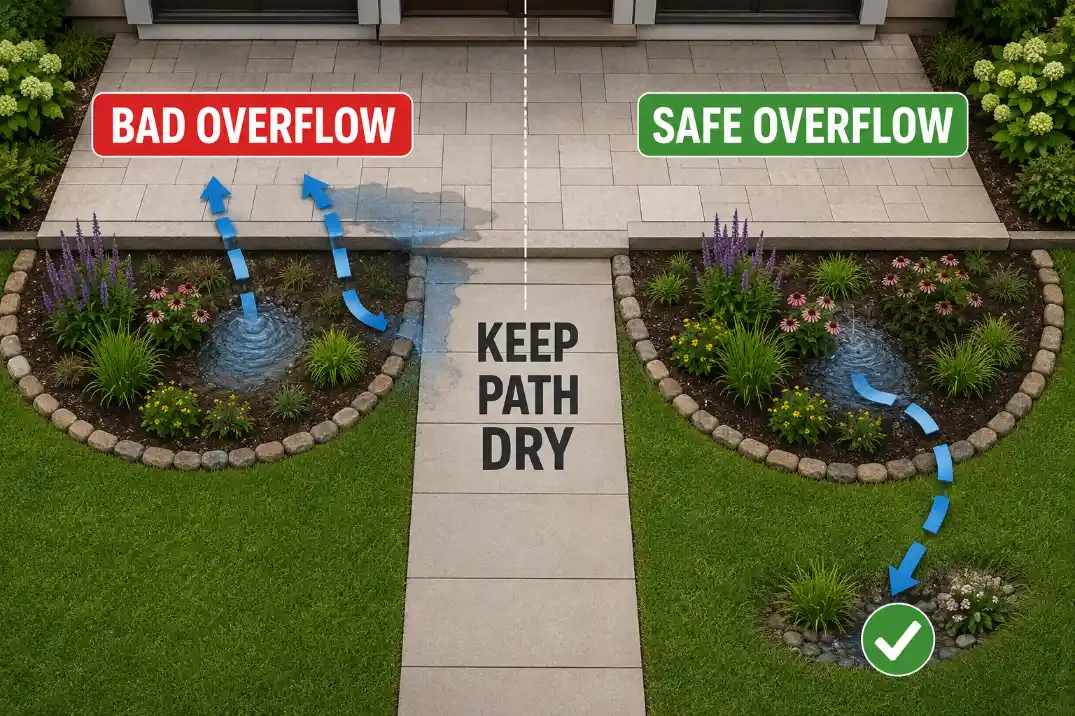
A rain garden is not a pond. It should temporarily hold runoff, then drain into the soil. During larger storms, it also needs a planned overflow route. Without one, water will choose its own exit, and near patios or walkways that usually means spilling across paving, backing up along an edge, or cutting a muddy channel through the planting bed.
A practical basin depth for many home rain gardens is about 4 to 8 inches. That gives water room to spread without creating a deep hole beside an active walking area.
But depth only helps if the overflow edge is controlled. One low notch, stone-lined spillway, or shallow turf outlet should sit lower than the rest of the rim so excess water exits away from the house and away from the walkway.
The routine fix that often wastes time is raising the edge because water is spilling out. If the overflow direction is wrong, capacity is not the first fix; direction is. A taller rim can trap more water in the wrong place. The better move is usually to lower and armor the correct overflow point.
When overflow becomes a placement failure
Overflow is normal during large storms. Placement is failing when overflow happens in small storms, moves toward the house, crosses a main walking route, or leaves sediment on the patio. If a rain garden overtops after less than 1 inch of rain, the basin may be undersized, the soil may be too slow, or the entry may be too concentrated.
Use the direction of overflow as the decision point. Water leaving toward lower lawn is usually manageable. Water leaving toward a slab, step, basement wall, fence base, neighbor’s yard, or main walkway is a placement problem. At that point, plant selection is secondary.
| Condition | Healthier Placement | Failing Placement | What To Change First |
|---|---|---|---|
| Foundation relationship | 10+ feet with grade falling away | Basin or overflow returns toward wall | Move basin or redirect inflow |
| Drain-down time | Empty within 24–48 hours | Still ponded after 48 hours | Test soil and reduce water load |
| Entry behavior | Water spreads into basin | Water cuts one narrow channel | Add broad, stable entry |
| Overflow direction | Lower lawn or safe outlet | Patio, walkway, foundation, neighbor side | Create controlled low overflow |
| Hardscape edge | Edge releases water into basin | Edge acts like a curb | Adjust entry or placement |
| Basin load | Sized to receiving surface area | Too much roof or patio runoff enters at once | Split, slow, or reroute water |
Walkways Create Hard Edges
The walkway can become the hidden dam
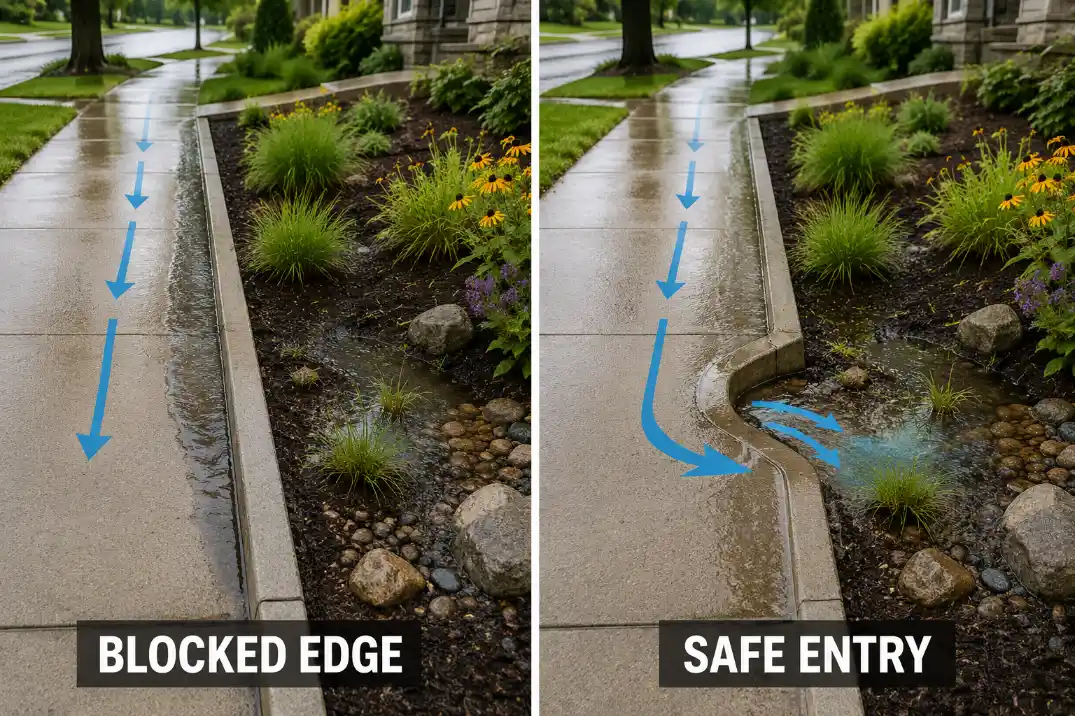
Walkways are easy to underestimate because they look flat and harmless. In drainage terms, they are often hard edges. A walkway can block shallow lawn runoff, split flow into two directions, or act like a curb that keeps water from reaching the rain garden. This is especially common with concrete paths, paver walks with raised edges, and compacted side strips.
The mistake is assuming water will cross the walkway because the rain garden is on the other side. In reality, even a 1-inch height change can redirect shallow runoff along the walkway edge.
Over several storms, that edge may become the wettest strip in the area while the rain garden stays underused.
This is why the hardscape pattern should be read before plants are placed. A basin just beyond the visual edge of the patio may still miss the flow if the patio has settled or the walkway slopes slightly the wrong way.
For a wider layout view, Patio Drainage Layout Problems explains why the paved surface often decides where water can actually go.
Do not create a wet walking zone
A rain garden near a walkway also has to respect use. If entry or overflow crosses the main walking line, the garden may technically collect runoff while making the space worse.
Wet mulch on a walkway, slippery algae at the edge, or muddy stepping stones are signs that the drainage feature is interfering with access.
A good placement leaves the walking surface usable within a normal drying window. After typical rain, the walkway should not stay slick into the next day. In freezing northern states, overflow across a path can become an ice strip overnight. In humid regions like Florida, repeated damp edges can also encourage algae and staining.
Soil Decides the Outcome
Slow soil turns good layout into stored water
Soil is the quiet condition readers often underestimate. A rain garden can be correctly located, nicely planted, and still fail if the soil cannot absorb water fast enough. Clay-heavy soil, compacted subsoil, construction fill, and shallow hardpan all slow drainage.
A simple test is worth doing before planting. Dig a test hole about 6 to 12 inches deep in the planned basin area, fill it with water, let it drain once, then refill it and watch the second drain-down. If water drops about 1 inch per hour, the site is usually workable for a home rain garden.
If it drops less than 0.5 inch per hour, especially after the soil is already wet, the garden may need amended soil, a smaller drainage load, a shallower basin, or a different location.
The condition people often overestimate is plant rescue. Native sedges, rushes, and moisture-tolerant perennials can handle short wet cycles, but they cannot make compacted clay drain like sandy loam in one season. Roots improve soil structure gradually. They are not a substitute for a soil test.
A soggy low spot is not automatically a rain garden site
The most misleading rain garden location is the spot that already stays wet. It seems logical: water collects there, so turn it into a rain garden. But a place that already holds water for 2 or 3 days after ordinary rain may be showing poor infiltration, not good opportunity.
A rain garden should receive water and release it into the soil within a reasonable window. A permanently soggy low spot may need regrading, a swale, an outlet route, or a different drainage feature. If the surrounding soil stays saturated, digging a deeper basin can make the problem worse by creating a planted bathtub.
This is where a standard rain garden fix stops making sense. Replacing a few inches of soil will not fix a site where water stalls at a compacted layer or clay boundary.
In tight spaces near patios, a swale, surface route, dry creek bed, or downspout extension may move water more safely than forcing infiltration beside daily-use hardscape.
If the issue is moving water across the yard rather than absorbing it in one place, French Drain vs Swale vs Dry Creek Bed may fit the decision better.
Pro Tip: Test soil after a wet period, not only during dry weather. A basin that drains well in dry soil can behave differently after two storms in 48 hours.
Pretty Placement Can Fail
Symmetry is not a drainage plan
The most tempting rain garden location is often the prettiest one: beside the patio curve, along a walkway bend, or centered in a visible planting pocket. That can work only if the water path agrees. If the basin is chosen first and the water route is justified afterward, failure is more likely.
A decorative rain garden fails in three predictable ways. It misses the actual runoff path, it receives water but sends overflow to the wrong place, or it sits in soil that cannot empty between storms.
None of those failures are solved by better edging. Better edging may even make the garden look finished while the drainage problem continues underneath.
This is similar to a dry creek bed that looks like a water route without actually catching water. A rain garden can have the same problem. It can look responsible and intentional while the real flow passes beside it.
That visual trap is why Dry Creek Bed Drainage Mistakes is relevant here: follow the water before designing the feature.
Quick diagnostic checklist
- Water stands in the basin longer than 48 hours after ordinary rain.
- Patio or walkway edges stay damp while the basin remains partly dry.
- Overflow moves toward the house, steps, or main walking route.
- A raised walkway edge redirects water along the path instead of into the garden.
- The entry point shows erosion, exposed roots, or displaced mulch after storms.
- The basin receives roof, patio, and walkway runoff but has no clear overflow.
- The spot was chosen because it looked balanced before runoff was observed.
What To Fix First
Start with flow, then soil, then plants
The right order is not plants first. Start with the water source and path. Confirm whether runoff comes from roof water, patio sheet flow, lawn slope, walkway edges, or a combination. Then decide whether the rain garden can safely intercept that water without creating a wet hardscape edge.
Next, test soil and drain-down time. If the site cannot empty within 24 to 48 hours, do not keep adding water to it. Reduce the drainage area feeding the basin, improve the soil profile, or move the garden to a better infiltration zone. Only after that should plant selection become the main decision.
Before digging, also check local site constraints such as septic areas, underground utilities, steep slopes, and property-line discharge. These are not design details to clean up later; they can decide whether the rain garden belongs in that spot at all.
When the standard rain garden fix is wrong
A rain garden stops making sense when the site needs water moved more than absorbed. That includes tight house-side patios, narrow walkway corridors, compacted side yards, and clay-heavy spots with no safe overflow.
In those cases, the stronger fix may be to route water to a lower lawn outlet, spread it through a swale, or intercept it before it reaches the patio.
The best rain garden near a patio or walkway is not the one that looks most intentional. It is the one that accepts water gently, drains within a reasonable window, overflows safely, and leaves the hardscape usable.
If any one of those conditions is missing, placement is the first thing to question.
Questions People Usually Ask
Can a rain garden be next to a patio?
Yes, but only if it does not trap water against the patio base or send overflow across the walking surface. The basin should receive water through a stable entry, drain within 24 to 48 hours, and overflow to a lower safe area. If the patio edge stays wet while the basin sits nearby, move the entry or move the garden.
Will a rain garden create mosquitoes?
A properly placed rain garden should not hold standing water long enough to become a mosquito problem. The concern rises when water remains for more than 48 hours, especially in warm humid weather.
If water lingers for several days, fix the soil, inflow, or outlet path before blaming the plants.
For broader official guidance on rain gardens, see the U.S. EPA rain garden overview.