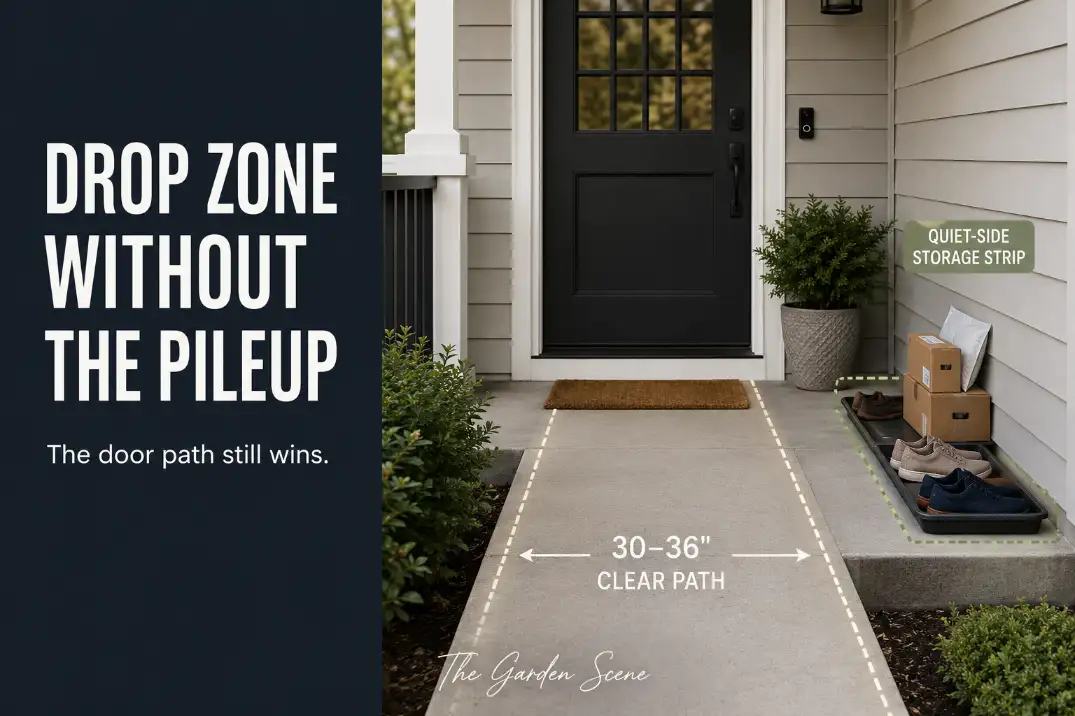
A small front porch drop zone works only when it protects the entry route first. The best ideas usually fall into four porch-safe categories: a shoe edge, a side package landing, a vertical bag stop, and one decorative item that stays out of the way.
If shoes, bags, packages, and planters all compete for the same 30–36 inches near the door, the porch will feel cluttered even when every item has a container.
Start with three checks: can the door swing freely, can one person stand at the lock without stepping over shoes, and can a package land somewhere other than the center mat? This is different from a decorating problem.
A decorated porch can still work. A failed drop zone usually breaks down in the first 5 seconds of arrival, when someone is holding keys, carrying groceries, or trying to step around yesterday’s delivery.
The Porch Cannot Hold Everything
Use the one-daily-problem rule
The strongest small porch drop zones are selective. They solve the one problem that happens most often, not every possible problem at once.
If wet shoes are the daily issue, the porch needs a shoe edge. If packages block the door twice a week, the porch needs a side landing. If bags and totes pile up after work or school, the porch needs a vertical stop.
If the porch mainly looks messy because planters and objects crowd the threshold, the fix is subtraction before storage.
This is where many small porches go wrong. A porch that tries to be a shoe closet, package station, bag rack, plant display, and seasonal storage area usually fails at the entry’s main job: letting people move in and out without negotiation.
That access-first logic is the same reason Front Entry Usability Ideas matters more than simply adding another container.
What earns porch space
A true drop-zone item should be short-term. If something stays outside for more than 24–48 hours, it is probably not a drop-zone item anymore. It has become storage.
That distinction keeps the porch from slowly turning into overflow space. One pair of wet shoes drying after rain makes sense. Six pairs of seasonal shoes living outside do not. A package waiting until evening is normal.
A box that sits there for 3 days changes how the entry functions. A tote on a hook for an hour is useful. A row of bags hanging beside the lockset becomes a wall.
People often overestimate how much a porch can hold because it looks empty when no one is standing there. But the working space changes once the door opens. A 48-inch-wide porch can look generous in a photo and still feel tight if a 16-inch bench, a 12-inch planter, and a shoe tray all sit in the same active zone.
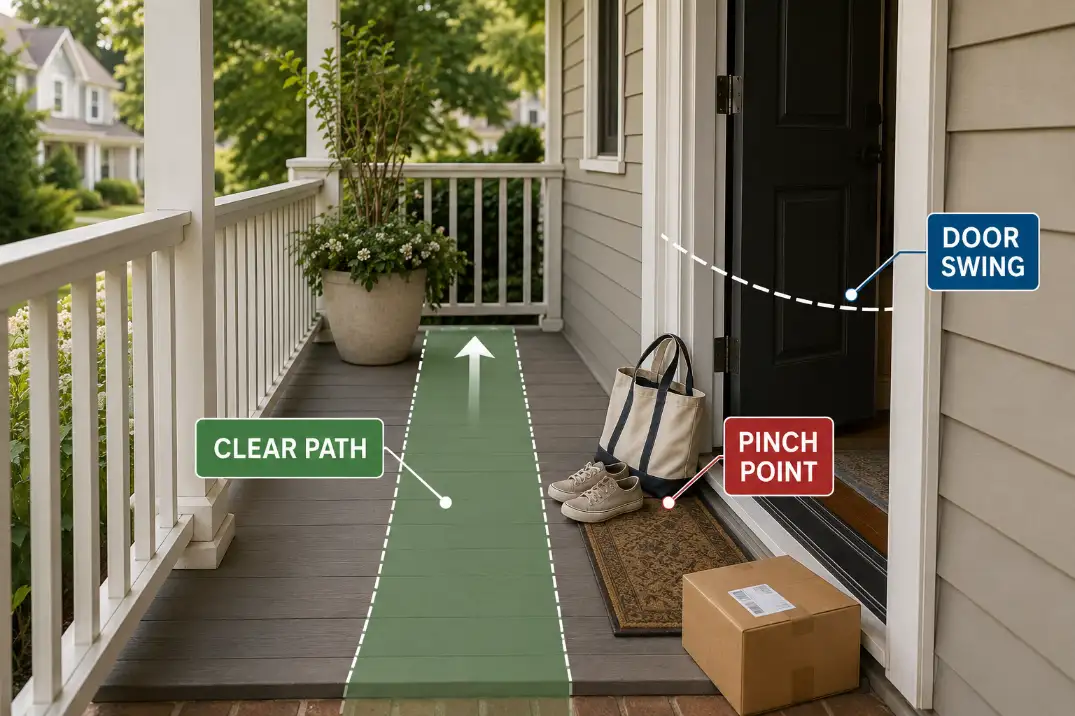
Shoes, Bags, and Deliveries
Shoes need an edge, not more mat
Shoes are usually the fastest porch clutter source because they spread sideways. A bigger doormat is often the wrong fix. It catches some dirt, but it also gives shoes more permission to live in the walking line.
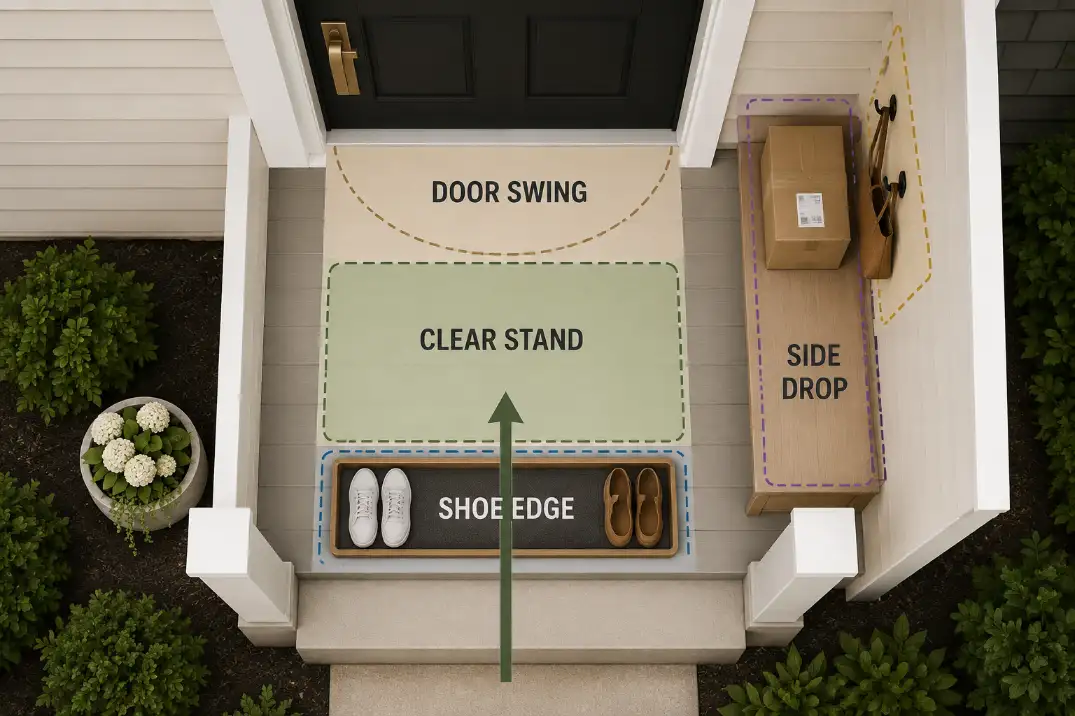
A better small-porch idea is a defined shoe edge: a raised tray, a slim slatted rack, or a narrow side strip. For many porches, a tray around 12–16 inches deep is more realistic than a full bench with cubbies. It should sit outside the door swing and away from the first step.
If wet shoes sit there after rain, choose an open-bottom or raised tray so water does not pool underneath for 12 hours and stain the porch surface.
If mud keeps showing up even with a tray, the porch is not the source. The mud may be arriving from bare soil, splashback, or a wet walkway edge before anyone reaches the mat.
In that case, Front Entry Mud and Dirt Control is the stronger fix than buying another porch organizer.
Bags need a vertical stop
Bags rarely need deep storage. They need somewhere to pause without falling into the route. A wall hook, narrow side rail, or small covered peg zone can solve more than a bulky bench.
The important measurement is projection. A tote that sticks out 8–10 inches may be fine on the quiet side of the porch.
The same tote can be irritating beside the lockset, where people naturally turn their body while opening the door. If the bag touches the person using the handle, it is in the wrong place.
Deliveries need a landing, not the mat
Packages need a predictable landing that does not block the door. On a small porch, that usually means a side basket, low shelf, or one dry corner rather than a box in the center of the porch.
This matters because delivery drivers usually choose the most obvious flat spot. If the mat is the only clear landing, the package will end up in front of the door.
If the porch has a visible side landing, the daily pattern changes. For entries that receive frequent packages, Front Yard Package Delivery Zone Ideas explains how to place that landing so it stays reachable without crowding the threshold.
| Daily problem | Best small porch idea | Avoid |
|---|---|---|
| Wet shoes | 12–16 inch raised tray | Bigger mat used as shoe storage |
| Frequent packages | Side basket or low package shelf | Door-center package box |
| Bags and totes | Wall hook on the quiet side | Hook beside the lockset |
| Kids’ shoes | One-pair-per-person tray rule | Unlimited open shoe pile |
| Pet leash | Small wall peg near the exit side | Basket sitting in the walking route |
| Planter clutter | One vertical planter at the edge | Two pots flanking a tight door |
Keep the Door Path Open
The door route outranks the drop zone
The door path is the part people underestimate most. They see a porch as a surface to fill, not as a short route with a pause point.
A useful small porch should let someone step up, pause, turn slightly, unlock the door, and move inside without shifting around objects. Even a 24-by-30-inch clear pause zone near the handle side can feel better than a larger porch with scattered objects.
The routine fix stops making sense when every added storage piece steals from that pause zone. A bench is not an upgrade if it makes guests stand sideways.
A planter is not welcoming if it pushes shoes into the threshold. A package box is not helpful if it blocks the screen door.
When the landing itself is already tight, the porch should be judged the same way as Front Door Landing Clearance: swing, stand, and pass-through space come before styling.
Quick porch drop zone check
- Can the door open fully without touching a basket, planter, bench, or shoe rack?
- Is there a continuous 30–36 inch route from the step or walkway to the door?
- Can one person stand at the lock without stepping on the shoe area?
- Do wet shoes have a defined edge instead of spreading across the mat?
- Is there one delivery spot that stays clear for at least 24 hours after a package arrives?
- Can the porch be reset in under 2 minutes?
If two or more of these fail, the porch does not need more organizing products first. It needs a clearer hierarchy.
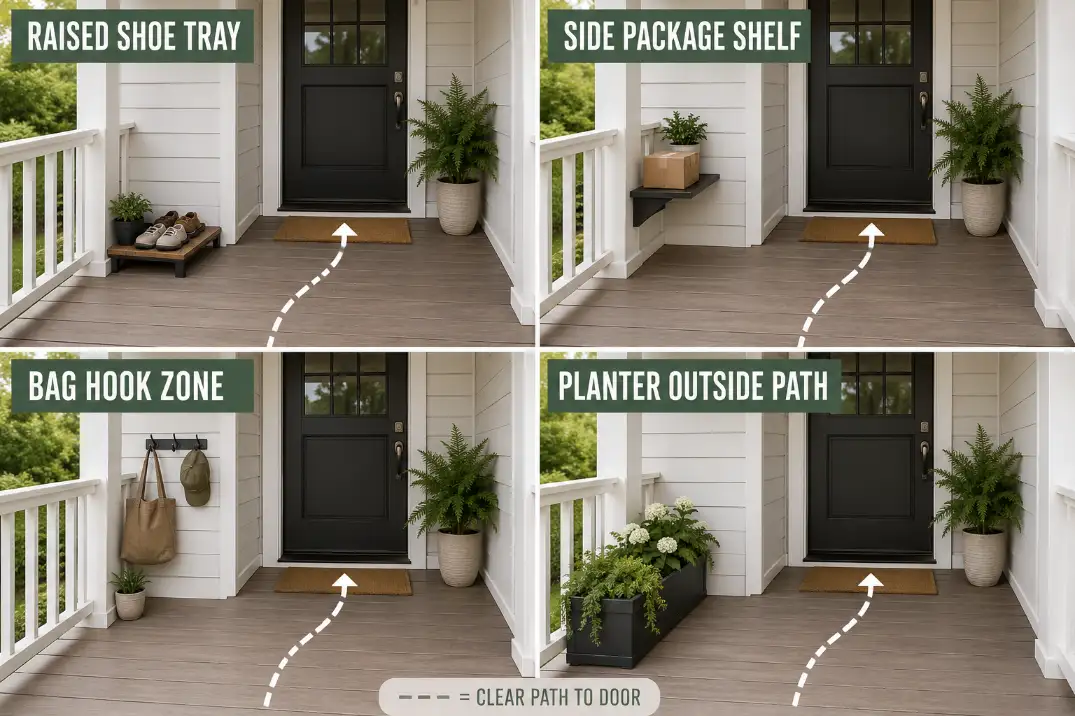
Storage That Does Not Crowd
Low, narrow, and single-purpose wins
For small porches, storage should usually be lower and narrower than people expect. A 10–14 inch deep bench, slim deck box, wall-mounted shelf, or open shoe tray often works better than a full cabinet. Deep furniture looks useful online but can dominate a porch that is only 4–5 feet deep.
The strongest storage choice depends on the daily friction. Wet shoes need airflow and a washable base. Bags need a vertical stop. Packages need a dry side landing. Small tools need closed storage away from the door side. Kids’ items need a reset limit, not unlimited bins.
Pro Tip: Choose one porch storage piece that solves the most frequent daily problem, then leave the rest of the porch visually quiet.
Storage also has to be easy to use. If the family will not open a lid every time they come home, a lidded bench may look cleaner but fail in real life. Open storage can be better when the goal is a 10-second reset at the end of the day.
When a bench is the wrong answer
A bench sounds natural for a drop zone, but it is not always the right first fix. It makes sense when the porch is deep enough, the bench sits outside the door route, and the space underneath has a clear job.
On a porch less than about 4 feet deep, a bench deeper than 14–16 inches often steals too much working room. It may start as seating and quickly become a shelf for packages, shoes underneath, and bags on the side. That holds more items, but it makes the entry feel smaller.
A bench is a good porch idea only if it protects the route. If it makes people turn sideways, it is furniture pretending to be storage.
Covered vs Exposed Porch Drop Zones
Covered porches allow slightly more flexibility
A covered porch can usually tolerate a little more drop-zone function because shoes, packages, and bags are less exposed to rain and sun.
Even then, airflow matters. Wet shoes under a covered porch can still stay damp overnight in humid climates, especially after summer storms in Florida or the Southeast.
For covered porches, the best ideas are often a raised shoe tray, a quiet-side bag hook, and a package shelf that sits away from the swing. These pieces can stay simple because the roof already does part of the work.
Exposed porches need stricter limits
An exposed porch needs a tougher edit. Fabric bags should not live outside. Shoes should not sit overnight through dew, rain, or sprinkler overspray.
In northern states, snowmelt and road salt can make a winter boot tray useful, but it should be washable and easy to dump. In dry Arizona-style climates, dust can make open baskets look dirty fast, so fewer items outside may actually look cleaner.
The common overestimate is weather protection. A porch can look sheltered and still get wind-driven rain. A good test is to check the floor after a storm. If the “dry” corner stays wet for more than 6–8 hours, it should not be the main shoe or bag zone.
Planters vs Daily Use
Planters should frame, not interrupt
Planters can make a small porch feel finished, but they often get placed where the porch needs working room. The common misread is treating a planter as harmless because it is decorative.
Functionally, a 14-inch planter can behave like furniture if it sits in the turn zone.
A better rule is to let planters frame the porch edge, not the door action. Place them where they guide the eye toward the entry without narrowing the route. On a small porch, one stronger vertical planter usually beats two medium planters that squeeze the door.
For porches where privacy is also part of the goal, Front Porch Privacy Ideas can help separate screening from the daily drop zone so the same corner is not asked to do everything.
Useful Without Looking Cluttered
Use fewer zones, not smaller clutter
The cleanest small porch drop zones usually have fewer zones than expected. One shoe edge plus one delivery landing may be enough. One wall hook plus one low tray may solve the daily problem.
Once every category gets its own container, the porch starts looking like a miniature mudroom, and the front entry loses its calm.
A useful porch should have a reset rhythm. If the porch can return to order in under 2 minutes, the system is probably simple enough. If it takes 10 minutes of sorting because every item belongs to a different bin, the layout is too complicated for an entry zone.
Another practical test is whether the porch can be reset with one hand while holding a bag. If not, the system is too fussy for a true drop zone.
The best order of decisions
Start with movement, then weather, then storage, then decoration.
First, protect the path from the step or walkway to the door. Second, place wet or dirty items where they can dry without spreading.
Third, choose the smallest storage piece that handles the daily pattern. Last, add planters or styling only where they do not compete with the first three decisions.
This order matters because the obvious fix is often backward. People buy a pretty bench, basket set, or pair of planters, then try to make daily use fit around it. A stronger porch starts with the route and lets the drop zone occupy whatever space remains.
A small front porch drop zone does not need to look empty. It needs to look edited. The right setup may be as simple as a narrow raised shoe tray, a quiet-side bag hook, a side package landing, and one planter that frames the entry instead of crowding it.
That is the real win: not more storage, but fewer moments where the door, mat, package, shoes, and planter all fight for the same square foot.
Because a small porch drop zone succeeds only when people can still stand, turn, and pass through comfortably, the U.S. Access Board offers a useful reference point for why narrow entry routes quickly start to feel difficult.