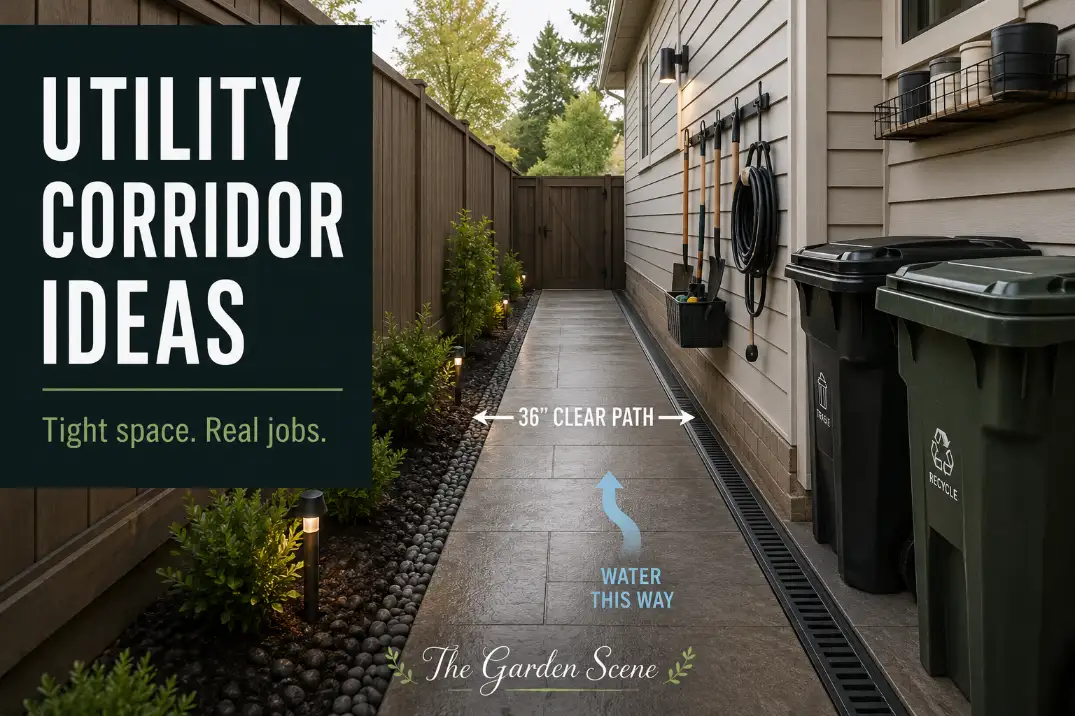
A side yard utility corridor should not be designed like leftover decorative space. It works better when you treat it as a narrow service zone with clear jobs: movement, drainage, storage, and access to utilities.
The first checks are practical. Keep at least a 36-inch clear route where people or bins need to pass, do not let water sit beside the house for more than 24–48 hours after normal rain, and avoid blocking hose bibs, cleanouts, meters, or HVAC equipment with fixed objects.
That is the main difference between a utility corridor and a general side yard makeover. The problem is not just that the space feels narrow.
The real failure pattern is that too many tasks are pushed into the same strip. Clutter is the symptom. Poor zoning is the mechanism.
The best ideas are the ones that assign one dominant job to each part of the corridor instead of making the whole area do everything at once.
Quick Diagnostic Checklist
Before choosing any side yard utility corridor ideas, check these first:
- Is there at least 36 inches of clear movement through the tightest working point?
- Do bins roll through without turning sideways or riding into beds?
- Does rainwater drain away within 24–48 hours?
- Can service points be reached without moving heavy planters or storage?
- Does the gate open fully with at least 6–12 inches of comfortable clearance at the turn?
- Will plants still fit after 2–3 years of growth, not just on day one?
The Most Useful Ideas Start With the Corridor’s Main Job
Many side yards have more than one function, but one pressure usually dominates. That is where the design should start.
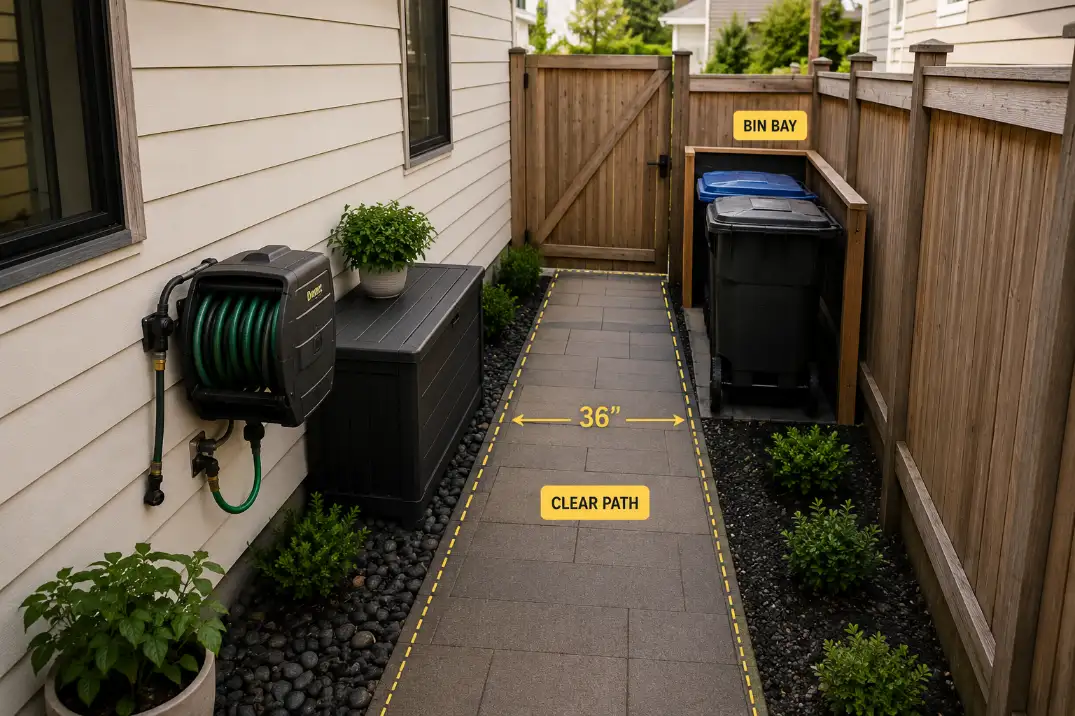
Idea 1: Create a bin bay near the gate
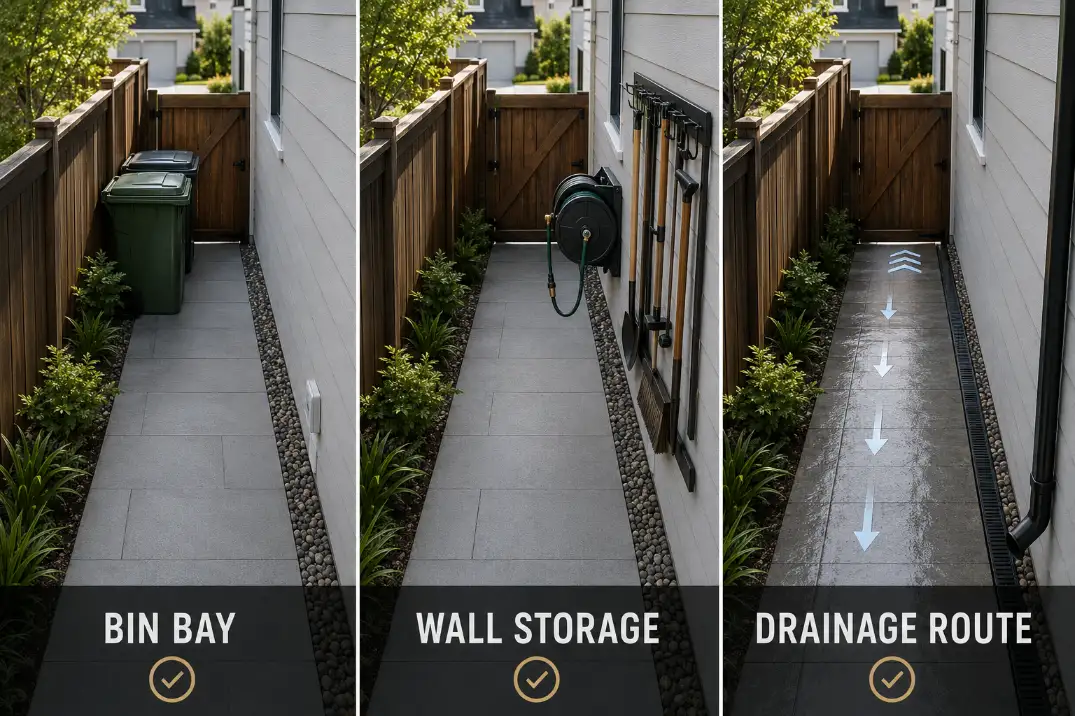
If the corridor handles trash and recycling, the cleanest idea is not “hide the bins somewhere.” It is “give the bins a stable parking bay near the exit path.” A recessed bay near the gate shortens the weekly route and keeps the main lane from being constantly blocked.
This works best when the bay sits to one side rather than at the end of the corridor. That way, the bins do not become a wall. In most homes, a layout that saves even 6–12 inches around the gate feels dramatically easier in actual use because that is where turning and dragging usually happen.
A related mistake shows up in many narrow access zones: people make the path look clean in photos but forget how it works in motion.
The same route-first logic behind Narrow Side Yard Walkway Flow applies here too. If the movement is awkward, the corridor is not really solved.
Idea 2: Use one wall for vertical utility storage
A side yard becomes much easier to manage when storage goes up instead of out. Wall-mounted hose reels, tool hooks, slim cabinets, and narrow shelves usually outperform low loose storage because they protect the floor route.
The key is restraint. Storage deeper than about 18–24 inches can start stealing the lane in a hurry, especially in corridors only 4–5 feet wide. This is one condition readers often underestimate: a cabinet that looks slim on paper can still feel bulky once its doors open into the walkway.
Idea 3: Give drainage a visible route
If a side yard stays damp, the answer is usually not “add gravel and hope.” Gravel can hide mud, but it does not automatically fix bad slope, runoff concentration, or slow-drying shade.
A stronger idea is to give water a deliberate path. That might mean a downspout extension, a catch basin, a shallow swale, or a path surface that slopes about 1–2% away from the house. If water still lingers after 24–48 hours, the corridor has a drainage problem, not a cosmetic one.
That is why a focused topic like Side Yard Ideas for Drainage and Access often becomes more relevant than generic side yard styling advice.
Use Width to Choose the Right Kind of Idea
Not every side yard can support the same solution. The smartest ideas depend on width, not just style preference.
| Side yard width | Best utility idea | What usually fails |
|---|---|---|
| Under 3 ft | Keep it as service access only | Cabinets, bins, deep planters |
| 3–5 ft | Clear lane plus one storage edge | Storage on both sides |
| 5–7 ft | Bin bay, drainage strip, narrow softening | Full-width shed or dense screening |
| 7+ ft | Utility route plus controlled planting | Treating the whole space like dead filler |
Under 3 feet: strip it down
A side yard under 3 feet wide is usually too tight for ambitious storage ideas. It can still work well as a utility access strip, but only if it stays simple. This is where many homeowners overestimate “just one planter” or “just one small cabinet.” In a narrow lane, that small object may remove one-third of the usable width.
3 to 5 feet: protect one edge, not both
This is the sweet spot for many utility corridors. There is enough room for a true walking lane and one organized edge, but not for clutter on both sides.
If you want a hose reel, a narrow cabinet, and a bin bay, they need to live in a controlled sequence rather than as random pieces.
That is also where side yards start working better as true front-to-back connectors. If the path has to carry people from the driveway or front gate into the backyard, Side Yard Front-to-Back Connection becomes a very relevant companion because flow matters as much as appearance.
5 to 7 feet: add one secondary layer carefully
At this width, a side yard can often handle a functional path plus one extra zone such as a slim planting strip, bin bay, or drainage edge. The danger here is overconfidence.
People assume the extra width means the corridor can now absorb a shed, dense hedge, and bins all at once. Usually it cannot without getting heavy and visually cramped.
What People Usually Misread First
The most common misread is thinking the problem is ugliness when the real problem is friction. A side yard can look neat and still fail.
Screening is often overused
People often jump to screens because they want to hide bins, AC units, or utility clutter. But in a utility corridor, a screen can create a new problem just as easily as it solves an old one. Tall fixed screening narrows the airspace, slows drying, catches debris, and can make service access worse.
If the corridor gets only 3–4 hours of direct sun, especially in humid climates, dense screening can make moisture linger longer and increase mildew or slippery surfaces. In most cases, partial screening works better than full enclosure.
Plants get blamed when layout is the real issue
Overgrown plants do cause trouble, but they are often not the first cause. The underlying problem is that the route was never protected in the first place. A corridor with no fixed lane almost always gets slowly eaten by plants, bins, tools, or extra storage.
That long-term creep is why Narrow Side Yard Problems That Get Worse Over Time connects so well here. Side yard failure is usually gradual. It does not look dramatic at first, which is exactly why people let it continue.
Practical Side Yard Utility Corridor Ideas That Usually Work
The strongest ideas are usually simple and practical, not dramatic. They work because each one protects a job the corridor already has instead of adding another thing for the narrow space to fight.
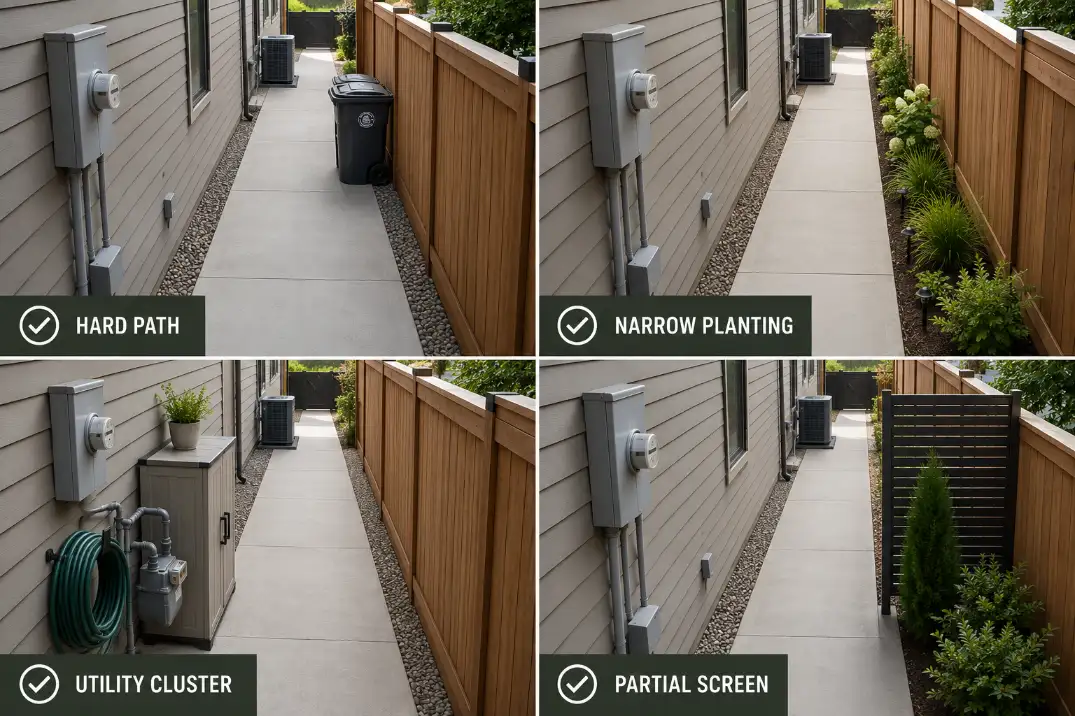
Idea 4: Hard path for rolling traffic
If bins, carts, or service tools move through the corridor weekly, use a continuous surface. Stepping stones are usually a bad idea for rolling movement. Loose gravel can also be a disappointment unless it has solid edging and a compacted base. Bin wheels and wet shoes both expose weak surfaces quickly.
The decision rule is simple: if something rolls through the corridor, the surface should behave like a route, not a decorative garden path.
Idea 5: Narrow planting only where it stays disciplined
A soft edge can help the corridor feel less harsh, but planting should behave like trim, not like furniture. Narrow upright plants or controlled low planting usually work better than broad shrubs that encroach into the route after one or two growing seasons.
This idea only works when future width is protected. A plant that looks harmless in a nursery pot can become a route problem once it leans, spreads, or needs pruning every few weeks.
When plant selection matters more than the corridor logic, Best Plants and Materials for Narrow Side Yards becomes the better follow-up read. But the sequence matters: solve access first, then refine the soft edge.
Idea 6: Utility cluster at one end
If several service elements already exist, such as a hose bib, meter, and storage hook zone, it often helps to cluster utility items toward one end of the corridor rather than spreading them along the full length. That leaves the rest of the route calmer and easier to walk through.
This only helps if the cluster shortens movement and preserves service access. If the cluster turns into a pile of hoses, tools, and loose supplies in front of a meter or cleanout, it has failed the corridor’s main job.
Idea 7: Partial privacy panel near the exposed view
If the only goal is to stop the ugliest view from the street or neighbor side, use one targeted panel rather than screening the whole corridor. The visual improvement can be strong, but the path stays open and easier to maintain.
The panel should solve one view problem, not enclose the whole side yard. A partial screen near the exposed angle usually works better than a full-length barrier that traps leaves, slows drying, and makes the corridor feel tighter.
When the Standard Fix Stops Making Sense
Some fixes sound sensible but stop paying off pretty quickly.
Gravel alone is not a drainage fix
If the side yard slopes toward the house, or if runoff is concentrated from a downspout, loose gravel is often just a cleaner-looking failure. It may reduce splash, but it does not solve the direction of the water.
Once you see repeat ponding after normal rain, the problem has moved past surface cosmetics.
More storage is not always more function
If adding a cabinet or bench reduces the lane below about 30–36 inches through the working path, the storage gain often is not worth it. The side yard becomes harder to use every week just to hold a few more things. That is the point where standard “add storage” advice stops making sense.
Full enclosure usually over-corrects
Trying to hide every ugly utility element often creates a side yard that feels boxed in, damp, and annoying to maintain. A utility corridor does not need to be invisible. It needs to be orderly.
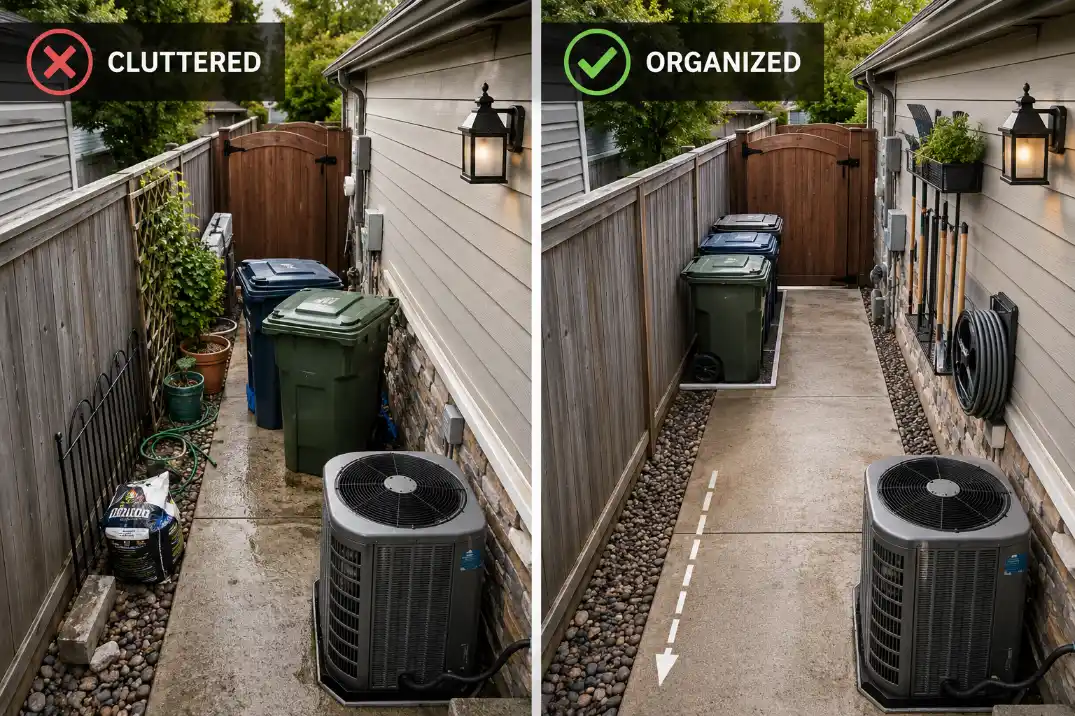
Key Insight
The best side yard utility corridor ideas are not about filling the strip with more features. They are about giving the narrow space a clear operating system: one lane for movement, one edge for storage, one route for water, and protected access around service points.
Respect those zones, and the corridor can look clean without becoming fragile. Ignore them, and even attractive materials usually end up hiding a layout that still works poorly.
For broader official guidance on redirecting downspouts and reducing residential runoff, see the U.S. EPA’s Soak Up the Rain guidance.