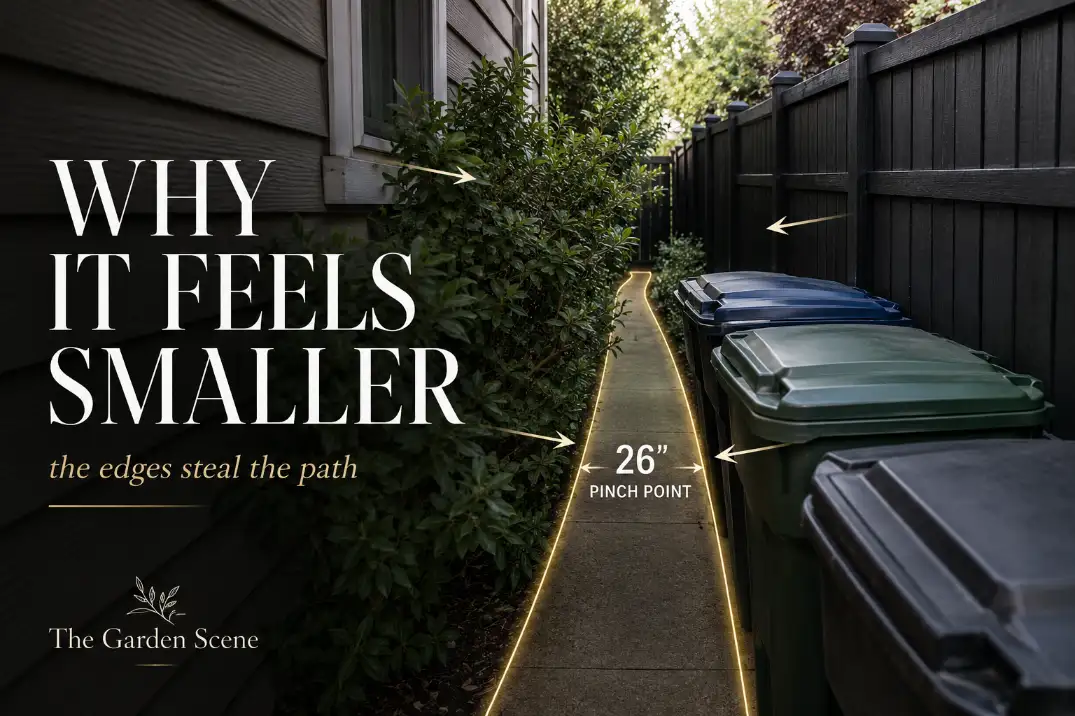
A side yard usually feels cramped because it was designed as leftover space instead of a working corridor.
The first checks are simple: measure the clear walking width, count how often the path gets interrupted, and look at the mature spread of every plant touching the route.
A 36-inch clear lane usually feels usable. Around 30 inches, the space becomes borderline. Near 24 inches, most people start turning sideways or avoiding the route.
That is different from a side yard that only looks plain. A plain side yard may need better planting, lighting, or surface material. A cramped side yard has a movement problem.
If bins, shrubs, hose reels, gates, or AC equipment create pinch points every 4 to 6 feet, prettier materials will not fix the feeling. The layout has to give the body and the eye one clean path first.
Why Side Yards Make Small Properties Feel Smaller
Backyards can absorb small mistakes. Side yards usually cannot. They are narrow, bordered by hard vertical surfaces, and often asked to handle too many jobs at once: trash-bin access, utilities, drainage, pets, storage, planting, and privacy.
When a side yard fails, the whole property can feel smaller because the front-to-back connection breaks. The outdoor space starts to feel like separate fragments: front yard, blocked side strip, backyard.
That broken sequence makes the usable square footage feel less generous than it really is.
Two hard edges magnify every mistake
A shrub that would look modest in an open backyard can feel aggressive in a side yard because the fence and house wall already create visual pressure.
The same is true for planters, trellises, path lights, hose pots, and storage boxes. Each object reduces usable space physically, but it also makes the corridor feel busier.
The most useful question is not “Can this fit?” It is “Does this leave the route feeling continuous?” A side yard can technically contain a lot and still feel bad.
The eye needs a long line
Small properties feel larger when the eye can move through them without stopping every few feet. In a side yard, that usually means one continuous walking surface, one quieter vertical plane, and one active design edge.
When both sides compete for attention, the side yard starts to feel shorter, darker, and more closed in than it really is.
Mistake 1: Designing the Edges Before the Walking Lane
The biggest side yard mistake is treating both edges as open design territory. Homeowners add plants along the fence, storage against the house, stepping stones in the middle, and maybe a trellis or lights for interest.
Each choice seems reasonable. Together, they steal the only thing the side yard needed most: uninterrupted clearance.
Measured width is not usable width
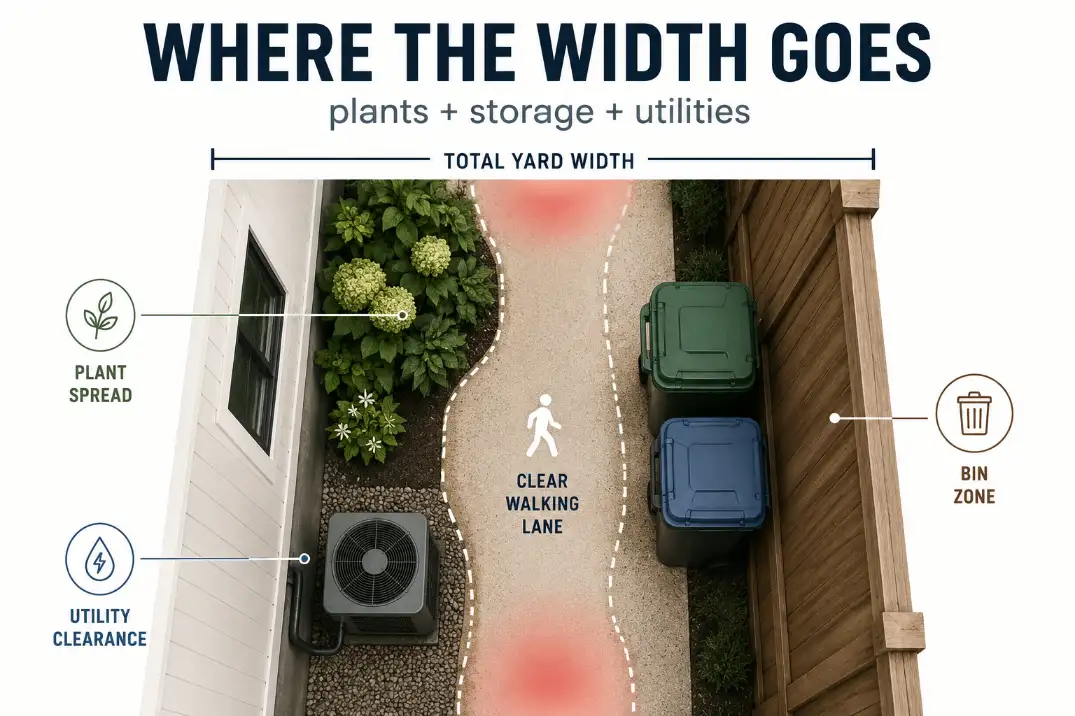
A 5-foot-wide side yard does not function like a 5-foot walkway. Subtract 8 to 12 inches for plant spillover, 6 to 10 inches for downspouts or hose reels, and a few inches for edging or uneven surfaces.
The usable route may shrink to 28 inches without looking obviously blocked in a photo.
For everyday foot traffic, a continuous 36-inch walking lane is a strong target. Short narrower moments can work, but repeated squeezes below 30 inches make the route feel like a service gap rather than a usable part of the property.
If the side yard is also used for trash bins or garden equipment, design around the moving object. A typical residential bin can be about 24 to 28 inches wide, and it needs extra clearance to roll without scraping siding, plants, or a gate.
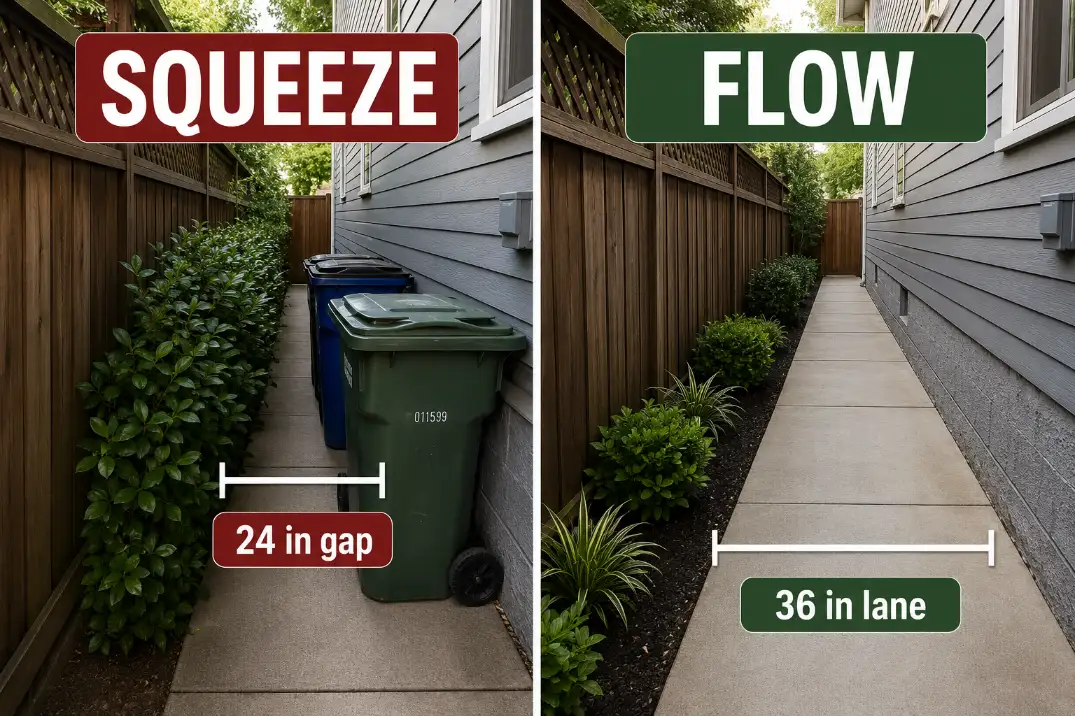
A stronger layout starts with the walking lane, then decides what can live outside it. The route should not bend around every feature. The features should support the route.
That is especially important in narrow access areas where the goal is not just decoration but everyday movement.
The ideas in Side Yard Layout Ideas for Tight Access work best when the clear route is treated as the main design element, not whatever space remains after planting.
Mistake 2: Choosing Plants by Nursery Size Instead of Mature Width
Overplanting is the visible symptom. The real mistake is choosing plants by how they look in a pot instead of how they behave after two to five growing seasons.
Small plants can become large obstacles
A shrub sold in a 3-gallon container may look harmless at 18 inches wide, then mature to 4 feet across. In a 5-foot side yard, that plant can consume most of the usable width. Even worse, the problem may not show up until the landscape has already filled in and feels “finished.”
For tight side yards, plant width matters more than flower color. Plants near the route often need to mature in the 12- to 24-inch width range unless there is a deeper bed. Anything wider should be placed where its spread will not invade the walkway.
Pruning is not always a real fix
Light seasonal pruning is normal. Constant correction is a design warning. If branches grow back into the path within 4 to 8 weeks during the active season, the plant is too large, too vigorous, or too close to the walking lane.
This is where many homeowners waste time. They keep trimming a plant that is doing exactly what it naturally does. In humid regions such as Florida or the Southeast, fast warm-season growth can close a narrow path quickly.
In dry Arizona conditions, the issue may be less about lush growth and more about rigid, thorny, or architectural plants placed too close to the route.
Pro Tip: Choose side-yard plants by mature width first. Texture, bloom, and color only matter after the plant’s adult size fits the corridor.
For a broader version of this problem around outdoor routes, Backyard Plants Crowding Paths and Seating explains why plants that look fine in beds can still fail beside movement zones.
Mistake 3: Treating Storage as Something to Hide Instead of Route Around
Storage is often the real reason a side yard feels smaller than the property plan suggests. Trash bins, hose reels, garden tools, extra pots, and delivery overflow do not need to fill the whole space. They only need to interrupt the route at the wrong point.
One bad pinch point can ruin the whole corridor
A side yard with a 36-inch path can still feel cramped if one trash bin narrows the passage to 20 inches near the gate. People remember the squeeze, not the average width.
The same thing happens when a hose pot sits at ankle height, a tool rack projects from the wall, or a gate swings into the walking lane.
The better fix is not necessarily a prettier storage box. It is a storage zone that does not break movement. If bins must live in the side yard, place them in one defined bay near an end of the route, not scattered along the passage.
Utility access should stay boring
AC condensers, gas meters, cleanouts, downspouts, and electrical panels are not decorative features, but designing too tightly around them creates future problems.
Avoid planting or storing items where someone needs to service equipment. A side yard that looks tidy for photos but blocks utility access is not actually well designed.
This is where the logic behind Narrow Side Yard Walkway Flow becomes useful: the path should read as one continuous movement line, not a set of small negotiations.
Side Yard Width Decision Guide
Use the actual clear width, not the property-line-to-house measurement.
| Clear side yard width | What usually works best | What usually backfires |
|---|---|---|
| 3–4 ft | Simple access corridor, low planting, continuous surface | Dual-side planting, bins in the path, loose stepping stones |
| 5–6 ft | One active planted edge plus one quiet edge | Matching beds on both sides |
| 7–8 ft | Narrow garden walk, screened utility bay, controlled vertical accents | Dense privacy layers from ground to eye level |
| 8+ ft | Small destination moment, bench niche, wider planting rhythm | Treating the whole side yard as storage overflow |
This guide is not about making every side yard feel wide. It is about matching the design ambition to the space. A 4-foot side yard should not be forced to behave like a garden room. A 7-foot side yard should not be wasted by letting storage take over the most useful stretch.
Mistake 4: Using Surface Materials That Break the Flow
A side yard surface has one job before it has any style job: it must let people move through without thinking too much. Materials that look charming in photos can fail if they make the path feel unstable, fussy, muddy, or visually chopped up.
Loose stepping stones can make the space feel tighter
Stepping stones often look light and garden-like, but they can make a narrow side yard feel awkward if the stride pattern is wrong. Stones spaced more than about 24 inches apart force people to watch their feet. Stones that wobble after rain create hesitation. In a tight corridor, hesitation reads as cramped.
A continuous gravel path, compacted fines, concrete strip, or tight paver run may look simpler, but it often feels better because it supports movement instead of interrupting it.
Mud and drainage make narrow spaces feel neglected
A side yard that stays wet for 24 to 48 hours after rain will usually feel smaller, darker, and less usable, even if the layout is technically open. Mud tracks onto patios, dogs create worn channels, and loose gravel migrates toward gates or lawn edges.
In rainy Midwest regions or coastal California areas with seasonal moisture, drainage and surface stability can matter more than decorative planting. If water regularly collects against the house, the surface decision is secondary; the grading and drainage problem comes first.
If you are deciding whether to solve layout or water movement first, Fix Drainage or Layout First is the more useful next step because a beautiful corridor still fails if it sends water to the wrong place.
Mistake 5: Adding Privacy Until the Side Yard Feels Like a Tunnel
Privacy is a common reason side yards get overbuilt. A homeowner wants to screen a neighbor window, hide utility equipment, or soften a fence line. The mistake is trying to block every view from every angle.
Continuous screening creates visual compression
A tall fence, dense hedge, overhead vines, and dark surface material can turn a narrow route into a tunnel. The side yard may become more private, but it also becomes heavier.
In small properties, that tradeoff is often not worth it because the passage starts to feel like a closed service slot instead of a usable outdoor connection.
Better privacy is more selective. Screen the exact view that bothers you. Leave some visual relief near the ground, above the planting, or between vertical elements. Even a 12- to 18-inch visual break can help the corridor feel less sealed.
One active edge is usually enough
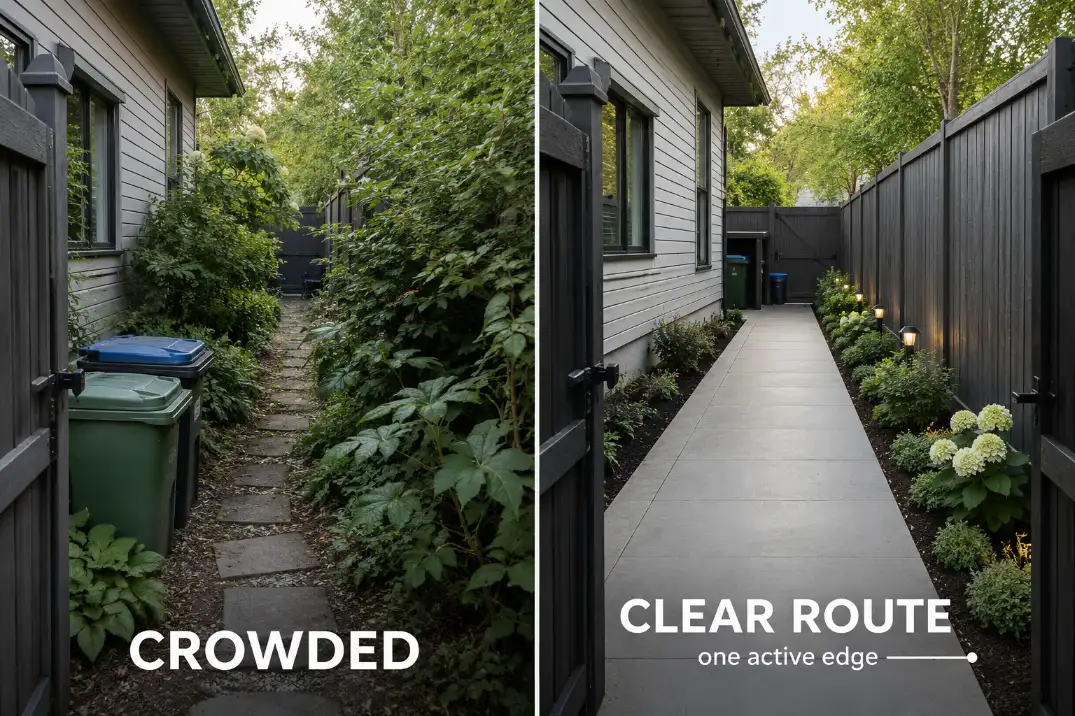
Matching both sides may look balanced on paper, but it often feels crowded in real life. A planted fence side with a quieter house-wall side usually feels calmer than two thin planting strips fighting for space.
This is one condition homeowners commonly overestimate: symmetry. In a narrow side yard, symmetry can make the space feel less intentional, not more.
For side yards that already feel like wasted leftover strips, Why Side Yards Become Wasted Outdoor Space helps separate visual neglect from actual access problems.
The 3 Fixes That Usually Make the Biggest Difference
Most cramped side yards do not need a full redesign first. They need the few changes that restore movement, reduce visual pressure, and make the side yard feel connected to the rest of the property.
1. Clear one continuous lane
Start by protecting one walking lane before choosing plants, lights, or decorative details. A consistent 36-inch route will usually improve the feel more than a new planter or another privacy screen.
2. Move storage into one defined bay
Storage feels less cluttered when it has a single home. Group bins, hose storage, or tools near one end or in a recessed bay so the main route does not keep narrowing and widening.
3. Make one edge active and one edge quiet
A narrow side yard rarely needs both sides to perform. Let one side carry the planting, screening, or visual rhythm. Let the other side stay calm. That single decision often makes a small property feel more organized and more spacious.
What Actually Makes a Small Side Yard Feel Larger
The strongest side yard fixes are usually not the most decorative ones. They are the ones that restore a clear line, reduce edge pressure, and make every object justify its footprint.
Let one long line carry the space
A clean path edge, a repeated low planting rhythm, or a simple fence plane can make a narrow side yard feel more generous. Random pots, alternating materials, small ornaments, and uneven edging break that line. They may add interest, but they also make the space feel shorter.
This is the distinction between a symptom and the mechanism. The symptom is clutter. The mechanism is interrupted visual movement.
Keep heavy mass away from tight points
Do not place the largest planter, shrub, storage box, or trellis at a gate, corner, utility zone, or narrow turn. Tight points need relief. Put taller or denser elements where the walking lane is already stable.
Pro Tip: If one spot already makes people slow down, do not decorate it. Clear it first, then decide whether it needs anything at all.
That same principle applies across small yards. Overplanted Backyards Feel Smaller shows how plant mass becomes a spatial problem when it lands near movement, seating, or access zones.
Quick Diagnostic Checklist
Check these before adding more plants, lighting, or decor:
- The clear walking lane drops below 30 inches.
- A bin, branch, fixture, or gate interrupts the route every 4 to 6 feet.
- Plants need hard pruning more than twice in one growing season.
- The walking surface makes people look down instead of move naturally.
- Both sides are busy at knee, waist, and shoulder height.
- Storage sits in the path because no separate bay was planned.
- The side yard feels more private but also darker, tighter, or more tunnel-like.
Questions People Usually Ask
Is gravel good for a narrow side yard?
Gravel can work if it is compacted, contained, and comfortable underfoot. Smaller angular gravel or compacted fines usually feel more stable than large rounded stone. If trash bins roll through every week, a firmer paver or concrete strip may perform better.
Should I plant both sides of a side yard?
Only if the clear walking width stays comfortable after mature plant spread is counted. In many small properties, one planted edge and one quiet edge feel larger than two narrow planting strips.
When should I remove plants instead of pruning them?
Removal makes sense when pruning cannot hold the path for a full season, when the mature plant width exceeds the bed, or when the plant blocks utility access, drainage, gates, or the main walking route.
For broader official guidance on landscape design and plant selection, see the University of Minnesota Extension.