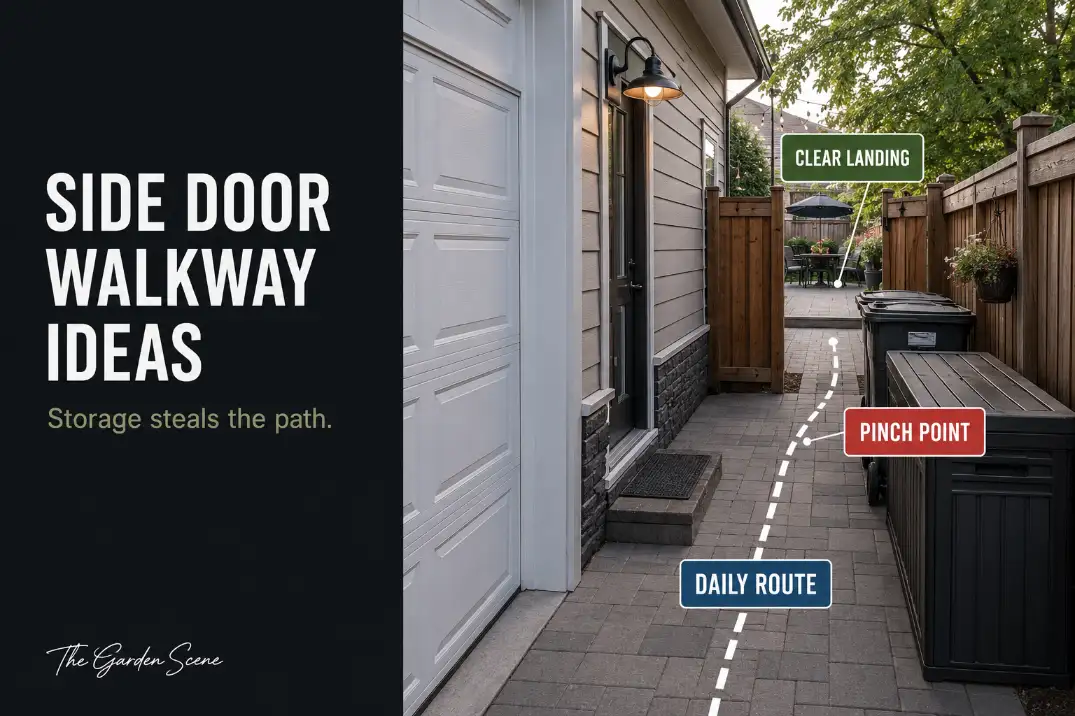
The best side door walkway ideas from a garage to a patio solve four things before they try to look finished: a clear route, a usable landing, dry edges, and safe night visibility.
A path can look neat and still fail if the first 3 feet outside the door are blocked, if the walkway drops below about 30 inches at a pinch point, or if water stays along the garage wall for more than 24 hours after normal rain.
Start by checking how the route actually works. Can someone step out, turn, and carry a bin, cushion box, tray, or tool bag without brushing the fence?
Does the gate swing into the same space as the door? Can the step and latch be seen after dark without glare? This is different from a decorative garden path. A garage-to-patio walkway is a working route, and working routes fail first at movement points.
The Forgotten Door
A side door between the garage and patio is often treated like a minor exit, but it may carry more daily outdoor traffic than the back door. Trash, recycling, grill tools, patio cushions, pet supplies, garden tools, and party overflow often move through this route because the garage becomes the storage hub.
Treat the side door as a working entry
The first decision is simple: design the side door as an entry, not as leftover space. That means the route should have a protected walking line, a landing area where someone can pause, and enough clearance for moving objects.
A 36-inch clear walking line is a good starting point for normal foot traffic. Where bins, carts, wheelbarrows, or outdoor storage tubs move through the same route, 42 to 48 inches is more realistic.
The difference is not just comfort. It changes whether someone can walk naturally or has to turn sideways every time they leave the garage.
This is where a side door walkway overlaps with broader Garage to Backyard Access Ideas because the route is not only a path. It is the daily connection between storage, utility, and the outdoor living area.
Protect the landing before the path
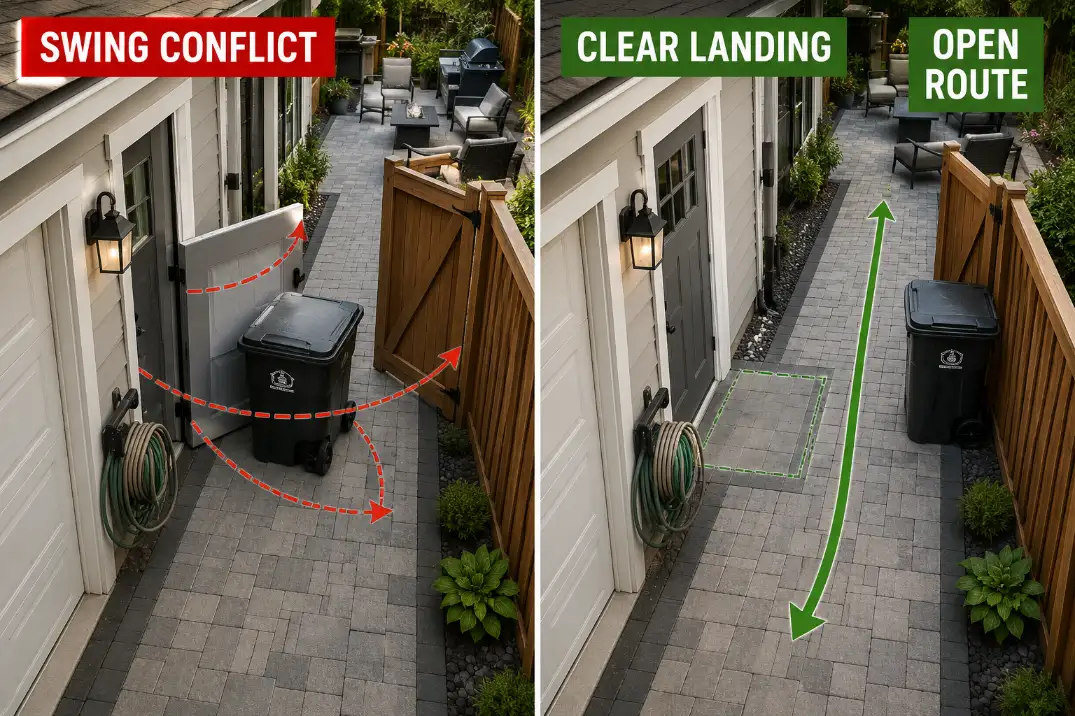
The landing right outside the side door matters more than most people expect. If the path is 36 inches wide but the door opens into a bin, hose reel, planter, or gate swing, the walkway still fails.
The person using the door needs a small pause zone before stepping fully into the route.
As a practical rule, keep the first 36 inches outside the door as open as possible. If the door swings outward, keep the swing arc clear.
If it swings inward, the outside still needs room for someone to stand with both hands full while closing the door, turning toward the patio, or checking the gate latch.
Many homeowners blame the visible walkway first. In practice, the cramped feeling often begins at the landing. Fix that first, then shape the path.
A Path People Actually Use
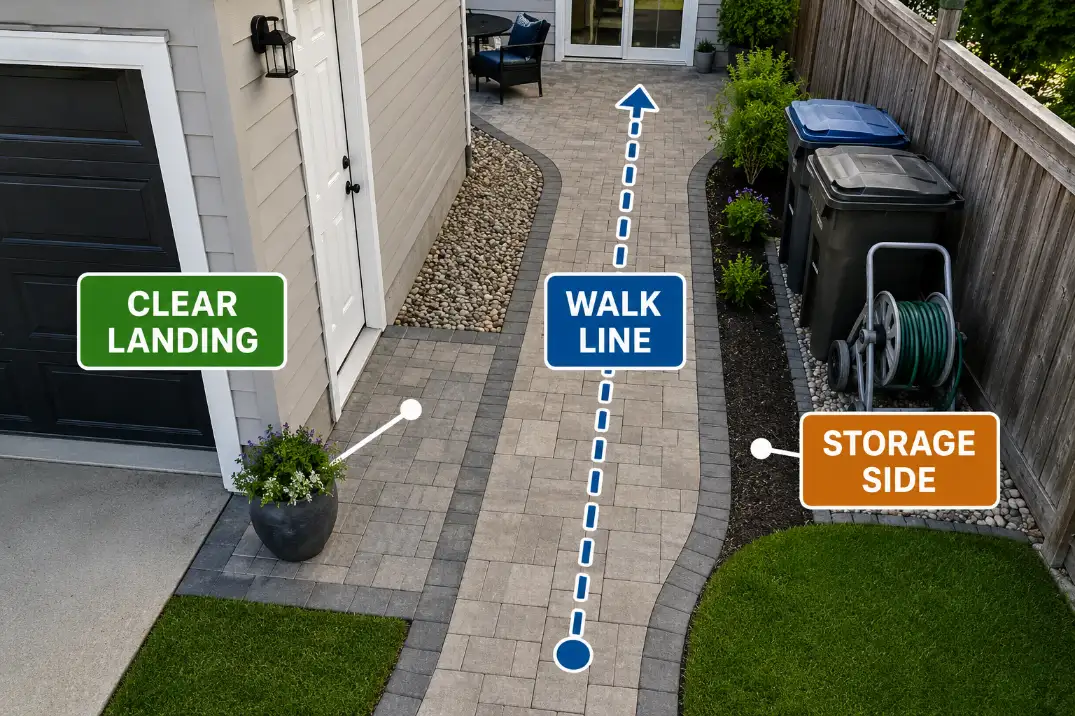
A side door walkway should be planned around the busiest movement, not the prettiest material. If the garage stores outdoor gear, the path has to handle carrying, rolling, turning, stopping, and opening a gate.
Keep the clear lane continuous
A clear lane only works if it stays clear the whole way. A 36-inch section near the garage does not help much if the route narrows to 24 inches beside the fence or at the patio edge.
Most frustrating side walkways are not narrow everywhere. They fail at one or two exact points.
Look for the tightest place, not the average width. A bike handlebar, hose loop, bin handle, low branch, or decorative pot may steal 6 to 10 inches from the actual walking line.
That is enough to make a route feel cramped even when the hardscape itself is technically wide.
Gate movement deserves special attention. A walkway can look open until the gate swings across it, a bin rolls through it, or a door opens into it.
If the side gate shares this route, the clearance logic in Side Yard Gate Swing Clearance becomes part of the walkway design, not a separate detail.
Choose the surface by use, not just appearance
For a garage-to-patio path, the surface should match the way the route is used. Concrete works well when the path carries bins, carts, or heavy repeated traffic.
Pavers give a more finished patio connection, but they need stable base preparation and tight joints. Large slabs can look clean in a narrow side yard if the joints do not become awkward foot traps.
Loose gravel is the surface people often overestimate. It can look attractive in photos and drain well in some settings, but it is not always friendly to bins, carts, kids, older visitors, or wet shoes.
If anything rolls through the route more than once a week, loose gravel without firm containment usually becomes maintenance rather than a solution.
Pro Tip: For a working side door route, choose the surface that handles the hardest movement first. The prettier edge can come later.
| Walkway choice | Works best when | Starts failing when | Better adjustment |
|---|---|---|---|
| Concrete strip | Bins or carts move often | It looks too service-like | Add clean edging or a narrow planting strip |
| Pavers | The patio connection should feel finished | Base shifts or joints widen | Use a stable base and restrained pattern |
| Large slabs | The side yard is narrow but visible | Gaps force uneven steps | Keep spacing predictable |
| Compacted gravel | Foot traffic is light and drainage matters | Wheels or bins cross it often | Use firm edging or switch to slabs |
| Stepping stones | Use is occasional | The route is used daily | Replace with a continuous walking surface |
Keep Storage Off the Route
Storage is the most common reason a garage-to-patio walkway stops working. The layout usually fails when stored items are allowed to borrow space from movement.
Separate static storage from moving storage
A storage item has two footprints: where it sits and how it moves. A trash bin may sit neatly against the wall, but it still needs room for the lid, handle, wheels, and pulling angle.
A bike may hang cleanly on a rack, but handlebars can still cut into the shoulder line. A hose reel may look compact until the hose loop lands in the walking lane.
This is why tidy storage can be misleading. A side yard can look organized in a photo and still make daily use irritating. If the route drops below about 30 inches at the storage zone, the layout is not functioning as a walkway anymore. It is functioning as a squeeze gap.
When bins create the main conflict, the smarter move is to give them a defined parking edge instead of letting them float across the route.
A focused layout like Trash Bins in a Narrow Side Yard can keep the service function without allowing it to dominate the garage-to-patio connection.
Keep one side active and one side clear
The cleanest layout is usually not centered. In many side yards, it works better to create a storage side and a walking side.
Bins, hooks, hose reels, and narrow cabinets stay on one edge. The walking line stays uninterrupted from the side door to the patio.
This does not mean the storage side has to look harsh. A slim storage screen, matching bin pad, wall hooks, or low utility cabinet can make the area feel intentional. The key is that nothing crosses the route during normal use.
A routine fix stops making sense when the same object has to be moved every time someone walks through. If a planter, bin, chair, or cart has to be shifted for the path to work, it is not a design feature. It is a recurring obstruction.
Drainage Near the Wall
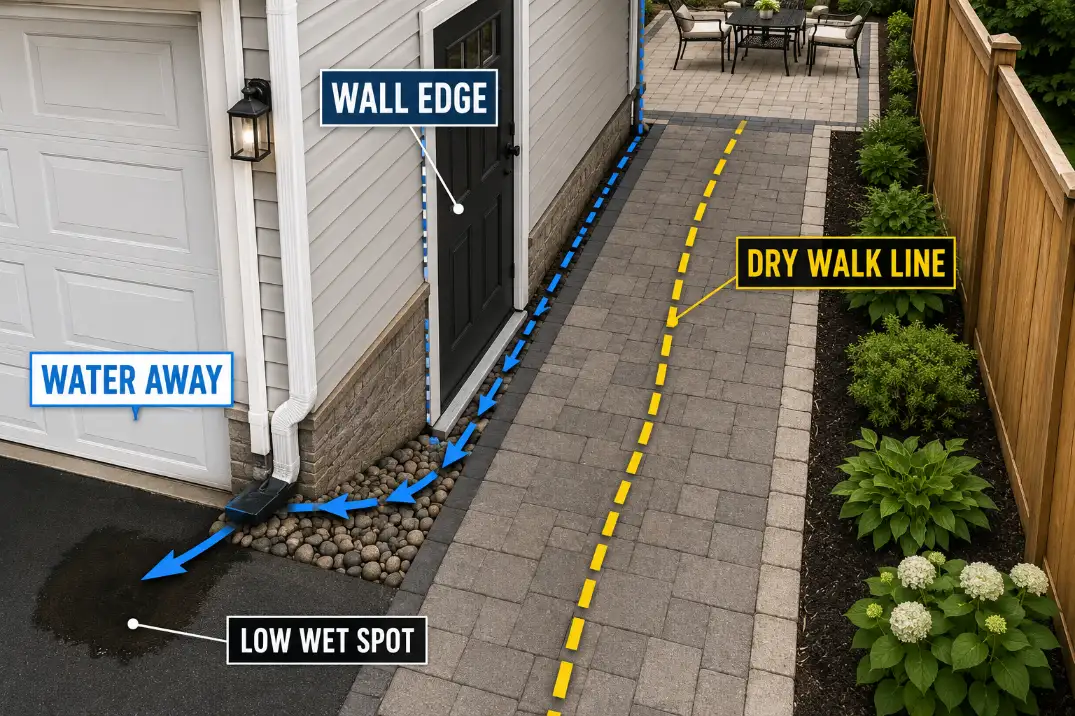
Drainage should be solved before the walkway is dressed up. A garage-side route often sits between a wall, fence, downspout, shaded strip, and patio edge. Water has fewer escape paths, so small grading mistakes show up quickly.
Make water leave the walking line
A useful walkway near the house should move water away from the garage wall and away from the main walking line. Where the site allows it, a common target is about 1/4 inch of fall per foot, or roughly a 2% slope. That is enough to help water move without making the path feel noticeably tilted.
The practical test is drying time. If the route is wet during rain and then dries within about 24 hours in normal weather, that may be acceptable.
If dampness stays for 24 to 48 hours, especially along the wall edge or in shade, the path is telling you that runoff is collecting where people walk.
After 48 hours, the problem is no longer just cosmetic. Wet edges can collect silt, algae, leaf film, and slippery residue.
In freeze-prone northern states, repeated wet edges can also turn small surface movement into a winter hazard. In humid areas, the same damp strip can stay unpleasant even without freezing.
Do not cover a wet base with nicer pavers
One expensive mistake is adding better-looking material over the same wet route. New pavers, decorative gravel, or a nicer border may hide the problem for a season, but the low spot, downspout discharge, or fence-side runoff will keep pushing water back into the path.
If water repeatedly sits along the garage wall, the condition is closer to Patio Water Pooling Against the House than a simple walkway styling issue. The surface is the symptom. The grade and water source are the mechanism.
Keep several inches of visible clearance near siding, trim, and the door threshold. Soil, mulch, or storage piled against the wall can hide moisture and make the walkway look finished while the wall edge stays vulnerable.
Lighting the Side Entry
Side-door lighting should make the threshold, latch, gate, path edge, and first few steps easy to read. It should not blast the entire side yard. Many homeowners overestimate brightness and underestimate aim.
Light the ground, not the eyes
A shielded fixture aimed downward usually helps more than a bright exposed fixture aimed outward. The route needs readable ground, not a glowing fence.
The important places are the door threshold, step edge, bin handle, gate latch, and patio entry.
Path markers in the 100–200 lumen range can help define the route, while a shielded wall fixture near the side door can handle the landing.
More light is not automatically safer. If the fixture creates eye-level glare, it can hide the ground and make the step harder to read.
For routes with steps, slopes, or awkward edges, Path Lighting for Steps, Slopes, and Walkways gives the better lighting logic: reveal the walking surface first, then add atmosphere.
Run the night walk test
Test the walkway after dark, not while choosing fixtures online. Walk from the garage to the patio and back. Do it once with your hands free, then again while carrying something. The second walk usually reveals the real problem.
Check four points:
- The side door threshold is visible before stepping out.
- The gate latch can be found without guessing.
- Bin handles or storage edges do not disappear into shadow.
- The patio entry is visible before the walkway ends.
If you have to stare at the ground to avoid missing the edge, the lighting is too weak or poorly placed. If you have to look away because the fixture is too bright, the lighting is aimed wrong.
Pro Tip: Aim the light after the walkway layout is fixed. Otherwise the fixture may simply highlight the old obstacle pattern.
Easy Without Looking Like a Service Path
A garage-to-patio side walkway should work like a utility route without looking like a utility alley. That balance comes from cleaner edges, repeated materials, and fewer competing objects.
Use one material language
The simplest way to make the route look intentional is to repeat one main surface and one edge treatment. Pavers with a narrow gravel edge, concrete with a planted strip, or large slabs with tidy joints can all work.
What usually looks bad is not the material itself. It is the patched mix of too many small fixes.
Three layout ideas tend to work well:
A clean paver route with a storage edge works when the side yard is visible from the patio and needs to feel finished.
A concrete strip with a planted fence side works when bins, carts, or tools move through the route often.
A large-slab path with a bin pocket near the garage works when the space is tight but the first landing must stay open.
The point is not to decorate the route into usefulness. It is to make the useful route look deliberate.
Soften without stealing clearance
Plants, screens, and decor can help the walkway feel less like a service path, but only after the walking line is protected. A narrow planter that matures into the path is not softening the route. It is slowly closing it.
Keep plant growth, storage doors, cabinet handles, and decor outside the walking lane. If the path is only 36 inches wide, even 6 inches of mature plant spread matters. If the gate swings across the route, keep the landing cleaner rather than adding another object to disguise it.
Make the patio end clear
A side door walkway should not deliver people into a second obstacle. If the route opens into chair legs, grill traffic, a storage bench, or a narrow patio corner, the walkway may feel wrong even when the side yard is fixed.
At the patio end, keep the arrival point open before adding furniture. A 36-inch clear entry zone is a useful minimum, and more is better if people carry trays, cushions, or grill supplies through the route.
When the patio itself is the bottleneck, Keep Patio Entry Clear is often the next fix after the side walkway.
The right order is clearance first, drainage second, lighting third, and finish last. That order prevents the most common wasted work.
A beautiful walkway over a wet edge fails. A bright fixture over a cluttered route still feels awkward. A planter added before the walking line is protected becomes another obstacle.
A side door walkway does not have to become the main entrance. It only has to stop acting like leftover space. When the door landing is open, the path stays near 36 inches or wider, water leaves the wall edge, and the route reaches the patio without a squeeze, the side door becomes a useful outdoor connection instead of a hidden service gap.
When the route needs to be safer for older guests, deliveries, or frequent carrying, the clear-route principles in the U.S. Access Board are a useful reference point.