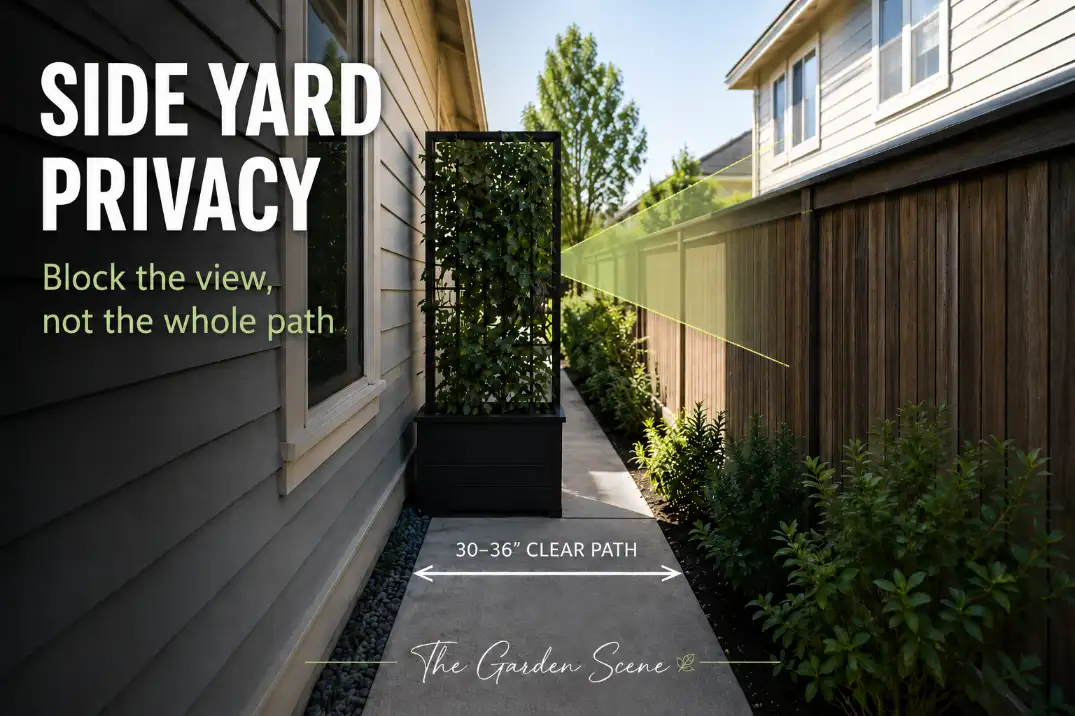
The best side yard privacy ideas for tight spaces are planter-trellis screens, slatted panels, fence-mounted trellises, narrow evergreens, and small canopy trees—but only when they block the actual sightline without shrinking the walking path.
Most failed side-yard privacy fixes come from screening the entire boundary instead of the 6–12 feet where the view actually crosses.
Before choosing plants or panels, measure the clear walking width, find the eye-level view from the window, gate, patio, or neighbor’s deck, and note where AC units, meters, hose bibs, drainage paths, or trash access already compete for space.
A side yard under about 5 feet wide rarely handles a full hedge well. A 30-inch clear path is the practical minimum for normal walking, and 36 inches feels noticeably better if bins, bikes, or tools pass through.
Start With the Sightline, Not the Fence Line
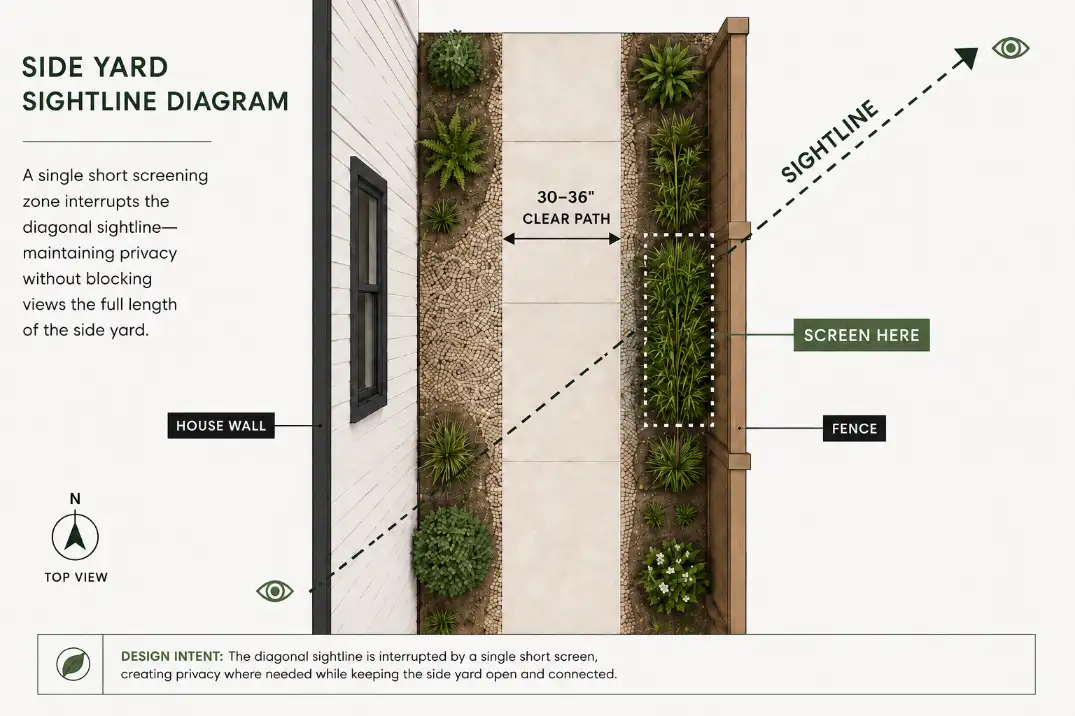
The most common mistake is treating privacy as a boundary problem. In a tight side yard, it is usually a view-angle problem. A neighbor may only see into the space from one kitchen window, one upstairs landing, or one deck corner. If you block that line cleanly, the rest of the side yard can stay open enough to breathe.
The Useful Privacy Zone Is Often Short
Walk the side yard and stop where the exposed view feels worst. In many suburban lots, the useful privacy zone is only 4–8 feet long. That is where a freestanding screen, narrow planter, or vine panel earns its space.
Screening the remaining 20 feet can create shade, damp soil, leaf litter, and awkward maintenance without improving privacy much.
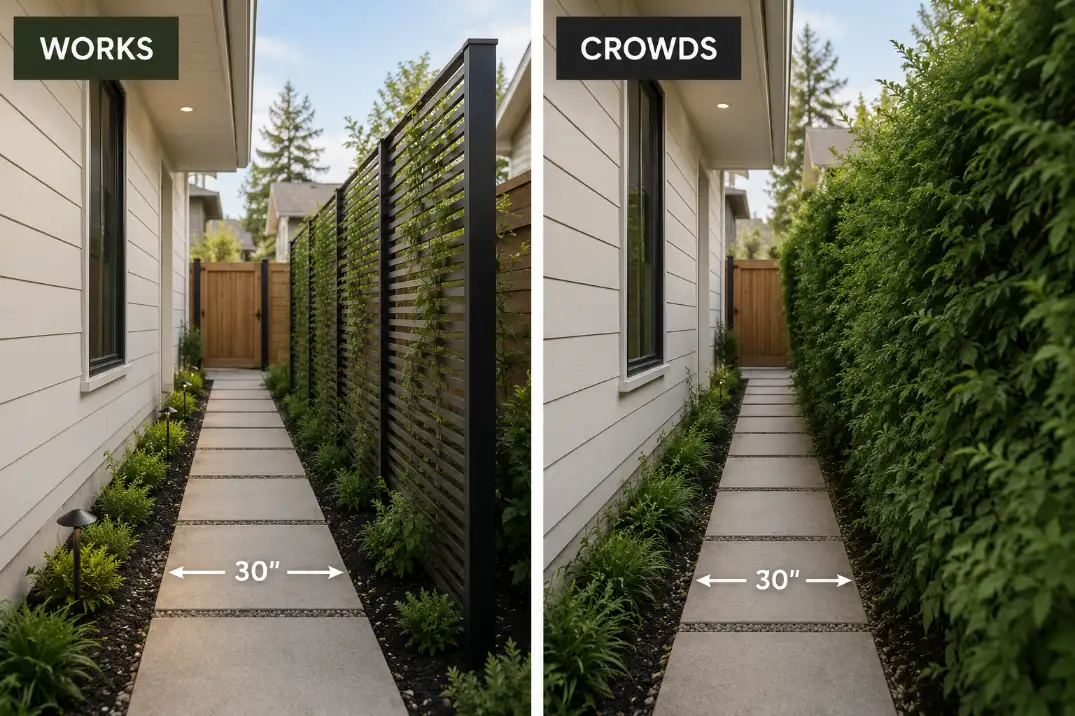
This is why a targeted side-yard solution often beats a continuous hedge. A continuous hedge may look like the proper answer, but it can steal 18–36 inches of width once it reaches mature size. In a 4-foot side yard, that is the difference between a usable passage and a shoulder-brushing corridor.
Privacy Height Should Match the Viewer
For ground-level views, a 5–6 foot screen is often enough. For a raised deck or second-story window, a taller fence may still fail because the view comes from above.
In that case, a vertical trellis, small ornamental tree, or layered planting placed closer to the viewer’s angle usually works better than adding more solid material along the fence.
If the main problem is an upper window looking down into the yard, the logic is closer to overhead screening than side screening.
The same principle applies in Upstairs View Privacy Yard, where the fix depends less on fence height and more on interrupting the downward line of sight.
7 Side Yard Privacy Ideas That Fit Tight Spaces
The best idea is not always the greenest, tallest, or most permanent one. It is the one that blocks the exposed view while preserving access after the setup matures.
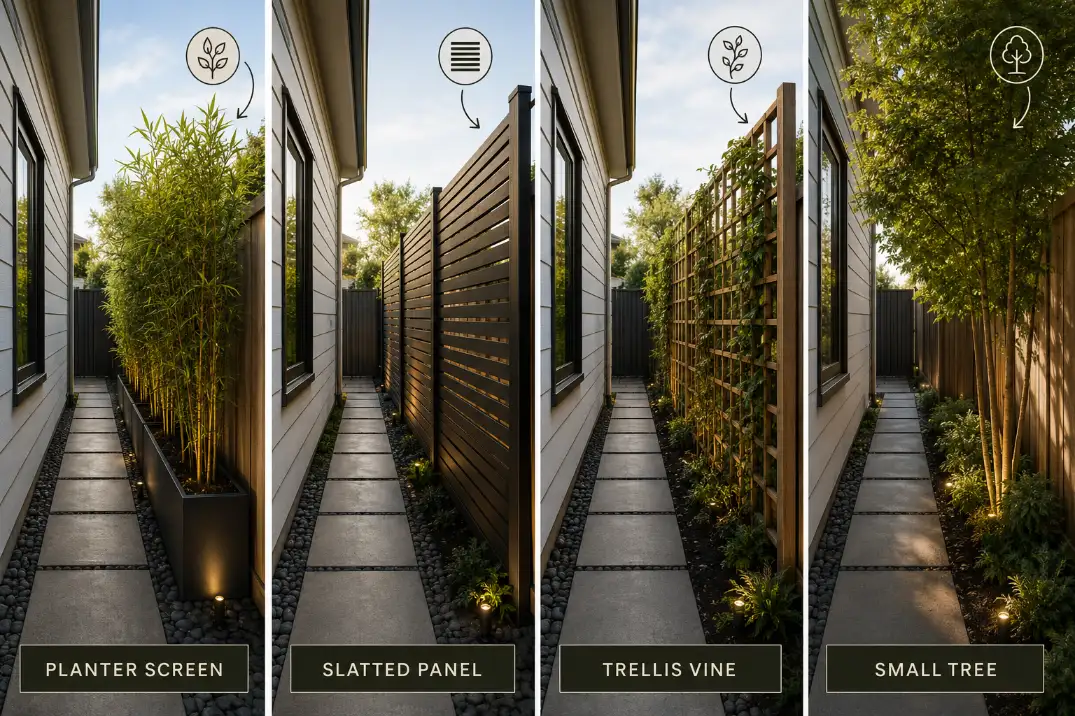
1. Planter-Trellis Screen
Best for: renters, no-dig installs, short exposed views.
A planter-trellis screen is the safest first choice when the exposed zone is short and the side yard cannot spare much ground width. A planter about 12–18 inches deep can support a vertical screen without turning the whole passage into a planting bed.
This works especially well for townhomes, side gates, rental-friendly layouts, and areas where digging is not realistic. Use it where the sightline crosses, not along the entire fence.
2. Slatted Freestanding Panel
Best for: instant privacy, poor soil, airflow.
A slatted panel gives immediate privacy without waiting for plants to grow. It is better than a fully solid panel in many tight side yards because small gaps let air and light move through.
That matters in humid regions, including much of Florida and the Southeast, where a sealed-off side yard can stay damp for 24–48 hours after rain and start to feel like a mildew corridor.
3. Fence-Mounted Trellis Strip
Best for: side yards under 4 feet wide.
A fence-mounted trellis strip adds height without using floor space. It is best when every inch of walking clearance matters.
The mistake is letting the vine become heavier than the structure. Choose a plant that can be reached and pruned from the path side. A trellis you cannot maintain becomes clutter, not privacy.
4. Columnar Evergreen Pair
Best for: year-round screening in one short zone.
Two narrow evergreens placed at the view point can feel more intentional than a long hedge. The key is mature width. A plant sold as “narrow” may still reach 3–5 feet wide over time.
If the mature spread leaves less than 30 inches of passage, skip it. That plant may solve privacy while making the side yard harder to use.
5. Offset Screen Near a Window
Best for: diagonal views and exposed windows.
Sometimes the best screen is not on the property line. A short offset screen near the exposed window or sitting area can block the view sooner and with less material.
This is useful when the neighbor’s line of sight cuts diagonally across the side yard. A screen on the fence may miss the angle; a screen closer to the house may solve it.
6. Small Ornamental Tree
Best for: raised decks and upper-window views.
A small ornamental tree helps when the view comes from above. Instead of trying to raise the entire fence, use canopy placement to interrupt the downward view.
Look for narrow, well-behaved forms that fit the available root space. This works better in side yards over 6 feet wide or where the tree can sit just outside the main walking route.
7. Mixed Narrow Planting Layer
Best for: wider side yards that need a softer garden feel.
A mixed planting layer is best for side yards with enough width, decent drainage, and a softer look. It should still be selective. One short run of upright shrubs and climbing plants usually works better than filling the entire boundary.
For plant and material choices that hold up in narrow conditions, Best Plants and Materials for Narrow Side Yards is a useful companion because privacy depends on mature size, light, soil, and path clearance together.
Quick Privacy Fit Checklist
Use this before buying plants or panels:
- Keep at least 30 inches of clear walking width; aim for 36 inches if bins or tools move through.
- Place the screen where the view crosses, not automatically along the full fence.
- Avoid plants with mature widths over 3 feet unless the side yard is unusually generous.
- Leave 12–18 inches around utility meters, hose bibs, AC units, and cleanouts.
- Check whether the side yard stays damp more than 24–48 hours after rain.
- Use open or slatted screens where wind is strong; fully solid panels can feel harsh in narrow corridors.
- Treat a 6-foot fence as a limit, not a guarantee, especially with raised neighboring views.
Which Side Yard Privacy Option Fits Best?
| If your side yard is… | Best privacy move | Avoid |
|---|---|---|
| Under 4 feet wide | Fence-mounted trellis or shallow slatted screen | Full hedge or wide shrubs |
| 4–6 feet wide | Planter-trellis or short screen run | Continuous planting along the whole fence |
| Mostly shaded | Slatted screen plus shade-tolerant vertical planting | Full-sun hedge plants |
| Viewed from above | Small canopy tree or tall vertical layer | Only raising the side fence |
| Wet after rain | Hard screen first, planting after drainage improves | Dense hedge before solving water movement |
| Used for bins or tools | Movable planter screen with 36-inch clearance | Fixed features that narrow the route |
The healthier choice is usually the one that preserves access after it matures. A privacy screen that leaves 36 inches open today but only 20 inches after three seasons is already failing, even if it still looks attractive in photos.
What People Usually Misread First
They Mistake Exposure for Lack of Height
Many side yards do not need more height. They need better placement. A 6-foot screen placed 8 feet away from the actual sightline may fail, while a 4-foot screen placed at the crossing point may work.
This is the difference between a symptom and a mechanism. The symptom is feeling exposed. The mechanism is the path of the view.
They Underestimate Maintenance Access
A tight side yard is rarely just a garden space. It is also the route to the backyard, hose, trash bins, meters, utilities, and sometimes drainage. A privacy feature that blocks access will become annoying long before it becomes beautiful.
This is why layout matters as much as screening material. If the path already feels awkward, Side Yard Layout Ideas Tight Access helps frame privacy as part of movement, not as a separate decoration.
They Overestimate Fast-Growing Plants
Fast growth sounds useful, but in side yards it often creates the next problem. A plant that grows 2–3 feet per year may close the view quickly, but it can also push into paths, scrape siding, trap moisture, or need trimming every few weeks during active growth.
Slow-to-moderate growth with a predictable mature size is usually better. The goal is not the fastest screen. The goal is the narrowest screen that stays useful.
When Plants Work Better Than Panels
Plants are better when the privacy problem needs softness, seasonal character, or a less confrontational boundary. They are also useful where a hard panel would make the side yard feel too narrow or echo-prone.
The best planting approach is mixed and selective. One species repeated tightly can look clean at first, but if disease, drought, freeze damage, or poor drainage hits, the whole screen can fail at once.
Mixed screens are usually more resilient, especially in regions with weather swings, clay soil, or irregular rainfall.
Ground Conditions Decide More Than Style
If the side yard stays wet for more than 48 hours after normal rain, avoid pretending the issue is only plant selection. Many privacy plants dislike saturated roots.
In Midwest or northern states, freeze-thaw cycles can also stress shallow containers, heave edging, and make narrow planted strips harder to keep neat.
In dry areas such as Arizona or inland California, the opposite problem appears: narrow side yards near walls and fences can reflect heat. A plant that tolerates full sun in an open bed may struggle beside stucco, concrete, or gravel where temperatures can run noticeably hotter.
If drainage already cuts across the side yard, privacy should not be installed first.
A screen that blocks runoff, traps mulch, or narrows the walking line can make the space less usable. For that decision order, Side Yard Ideas Drainage Access is the better companion topic.
Narrow Plant Examples Worth Considering
The right plant depends on climate and light, but the useful pattern is consistent: upright habit, controlled mature width, and manageable pruning.
For cold regions, narrow arborvitae and columnar juniper can work if their mature spread is checked carefully. In warmer regions, podocarpus and star jasmine on a trellis may be better fits where they are locally adapted. In mild coastal areas, espalier shrubs, jasmine, and compact evergreen layers can create privacy without the heavy look of a hedge.
Hot reflected-heat side yards need more caution. A plant that handles full sun in an open bed may struggle beside stucco, concrete, gravel, or a bright fence. Sky Pencil holly looks narrow on paper, but it can be site-sensitive and should not be forced into harsh heat, poor drainage, or exposed dry corners.
Running bamboo is the option to treat most cautiously. It can solve privacy fast, but it can also become the most expensive mistake in the side yard. If bamboo is considered at all, clumping types and local suitability matter.
Pro Tip: In a tight side yard, choose the support first and the plant second. A clean trellis with a modest climber usually ages better than an aggressive plant trying to become the structure.
When Panels Work Better Than Plants
Panels are better when you need privacy immediately, have poor soil, lack irrigation, rent the property, or cannot afford the mature width of plants. They also work well near gates, AC units, and service areas where roots and leaf drop would complicate maintenance.
The weak point is usually not the panel itself. It is anchoring, wind, and proportion. A tall solid panel in a narrow side yard can act like a sail. In windy corridors or corner lots, slatted designs are often safer and more comfortable than fully solid ones.
No-Dig and Renter-Friendly Options
A weighted planter-trellis, freestanding slatted screen, or modular privacy panel is usually the best no-dig option. These solve the view without drilling into a shared fence or committing to permanent planting.
The caution is stability. A 6-foot-tall panel should not rely on a lightweight decorative pot. If wind is common, the base matters more than the panel style.
Pro Tip: If a screen needs to stand taller than 6 feet or catch strong wind, treat it like a small structure, not decor. Footing, attachment, and local rules matter more than the style.
The Privacy Fixes That Often Waste Time
Adding small pots along the fence is the most common low-impact fix. It may make the side yard prettier, but it rarely blocks the actual view. Low plants soften the floor plane; they do not interrupt eye-level exposure.
Another weak fix is adding a continuous row of inexpensive shrubs without checking mature width. It looks decisive on planting day, then slowly steals the path.
By year three or four, homeowners often start cutting one side flat just to walk through, which leaves the plants stressed and awkward.
Decorative lattice can also disappoint when it is too short, too transparent, or placed where nobody is actually looking through. Lattice works when it supports a specific privacy job. It fails when it is used as a general symbol of screening.
This is where many cramped side yards go wrong: the privacy fix becomes another obstacle. Side Yard Mistakes Cramped is especially relevant when screening, storage, drainage, and walking space start competing in the same narrow strip.
A Simple Decision Rule for Tight Side Yards
If the side yard is under 4 feet wide, prioritize wall-mounted, fence-mounted, or very shallow screens. Avoid hedges unless they are outside the walking route.
If it is 4–6 feet wide, use a short run of planter screens, trellis panels, or tightly controlled upright plants. Keep the privacy feature concentrated in the exposed zone.
If it is over 6 feet wide, a mixed planting layer becomes more realistic, but access still matters. Leave enough room to prune, clean, and move equipment through the space without dragging branches along siding or fencing.
A side yard that already feels uncomfortable underfoot should be solved in sequence: walking surface first, drainage second, privacy third. If the path is too narrow, slick, or uneven, adding a screen only makes the discomfort more obvious.
That relationship is explored more directly in Side Yard Paths Uncomfortable.
Questions People Usually Ask
Can I get privacy in a side yard without making it darker?
Yes, but avoid fully solid walls unless the view problem is severe. Slatted screens, open trellis panels, and selective planting block sightlines while letting light move through. In tight spaces, filtered privacy often feels better than total enclosure.
What is the fastest side yard privacy option?
A freestanding screen or planter-trellis combination is usually fastest because it works the day it is installed. Fast-growing plants may catch up later, but they also create the highest risk of crowding.
Are bamboo screens a good idea for narrow side yards?
Usually only with caution. Running bamboo can become invasive and difficult to control. Clumping types are more manageable in some climates, but containers, barriers, and local suitability matter. For most tight residential side yards, a controlled trellis or narrow mixed screen is safer.
Should the screen match the fence?
Not always. Matching can look clean, but contrast sometimes helps. A warm wood slatted panel, dark metal trellis, or planted screen can make the side yard feel intentional instead of patched. The real test is whether it blocks the view without shrinking the route.
The Best Side Yard Privacy Feels Precise
The strongest side yard privacy ideas are not the biggest ones. They are the most accurately placed. A narrow screen at the exposed sightline, a planter that preserves walking width, or a trellis that adds height without bulk will usually outperform a full hedge or heavy fence extension.
Think of the side yard as a working corridor with one privacy problem inside it. Once the view is blocked, stop adding mass.
The space should still drain, breathe, open at the gate, and let someone walk through without turning sideways. That is the difference between privacy that looks good in a product photo and privacy that actually improves a tight side yard.
For broader plant-screening guidance, see University of Maryland Extension.