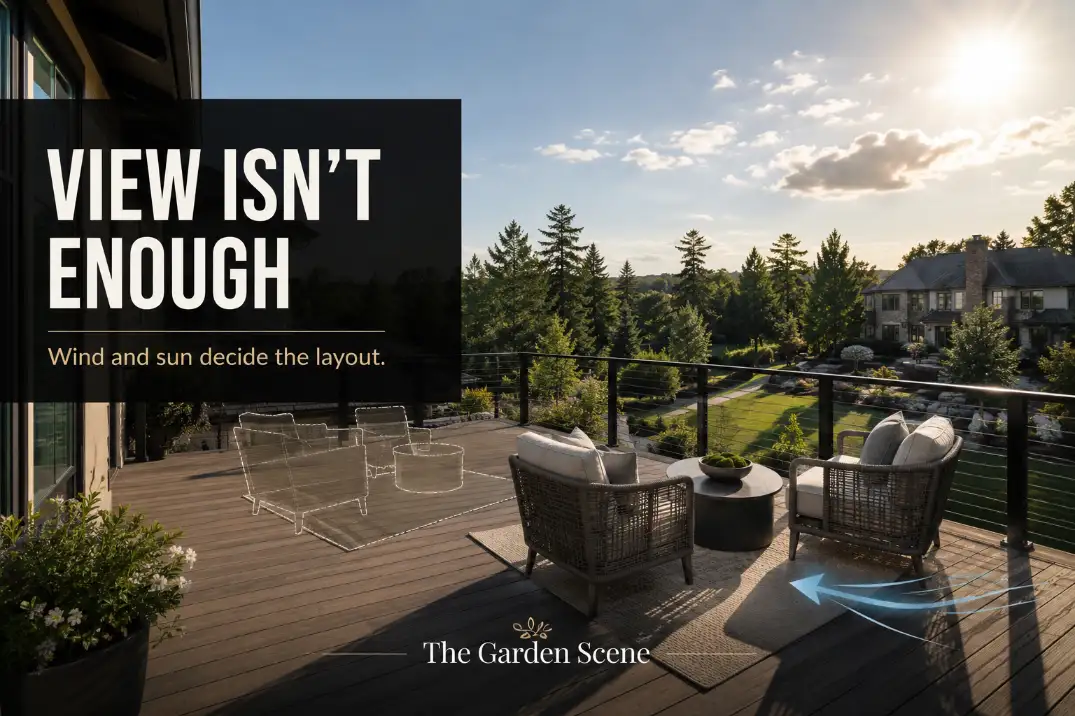
An upper-level deck punishes layouts that might work perfectly well on a ground patio. The main problem is not furniture size.
It is exposure: wind crosses the deck with fewer things slowing it down, afternoon sun hits from lower angles, and the best view zone can become the least comfortable place to sit.
Before choosing furniture, check three things: where the breeze becomes annoying around 12 to 15 mph, where the sun hits between about 2 p.m. and 6 p.m., and whether a 36-inch clear route still works after chairs are pulled out.
This is not just a shade problem or a view problem. A deck can have a beautiful sightline and still fail if the seating sits in the gust path. It can have an umbrella and still fail if the shadow misses chair backs by late afternoon.
The strongest layout protects one comfortable stay zone, keeps a view corridor open, and treats shade as part of the deck’s working structure, not as a loose accessory added at the end.
Why Upper-Level Decks Fail Differently Than Ground Patios
A ground-level patio gets help from fences, shrubs, grade changes, nearby walls, and surrounding planting. An upper-level deck often sits above those buffers. Comfort depends less on decorating the space and more on reading the exposure pattern.
Wind Has Fewer Things Slowing It Down
On an elevated deck, wind can accelerate around house corners, across open yards, or between neighboring homes. A breeze that feels harmless in the yard can feel sharper one level up because there is less landscape mass breaking it apart.
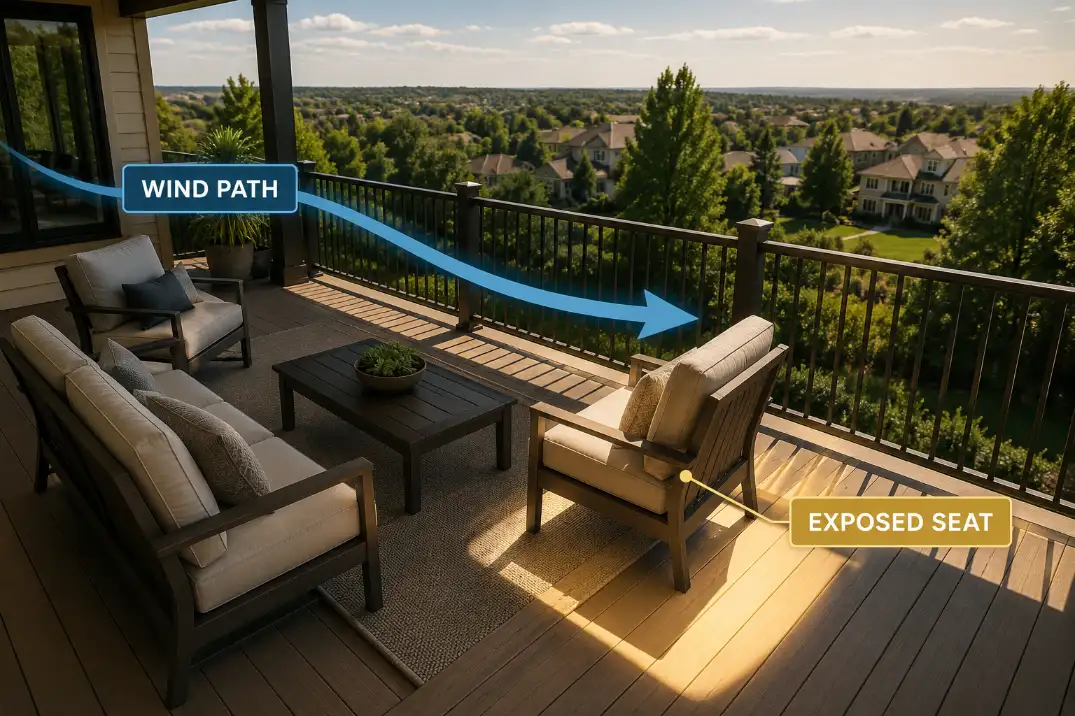
The warning signs are practical. Cushions lift at the same corner. Napkins move during dinner. A lightweight chair turns slightly when nobody is sitting in it. When this happens during normal use, the deck is not merely “a little breezy.” The layout is sitting in the wind path.
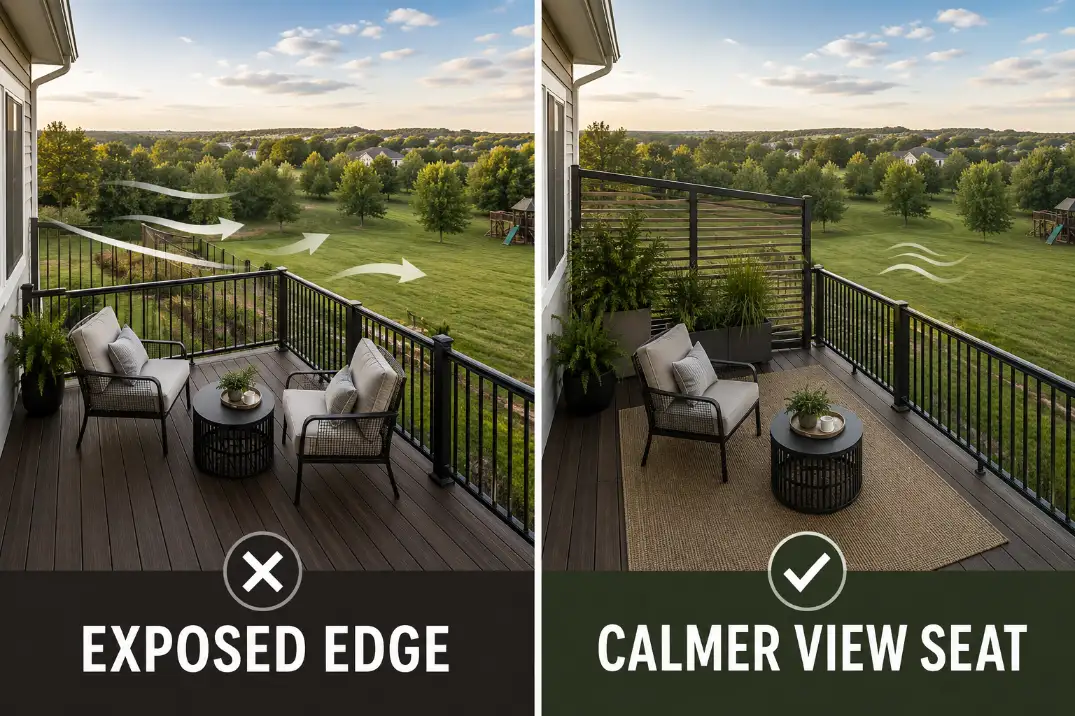
The common mistake is pushing the main seating to the outer railing because that edge has the best view. That can work for a short lookout spot, but it often fails as a 30-minute sitting area.
The better move is to shift the primary seating zone 2 to 4 feet inward or toward the house wall, then preserve the view through a clear opening instead of placing every seat at the edge.
Shade Hardware Catches More Force
On an upper deck, shade is not only shade. It is also a wind-catching surface. A freestanding umbrella, shade sail, or canopy can become the most unstable object in the layout if it is placed in the strongest airflow.
That does not mean umbrellas are wrong. A 7- to 9-foot umbrella can work well over a compact table if the deck is only moderately breezy and the base is properly weighted. But if the umbrella has to stay closed on the same afternoons when the deck is pleasant enough to use, it is solving the wrong problem.
Large shade sails should not be treated like removable decor on an elevated deck; the attachment points matter as much as the fabric.
Shade that is attached to the house, guided by the sun angle, or positioned as a partial side screen often works better than a large freestanding canopy on an exposed upper deck.
The goal is not the biggest shaded area. The goal is usable shade in the actual sitting zone.
The View Line Starts Inside the House
Many upper-level decks are judged from the railing, but they are experienced from inside the house first. The sightline from the kitchen, living room, or sliding door matters. Stand at the main door first; if the rail line already looks crowded from there, the deck will feel crowded before anyone steps outside.
The best view is often not the whole railing. It may be a 4- to 6-foot corridor from the door through the deck toward the yard. Protect that line first. Then place the heavier furniture outside it.
Put the Comfort Zone Before the View Zone
The view matters, but it should not control every furniture decision. A strong upper-level deck separates the comfort zone from the view corridor. The comfort zone is where people sit, eat, talk, and stay. The view corridor is what stays open so the deck and house still feel connected to the yard.
Keep the Best View Open, Not Crowded
The easiest way to ruin an upper deck view is to line the railing with everything that fits: tall chairs, storage benches, grill carts, large planters, and extra side tables. The deck may still function on paper, but the eye stops at the furniture instead of moving through the rail.
This is the same mistake that makes railing-side layouts feel smaller in articles about how deck furniture around railings affects the view. The issue is not simply how many pieces are on the deck. It is where height and bulk interrupt the sightline.
Keep the strongest view corridor low and open. Use low lounge chairs, narrow drink tables, or open-frame pieces near the rail. Put taller storage, larger dining pieces, or planters closer to the house wall or outside the main line from the door.
Use the Edge as a Lookout, Not Always the Main Seat
The railing edge can still have a role. It can hold a narrow drink ledge, two light chairs, or a standing lookout point. But that is different from making it the main stay zone.
If people stand at the rail for 30 seconds but move back toward the house to sit, the deck is already telling you the truth. The view zone and the comfort zone are not the same place.
A good layout accepts that. It protects the main seating from wind and glare, then gives the view its own clear opening.
Shade Has to Land Where People Actually Sit
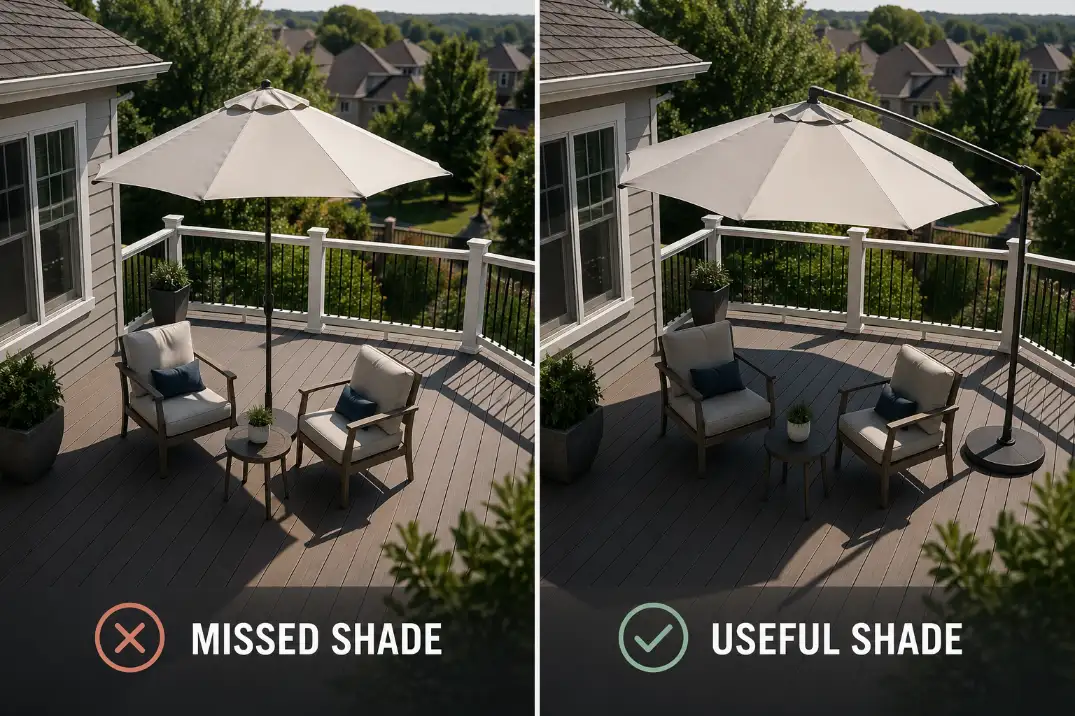
Shade mistakes on upper-level decks usually come from symmetry. The umbrella is centered over the table. The awning is chosen to look balanced on the house wall. The shade sail is stretched where it looks dramatic. None of that matters if the shade misses the chair backs during the hours people use the deck.
The 2–6 p.m. Test Matters More Than Noon
Noon shade can be misleading. On many upper decks, especially west-facing decks in hot climates, the real discomfort arrives later. Between about 2 p.m. and 6 p.m., the sun can hit faces, chair backs, and glass doors from the side. This is why a centered umbrella can look correct at lunch and fail by late afternoon.
A useful test is simple: mark the main seating area at 3 p.m. and again at 5 p.m. during the warm season. If the shade does not cover at least the upper body area of the seats, the product is not aligned with the problem.
For more general shade and airflow thinking, Backyard Layout Shade Seating Airflow is useful because the same comfort principle applies: shade has to support where people stay, not just where the plan looks balanced.
Side Shade Can Beat Overhead Shade
Late-day glare is often a side problem, not an overhead problem. That is why a partial side screen, retractable side shade, or wall-mounted shade can outperform a larger umbrella on some upper decks.
This is especially true in Arizona and other dry, hot regions where low afternoon sun can make a deck feel harsh even when the air is not humid.
In humid parts of Florida or the Southeast, the priority changes slightly: shade is important, but a solid screen that kills airflow can make the deck feel hotter after rain or on still evenings.
Pro Tip: If the deck feels hot but not windy, increase shade. If it feels hot and airless, protect from sun without closing the airflow path completely.
Use the House Wall as the Stable Side
The house wall is usually the most valuable organizing edge on an upper-level deck. It offers partial wind protection, possible shade attachment, and a place for taller furniture that will not block the railing view. Ignoring that edge creates a deck that is open everywhere but comfortable nowhere.
Put Heavier Functions Near the House
Dining tables, grills, storage benches, and larger lounge pieces make more sense near the house than at the outer railing. This does not mean crowding the door. It means using the house side as the stable side while keeping movement clear.
Preserve at least 36 inches from the back door to the stairs or main exit path. If people regularly carry trays, cushions, tools, or food through the space, 42 to 48 inches feels noticeably better.
This is where upper-level deck planning overlaps with deck landing space between doors, stairs, and furniture. A layout that looks fine with chairs tucked in can become awkward once people sit down.
The house-side zone also keeps bulk out of the view band. A storage bench under a wall may be useful. The same bench along the best rail can make the deck feel boxed in.
Keep the Railing Edge Lower and Lighter
A railing already creates a boundary. If the layout adds tall furniture directly along that boundary, the deck loses depth. Low pieces near the rail work better: open lounge chairs, small drink tables, low planters, or narrow benches that do not interrupt the eye-level view.
Chair movement matters here. A dining chair can pull back 18 to 24 inches when used. If that pullback overlaps the main route, the deck will feel tight even if the furniture technically fits.
Wind Fixes That Actually Help
The best wind fix is not always a wind product. The first fix is usually moving the seating out of the strongest path. After that, screens and panels can help, but only when they are used selectively.
| Wind condition | Better layout move | Weak fix | Why it matters |
|---|---|---|---|
| Breeze wraps around house corner | Shift seating inward and add a partial side screen | Push chairs tighter to the rail | The edge is usually the gust zone |
| Cushions lift weekly | Use heavier furniture in a calmer zone | Add decorative pillows or light planters | Weight alone does not fix exposure |
| Railing-edge gusts | Use a low, view-friendly wind panel | Add a tall solid wall everywhere | Full blockage can create pressure and kill the view |
| Umbrella moves often | Use anchored or wall-supported shade | Buy a larger freestanding umbrella | More canopy can catch more wind |
| Wind and glare come from same side | Combine side shade with low seating | Add overhead shade only | The discomfort is directional |
A privacy screen is not automatically a windbreak. Open slats may reduce the feeling of exposure while allowing air through. A solid panel may reduce direct wind but increase pressure if it is too large or poorly placed. On an upper deck, that distinction matters more than it does at ground level.
Pro Tip: Use wind control as a partial correction, not a full enclosure. A small protected seating pocket usually works better than trying to wall off the entire deck.
What Changes Under Different US Conditions
Upper-level deck layout should change with climate and exposure. The same furniture plan will not behave the same way in coastal California, the Midwest, Arizona, and Florida.
Hot Desert Decks
In desert climates, the late-day sun is often the bigger enemy than wind. The deck may need side shade more than overhead shade, especially on west-facing elevations. Light furniture frames can help visually, but the real comfort gain comes from blocking low-angle sun without trapping heat against the house.
Coastal or Open-Lot Decks
On coastal lots or open suburban lots, wind deserves more respect. A large umbrella or shade sail may look like the obvious fix, but it can become the least usable part of the deck if it has to be closed often.
Lower furniture, partial wind panels, and anchored shade usually make more sense than loose, oversized shade pieces.
Humid Southern Decks
In humid regions, shade is necessary, but airflow is still part of comfort. A solid screen that blocks sun and wind may feel good for 10 minutes and sticky after 30. Partial shade, open rail areas, and breathable side protection usually work better than fully enclosing the deck.
Northern and Midwest Decks
In colder regions, seasonal wind and storage matter. Furniture that works in July may become an obstacle during fall storms or winter storage. If the deck needs to handle snow, covers, or off-season furniture stacking, leave one zone flexible instead of filling every rail edge.
Quick Layout Checklist
Use this before buying furniture, shade hardware, or screens:
- Does the main seating still feel usable when wind is around 12 to 15 mph?
- Is there a 36-inch clear route from the door to the stairs or exit?
- Would 42 to 48 inches be better because people carry food, cushions, or tools through the space?
- Does shade cover chair backs during the 2–6 p.m. use window?
- Can the best view be seen from inside the house without tall furniture blocking the rail?
- Are loose cushions, umbrellas, and planters outside the strongest wind path?
- Is the railing edge kept low enough to preserve the view corridor?
Where the Routine Fix Wastes Time
The routine fix is buying heavier furniture after the layout has already put the furniture in the wrong place. Heavier chairs may stop sliding, but they do not solve glare, blocked views, or a poor traffic route.
They can also make the layout harder to adjust once you realize the seating belongs closer to the house.
Another weak fix is adding more planters for wind control. A few low, heavy planters can define an edge. But tall planters on an upper deck can become view blockers, maintenance problems, or wind-catching objects. They rarely solve a true elevated wind path on their own.
Large shade sails can disappoint when they are chosen for coverage before the wind pattern is understood.
A sail may provide excellent shade in the right installation, but on an exposed upper deck it needs the right anchors, angle, tension, and seasonal use plan. Otherwise, the shade solution becomes a new stress point.
A Strong Upper-Level Deck Layout Usually Looks Less Full
The best upper-level deck layout often looks more restrained than expected. It does not try to make every seat the best view seat. It does not solve every sunny moment with one oversized umbrella. It does not line the railing with storage just because the furniture fits.
A stronger layout has four clear decisions: one protected seating zone, one open view corridor, one shade strategy aimed at the real sun window, and one movement route that stays open after chairs are pulled out.
If wind, shade, and views compete, do not give them equal power. Start with movement and safety, then solve comfort, then frame the view.
A beautiful view will still exist if the seating moves a few feet inward. But a bad wind path, unusable shade pattern, or blocked route will make the deck feel wrong every time it is used.
For broader official wind-speed context, see the National Weather Service Beaufort Wind Scale.