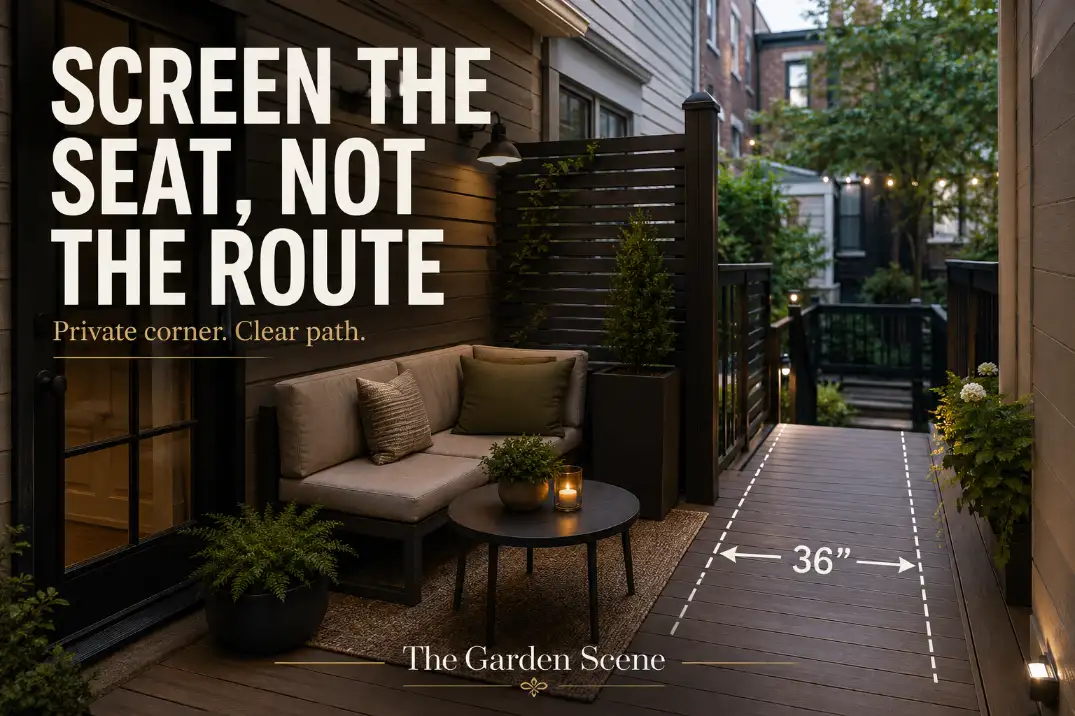
A good townhouse deck layout starts by protecting the path, not by filling the edges. The usual failure pattern is simple: a privacy screen, two chairs, a small table, and a few planters each look reasonable alone, but together they shrink the route between the back door, railing, and stair opening.
Keep at least 36 inches of clear walking space where people move often; 42–48 inches feels noticeably better near stairs or when guests pass through with food.
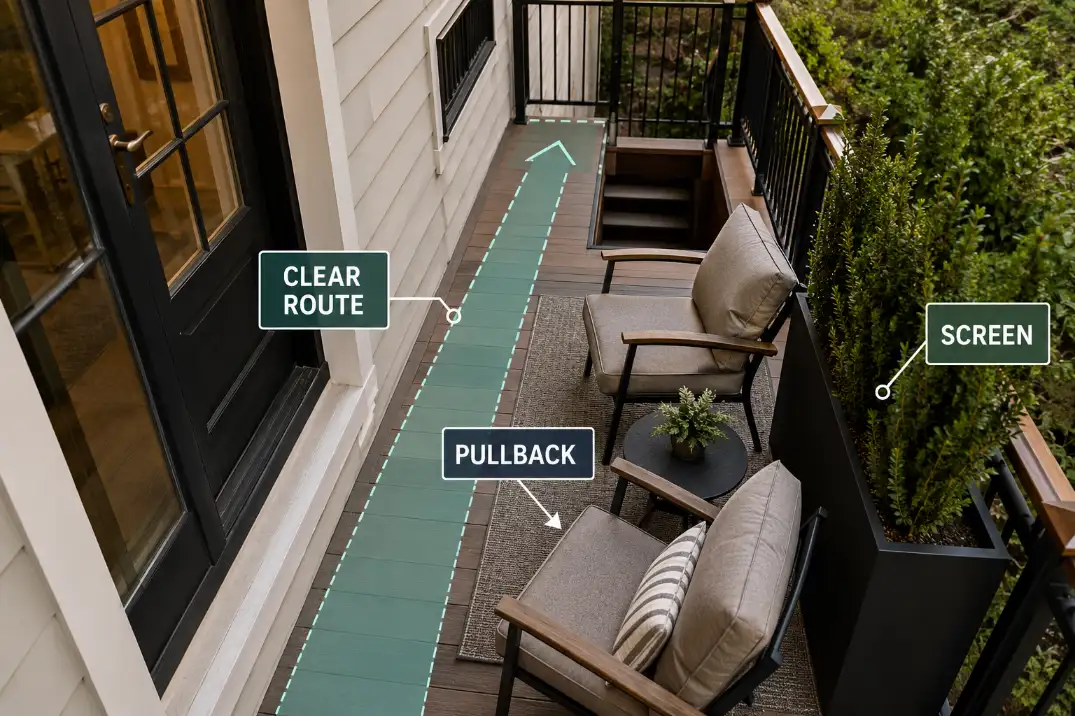
The first checks are the door swing, the stair turn, and the real chair pullback after someone sits down.
This is different from a ground-level patio problem because a townhouse deck has fixed edges, close neighbor sightlines, and fewer escape routes. You cannot borrow space from the lawn or hide a blocked path behind “just a small chair.”
The Layout Rule: Privacy Comes Second to Access
Start with the door-to-stair route
On most townhouse decks, the most important line is not the view. It is the route from the back door to the stair opening or gate. If that line narrows below 30 inches once furniture is in use, the deck will feel cramped even if every piece technically fits.
A deck can look open in photos and still fail in daily use. Chairs tucked under a small table may leave a clean floor rectangle, but the used footprint is larger. A dining chair often needs 30–36 inches behind it for pullback.
A lounge chair can need more because people turn sideways, set down a drink, or step around the front edge.
For a deeper route-first approach, the same access logic appears in Small Deck Layout With a Clear Route, but townhouse decks make the margin tighter because privacy usually competes for the same railing edge.
Do not make the stair opening the leftover space
The stair opening should never become the zone where furniture “almost” clears. A 36-inch route may be acceptable through the middle of the deck, but near stairs, 42 inches is a better target because people turn, carry trays, or guide children and pets.
The mistake is treating the stair area as dead space. It is not dead. It is the deck’s pressure point.
Where Privacy Should Actually Go
Screen the sightline, not the whole deck
Most townhouse deck privacy problems are not solved by closing off the entire railing. That often makes the deck darker, tighter, and more boxed-in while still missing the actual view angle from a neighbor’s window, balcony, or adjacent deck.
The better move is to identify the seated eye line. Sit where you actually want to relax and look toward the exposure point. If the privacy problem comes from one diagonal view, a 4–6 foot wide screen panel or a pair of dense planters may do more than a full railing-length barrier.
People commonly overestimate height and underestimate position. A 6-foot screen in the wrong place can feel heavy and still leave the chair exposed.
A lower, better-placed screen beside the seat can protect the view that matters without turning the deck into a corridor.
For softer screening ideas that do not rely on closing off the whole outdoor room, Patio Privacy Ideas for Secluded Seating is the closer companion topic.
Keep privacy elements out of the walking lane
Privacy planters are useful only if they do not become obstacles. On a narrow townhouse deck, a planter that is 18–24 inches deep can be enough to hold screening plants, but that same depth can ruin the route if it sits across the path from a chair or table.
Place screening along the side of the seating pocket, not across the movement line. If the screen makes people step around it every time they leave the house, it is not a privacy fix. It is a traffic problem with leaves on it.
Pro Tip: Place privacy where people sit still, not where people move. A screen beside a chair usually works harder than a screen beside the door.
Choose Seating by Used Footprint, Not Catalog Size
Benches are often stronger than extra chairs
For townhouse decks, the most reliable seating is usually a low bench, narrow loveseat, or two compact chairs with a small side table. A bench against a railing or house wall can stay within an 18–24 inch depth, while loose chairs expand every time someone sits down.
That does not mean chairs are wrong. It means chairs need room to behave like chairs. If a pair of chairs requires people to pull back into the stair route, the problem is not the chair style. The mechanism is pullback space colliding with access.
This is where Compact Deck Furniture for Tight Stairs and Railings becomes especially relevant: the best-looking small furniture is not always the furniture with the smallest used footprint.
Avoid the sectional unless the deck has a true pocket
A sectional can work on a townhouse deck only when it has a dedicated corner that does not steal from the route. If the chaise section points toward the stair opening, or if the corner piece forces people to walk around a coffee table, it usually makes the deck feel smaller within the first week.
A better arrangement is often one wall-hugging seat, one movable chair, and a small round or C-shaped side table. That gives you a real sitting zone without asking the route to double as a lounge zone.
Three Townhouse Deck Layouts That Usually Work
Side-screen seating pocket
This layout works when the main privacy problem comes from one neighboring deck, window, or diagonal backyard view.
Place a low bench or loveseat along the quieter edge, then use a partial screen beside the seated shoulder. The route stays open because the screen protects the seat, not the whole deck.
Stair-corner access layout
If the stairs sit close to the back door, keep that corner almost empty. Push seating to the opposite long edge and use only shallow pieces near the route.
If the deck feels slightly under-furnished at first, that is often a good sign. Townhouse decks usually fail from overlap, not from lack of furniture.
Neighbor-facing privacy angle
When the exposed view comes from an upper window or adjacent balcony, a straight railing screen may miss the problem. Angle the privacy element toward the actual sightline instead.
This can be as simple as one tall planter placed beside the chair rather than a full line of panels across the rail.
What People Usually Misread First
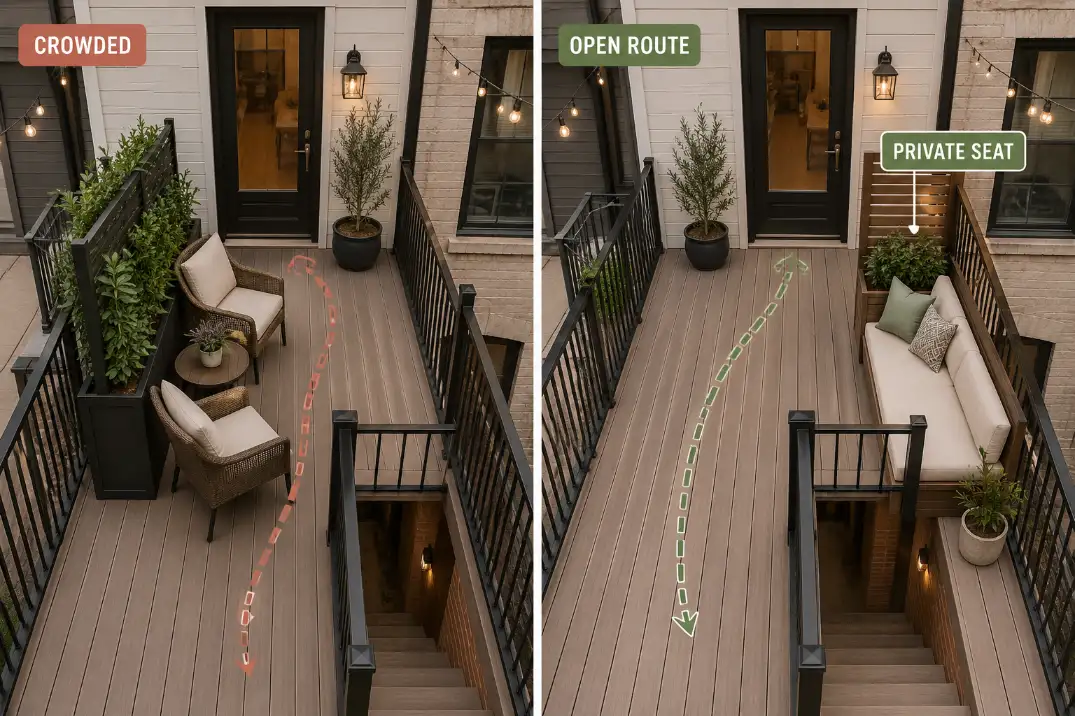
The symptom is “too small,” but the mechanism is overlap
When a townhouse deck feels tight, the first assumption is usually that the deck is too small. Sometimes that is true, but the more useful diagnosis is overlap. Privacy, seating, storage, and access are all trying to use the same strip of deck.
That distinction matters because adding smaller objects does not always fix the problem. Four small items can create more friction than two larger, better-placed pieces.
A deck with one clear route and one defined seating pocket will usually feel better than a deck filled with “space-saving” furniture on every edge.
If the back door and stair opening are already close together, the planning logic in Deck Landing Space Between Door, Stairs, and Furniture is more important than any decorative decision.
The obvious fix that often wastes time
The common wasted fix is buying more privacy before removing the access conflict. More screen panels, taller planters, or extra outdoor curtains may make the deck feel more secluded, but they also add edges, shadows, and maintenance.
A routine privacy fix stops making sense when the walking route is already under 30 inches at any normal-use point. At that stage, the first move is not more screening. It is removing, rotating, or downsizing the object that is stealing the path.
Townhouse Deck Choices That Actually Change the Layout
| Townhouse deck move | Best use | Watch for | Better threshold |
|---|---|---|---|
| Railing bench | Adds seating without chair pullback | Blocking the best view | 18–24 in. deep |
| Two compact chairs | Creates flexible seating | Pullback into path | 30–36 in. behind chairs |
| Side privacy screen | Blocks one neighbor sightline | Turning route into corridor | 4–6 ft wide panel zone |
| Tall planter pair | Softens exposure without full wall | Too much planter depth | 18–24 in. deep |
| Storage bench | Combines seating and cushion storage | Oversized lid swing | Route stays 36 in. clear |
| Sectional corner | Works only with a true pocket | Chaise steals circulation | 42+ in. nearby route |
A Practical Order That Keeps the Deck Usable
1. Tape the route before placing furniture
Use painter’s tape, cardboard, or folded towels to mark the route from the door to the stairs. Keep the marked lane at least 36 inches wide. Then place mock furniture footprints around it instead of over it.
Do not judge the layout while everything is tucked in. Pull chairs out. Open the door fully. Carry a tray through the route. Stand where someone would pause before going down the stairs. A 20-minute mock-use test often reveals more than an hour of measuring.
2. Place the privacy edge from the seated position
After the route is protected, sit in the planned seating spot and identify the one view that feels most exposed. That is where the privacy treatment belongs. On many townhouse decks, the best privacy line is diagonal, not parallel to the railing.
If the deck also has an important backyard view, use the approach in Deck Furniture Around Railings Without Blocking the View so privacy does not erase the best sightline you have.
3. Treat fixed screens differently from freestanding screens
A freestanding planter screen is a layout decision. A fixed screen attached to railing, posts, or framing can become a structural, wind-load, HOA, or permit question. Those are different decisions.
This matters most on exposed upper decks, windy lots, and townhome communities with strict exterior rules. A lightweight movable screen may solve a seated privacy problem.
A permanent panel may create a maintenance or compliance problem that is larger than the original view issue.
4. Test the layout for a full week
Before anchoring planters, installing privacy panels, or buying a heavier bench, live with the arrangement for 7 days. Use it at least once in the evening, once during a sunny period, and once while carrying something through the door.
Townhouse decks change by time of day. A privacy issue that feels minor at noon may become obvious between 6 and 9 p.m. when neighbors are outside and interior lights make your deck more visible.
Pro Tip: If a piece has to be moved every time you use the stairs, it is not flexible. It is misplaced.
When the Standard Layout Stops Working
The deck cannot support every outdoor function
A townhouse deck does not need to hold dining, lounging, grilling, storage, privacy, and plants at the same level. Trying to force every function onto one narrow platform is the fastest way to lose comfort.
Choose the primary use first. If the deck is mainly for morning coffee and evening privacy, build around two comfortable seats and a protected sightline. If it is mainly a route to the yard, keep furniture shallow and avoid fixed screens near the stair turn.
Privacy should not create a safety or maintenance problem
Planters and screens add weight, wind exposure, and watering needs. In humid climates, dense planters pushed tightly against walls or railings can hold moisture and slow drying. In freezing northern states, heavy planters that stay wet can become difficult to move before winter.
The practical threshold is simple: if privacy requires heavy objects across the route, a full wall of plants, or constant rearranging, the layout is asking too much from the deck.
Use a lighter screen, move privacy to one side, or shift the main seating position.
Questions People Usually Ask
Is a 36-inch path always enough on a townhouse deck?
It is a good minimum for a main walking route, but it is not always comfortable. Near stair openings, grills, or door swings, 42–48 inches feels safer and less awkward. If the deck is very narrow, keep the strict 36-inch route and reduce furniture depth rather than letting the path shrink.
Should privacy screens go on the railing or beside the seating?
Usually beside the seating. Railing screens can work, but they often block views while missing angled neighbor sightlines. A side-positioned screen near the chair or bench usually gives more privacy with less visual bulk.
What is the biggest layout mistake on a townhouse deck?
The biggest mistake is treating tucked-in furniture as the real layout. The real layout is what happens when chairs are pulled out, the door opens, someone walks to the stairs, and the privacy planter is sitting in its full footprint. Judge the deck in use, not staged.
For broader official deck-construction guidance, see the American Wood Council Prescriptive Residential Wood Deck Construction Guide.