Last updated: June 9, 2026
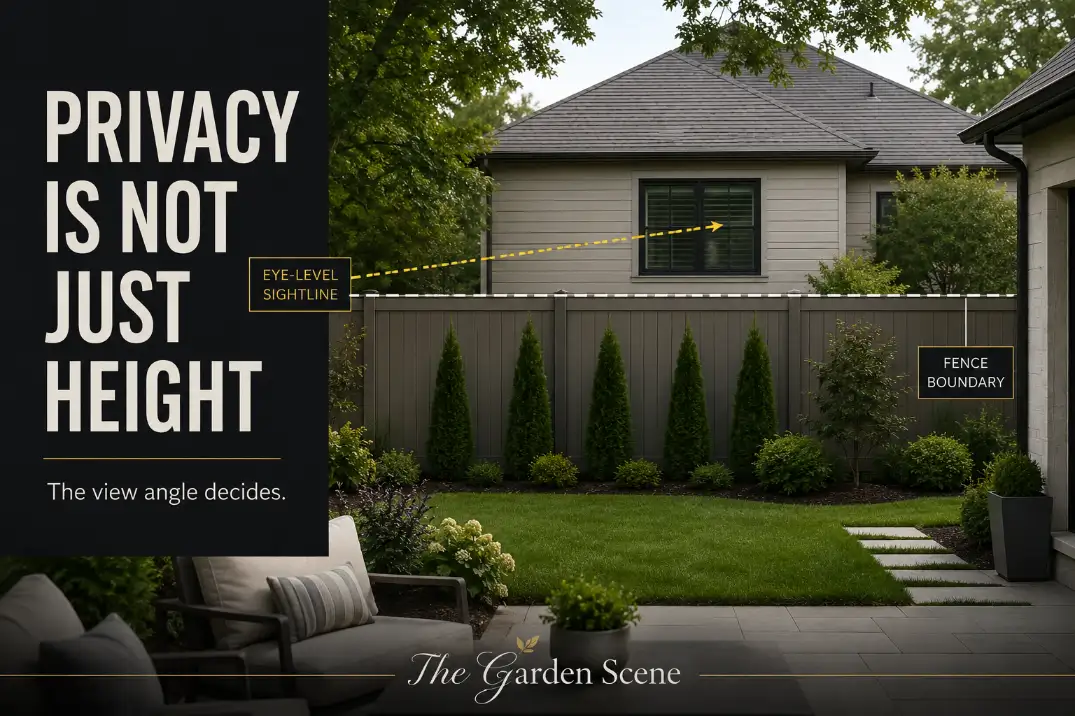
Privacy fence options for suburban homes should start with the view you are trying to block, not with the fence style you like first. A 6-foot solid fence may solve a side-yard neighbor view but do little against a second-story window, while a 3- to 4-foot front-yard fence may be the legal limit and still leave a porch exposed.
The first checks are practical: view height, viewing distance, and rule limit.
The most useful privacy threshold is eye level. If the unwanted view remains open between about 42 and 60 inches above the ground, the yard will still feel exposed during normal sitting, standing, grilling, or walking.
That is where many fence projects disappoint: the visible symptom is “my yard still feels open,” but the underlying mechanism is usually an unblocked sightline, a rule-limited height, or a gap pattern.
Start With the Privacy Problem
Fence style is the second decision
The first decision is not wood versus vinyl. It is the privacy job. A backyard dining area, a pool edge, a front porch, and a narrow side yard do not need the same fence.
One may need full visual blockage. Another may need a softer boundary. Another may need no fence at all, just a better screen placed closer to the view.
Walk the yard from the places where privacy actually matters. Sit in the patio chair. Stand at the grill. Open the back door. Walk the side gate. Look toward the exact spot that feels exposed.
If the view comes from a neighboring patio 20 feet away, a standard fence may solve it. If the view comes from an upstairs window, fence height alone is usually the wrong main tool.
A broader screening plan can be stronger than a fence-first plan, especially when views arrive from more than one angle. The ideas in Landscaping for Privacy are useful when the fence is only one part of the privacy system rather than the whole solution.
Enclosure is not the same as privacy
A fence can define a yard without truly hiding it. Picket fences, low rail fences, spaced slats, and decorative panels all create edges. They can make a property feel more intentional, but they may not stop visibility.
This distinction matters most in suburban neighborhoods because the distance between homes is often short. A semi-open fence that looks private in a product photo may become transparent when the neighbor is only 15 to 25 feet away.
If you can still identify faces, furniture, or movement through the fence, it is not functioning as a full privacy screen.
Quick Decision Checklist
Use this before choosing a material:
- The main view is close and ground-level: a solid fence can work.
- The view comes from upstairs, a raised deck, or an uphill lot: fence height alone likely fails.
- The front yard faces a sidewalk: expect lower height limits and softer screening.
- Gaps line up from 20 to 30 feet away: a semi-private fence is not private enough.
- Driveway or corner visibility is affected: keep the sight zone open.
- HOA rules control material, color, or height: design around approval first.
Full Privacy Fences
Best for close, direct ground-level views
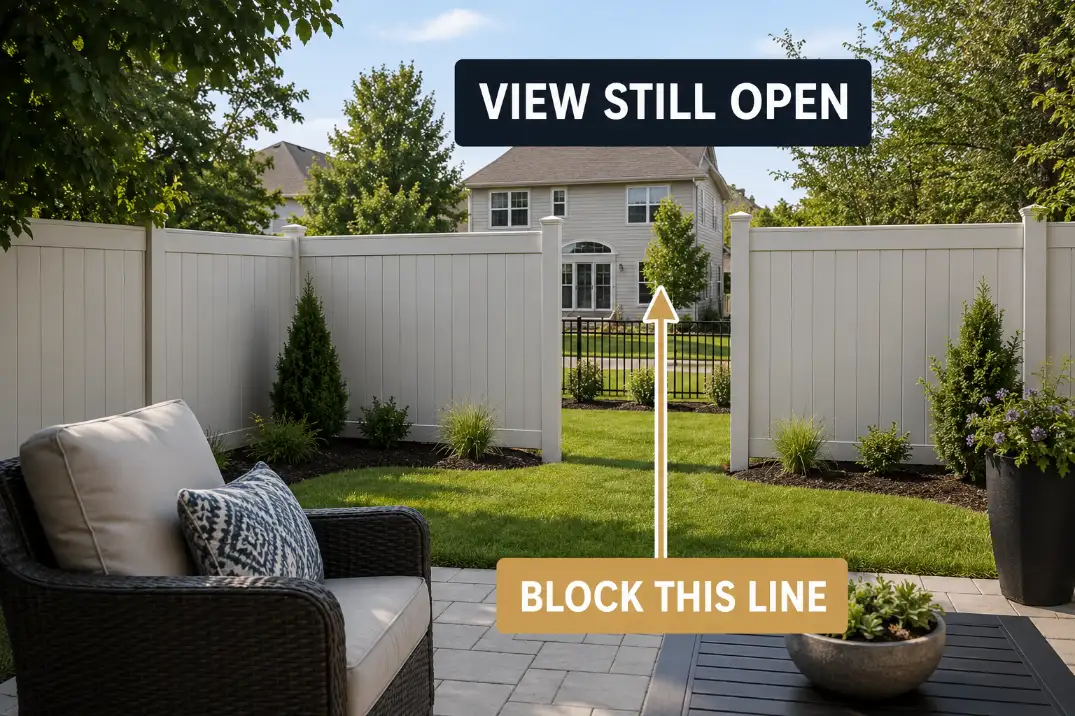
A full privacy fence is the strongest choice when the unwanted view is close, straight, and mostly at ground level. Most suburban backyard privacy fences are around 6 feet tall, with posts commonly spaced about 6 to 8 feet apart depending on material, wind exposure, soil, and local requirements.
For a neighbor’s patio, side door, trash area, or ground-level window, that can be enough.
The key phrase is ground-level. A 6-foot fence can block a standing adult in the next yard, but it will not reliably block views from raised decks, sloped lots, or second-story rooms.
That does not mean the fence failed. It means the privacy problem was taller or more angled than the fence could reasonably solve.
When solid fences become too much
Solid fences create immediate screening, but they also create the strongest visual wall. In a small backyard, especially one under about 30 feet deep, a full solid fence can dominate every view from the house. The space becomes private, but it may also feel boxed in.
Wind is another underestimated factor. A solid panel catches more force than a semi-open design. On exposed rear lots, corner properties, or open suburban edges, post depth and bracing matter more than the panel style.
A good-looking fence with weak posts is not a durable privacy solution; it is a repair waiting for the first severe weather season.
Semi-Private Fences
Better for soft screening than full blockage
Semi-private fences work well when the goal is to soften views, not erase them. Shadowbox fences, alternating boards, and spaced slat panels allow more light and airflow than solid panels.
They can feel less harsh along a long boundary or in a yard where total enclosure would look heavy.
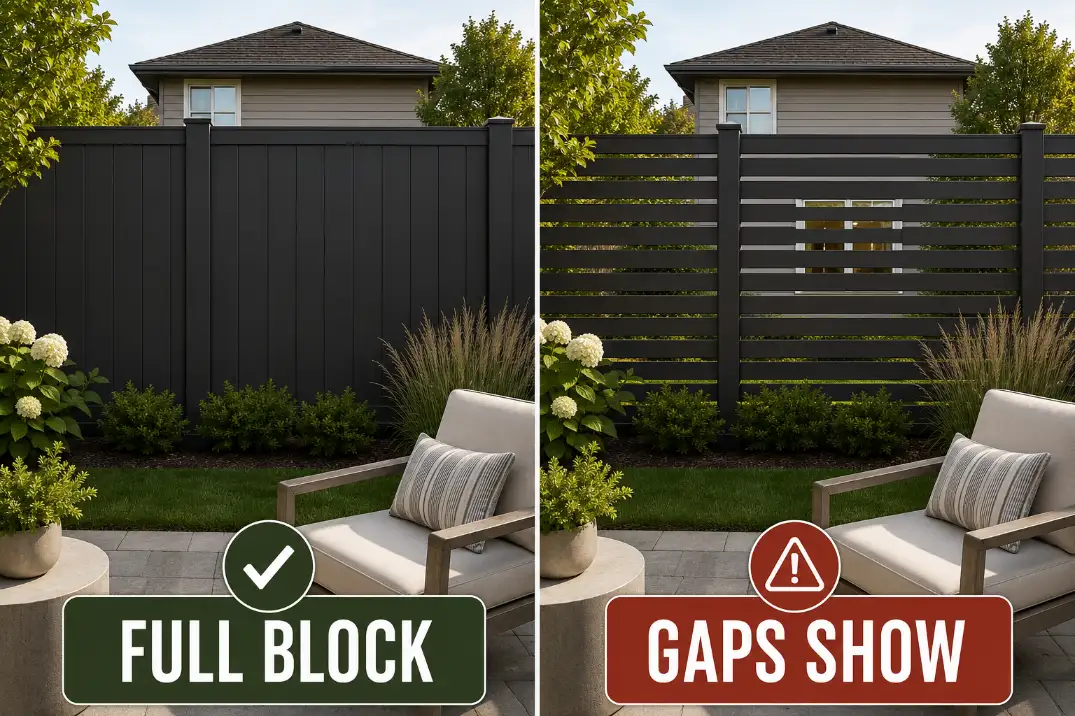
The weakness is gap behavior. A 1/2-inch reveal may read mostly private from an angle, while a 1- to 2-inch gap can become surprisingly open from straight on.
If the viewer can stand 20 to 30 feet away and see a continuous line through the panel, the fence is functioning as a filter, not a privacy wall.
Small yards are where this becomes most obvious. In tight lots, gaps align quickly because the viewing distance is short. Why Small Backyard Privacy Fences Fall Short explains why height and material are often less important than where the sightline remains open.
Board-on-board and shadowbox are not the same
Board-on-board fencing is more privacy-first. Boards overlap, so there is less direct view through the fence face. It usually feels heavier, but it is better when the goal is true visual blockage.
Shadowbox fencing is more neighbor-friendly because both sides look more finished. It also allows more airflow. The tradeoff is that angled views can still slip through the alternating boards.
If you are trying to block a close patio view, board-on-board usually performs better. If you are softening a long boundary, shadowbox may be enough.
The fix that often wastes time
Adding a decorative lattice topper to a semi-private fence often looks like an easy upgrade, but it rarely solves the main privacy problem.
If the open view is through the middle of the fence, from a diagonal angle, or from an upstairs window, a 12- to 18-inch lattice strip only decorates the wrong zone.
Lattice is useful for lightness, vines, and transition. It should not be treated as the primary privacy fix unless the view is actually entering through that upper band.
Wood Privacy Fences
Flexible, natural, and maintenance-heavy
Wood is one of the most adaptable privacy fence materials. It can be built vertical, horizontal, board-on-board, shadowbox, rustic, refined, tall, stepped, or custom-fit around grade changes.
It often suits older suburban homes better than bright vinyl because it can weather into the landscape more naturally.
The tradeoff is upkeep. In humid areas such as Florida or the Southeast, wood may need cleaning and sealing or staining every 2 to 4 years, depending on exposure, species, and finish.
In dry desert climates such as Arizona, sun exposure, splitting, and fading may become the bigger concerns. In northern states, freeze-thaw cycles and wet soil can shift posts during the first 6 to 12 months if drainage is poor.
Pro Tip: Judge a wood privacy fence by the post system first and the board style second. Weak posts make even expensive boards feel temporary.
Vinyl Privacy Fences
Low-maintenance, but visually strong
Vinyl privacy fences are popular because they look clean, uniform, and require less routine maintenance than wood. In many suburban backyards, rinsing or washing once or twice a year is enough for normal dirt, pollen, and surface buildup.
The limitation is not usually maintenance. It is visual fit. Bright white vinyl can look stark in shaded yards, small lots, older neighborhoods, or landscapes with mostly natural materials.
It may solve the view but make the boundary feel louder than the privacy problem itself.
Vinyl also has less flexibility on irregular lots. If the grade changes sharply, the property line jogs, or mature roots interfere with post placement, panel-based systems can be less forgiving than a custom wood build.
Horizontal Slat Fences
Modern style depends on gap control
Horizontal slat fences can look clean, architectural, and more current than standard vertical panels. They can visually widen a narrow yard and work especially well near patios, outdoor kitchens, and modern suburban homes.
But the gap decides the privacy level. Tight horizontal boards can screen well. Wider spacing may look premium in photos but behave like a viewing filter in real life.
If a neighbor can stand in one spot and see continuous bands of movement through the slats, the design is semi-private no matter how expensive it looks.
Horizontal fences also expose slope. A grade change that feels minor with vertical boards can look obvious when long horizontal lines step up or down across the yard.
Lattice Privacy Panels
Useful as a secondary screen
Lattice panels work best as transition pieces, accent screens, vine supports, or small privacy inserts near patios, gates, air conditioner areas, and awkward corners. They can soften a hard fence line without making the yard feel closed.
They are weaker when the privacy issue is direct and close. Even dense lattice usually allows partial visibility, especially when light shines through from behind. If you need to block a neighbor’s eye-level view from 15 feet away, lattice should be treated as a supporting layer, not the main screen.
A vine-covered lattice panel can become more private over one to three growing seasons, but that delay matters. If privacy is needed immediately, young plants on lattice will not perform like a finished fence.
Other Fence Options Worth Considering
Composite privacy fences
Composite fencing can be a strong choice when you want a cleaner look than wood with less routine maintenance. It usually costs more upfront, but it avoids some of the staining, sealing, and warping issues that come with wood.
The main decision is style fit. Composite can look polished and modern, but it may feel too uniform in a softer cottage-style or older suburban landscape. It works best when the house already has clean lines, modern trim, or a more structured backyard design.
Metal, corrugated, and louvered panels
Metal and corrugated privacy panels can create a bold, contemporary screen. They are useful for accent panels, patio screens, and mixed-material fences. The risk is that they can feel industrial, reflect heat or glare, and look too severe if used across an entire suburban boundary.
Louvered panels are more refined when you need airflow and angled privacy. They can block a view from one direction while keeping the fence from feeling completely solid. They are not always fully private from every angle, so they need to be tested against the actual sightline.
Chain-link with privacy slats
Chain-link with privacy slats or fabric screening is usually a budget or temporary solution, not a premium suburban privacy choice. It can reduce visibility quickly, but it rarely gives the same finished look as wood, vinyl, composite, or layered planting.
This option makes the most sense for utility zones, temporary screening, or parts of a property that are not central to the main outdoor living space.
Low Fence Options
Strong for definition, weak for concealment
Low fences are useful in front yards, along sidewalks, near garden beds, and around semi-public edges where a full privacy fence would feel too defensive. A 3- to 4-foot fence can organize the yard, guide foot traffic, and make a porch feel more settled.
But low fences should not be oversold. They create psychological separation more than visual privacy. They may make a front yard feel less exposed, but they usually will not hide people sitting on a porch or standing near a window.
For a front-yard privacy plan that still feels neighborly from the street, Front Yard Privacy That Still Looks Welcoming is often a better model than trying to force a backyard-style fence into the curb-facing part of the property.
Where low fences actually work
A low fence makes sense when the goal is edge control, not concealment. It can protect a planting bed, mark the public-private transition, or make a front garden feel intentional. It can also support layered planting by giving the landscape a visual base.
The threshold is expectation. If you expect a low fence to block standing views, it will fail. If you expect it to organize the yard and help planting feel designed, it can work very well.
Fence and Planting Combos
Often the best suburban answer
The strongest suburban privacy solution is often not a taller fence. It is a fence plus planting placed where the view actually travels. A 6-foot fence may handle the lower view, while a small tree, evergreen shrub, or layered bed interrupts the diagonal or upper view the fence cannot reach.
This works because plants do not have to sit on the property line to create privacy. A shrub placed 6 to 10 feet inside the yard can block a diagonal view more effectively than a long hedge on the boundary. That is a common point homeowners underestimate.
If you need to build privacy in layers instead of relying on one fence plane, How to Create a Privacy Buffer in a Suburban Yard Step by Step gives a clearer framework for turning fence, shrubs, and small trees into one system.
When plants outperform fences
Plants outperform fences when the privacy problem is high, angled, seasonal, or spread across several small gaps. A fence creates one vertical plane. Planting can create depth at several heights.
The tradeoff is time. A fence works immediately. Planting may take 2 to 5 years to reach useful screening size, depending on plant species, starting size, water, soil, and climate.
The strongest plan often uses the fence for immediate lower privacy and plants for the view the fence cannot legally or visually block.
Front Yard Fence Limits
Rules usually matter before style
Front yards are where privacy fence ideas collide with neighborhood rules. Many suburban areas limit front fences to around 3 or 4 feet, especially near sidewalks, intersections, driveways, and corner sight triangles. HOAs may be stricter than city code.
That means a front-yard privacy fence is often not a true privacy fence. It is a boundary, a planting support, or a partial screen. Trying to make it behave like a backyard fence often creates conflict with curb appeal, visibility, or approval rules.
If the main privacy issue is a porch, sidewalk, or street-facing window, Front Yard Landscaping for Privacy may be a more realistic starting point than focusing only on fence height.
Driveway visibility is not optional
A fence near a driveway can become a safety problem if it blocks the view of pedestrians, cyclists, or cars. Even when a fence is technically allowed, keeping the driveway sight zone open matters. A privacy solution that makes backing out more dangerous is not a good solution.
This is where the standard fix stops making sense. If the fence has to stay low, transparent, or pushed back to preserve visibility, then porch-level screening and planting placement become more important than fence style.
Side Yard Fence Options
Narrow spaces need precision
Side yards are often where fences perform best because the view is close and directional. A solid 6-foot side fence can block a neighbor’s window, trash area, utility zone, or side entry without changing the whole yard.
But narrow spaces punish sloppy placement. A fence that reduces a 5-foot access route to a tight 3-foot passage can make bins, hoses, gates, and maintenance harder. If the side yard is used for movement, the fence has to protect privacy without damaging function.
Side-yard privacy also depends on gates. A beautiful fence with a transparent or poorly aligned gate can leave the exact view open. The gate should match the privacy goal, not just the fence material.
Backyard Fence Options
Match the fence to the living zone
Backyard privacy is usually about patios, pools, decks, dining areas, and family space. The best fence is the one that protects those zones without making the entire yard feel smaller.
For a patio near the house, a partial screen or fence-and-planting combination may work better than enclosing every boundary. For a pool, safety codes, latch requirements, and local barrier rules may matter as much as privacy.
For a deck, the viewing height is raised, so the fence usually needs help from planting, a pergola-style screen, or targeted panels.
When HOA limits affect backyard fence height, Backyard Privacy and HOA Fence Height Limits can help clarify why the strongest solution may be a layered screen rather than a taller fence request.
Small backyards need targeted privacy
In small backyards, the instinct is often to build the tallest allowed fence on every side. That can work for basic enclosure, but it can also make the yard feel tighter. If every view ends at a flat 6-foot wall only a few steps away, the space may feel private but compressed.
A better approach is to identify the one or two views that actually bother you and treat those first. A partial solid panel near the patio, a staggered shrub cluster, or a corner screen can create more comfort than wrapping the entire yard in the same material.
HOA and Height Rules
Approval risk changes the design
Before choosing a fence, check the rules that control height, material, color, location, finished-side orientation, and setbacks. In many HOA neighborhoods, approval can take 7 to 30 days, and starting before approval can lead to rework.
Rules are not just paperwork. They can change the best design. If vinyl is required, the question becomes how to soften it. If wood is restricted, planting may need to carry more of the privacy job. If front-yard fences are capped low, the plan must shift toward sightline planting and partial screening.
This is especially important in planned communities where front-yard design is regulated. Front Yard Design Constraints with HOA Plants is useful when the fence itself cannot do everything the yard needs.
What to check before you build
Height limit is only one item. Also check whether the rule changes between front yard, side yard, and backyard.
Confirm material and color restrictions, finished-side requirements, setback rules, easements, corner visibility, driveway visibility, and whether permits or HOA approval must be complete before installation begins.
This is the point where a cheaper fence can become expensive. Removing or rebuilding a fence because it is 12 inches too tall, too close to an easement, or built with the wrong finished side facing out is far more frustrating than adjusting the design before installation.
When a Taller Fence Will Not Fix It
Second-story views need depth
A taller fence is not always the next step. If the view comes from a second-story window, raised deck, uphill neighbor, or diagonal angle, adding height at the property line may not intercept the sightline. You may spend more and still feel exposed.
The better move is often to block the view closer to where you use the yard. A patio-side panel, offset evergreen, small ornamental tree, pergola screen, or layered shrub group can interrupt the actual line of sight without turning the whole yard into a wall.
The 8-foot warning point
If your privacy plan seems to require more than about 8 feet of visual blocking, a standard fence is probably no longer the cleanest solution. In many suburban settings, that height creates rule problems, wind-load concerns, and a heavy visual boundary.
At that point, fence plus landscape usually wins. The fence handles the lower view. Planting, overhead elements, or targeted screens handle the angle the fence cannot reasonably reach.
When Landscaping Works Better
Use planting when the fence cannot solve the angle
Landscaping works better when the privacy problem is not a straight property-line problem. A second-story view, diagonal neighbor window, corner-lot sidewalk angle, or porch-facing street view often needs depth rather than height.
In these cases, the fence may still help, but it should not carry the whole job. A layered planting plan can interrupt views at several levels: low shrubs for lower yard exposure, medium shrubs for seated privacy, and small trees for raised views.
For suburban front yards where fencing is limited or would make the house look closed off, Front Yard Privacy Without a Fence in Suburban Neighborhoods is often the smarter direction.

Quick Comparison Guide
| Option | Best when | Weak point | Better alternative if it fails |
|---|---|---|---|
| Full solid fence | The view is close, direct, and ground-level | Can feel heavy in small yards | Partial fence plus planting |
| Board-on-board wood | You need stronger visual blockage with a natural look | Requires maintenance | Composite or vinyl |
| Shadowbox fence | You want airflow and a finished look on both sides | Angled views can slip through | Board-on-board fence |
| Vinyl privacy fence | You want low-maintenance uniform screening | Can look stark or rigid | Wood with planting |
| Horizontal slats | You want a modern patio screen | Gap width controls privacy | Tighter slats or solid panel |
| Lattice panel | You need a soft accent or vine support | Weak as a main privacy screen | Solid panel or layered shrubs |
| Fence plus planting | The view is diagonal, raised, or layered | Needs growth time | Temporary panel plus young planting |
Final Decision Rules
Choose the least fence that solves the real view
The best privacy fence is not always the tallest or most solid option. It is the least visually heavy solution that blocks the actual view. If a 6-foot side fence solves a direct neighbor view, keep it simple. If the view comes from above, do not keep adding fence height and hoping the problem disappears.
Watch the first full year
New fences often reveal issues during the first full year: post movement after wet seasons, warping after summer heat, glare from bright vinyl, or unexpected sightlines once leaves drop in winter. A good design accounts for those seasonal changes before installation.
Know when to stop fencing
A fence stops making sense when it creates more conflict than privacy. That may mean blocked driveway visibility, HOA rejection, a boxed-in small yard, or a height request that still does not block the upper view. At that point, targeted planting, partial screens, or a privacy buffer are not compromises. They are the stronger design choice.
Questions People Usually Ask
Is a 6-foot fence enough for backyard privacy?
A 6-foot fence is enough for many ground-level backyard views, especially between neighboring patios. It is usually not enough for raised decks, upstairs windows, uphill neighbors, or steep grade changes.
What is the most private fence style?
A solid board-on-board, tongue-and-groove, or full vinyl privacy panel usually creates the strongest immediate privacy. The best style still depends on whether the view is direct, angled, or elevated.
Are horizontal fences less private?
They can be. A tight horizontal fence can screen well, but wider gaps may reveal more than expected when the viewer stands straight on. The gap size matters more than the modern style.
Should I use plants instead of a fence?
Use plants instead of a fence when rules limit height, when the view is diagonal or elevated, or when a full fence would make the yard feel too boxed in. Use both when you need immediate lower privacy and softer long-term screening.
Before choosing height or placement, check your city or county planning department through USA.gov’s local governments directory.