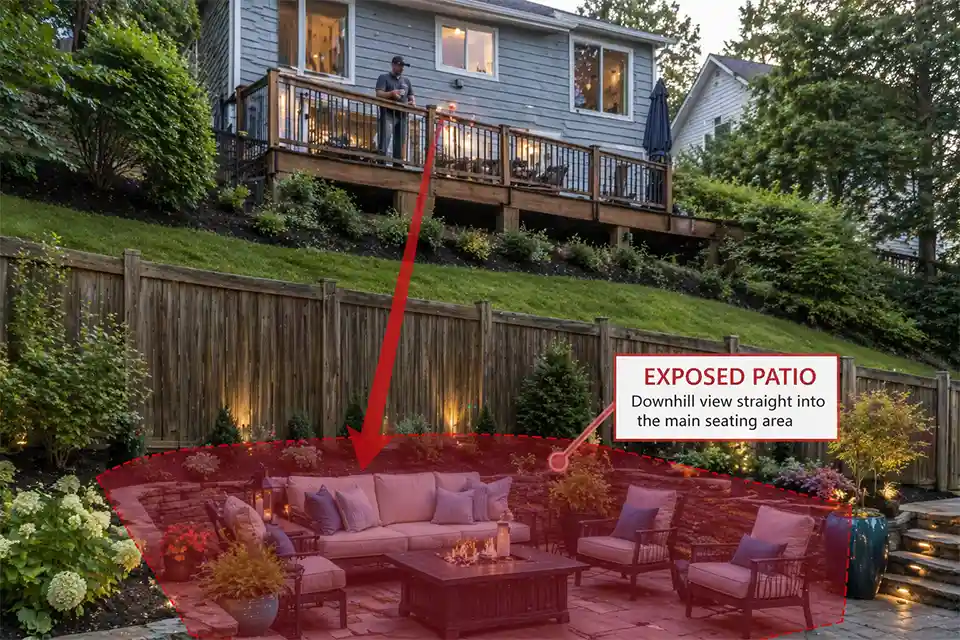
If an uphill neighbor can see straight into your backyard, the problem usually is not that your fence is too short. It is that their viewing point sits high enough above your yard to look down past it.
That changes the fix. Start with three checks: how many feet higher the neighbor’s deck, patio, or windows sit above your main use area; how far your patio or seating zone is from the fence; and whether the slope drops sharply within the first 10 to 20 feet.
If the uphill viewing point is even 3 to 5 feet above your grade, a standard 6-foot fence can look substantial from the property line and still fail where you actually sit.
That is what separates this from ordinary backyard privacy problems. On flat lots, boundary height often does most of the work.
On sloped lots, privacy is lost through angle, not just openness. People often overestimate what another 1 or 2 feet of fence will do and underestimate how much privacy improves when the screen moves 8 to 12 feet inward, closer to the patio.
Quick decision guide
Start here before you build anything
- View mainly from an uphill deck or raised patio: place a screen near the patio, not just at the fence
- View mainly from second-story windows: use layered screening plus an overhead or side element
- Whole house sits above your yard: create one private use zone instead of trying to hide the entire lot
- Need privacy within 30 to 90 days: structure first
- Want softer long-term privacy: structure plus dense evergreen layering
A fast example of why fence height misleads
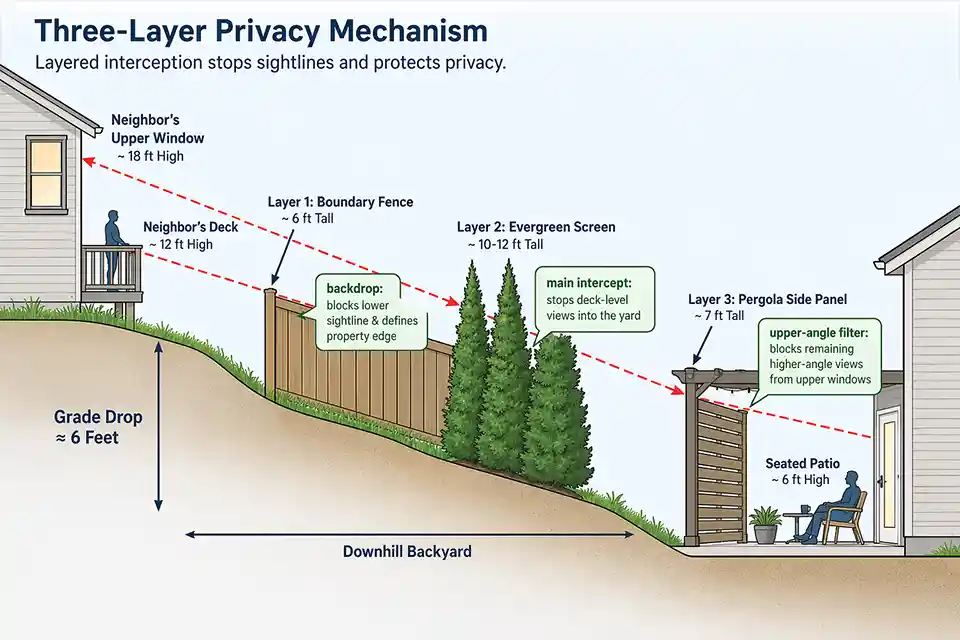
Say your uphill neighbor’s deck is about 4 feet higher than your patio, and your seating area is 16 feet inside the fence. From a seated eye level of roughly 42 inches, the deck can still look down over a 6-foot fence because the sightline is dropping into the yard. In that setup, a 6-foot screen placed 10 feet from the patio often blocks more of the real view than adding 1 foot to the rear fence.
The quickest way to tell what kind of fix you need
Measure the view from where you use the yard
Do not judge privacy while standing at the fence. Sit in the chair, step into the spa, or stand at the grill. A seated eye level is roughly 42 inches.
A standing eye level is usually around 60 to 66 inches. If the neighbor’s deck rail, windows, or upper patio are still visible from there, your fence is only marking the edge, not solving the problem.
Identify the source of the overlook
This matters more than people expect.
- If the view comes mainly from an uphill deck or raised patio, you usually need an angled or near-patio screen.
- If it comes from second-story windows, you often need a combination of vertical and overhead filtering.
- If the entire house sits above your lot, full-yard screening usually stops making sense. One private outdoor room is the smarter target.
Check whether the slope changes the project
Once a slope gets steep enough that mulch slides, watering runs off quickly, or footing feels awkward, privacy planning stops being just a visual issue. It becomes a placement and stability issue too. That is why slope problems such as fence-line erosion in a sloped backyard should be handled before you rely on new planting or heavy screens near the edge.
Why the obvious fix often fails
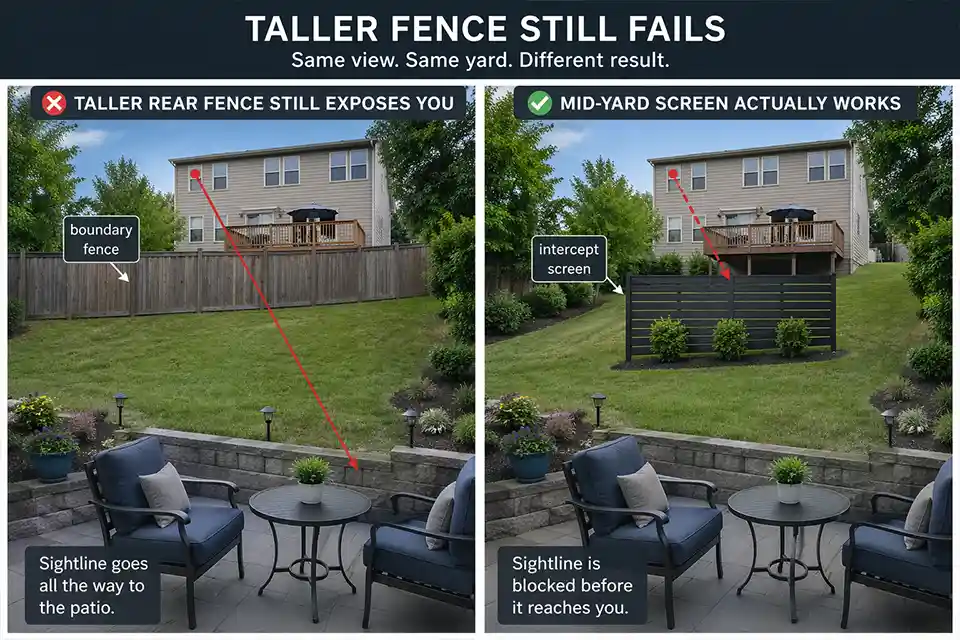
A taller fence does less than people expect
This is the most common wrong fix. A 7- or 8-foot barrier may improve privacy a little, but on a downhill lot it often does not improve it enough to justify the cost, especially if the neighbor is looking from above within 20 to 30 feet of the boundary.
That does not mean fences are useless. It means their job changes. The fence becomes a backdrop and a first privacy layer, not the whole solution. That distinction matters, especially when backyard privacy and HOA fence height limits leave very little room to keep building upward.
The better fix is usually closer to the activity zone
A 5- to 7-foot screen placed 8 to 12 feet inside the yard often blocks more of the real sightline than a taller fence at the property line. That is because it cuts across the view where people sit, not where the lot ends.
This is the point many homeowners miss: moving the privacy element inward can make a shorter structure more effective.
Temporary fixes can work, but only for the right goal
If you need a low-commitment solution this season, a weighted outdoor screen, movable planter screen, tensioned fabric panel, or shade sail edge can help. These are useful when the exposed area is small and the goal is to shield one seating zone quickly. They are much less useful when the whole uphill house overlooks the yard year-round.
Choose the fix by where the view is coming from
Uphill deck or raised patio
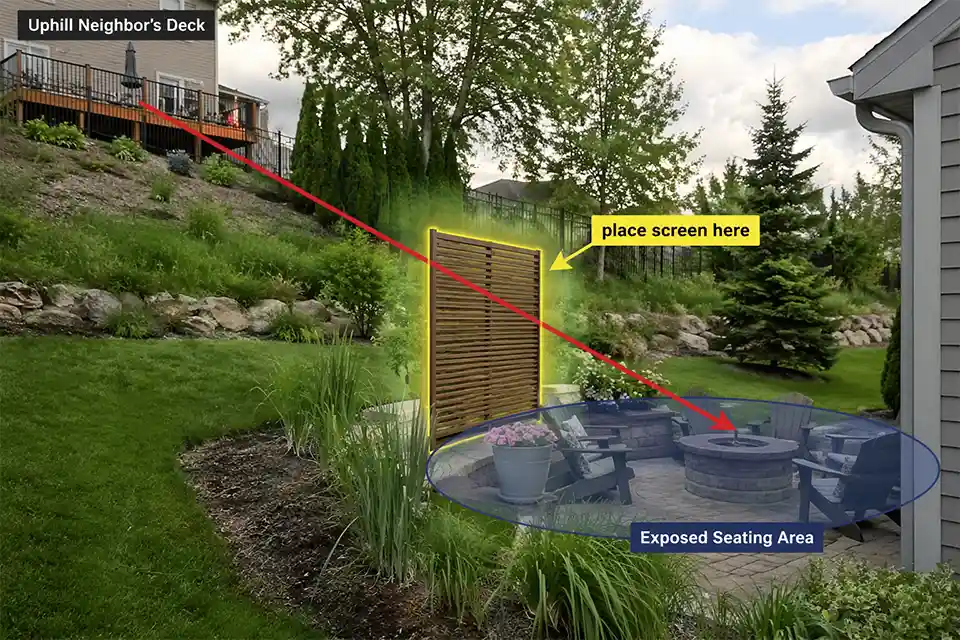
This is the clearest case for a near-patio solution. A pergola side panel, freestanding privacy wall, slatted screen, or tensioned outdoor fabric panel usually works better than adding more planting along the back edge.
What people often overestimate here is shrub height. What they underestimate is angle. If the deck is the main problem, block the deck-to-patio line directly. That logic is similar to neighbors’ decks overlooking backyard privacy fixes, but slopes make the angle more severe.
Second-story windows
Second-story windows usually need a taller visual interruption than deck-level views, but not necessarily a taller fence. This is where layered screening works best: one vertical layer at the boundary, one denser layer in the middle, and a top element near the use area if needed. A pergola with side louvers or a partial roof edge can do a lot here because it blocks upper angles that shrubs miss.
That is also why second-story windows and backyard privacy fixes overlap so closely with sloped-lot privacy planning.
Whole-house elevation above your lot
If the entire uphill house sits well above your grade, stop trying to screen every inch of the backyard. That is usually where projects get too expensive, too bulky, or too dark. The smarter move is to create one genuinely private use zone: dining corner, lounge pad, hot tub area, or covered retreat.
At that point, “screen the yard” stops making sense and “build one private outdoor room” starts making sense.
What works fastest, and what takes time
| Need | Best fit | Typical result window | Main drawback |
|---|---|---|---|
| Privacy this month | Freestanding screen, pergola side panel, privacy wall | 1–30 days | More built look |
| Privacy by this season | Tall planters, trellis, fast-cover vines, combined screen | 1–3 months | Needs watering and upkeep |
| Softer long-term privacy | Evergreen layers with structural backup | 2–5 years | Slow payoff |
| Year-round screening in cold climates | Dense evergreen massing plus a hard screen | 1–36 months | Higher upfront cost |
| Narrow-yard fix | Slim vertical panel or trained vine frame | 1–60 days | Limited total coverage |
What people usually misread first
They screen the property line instead of the patio
This is the biggest wrong diagnosis. The exposed area is often only one section of the yard. If the overlook mainly affects the dining pad or spa corner, treat that space first. Screening the entire boundary can cost far more and still feel less private.
This gets even worse when privacy was lost after removing a mature hedge or tree group. In cases like lost privacy after removing trees or hedges, people often rush to replace the old screen at the fence line without asking whether the old plant mass worked because of its placement, depth, or canopy shape.
They trust mature height more than lower density
A tree that eventually reaches 20 feet can still be a poor privacy choice if its lower branches open up after a few years. For sloped-lot privacy, the important coverage often sits between about 3 and 8 feet above your patio grade, not at the top of the canopy.
They ignore how slope affects maintenance
On mild slopes, planting can still do a lot of the work. On moderate slopes, planting usually needs structural help. On steeper grades, privacy planning starts to overlap with drainage and stability planning. If water runs off so fast that new plants dry out in a day or two, or mulch shifts after hard rain, planting alone is no longer a realistic first move.
Broader issues like sloped backyard problems with drainage, erosion, and safety change what is realistic.
A tighter decision guide for real yards
Use structure first when:
- you need meaningful privacy within 30 to 90 days
- winter coverage matters
- the yard is narrow
- the slope makes plant establishment unreliable
Use planting first when:
- you have room for depth
- the slope is stable
- you can wait 2 to 5 years for full effect
- you want softer visual screening and some sound buffering
Use both when:
- the overlook is moderate but constant
- you want immediate privacy without a harsh built wall
- fence height is limited but interior screens are allowed
Pro Tip: The best sequence on most sloped suburban lots is simple: stabilize the edge, place one screen where the line of sight crosses the patio, then use planting to soften and deepen privacy. Reversing that order is where many projects lose time and money.
When a standard privacy fix stops making sense
When the uphill view is dramatically higher
If the neighbor’s deck or windows sit roughly 8 feet or more above your main use area, full-yard screening usually becomes a losing battle. The materials get taller, the planting gets bulkier, and the yard can start to feel boxed in without ever becoming truly private.
When the yard is too shallow for layering
If you do not have at least about 8 feet of interior depth to work with, deep layered planting may eat usable space without giving enough screening. In that case, a slim structural solution usually outperforms a hedge.
When the best-looking fix is not the best-working fix
This is one of those cases where the cleanest design answer is not always the most effective one. A discreet screen panel placed exactly where the sightline crosses the patio may do more than a beautiful full-perimeter planting plan.
On sloped lots, the winning move usually is not a taller perimeter. It is a better-placed screen that blocks the real line of sight.
For broader official guidance on planting and managing sloped sites, see Iowa State University Extension’s Gardening on Slopes and Hillsides.