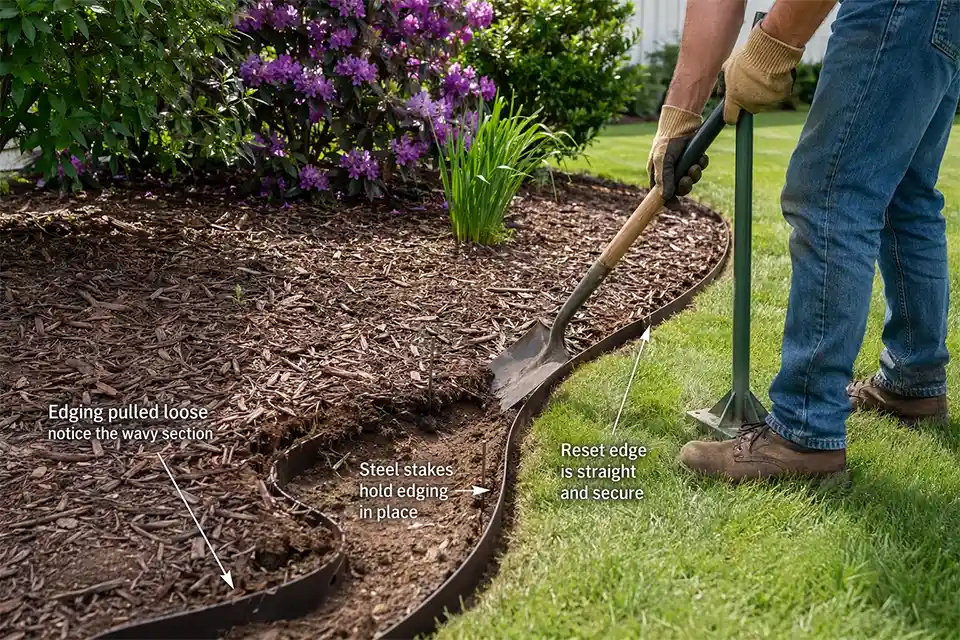
If landscape edging keeps shifting, the best fix usually is not “buy stronger edging” or “add more stakes” by default. It depends on what is actually failing.
If the edge line is mostly intact but keeps creeping, lifting, or loosening after rain, the first tools worth looking at are usually a manual trenching spade, heavy-duty edging stakes, and a hand tamper.
If the edging itself is bending, springing outward, or losing shape after each reset, the smarter move is often to stop repairing a weak edging type and move up to a more stable category.
That is the real decision here: are you fixing a weak install, or are you trying to rescue the wrong edging type?
What usually causes landscape edging to keep shifting
Most shifting edging problems come from one of four causes:
- the trench is too shallow or uneven
- the anchoring is too short or too weak
- the backfill was never compacted enough to lock the edge in place
- the edging type is too flimsy for the soil pressure, bed shape, or mower traffic
That last one matters more than people expect.
A lot of homeowners install a lightweight no-dig kit because it is fast and inexpensive, then keep trying to save the same line with better stakes every season. Sometimes that works. Often it just turns into repeat maintenance.
A simple rule helps:
- edge line mostly intact, just loosening: installation problem
- stakes pulling loose at curves or wet spots: anchoring problem
- edging bows, kinks, or springs back out: edging category problem
- same section sinks or washes out after storms: base stability problem
Once you know which of those is happening, the buying decision gets much clearer.
Is this a no-dig edging problem or a full reset problem?
This is the split that matters most.
If your edging came in a quick-install kit with short spikes and a lightweight flexible strip, you are probably dealing with a no-dig edging setup. Those can work in light-duty beds with simple lines and fairly stable soil. They tend to struggle more when the bed has tight curves, mower contact, soft soil, repeated washout, or a line that needs to stay very crisp.
You probably need a full reset, not just another patch, if:
- the edging keeps lifting above grade
- the line looks wavy even right after reinstallation
- the same curve keeps opening up
- the edging has already taken on a permanent bow or kink
- the included stakes feel too short for the soil conditions
You are more likely dealing with a repairable install problem if:
- the edging still holds its general shape
- only a few sections are loose
- the problem is concentrated at stake points
- the trench has become shallow or partly filled in over time
Tools help most when the edging still deserves to be saved. If the edging itself is the weak link, tools only improve the failure, not the outcome.
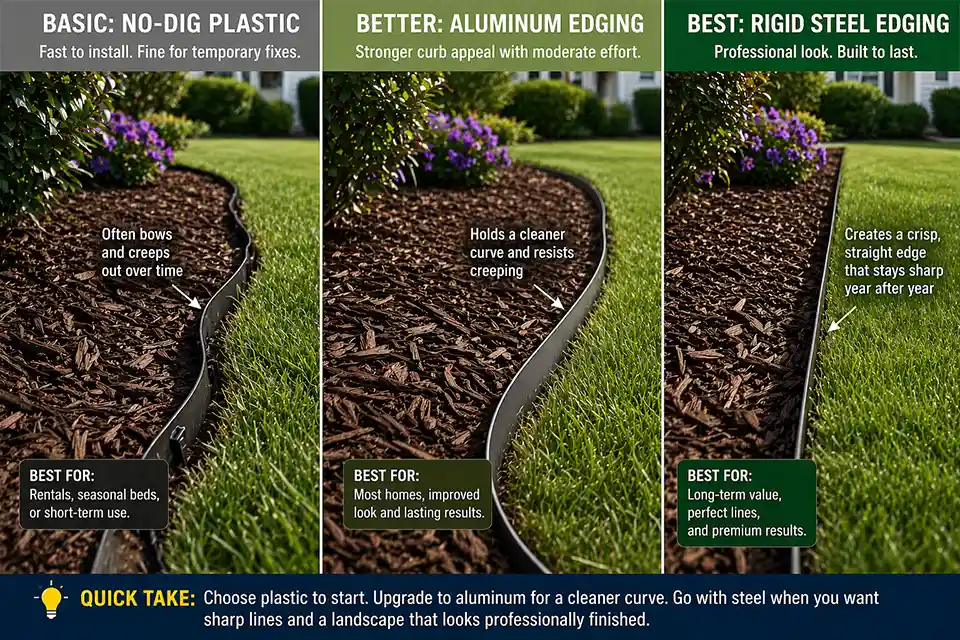
The edging types that fit different situations
Before getting into tools, it helps to narrow the edging type itself.
| Category | Best for | Usually fails when | What to look for |
|---|---|---|---|
| No-dig plastic edging | light-duty beds, gentle curves, quick DIY installs | short stakes, soft soil, sharp curves, repeated mower pressure | thicker profile, better stake system, cleaner connectors |
| Pro-grade flexible edging | curved beds that need more control than cheap plastic kits | very crisp long straight runs, weak anchoring, unstable base | heavier wall thickness, better stake channel, deeper profile |
| Aluminum edging | cleaner lines, moderate curves, more polished finish than basic plastic | severe washout, unstable trench, very high-impact conditions | thicker stock, secure joins, enough depth below grade |
| Rigid steel edging | straight runs, strong long-term shape retention, mower-facing bed edges | frequent layout changes, very tight curves, unstable sub-base | heavier gauge, strong connectors, good finish for climate exposure |
Not every shifting edge needs steel. But not every cheap no-dig line is worth saving either.
The tools that help most when the edging is still worth saving
A manual trenching spade is often the real first fix
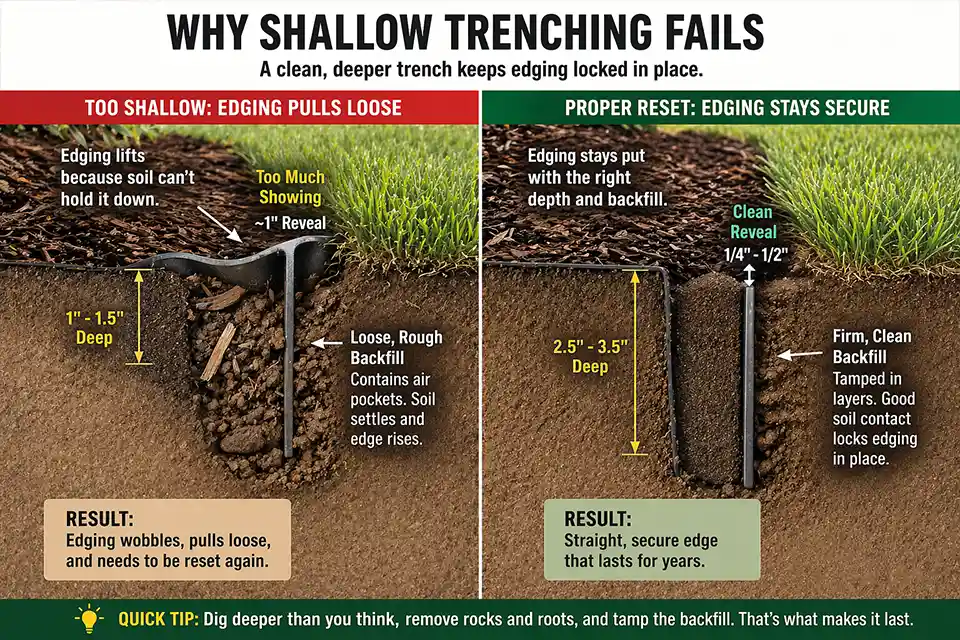
When edging shifts, many homeowners focus on stakes first. But a bad trench creates weak hold no matter what stake you use.
A manual trenching spade or half-moon edger is often the best first purchase when the edging has drifted upward, the trench line has softened, or the top edge is sitting too high above grade.
It is best for:
- edging that is mostly still usable
- shallow or messy trench lines
- beds that need a cleaner re-set rather than full replacement
- homeowners trying to lower the edging back into the soil correctly
Skip it as the first purchase if:
- the edging has already warped badly
- root pressure is pushing the line out
- the problem is mainly stake pullout in soft ground
- you already know the edging type is too flimsy
What to look for:
- a rigid narrow blade that cuts a defined trench instead of smearing soil
- a solid step plate for cleaner penetration
- enough blade depth to re-set the edge lower
- a durable handle-to-blade connection
If the edge looks sloppy more than broken, this is usually the first tool to browse.
The reason is simple: a clean trench gives the edging something to sit in. Without that, the rest of the install is guesswork.
| BEST TOOL FOR A CLEANER RESET |
|---|
| Trenching shovel |
| Best for edging that still has life left but sits too shallowly, unevenly, or sloppily in the trench. |
| It helps create a cleaner, lower, more stable channel so the edging can seat properly again instead of floating at grade. |
| Look for a narrow digging blade, a solid step plate, and enough depth to re-cut the trench cleanly. |
| 🔴 SHOP trenching shovel |
Heavy-duty edging stakes help when the edging is decent but the hold is weak
This is the classic “almost fixed” situation. The edging itself is still usable, but the line loosens because the anchoring system is too weak for the soil, the shape, or the season.
This category fits best when:
- the edging still holds shape reasonably well
- failures happen mostly at stake points
- curves keep opening up
- the soil stays soft after rain
- the bed edge was recently disturbed and never fully settled again
Skip this as your first move if:
- the trench is clearly too shallow
- the edging folds easily in your hands
- the connectors keep separating
- the same section is washing out from underneath
What to look for:
- longer stakes than the short kit spikes that often come with no-dig sets
- steel or other rigid heavy-duty construction
- a secure fit with your edging profile
- enough stake count to use tighter spacing on curves and stress points
This is where homeowners often under-correct. Straight runs can get away with less. Curves cannot.
If the line keeps moving at bends, corners, or soft sections, better anchoring usually beats random section replacement.
That is when this becomes the category to browse first.
| BEST HOLD FOR LOOSE CURVES |
|---|
| Landscape edging spikes |
| Best for edging that is still structurally usable but keeps loosening where short or weak kit fasteners fail. |
| They help curved sections and soft-soil runs stay put better without forcing a full edging replacement. |
| Look for longer, rigid spikes that fit landscape edging securely and give you tighter hold at curves and stress points. |
| 🔴 SHOP landscape edging spikes |
A hand tamper is what makes the reset actually stay reset
This is one of the least exciting tools in the whole category, and one of the most useful.
A lot of edging gets reinstalled into loose, fluffy soil that looks finished but never becomes stable. That is why the line looks good for a week and then starts drifting again after rain, mowing, or repeated foot traffic.
A hand tamper is best for:
- small to medium planting beds
- re-setting edging after trenching
- firming backfill around the edge line
- stabilizing repaired sections that keep loosening seasonally
Skip it if:
- the trench is still wrong
- the edging material itself is failing
- water is actively washing out the base below the edge
What to look for:
- a solid tamper plate
- enough tool weight to compact effectively
- a sturdy handle connection
- a size that is practical for narrow bed edges
If you have already reset the line once or twice and it still never feels locked in, this tool deserves more attention than most homeowners give it.
The edge is not stable just because it looks straight. It is stable when the soil around it stops behaving like fill and starts behaving like support.
| BEST TOOL FOR LOOSE BACKFILL |
|---|
| Hand tamper |
| Best for edging resets that keep failing because the surrounding soil was never compacted firmly enough to lock the line in place. |
| It helps turn a loose reinstall into a more stable edge by firming the trench shoulders and backfill around the profile. |
| Look for a solid tamper plate, real working weight, and a durable handle-to-plate connection. |
| 🔴 SHOP hand tamper |
When the base is the real problem, not the edging
Sometimes the issue is not sideways movement at all. It is loss of support underneath or beside the edging.
That is common when:
- the same section sinks after heavy rain
- mulch and soil keep washing away from one side of the edge
- the edging borders gravel or pavers
- the line sits on a slight slope or runoff path
In those cases, stronger stakes alone usually disappoint. Anchoring into failing soil is still anchoring into failing soil.
The better move is to stabilize the trench zone first, then re-seat the edging. On short runs, that may still pair naturally with a hand tamper. On longer problem areas, the real issue may be closer to washout or bed-edge erosion than an edging-only failure.
When it makes sense to stop fixing cheap no-dig edging
This is where the article shifts from “repair tools” to “category upgrade.”
If the edging keeps springing outward, developing permanent waves, or losing its form after each reset, the problem may not be your technique anymore. It may be the edging’s limit.
That is especially likely when:
- the bed has tight curves
- the lawn edge gets regular mower pressure
- the soil swells and shrinks through the seasons
- freeze-thaw cycles lift and re-set the line unevenly
- the original edging was chosen for convenience, not long-term hold
At that point, the better decision is often to upgrade the edging type rather than keep improving the install around a weak material.
When pro-grade flexible edging makes more sense than basic no-dig kits
This is the right middle ground more often than people expect.
Pro-grade flexible edging works best when the bed shape still needs curves, but the bargain no-dig category is no longer holding up well enough. It gives you more control and usually more substance than the lightest DIY kits, without forcing you into the stiffest metal category.
Best for:
- curved or flowing bed lines
- homeowners who want better hold without a full rigid upgrade
- beds where appearance matters but the layout is not strictly straight
- replacing weak plastic kits that keep loosening
Skip if:
- you want long crisp straight runs
- the site has active washout or slope undermining the trench
- the bed edge faces heavy repeated impact
What to look for:
- thicker flexible profile
- a better stake channel or anchoring system
- more depth below grade
- compatibility with heavy-duty stakes, not just basic kit spikes
This category usually wins when the layout needs flexibility, but the cheap-kit phase is over.
That makes it the better browsing path before metal if curves are still central to the design.
When aluminum edging makes sense, but may not need its own shopping path
Aluminum is a valid middle upgrade. It often makes sense for homeowners who want a cleaner, more refined line than plastic can usually hold, but do not necessarily need the strongest heavy-duty steel option.
It can work well for:
- moderate curves
- cleaner visual lines
- homeowners stepping up from plastic without going fully heavy-duty
- beds where a neater finish matters
But it is not always the most important category to browse first. If the site is unstable, washing out, or taking real impact, aluminum does not automatically solve that. In many yards, the practical shopping decision still narrows more cleanly to better flexible edging for curves or rigid steel edging for crisp long-term hold.
So aluminum belongs in the comparison, but it does not have to become a separate buying path for every reader.
When rigid steel edging is the category that finally ends the cycle
Rigid steel edging earns its recommendation when the problem keeps returning because the line needs real shape retention.
This is usually the strongest fit for:
- long straight or gently curved bed lines
- lawn-facing edges that take mower pressure
- homeowners who want a crisp, lasting boundary
- repeat failure points where lightweight edging never really stays true
Skip it if:
- the bed design changes often
- the layout has lots of tight small-radius curves
- you still have not fixed trench washout or base instability
What to look for:
- heavier-gauge steel
- secure section connectors
- enough depth below grade
- finish quality suited to your climate, especially in wetter regions
This category is especially useful in suburban U.S. yards where clean mow lines and repeated lawn-edge contact matter. In freeze-thaw regions, it still needs good installation depth and support, but once installed well, it usually holds form far better than light flexible edging.
If you are tired of adjusting the same edge every season, this is often the category that finally earns the extra effort.
That is why it becomes the first category to browse when shape retention, not just anchoring, is the real issue.
| BEST LONG-TERM SHAPE RETENTION |
|---|
| Rigid steel landscape edging |
| Best for straight or gently curved bed edges that keep defeating lightweight edging and need a cleaner, longer-lasting line. |
| It holds form better under mower pressure, seasonal soil movement, and repeated rework than most light flexible edging types. |
| Look for heavier-gauge steel, solid connectors, and enough profile depth for a true below-grade install. |
| 🔴 SHOP metal landscape edging |
Why stone or brick edging is not the main answer here
Stone, brick, and concrete border systems are real options, but they are usually not the first answer to this exact search intent.
If someone is looking for tools that help shifting edging stay put, they are usually trying to solve a repair, reset, or upgrade problem, not fully redesign the edge with a heavier hardscape border. Stone and brick move the decision into a different project: more structural, more permanent-looking, and often more about visual style than about rescuing an existing edging line.
So they are not bad options. They are just usually a different project than the one this reader is trying to solve.
Small supporting tools that make the reset cleaner
These are not usually the main purchase, but they can make the reinstall cleaner and easier:
- rubber mallet for tapping stakes or sections without damaging the material
- utility knife or edging cutter for trimming flexible edging cleanly
- layout paint or marking line for re-establishing a wandering bed edge
- garden rake for evening out backfill before final compaction
These do not replace the main fix. They just make a proper reset much easier to execute cleanly.
The most common buying mistakes in this category
Buying more stakes when the trench is bad
This improves the anchor count, not the seating of the edging.
Trying to save a permanently distorted edge
Once the material has lost its shape, tools only polish the failure.
Treating every curve like a straight run
Curves need tighter control and usually more anchoring.
Ignoring base stability near runoff
If the edge is being undermined, restraint alone will not fix it.
Jumping straight to the heaviest category
Sometimes the problem is shallow installation, not underbuilt material.
Staying too long with a weak kit
There is a point where repeated repair costs more than upgrading categories.
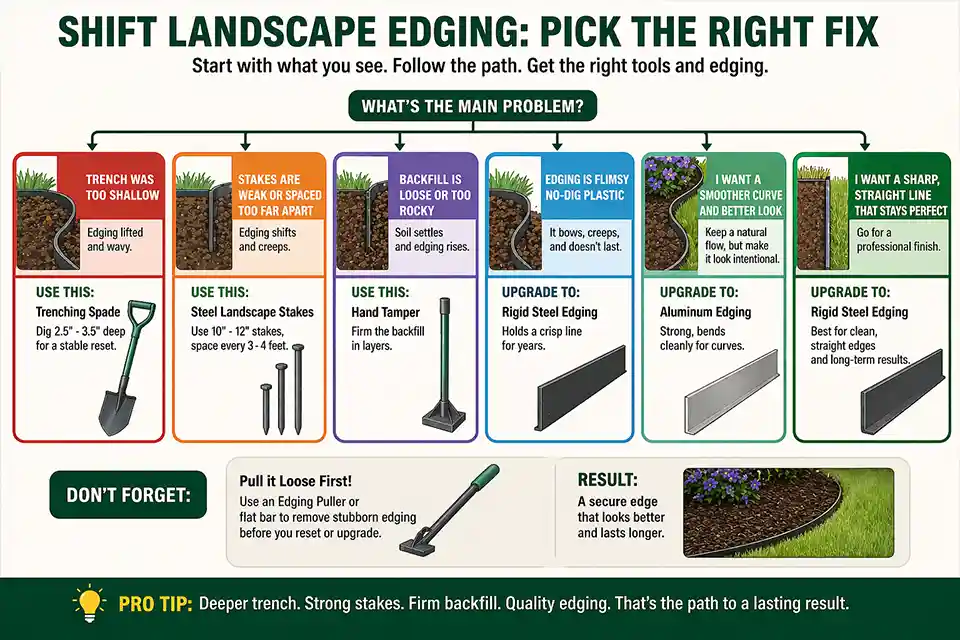
The smartest first buy based on what your edging is doing
If the edge is messy, high, or half-buried in a weak trench, start with a manual trenching spade.
If the edging still has shape but keeps loosening at curves or stake points, start with heavy-duty edging stakes.
If the line looks good after a reset but never stays stable, add a hand tamper.
If cheap no-dig edging keeps failing because the material itself will not hold shape, move to pro-grade flexible edging for curves or rigid steel edging for the strongest long-term line control. Aluminum still has a place as a cleaner middle-ground option, but it is not the first shopping path most readers need.
That is the cleanest way to avoid both overbuying and underbuying.
When not to buy yet
Pause before buying if the real issue is larger than the edging system itself:
- runoff keeps cutting away the bed edge
- roots are pushing the line upward
- the border sits on a slope that never stays stable
- gravel migration is undermining the trench
- repeated frost heave is exposing shallow sections every year
In those cases, buy after you understand the pressure causing the movement. Otherwise, you risk buying a better version of the wrong solution.
Final verdict
If landscape edging keeps shifting, the best purchase depends on whether you are dealing with a weak install or a weak edging type.
For most homeowners, the smartest repair-first tools are a manual trenching spade, heavy-duty edging stakes, and a hand tamper. Those are the right starting points when the edging still deserves to be saved. But if a cheap no-dig system keeps bending, drifting, or losing its line after every reset, stop treating it like a tool problem. That is when the better decision is to upgrade the edging category itself.
Choose pro-grade flexible edging if curves still matter most. Choose rigid steel edging if the real goal is to finally get a crisp edge that holds shape season after season.
That is the version of this problem that usually ends the cycle: diagnose the failure honestly, then browse the category that actually fits it.
Related Articles
- Why front-yard edging keeps shifting in the first place
- What sliding mulch often reveals about edge failure
- How to spot when washout is undermining the bed
- What repeated fence-line erosion can tell you about edge instability
- How larger drainage and slope issues can keep causing repeat landscape failures
- When a product-led erosion fix makes more sense than another edging reset