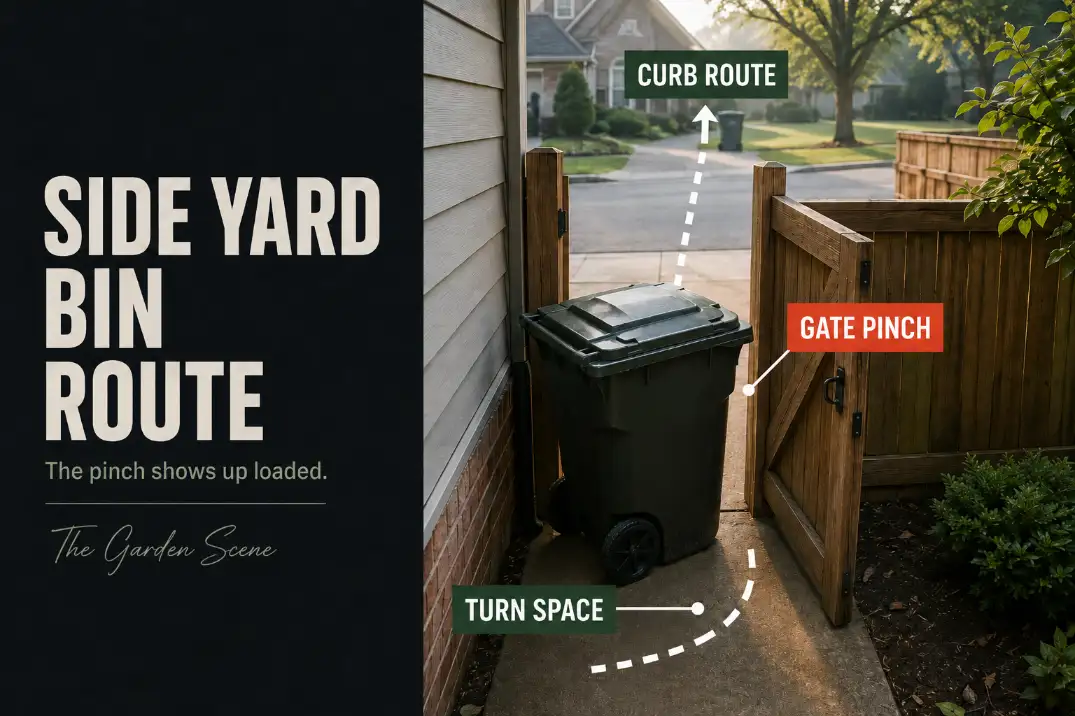
A trash bin route from side yard to curb is usually a movement problem before it is a storage problem.
The storage spot may look clean all week, but pickup day tests the gate opening, the first turn after the gate, the driveway crossing, and the final curb staging zone.
A typical 64- or 96-gallon cart may be roughly 24 to 30 inches wide, but the route usually needs closer to 36 inches of clear path to roll without dragging. At turns, 42 inches or more feels noticeably safer.
Start with three checks: roll the fullest bin through the gate, turn it with the car parked normally, and place it at the curb without blocking the sidewalk, mailbox, or driveway edge.
If the trip takes more than 2 or 3 minutes, needs repeated angle corrections, or leaves wheel ruts after one wet pickup, the route is failing even if the bins technically “fit.”
Pickup Day Reveals the Problem
Test the loaded route, not the empty space
The clearest test is not whether the bin can sit in the side yard. It is whether a full cart can roll from its everyday position to the curb without being lifted, twisted, or dragged sideways.
Empty bins hide weak routes because they are easier to bounce over gravel, pull across grass, and pivot around posts.
A better test is to roll the heaviest cart first. If you use trash, recycling, and yard waste carts, test two carts in sequence.
A route that works for one empty cart may fail when two full carts have to move through the same gate, around the same parked car, and toward the same curb position before pickup.
The key distinction is between a bad storage area and a bad pickup route.
Trash Bins in a Narrow Side Yard is about where bins can live without taking over the side yard. This issue is more specific: whether the weekly movement line actually works.
The warning signs are small at first
Most trash routes do not fail dramatically. They become annoying in repeatable ways. The bin bumps the latch post. One wheel drops into mulch.
The handle catches a fence. The cart has to be dragged diagonally across the driveway because the car is too close.
Those are not cosmetic signals. They show where the route is too narrow, too soft, or too dependent on perfect conditions. If the route only works when the driveway is empty and the ground is dry, it is not a reliable pickup-day route.
The Gate and Turn Radius
The first turn matters more than the opening
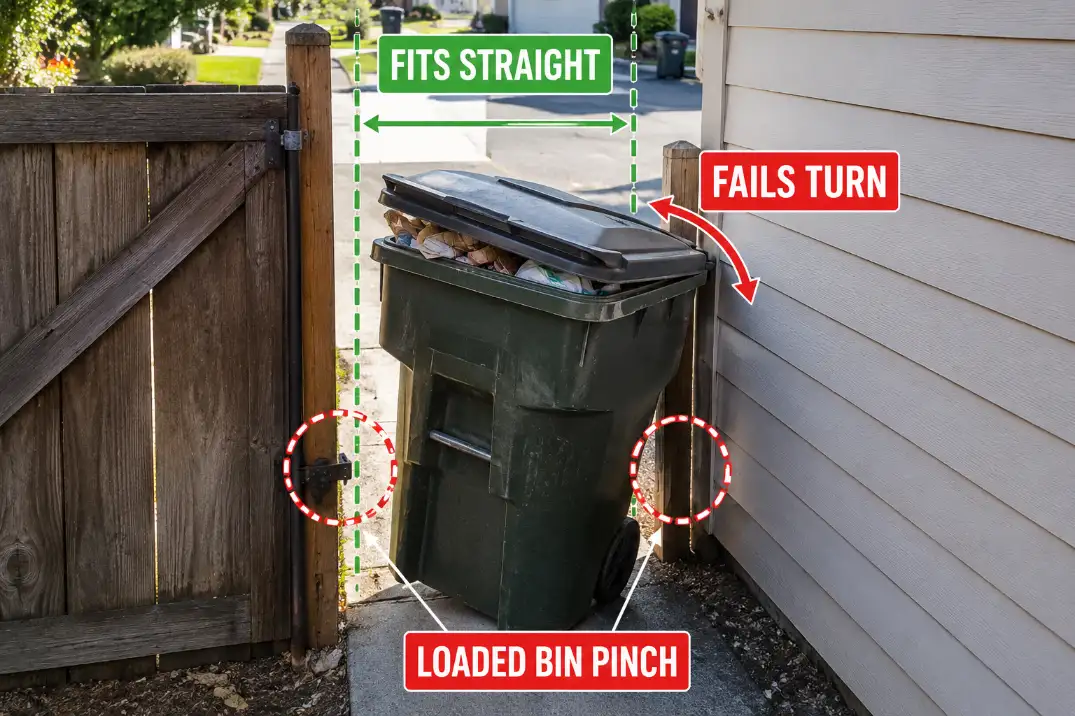
Gate width is only the first measurement. A 32-inch gate can look acceptable for a 27-inch cart, but the route can still fail if the bin has to turn immediately after passing through.
The cart body may clear the opening while the handle, lid, and wheels swing through a wider arc.
For straight portions, aim for about 36 inches of clear width where possible. Around the gate and first turn, 42 to 48 inches is more forgiving, especially if the bin exits beside a house wall, fence, AC screen, raised edging, or parked vehicle.
The practical measurement is the narrowest usable space, not the advertised gate size. Latch hardware, hinges, trim, leaning fence posts, plant containers, and hose reels can steal 1 or 2 inches exactly where the cart needs room to pivot.
Keep both gate landings plain
A useful bin route needs a small landing on both sides of the gate. Inside the side yard, the cart should be able to pull straight forward before turning. Outside the gate, the first 3 feet should stay clear enough for the wheels to realign.
This is where decorative fixes often cause trouble. A planter beside the gate, a solar light stake, a loose gravel border, or a narrow stepping-stone edge may look harmless, but it forces the loaded cart into a sharper angle.
If the gate swing itself blocks the route, the issue overlaps with Side Yard Gate Swing Clearance because an opening that technically works can still steal the usable turn.
Pro Tip: Test the gate with the bin handle in your normal pulling position, not with the cart carefully centered for a photo.
Driveway Crossings
The parked car is part of the route
A driveway crossing should be judged with the car parked where it normally sits. If the route only works after moving the vehicle, the system depends on a weekly extra step. That may be fine once, but it becomes the first thing skipped when pickup morning is rushed.
Allow at least 30 inches beside a parked vehicle for a tight rolling route. Closer to 36 inches is better if the bin passes near mirrors, open car doors, or a garage wall.
The route should also avoid forcing the bin behind a vehicle where the driver has to move the car before collection or before leaving.
Driveway routes often fail in the same way as backyard access paths: the pavement exists, but the usable movement line is interrupted.
If the bin shares a path with mowers, wheelbarrows, or utility access, Backyard Access Path From Driveway supports the same priority: protect the route before decorating around it.
The curb handoff needs its own space
Getting the bin to the front is not the final step. The cart still needs a curb position that collection crews or automated arms can reach.
Local rules vary, but a practical target is to leave about 3 feet of clearance from parked cars, mailboxes, trees, utility poles, and other carts whenever possible.
Do not solve the side-yard route by placing the bin where it blocks the sidewalk, sits behind a parked car, or crowds the driveway apron. That only moves the problem from the side yard to the curb.
| Route Condition | Works When | Fails When | Better Fix |
|---|---|---|---|
| Gate opening | Clear width is near 36 inches | Latch or post narrows the real opening | Measure the usable opening, not the panel |
| First landing | Cart has 3 feet to straighten | Bin must turn immediately at the post | Keep both sides of gate plain |
| Driveway crossing | Route works with car parked | Car must move every pickup day | Shift route to driveway edge |
| Curb staging | Cart has about 3 feet of clearance | Bin crowds car, mailbox, tree, or sidewalk | Mark a clear curb position |
| Two-bin use | Carts move out in sequence | First cart blocks the second | Create a wider waiting spot |
Surface for Rolling Bins
Wheel behavior matters more than appearance
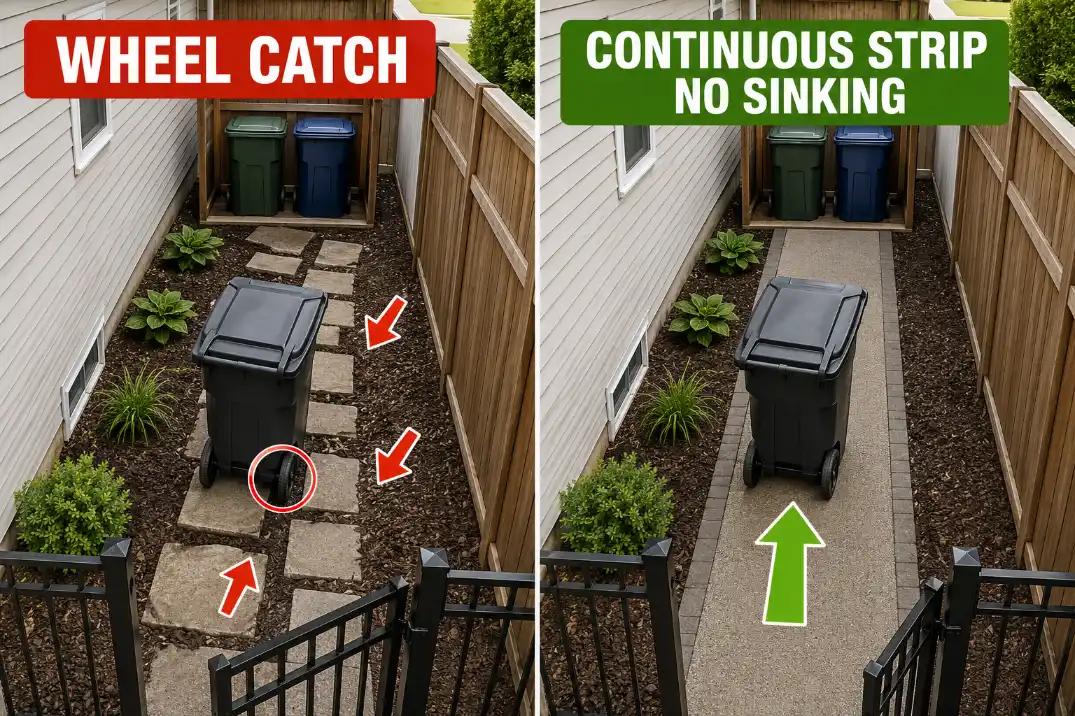
Trash bins need a continuous rolling surface. Smooth concrete, stable pavers, compacted fines, or a narrow hard path usually work better than loose gravel, bark mulch, grass, or decorative stepping stones.
The surface does not have to be expensive. It has to keep small wheels from sinking, twisting, or catching.
A useful rule is the 24-hour rain test. If wheels still sink more than about 1/2 inch the day after normal rain, the surface is not reliable for a loaded cart.
In humid regions and clay-heavy Midwest yards, that shows up as recurring ruts. In dry climates, loose gravel can be the bigger problem because the bin wheels plow through it instead of rolling over it.
Side yards that also handle pets, hoses, storage, and utility access fail faster because the same narrow strip gets repeated traffic.
That is why Side Yard Mud Control for Dogs, Bins, and Access matters here: mud control is not just about cleanliness when it decides whether a full bin can move.
Where small pavers stop making sense
A few pavers in grass can help foot traffic, but they often disappoint for trash carts. If the wheel drops between stones, catches on a raised edge, or climbs more than about 1 inch, the bin still behaves like the route is broken.
A better fix is a continuous strip. That may be concrete, tightly set pavers, compacted decomposed granite, or a firm gravel path with fines that lock together.
The important difference is continuity. A bin route is judged by the wheel path, not by how finished the area looks from the patio.
Keep Bins Away From Entry
The front walk is not a holding zone
A curb route should not make the main entry harder to use. This mistake is easy to miss because the bins may only sit there for 6 to 12 hours on pickup day. But during that window, guests, delivery drivers, kids, and homeowners still need the front walk.
Keep about 36 inches of clear approach near the entry when possible. If the bins wait near the front walkway, place them beside the movement line rather than directly in it.
A cart that pushes visitors onto wet grass or into the driveway is not well placed, even if it is convenient for collection.
If your entry already has a narrow approach, Front Walkway Safety for Visitors and Deliveries is the better supporting layer because the same pinch that annoys trash day can also affect packages, visitors, and daily access.
Do not hide bins so deeply they become harder to move
This is the most common overcorrection. A homeowner adds a screen, enclosure, or shrub border to make the bins disappear, then creates a pull-out route that is worse than the original storage spot.
Screening works when the bin pulls straight out and turns once. It fails when the cart has to back out, rotate between a wall and a panel, then squeeze through a gate. The screen may improve the view, but it does not improve the route.
Easy Out, Hidden After
Plan two positions, not one
The best layout has two separate jobs: a hidden everyday position and a clean pickup-day route. The everyday position can sit against a fence, side wall, or utility zone. The movement line should remain open enough for a full bin to roll without lifting.
Think of this as a service corridor. It has to work in the dark, after rain, with the car parked, and when the cart is heavier than expected. That does not mean the side yard has to stay empty. It means fixed objects belong outside the rolling line.
Many side yards also hold hose reels, meters, AC access, bikes, scooters, and garden tools. If your side yard has become a mixed-use strip, Side Yard Utility Corridor Ideas gives the broader layout logic, but the bin route still needs one protected lane.
The fix that often wastes time
A nicer bin enclosure often wastes time when the route is still broken. So do decorative gravel, extra planting, and a new storage pad placed behind the same tight turn.
They make the side yard look more finished while leaving the weekly movement problem untouched.
Fix the route first. Make the bin easy out. Then make it hidden after. A plain 36-inch route with one clean turn will outperform a beautiful screen that forces lifting every pickup day.
Quick route check before changing anything
- Roll the fullest bin from storage to curb without lifting it.
- Test two carts in sequence if you use trash and recycling bins.
- Measure the narrowest clear opening, including latch hardware.
- Keep the first 3 feet on both sides of the gate plain.
- Test the driveway crossing with the car parked normally.
- Check for wheel sink deeper than 1/2 inch after rain.
- Leave practical curb clearance from cars, mailboxes, trees, and sidewalks.
- Confirm the hidden storage spot allows a straight pull-out.
Questions People Usually Ask
Is a 30-inch path enough for a trash bin?
Sometimes, but it is tight. A 30-inch path may work for a smaller cart on a straight, smooth route. For most weekly use, about 36 inches of clear width is more forgiving, especially near walls, fences, parked vehicles, and gate posts.
Should trash bins roll over gravel?
Only if the gravel is compacted and stable. Loose decorative gravel often shifts under small wheels and becomes harder to use than plain concrete or compacted fines. If the wheels plow, sink, or leave ruts after one or two pickups, the surface is not working.
How much space should bins have at the curb?
Local rules vary, but about 3 feet of clearance from cars, mailboxes, trees, and other carts is a useful working target. The bin should be reachable without blocking the sidewalk, driveway, or front entry path.
For local cart placement rules, check your city’s curbside collection guidance, such as the City of San Antonio cart placement guidelines.