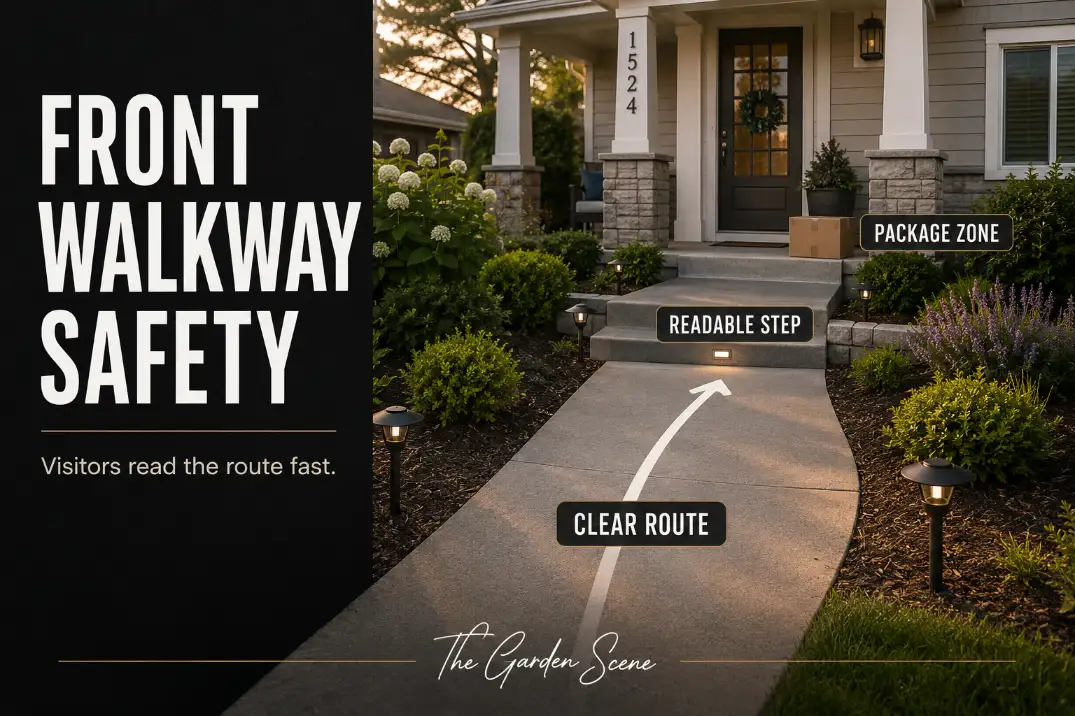
A front walkway becomes unsafe when a visitor’s eyes, feet, and hands need different things at the same time. Their eyes are looking for the door, address, bell, or package spot.
Their feet are trying to read steps, edges, slope, and surface changes. Their hands may be holding flowers, groceries, a phone, a child’s hand, or a delivery box.
That is why the usual problem is rarely one dramatic hazard. It is a sequence of small conflicts: a step that blends into the porch, a plant edge that steals walking width, a loose surface patch, or a package left where feet need to land.
A safer front walkway keeps the main walking line clear before it improves the planting edge. Start with three checks: whether the route stays at least 36 inches clear, whether step edges are visible from 6 to 10 feet away, and whether a delivery box can sit near the door without blocking the last 30 inches of usable landing space.
Visitors look for the door; delivery drivers look for the address, the fastest route, and a place to set weight down. The walkway has to serve both.
The First Route Matters
The safest front walkway is the one a visitor chooses without pausing. If someone steps out of the driveway and hesitates for more than a few seconds, the design may be attractive, but the route is not doing enough work.
Visitors Follow the Most Obvious Line
Homeowners often judge the walkway from the porch looking outward. Visitors experience it from the curb, driveway, sidewalk, or parked car.
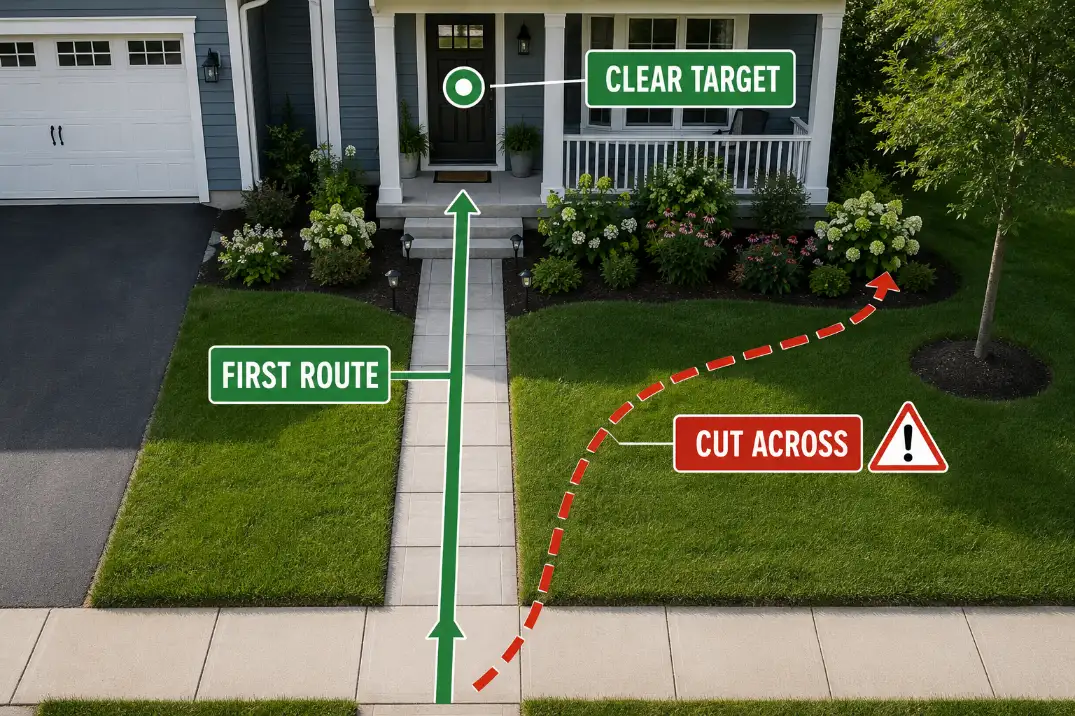
That changes the design priority. The first visible route should point clearly toward the front door, not toward a decorative bed, side gate, or narrow porch corner.
A walkway that is 42 inches wide near the driveway but narrows to 28 inches beside shrubs is still a narrow walkway where it matters. The tightest point controls the experience because that is where visitors carry groceries, flowers, luggage, or delivery boxes.
When the front door sits off to the side or the driveway pulls people away from the entry, the route needs stronger visual guidance.
The access logic is similar to Front Yard Design With Driveway and Front Door Access: the yard may look finished, but the approach fails if people cannot tell where to go first.
The First 10 Seconds Reveal the Problem
Walk the route as if you have never visited the house. Start where a guest or delivery driver actually arrives, not where the walkway looks best in a photo. The first hesitation point matters more than the prettiest planting bed.
A safe visitor route usually has a clear door target, a steady walking width, and no forced sidestep before the porch. The route should also make sense after dark, when shadows, parked cars, and porch lights change what people notice.
The real test is simple: can someone find the door, keep their feet on the correct surface, and carry something to the entry without making a last-second adjustment? If not, the walkway is asking the visitor to solve too many small problems at once.
Steps Need Clear Reading
Steps become risky when visitors do not register them early enough. The issue is not only step height. A 5-inch step with a hidden edge can be more awkward than a 7-inch step with clean contrast, good light, and enough landing space.
A Hidden Riser Is the Mechanism
A trip near the entry often looks like clumsiness, but the underlying mechanism is usually poor edge reading. Same-color pavers, dark porch flooring, busy mats, shadowed risers, and damp leaves can make a step disappear until the foot is already moving.
Use a simple test: stand 6 to 10 feet away in normal evening light. If the step edge does not separate clearly from the landing, visibility should be fixed before adding more decorative material.
A welcome mat replacement often wastes time here. The mat may look cleaner, but it does not fix a step that blends into the porch. A contrast strip, better low-glare light, or clearer landing edge usually changes the outcome more.
The Landing Must Let People Pause
The most important safety zone is often the final 3 to 5 feet before the front door. That small area has to handle stepping, waiting, door swing, keys, packages, pets, and sometimes wet shoes.
A landing under about 36 inches deep can force movement and door use into the same cramped spot. That becomes worse during rain or freezing weather, when visitors move more cautiously and may look down at the surface instead of the doorbell.
If the front door area already feels tight, the deeper issue may not be the walkway. It may be that the landing does not give people enough room to stop, turn, and use the door.
In houses with shallow porches or tight door swings, Front Door Landing Clearance is often the more useful problem to study before adding another path light.
A walkway can be clear and still feel unsafe if the final pause area is too small. The landing is where movement slows down, so it deserves more attention than a decorative border farther back on the path.
Clear Edges at Decision Points
Edges matter most where the visitor’s attention shifts. A person may look down while leaving the driveway, then look up at the house number, then back down at the step, then toward the doorbell or package spot.
The risky edge is often the one that appears during that attention change.
Surface Changes Deserve Priority
The most safety-relevant spots are usually transitions: driveway to walkway, walkway to porch, porch to step, and hard surface to planting bed. A raised lip over 1/2 inch deserves repair priority before cosmetic edging or new mulch. Even a 1/4-inch change can be noticeable when the surface is wet, shadowed, or crossed while carrying weight.
Loose gravel on top of a hard path creates a different failure pattern. The path looks stable, but the top layer shifts underfoot.
In shaded entries, damp leaves, moss, or algae can create a slick patch that stays risky for 24 to 48 hours after repeated rain. In cold northern states, freeze-thaw movement can lift pavers just enough to create a toe-catching edge near the porch.
The real issue is not only that the surface changed. It is that the surface often changes exactly where the visitor is also trying to read the door, address, step, or delivery spot.
Clean Edging Is Not Always Safe Edging
Steel edging, stone borders, brick strips, and raised landscape borders can sharpen curb appeal, but they are not automatically safer. If the edge rises above the walking surface, leans inward, or disappears under groundcover, it becomes another object visitors have to negotiate.
The safer edge is clear, stable, and predictable. On a route used by guests and delivery drivers, a low visible edge usually beats a more decorative edge that competes with foot placement.
| Walkway signal | Usually cosmetic | Safety-relevant reading | Better priority |
|---|---|---|---|
| Fresh mulch beside path | Cleaner bed appearance | Does not define foot space if it spills | Keep mulch below the path edge |
| Decorative border | Stronger curb appeal | Risky if raised or tilted inward | Use low, visible, stable edging |
| Dark porch step | Looks refined | Can hide the riser at dusk | Add contrast or step lighting |
| Loose gravel on hard path | Decorative texture | Shifts underfoot when carrying weight | Contain or replace near the main route |
| Wide-looking curve | Feels generous | Still unsafe if plants crowd the inside line | Measure the narrowest clear width |
| Package near door | Convenient drop spot | Blocks final landing or door swing | Create a side drop zone |
Plants Should Not Crowd Feet
Plants are often underestimated because they look harmless right after trimming. The real test is not pruning day. It is mature size after rain, wind, summer growth, or seasonal dieback.
Judge the Walkway at Peak Spread
A walkway bordered by grasses, perennials, or loose shrubs can lose 6 to 12 inches of usable width during peak growth. After rain, soft stems may lean even farther into the route. A 36-inch path can behave like a 24- to 28-inch path if both sides spill inward.
This is where homeowners commonly overestimate plant neatness. They remember the trimmed shape, while visitors meet the plant at its widest and wettest. A front walk should be judged when the plant is at its least cooperative, not when it has just been cleaned up.
For front walks, choose plants that keep their mass away from the foot line. Upright shrubs, compact perennials, and low groundcovers that do not creep over the edge usually work better than floppy grasses or spreading plants beside the main approach.
The same access problem appears in Backyard Plants Crowding Paths and Seating, but the front yard is less forgiving because visitors are moving through unfamiliar space.
When Trimming Stops Making Sense
Routine trimming makes sense when growth is occasional and the plant still belongs near the path. It stops making sense when the plant needs cutting every 2 to 3 weeks just to keep the walkway usable.
At that point, the plant is not a maintenance issue. It is the wrong plant in the wrong edge condition. Replacing one crowding shrub can improve safety more than adding signs, brighter lights, or more decorative edging around it.
Pro Tip: Do not measure walkway width from hard edge to hard edge if plants spill over it. Measure the clear space where feet can actually move.
Deliveries Change the Path
A delivery driver does not experience the walkway as a guest. They experience it as a fast route with weight in their hands. That difference exposes weak spots a homeowner may never notice during normal entry.
The Package Zone Should Sit Beside the Route
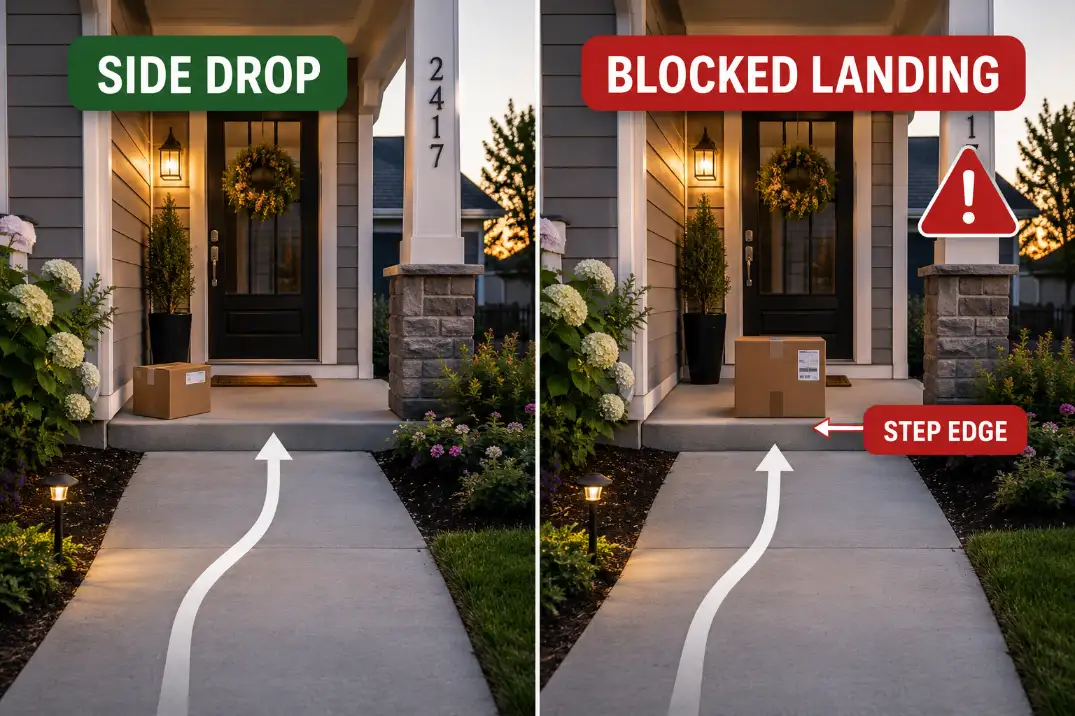
A delivery zone should sit beside the landing, not on the landing. The common mistake is treating the flattest spot near the front door as the best package spot. Sometimes that is exactly where people need to stand.
A small box may not matter. A 20- to 30-inch-wide package on a shallow landing can block the door side, hide a step edge, or force a twist-and-reach movement. If the landing is already under about 36 inches deep, one box can turn a normal arrival into a cramped balancing act.
A better setup is a visible side zone: a low package platform, covered porch corner, bench-height surface, or side landing area that keeps the walking line open.
If packages already collect near the entry several times a week, Front Yard Package Delivery Zone Ideas is a closer fix than simply widening the path.
The goal is not just to receive packages neatly. It is to prevent the package from becoming the thing that hides the step, steals the landing, or forces the next visitor into a sidestep.
House Numbers Reduce Wandering
Package safety is not only about the ground surface. If the address is hard to find, the driver may walk the wrong route, check a phone while moving, or approach the wrong door. That creates more movement across beds, steps, and side paths.
House numbers should be visible from the usual arrival direction, not only from directly in front of the porch. At night, they need contrast or direct light.
If numbers disappear into siding, shadows, plants, or decorative plaques, the walkway becomes less predictable because people cannot commit to the right route early.
For that reason, Front Yard House Number Visibility belongs in the same practical safety layer as route width and landing space.
A clear address helps visitors and delivery drivers choose the correct path sooner, before they wander across the wrong surface.
The safer front entry is not only easier to walk. It is easier to identify from the place people actually arrive.
Safe Without Losing Curb Appeal
A safer front walkway does not have to look institutional. The best version keeps the path visually calm and moves decorative interest away from the foot line.
Move Detail Outward
The easiest curb appeal mistake is loading the walkway edge with everything at ankle level: border stones, low lights, spilling plants, seasonal pots, gravel texture, and decorative edging. It may photograph well, but it makes the walking line busy.
Keep the path itself simple, steady, and readable. Use planting height, porch color, lighting rhythm, house numbers, and a clean door target for beauty instead of asking the path edge to carry every design detail.
Light the Decision, Not the Whole Yard
More lighting is not automatically safer. Overlighting the front yard can create glare while the step, turn, or package zone remains unclear. The better priority is to light decisions: driveway transition, walkway curve, step edge, porch landing, house number, and door.
Low path lights spaced roughly 6 to 8 feet apart can guide the route, but the final step and landing may need more focused light. If a visitor can see the planting bed but not the step edge, the lighting is decorative before it is useful.
For route-based lighting decisions, Path Lighting for Steps, Slopes, and Walkways is more relevant than simply adding brighter fixtures.
Fix in the Right Order
The best order is practical, not decorative:
- Clear the main route to at least 36 inches where possible.
- Repair raised lips, loose surfaces, and slippery transition points.
- Make step edges readable from normal approach distance.
- Keep plants and containers out of foot space.
- Move packages beside the landing instead of onto it.
- Use lighting to mark turns, steps, address numbers, and the door.
That order prevents wasted upgrades. New mulch does not solve a raised paver. A brighter porch light does not solve a package zone that blocks the landing. A prettier border does not fix a walkway that visitors misread from the driveway.
The strongest front walkways do not ask the visitor to admire every detail while avoiding every detail. They let the feet move simply, the eyes find the door, and the hands carry what they need to carry.
Questions People Usually Ask
What should I fix first if my front walkway feels unsafe?
Fix the route before the decoration. Clear the walking line, repair raised or loose surface changes, make step edges visible, and keep the final landing open. Planting, edging, and lighting should support that route, not compete with it.
Is a wider front walkway always safer?
No. A wider walkway helps only if the extra width stays usable. A 48-inch path crowded by plants, pots, gravel, or packages can perform worse than a clear 36-inch path with visible edges and a usable landing.
What is the most overlooked front walkway safety problem?
The final 3 to 5 feet near the door. That is where steps, mats, packages, door swing, porch shadows, visitors waiting, and wet shoes all overlap.
Can front walkway safety still look attractive?
Yes. Keep the walking surface calm and predictable, then place curb appeal in the planting structure, porch details, lighting rhythm, and door approach. The safest walkways usually look intentional, not plain.
For homeowners who want a practical technical reference point—not a residential design requirement—the ADA Standards for Accessible Design are useful for understanding walking width, surface changes, and route clarity.