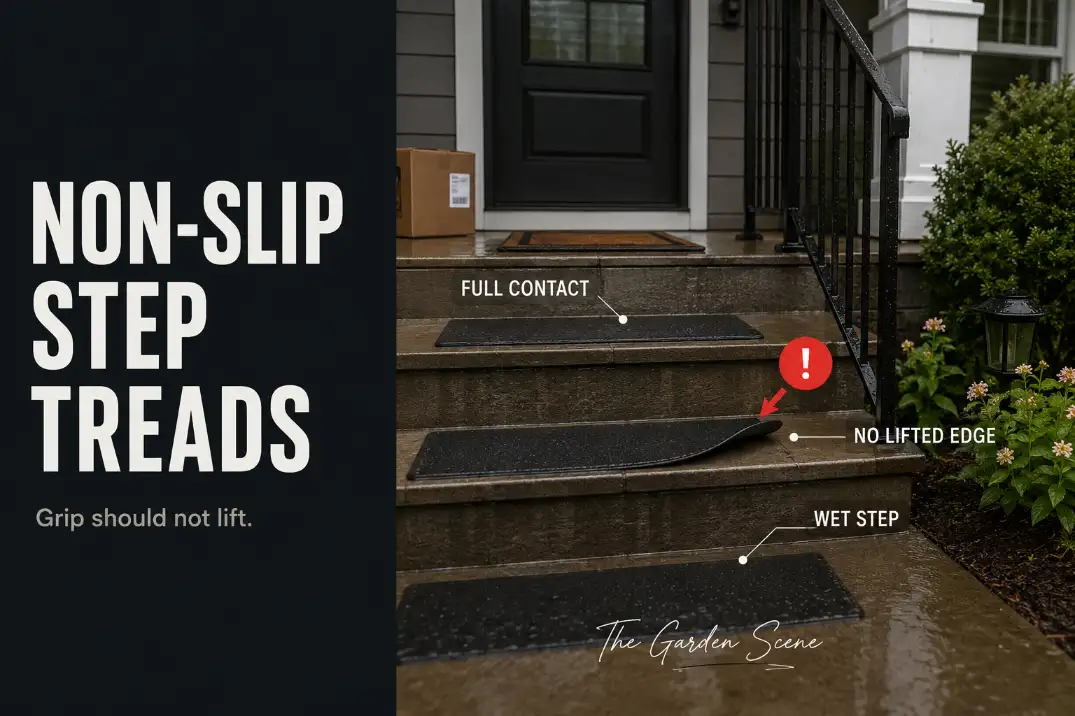
The best non-slip step treads for outdoor entries are the ones that add grip without creating a raised edge, curled corner, or loose strip that catches a foot.
For most U.S. front entries, full-width rubber treads are the strongest first buy when the steps are structurally sound but get slick from rain, dew, light frost, or wet shoes.
Adhesive grip strips work better when only the front 4–6 inches of each step needs more traction. Screw-down metal nosing makes more sense when the step edge itself is worn, shadowed, or hard to see.
Before buying, check three things: whether the step sits solid, whether water drains away within a few hours, and whether any existing tread edge lifts more than about 1/8 inch. A slick step is a traction problem.
A loose tread is a trip problem. A hard-to-see edge is a visibility problem. The right product depends on which one you actually have.
If your outdoor steps are flat, solid, and mainly slick after rain or dew, this is the first category worth buying before you look at tapes, coatings, or decorative mats.
BEST FIRST BUY FOR WET ENTRY STEPS
Outdoor Non-Slip Stair Mats
Choose this category when the step itself is stable, but rain, dew, or light frost makes the walking surface unreliable.
Look for low-profile outdoor stair mats with rubber or weather-resistant backing, beveled edges, drainage texture, and enough coverage for the main foot-landing area.
Skip it if the product looks like a soft indoor carpet tread, holds water, has thick raised edges, or cannot sit flat on your step surface.
🔴 SHOP non-slip outdoor stair mats
Start With the Step, Not the Product
A good tread cannot make a bad step safe. If the step is cracked, crowned, rotted, tilted, or holding water, the tread becomes a cover over the real problem.
That is where many outdoor entry fixes waste money: the product adds texture, but the step still moves, drains poorly, or hides its front edge.
When the step surface is sound but slick
If the step feels stable but gets slippery after rain, irrigation overspray, morning dew, or tracked-in snow, traction is the main issue. Smooth painted wood, sealed concrete, stone, and composite boards can all behave this way.
A common outdoor entry pattern is a step that looks fine when dry but becomes risky for 30–90 minutes after a rain shower or overnight dew. In that case, a tread is not hiding damage; it is adding friction where the shoe lands.
On smooth painted wood, sealed concrete, metal, or glossy composite steps, do not assume a loose rubber tread will stay put. Choose a tread that can be fastened or bonded securely, especially where rain can work underneath the edge.
When the step edge is the real hazard
If people miss the front edge, stub a toe, or step partly off the tread, the issue is not just slipperiness. It is edge readability. A tread that blends into a dark porch or stops short of the nosing may not solve that.
This is especially true on shaded front entries, narrow porch landings, and steps near package drop zones. If the foot cannot quickly read where the next level begins, more surface texture may only solve half the problem.
When a tread becomes the hazard
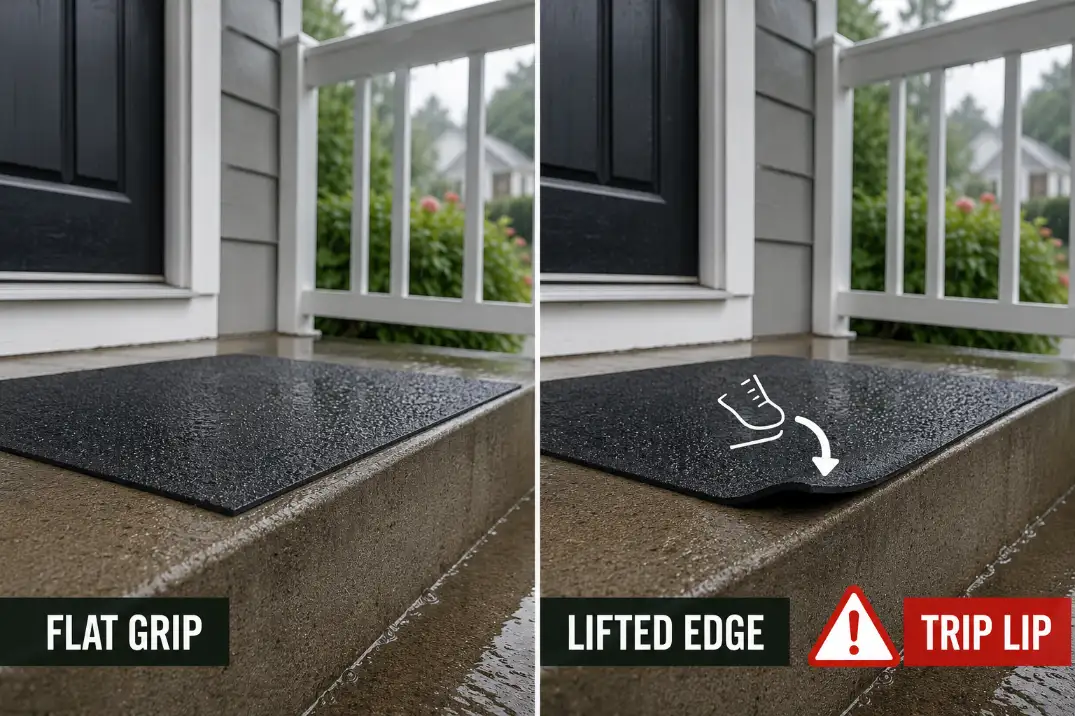
The most misleading failure is a tread that looks useful from the doorway but has one corner lifting. Anything that rises more than about 1/8 inch at the leading edge deserves attention. On stairs, that small lip sits exactly where toes slide forward during descent.
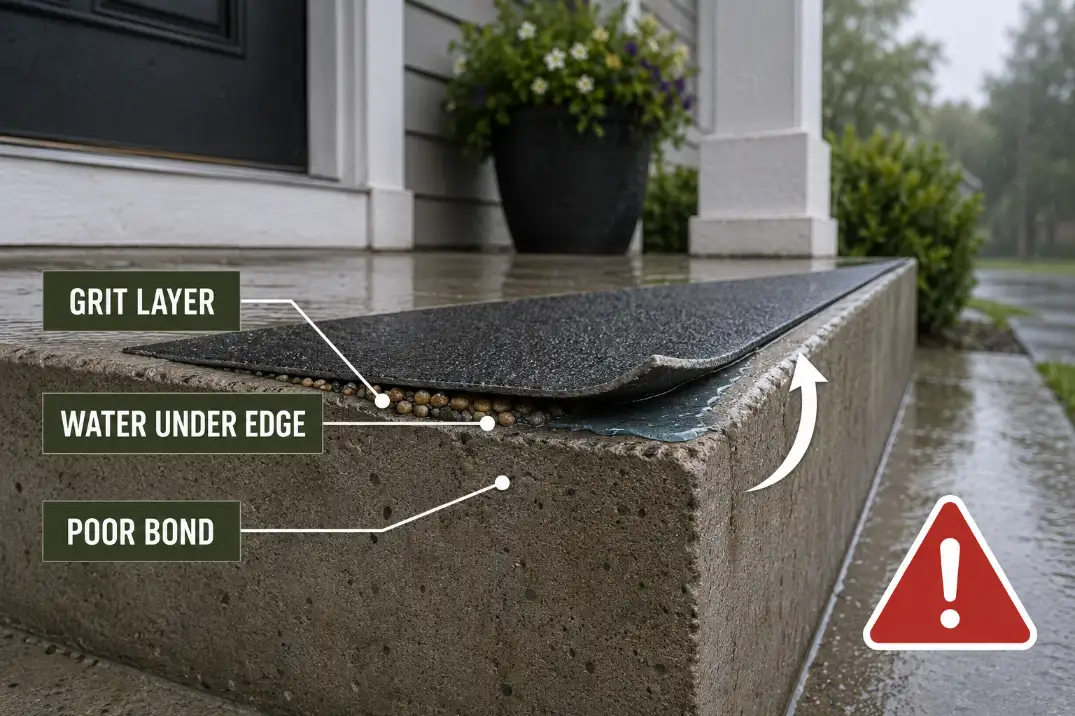
Pro Tip: Press each tread edge with your thumb after the first heavy rain. If the edge flexes, lifts, or traps grit underneath, it is not fully bonded anymore.
Choose the Tread Type by the Failure Pattern
The best tread category is not the one with the roughest texture. It is the one that matches the way your entry fails in real weather.
Full rubber treads for wet everyday steps
Rubber outdoor stair treads are usually the best first category for front steps, porch steps, garage-entry steps, and back-door entries that are structurally sound but slick.
They give broad foot coverage, soften the step feel slightly, and are more forgiving than narrow tape when people do not land in the exact same spot every time.
On a typical 10–11 inch deep step, choose a tread that covers most of the walking surface without creating a bulky front lip. A tread that sits too far back can miss the most important landing zone. A tread with squared, thick edges can create a new toe catch on shallow steps.
Grip strips for clean, flat steps
Anti-slip strips or exterior grip tape make sense when the step is already readable and only needs a traction band where the shoe first lands. This is often the case on painted wood steps, smooth concrete stoops, or newer composite entry steps.
The advantage is precision. A 2–4 inch strip near the front of each tread can improve grip without covering the entire step. The weakness is bonding.
Tape depends heavily on clean prep, dry weather, and full pressure during installation. Many adhesive products need roughly 24–48 hours of dry bonding time before they should be exposed to heavy rain or regular foot traffic.
If the step is clean, flat, and already easy to see, grip strips are the low-profile fix that makes sense. If the surface is peeling, dusty, sealed, or damp, they are usually the wrong buy.
BEST LOW-PROFILE FIX
Exterior Anti-Slip Grip Strips
Choose this category when the step surface is clean, flat, and only needs grip where shoes first land.
Look for exterior-rated adhesive, coarse texture, weather resistance, and enough strip width to cover the main landing zone.
Skip it on dusty concrete, peeling paint, damp wood, or steps that cannot stay dry for the first 24–48 hours.
🔴 SHOP exterior anti-slip grip strips
Metal nosing for worn or hard-to-see edges
Screw-down aluminum stair nosing with a textured insert is the better category when the front edge of the step is the concern. This is not just about grip. It gives the foot a defined edge and can make a worn step read more clearly in shadow.
This is the category people often underbuy. They keep adding tape to the flat part of the tread when the real problem is that the edge disappears at night, blends into the porch, or feels rounded from wear.
If the step edge is the part people miss, do not buy more surface texture first. Buy edge control.
BEST FOR STEP EDGE CONTROL
Outdoor Non-Slip Stair Nosing
Choose this category when the step edge is worn, dark, chipped, rounded, or easy to misread in shadow.
Look for a low-profile outdoor stair nosing or edge protector with visible contrast, textured grip, weather-resistant material, and secure adhesive or fastening.
Skip it if the step edge is too damaged to hold the nosing flat or if the product looks too bulky for a shallow entry step.
🔴 SHOP outdoor non-slip stair nosing
What Makes Outdoor Treads Fail Early
Most tread failures come from contact problems, not from the idea of using treads. The product can be decent and still perform poorly if the step surface, weather, or installation method works against it.
Outdoor steps collect grit, pollen, leaf dust, salt residue, and algae film. If that layer is still present, adhesive bonds to debris instead of the step. A tread may feel secure on day one, then lift after the first 2–3 rain events.
Cleaning is not just cosmetic. A step should be washed, dried, and checked for loose paint or sealer before adhesive products go down. If water beads on the step instead of drying evenly, the surface may be sealed enough that some adhesives struggle.
Cold installation is another quiet failure point. Many adhesive-backed treads and tapes need moderate temperatures to bond well.
Installing them on a cold morning below about 40°F can leave the adhesive stiff before it has fully grabbed the surface. In northern states, the better installation window is often a dry afternoon, not the first freezing weekend when the step becomes slippery.
If the entry also has a delivery zone or tight landing, tread placement should not narrow the walking route. A safer surface still has to be easy to use while someone is carrying a bag, holding a rail, or stepping around a package, which is why route clarity matters in Front Walkway Safety for Visitors and Deliveries.
Quick Comparison: Which Non-Slip Tread Should You Buy?
| Tread category | Best use | Watch first | Avoid when |
|---|---|---|---|
| Outdoor rubber treads | Wet, stable porch or entry steps | Full contact and beveled edges | Step surface is uneven or crumbling |
| Exterior grip strips | Clean wood, concrete, or composite steps needing a traction band | Surface prep and dry bonding time | Paint, dust, or sealer is peeling |
| Aluminum nosing with grip insert | Worn or hard-to-see step edges | Straight, flush fastening | You cannot drill or fasten securely |
| Textured stair mats | Temporary or seasonal traction | Shifting under foot | Wind, ice, or daily traffic moves them |
| Coating or grit additive | Large uniform surfaces | Prep, cure time, and drainage | Only one step edge is the problem |
This comparison should narrow the decision fast. If the step is slick but flat, start with rubber treads. If the step is clean and you want the least visual change, use exterior grip strips. If the edge is worn, shadowed, or chipped, choose nosing before tape.
For older adults or anyone with balance concerns, edge clarity matters as much as surface texture. The same logic applies to garden and entry routes where stable footing depends on a readable surface, not just a decorative finish, as explained in Safe Garden Paths for Seniors That Feel Stable.
Installation Details That Decide Whether Treads Stay Safe
A non-slip tread is only as safe as its weakest edge. That sounds obvious, but it is the detail most often missed because the top surface looks grippy.
Keep the front edge readable
Do not place a tread so far back that the front nosing disappears. On outdoor steps, people often look at the door, package, handrail, or landing, not directly at their feet. A tread should reinforce the step edge, not visually erase it.
If the front landing is small, keep the walking zone open before adding thicker tread material. A tread that improves grip but narrows the usable landing can create a different entry problem.
That is where Front Door Landing Clearance becomes part of the same safety decision, especially near storm doors and package drop spots.
Avoid thick edges on shallow steps
Thicker is not automatically safer. A bulky tread on a shallow step can shorten the usable foot area and create a lip. If the step is only about 9–10 inches deep, a low-profile tread with a beveled front edge usually feels better than a heavy mat with a squared edge.
People often overestimate how much texture they need and underestimate how much edge shape matters. For daily entries, a tread that stays flat for 12 months is more valuable than an aggressively rough surface that begins peeling in one season.
Test after real weather
The meaningful test is not how the tread feels five minutes after placement. Check it after the first heavy rain, after the first freeze-thaw cycle if you live in a cold region, and again after two weeks of normal use.
Look for corners lifting, water trapped underneath, grit collecting at the front edge, or a tread shifting by even 1/4 inch. Movement that small may not look dramatic, but on a step it means the product is no longer acting like part of the surface.
Pro Tip: If one tread fails before the others, do not replace that single piece immediately. First check whether that step gets more roof drip, sprinkler spray, shade, or foot pivoting than the rest.
When Treads Are Not Enough
Treads help with surface grip. They do not fix bad geometry, weak lighting, crowded landings, loose handrails, or steps that move under weight.
Standing water means drainage comes first
If water sits on the step for more than 4–6 hours after rain, the tread is being asked to solve a drainage problem. It may add grip for a while, but moisture will keep working under edges, into fastener holes, or around adhesive lines.
That is the point where a surface product stops making sense as the main fix. If the entry is holding water near the threshold, the better starting point may be drainage, slope, or landing correction.
The same surface-versus-water distinction shows up in Slippery Patio Finish, Cleaning, Sealer, or Drainage?, where the visible slip is often only the symptom.
Poor lighting makes a good tread underperform
If the step is easy to see during the day but confusing after dark, a tread alone may disappoint. Edge contrast and low glare matter. A small path or step light that reveals the front edge can do more than adding a second layer of grip.
This is especially important for entries with dark porch paint, black rubber treads, or deep shadows from railings. The lighting plan should show the step edge without shining into the eyes.
For route visibility, Path Lighting for Steps, Slopes, and Walkways connects directly to the same safety problem.
Damaged steps need repair before tread upgrades
If concrete is flaking, wood is soft, paint is peeling, or the step rocks under pressure, do not spend money on premium tread material first. The tread may hide the surface for a short time, but it will not stop movement or decay.
A routine tread fix stops making sense when more than one step has loose material, when water stays trapped at the edge, or when the tread cannot make full contact across the surface. At that point, the repair order is step first, tread second.
Questions People Usually Ask
Are rubber step treads better than anti-slip tape?
Rubber treads are usually better for full outdoor steps where people land in slightly different spots, especially at busy front entries. Anti-slip tape is better when the step is clean, flat, and only needs a narrow traction strip near the front landing zone.
Can non-slip treads be used on wooden porch steps?
Yes, but wood must be clean, dry, and sound. Adhesive products struggle on damp, peeling, or rough wood. Screw-down options can work better, but fasteners should not split weak boards or trap water.
Should outdoor step treads cover the whole step?
Not always. Full coverage helps when the entire step gets slick, but a low-profile strip can be enough when the main risk is shoe contact near the front edge. The tread should improve grip without hiding the step edge or adding a raised lip.
What is the safest choice for older adults?
For older adults, prioritize a flat, secure tread with clear edge contrast over the roughest texture. Grip matters, but a lifted edge, poor lighting, or hard-to-read step can be more dangerous than a moderately slick surface.
The strongest choice is not the most aggressive tread. It is the tread that matches the step, stays flat through weather, keeps the edge visible, and does not create a new trip point while solving the old slip problem.
For broader official fall-prevention guidance around stairs and home safety, see the CDC STEADI patient resources.