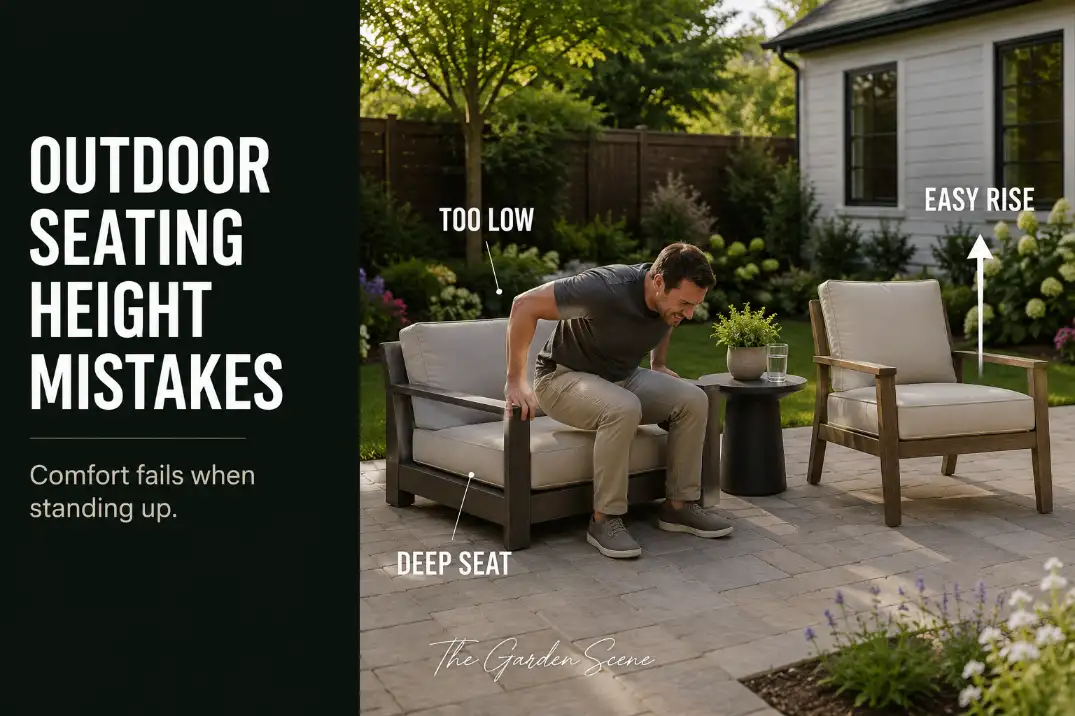
Outdoor seating height mistakes happen when a chair’s height, depth, cushion softness, arm support, and patio clearance do not support an easy sit-to-stand movement.
The real problem is the rise path: how the hips, knees, feet, hands, and patio surface work together when someone tries to stand.
A seat around 12–14 inches high can look relaxed but feel difficult after 20–30 minutes, especially if the cushion sinks or the seat is deep.
A chair around 17–19 inches high usually works better for dining and everyday use, but even that can fail if the legs rock on pavers or the person cannot pull the chair back at least 24 inches.
This is not always a small-patio layout problem. Sometimes the patio has enough room, but the furniture makes every sit, turn, and stand-up motion harder than it should be.
Low Seating Looks Relaxed
The mistake is choosing the photo, not the movement
Low outdoor seating looks calm in a product photo because no one is trying to get out of it. On a real patio, that same low chair has to work after dinner, during conversation, when someone is holding a drink, or when a guest does not want to make standing up feel awkward.
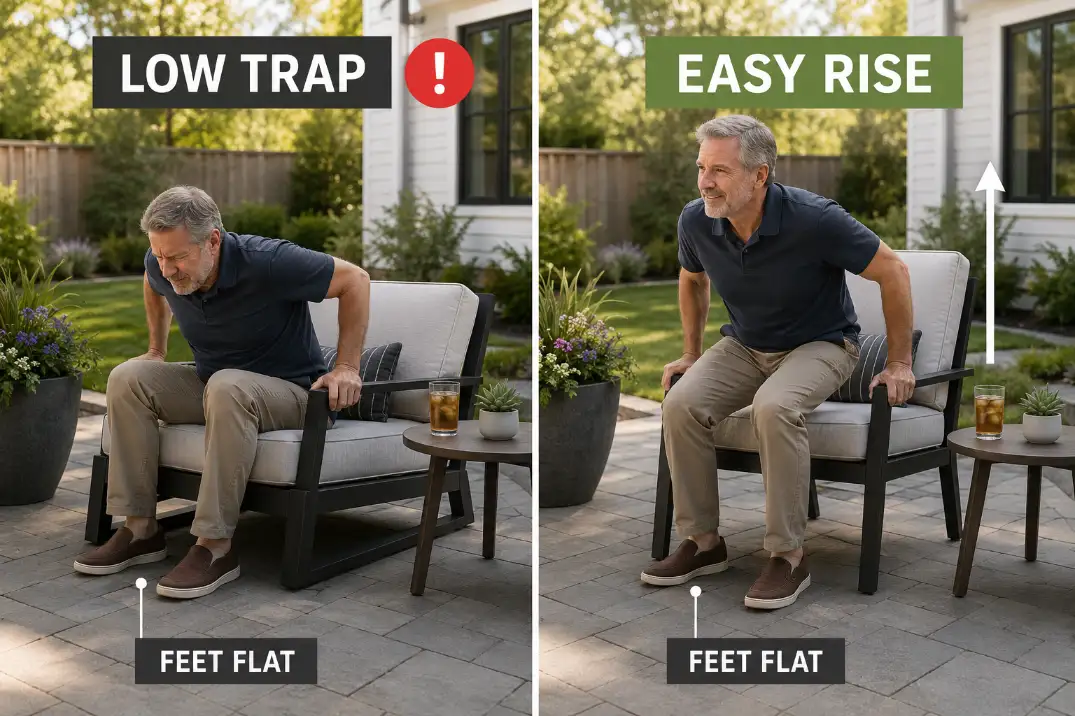
The first warning sign is hips dropping lower than the knees. Once that happens, the sitter often needs to rock forward before rising. If the chair is also soft, angled back, or armless, the body has to travel farther before the feet can do the work.
For everyday patio use, a 16–18 inch lounge seat usually works better than a very low 12–14 inch frame. Dining and conversation chairs often sit closer to 17–19 inches.
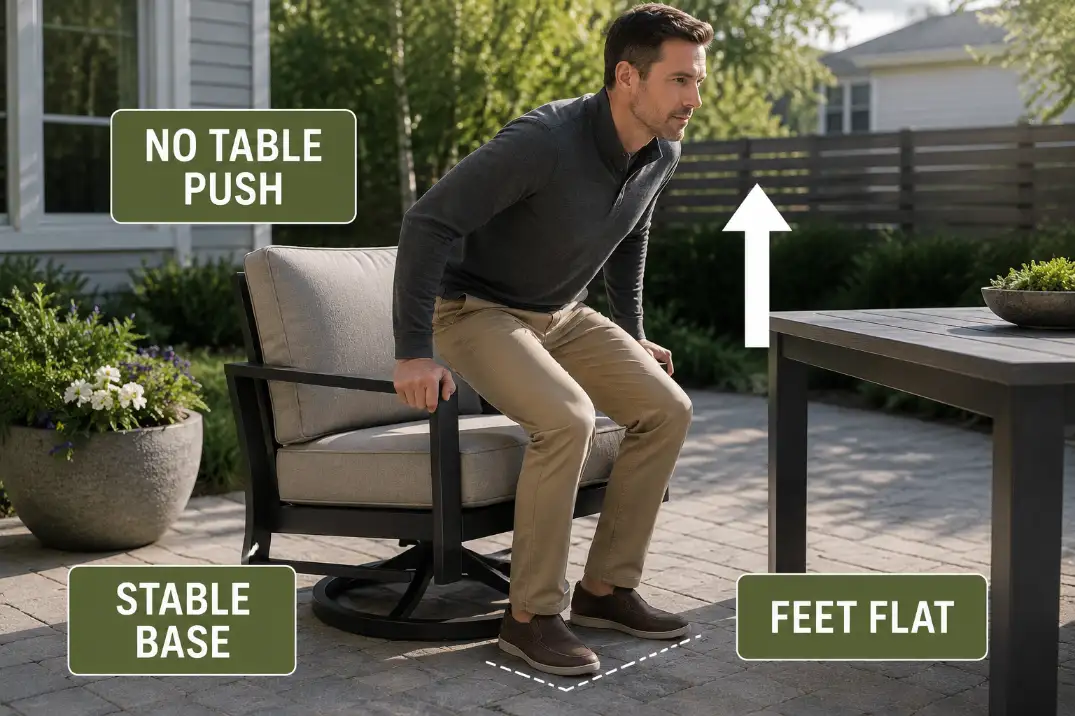
The exact number matters less than whether the person can place both feet flat, lean forward naturally, and stand without grabbing the table.
Thick cushions do not always fix low seating
A thicker cushion sounds like the obvious fix, but it often raises the chair only on paper. If a 3-inch cushion compresses more than about 1 inch after a few minutes, the usable seat height may still feel too low. Soft cushions can also push the sitter deeper into the back angle, which makes standing up harder, not easier.
This is where many homeowners waste money. They keep replacing cushions when the frame height and seat angle are the real problem. A firmer front edge, a slightly higher frame, or a more upright chair usually changes the outcome more than another soft cushion.
Low seating is not wrong. It is just better as a true lounge choice than as the main seat for eating, conversation, or mixed-age guests.
The same problem becomes more obvious in compact layouts where deep furniture already steals movement space, especially in situations like Deep Seating on Small Patios.
Deep Chairs Trap People
Seat depth controls the exit path
Deep chairs are often a bigger problem than low chairs because the issue stays hidden until someone tries to stand. A chair can have a reasonable seat height and still be difficult if the usable depth pushes the sitter too far back.
Once usable seat depth passes about 23–24 inches, many people need to slide forward before rising. That extra slide is the giveaway.
If someone has to scoot forward, brace on the arm, then stand, the chair is not simply deep. It is interrupting the exit path.
This matters most in conversation seating, fire pit seating, shaded patio corners, and outdoor rooms where people stand often.
A deep chair can be fine for one long lounge session. It is weaker when people are eating, greeting guests, moving between zones, or getting up every 10–15 minutes.
The symptom is shifting; the mechanism is poor leverage
The visible symptom is a person shifting several times before getting up. The mechanism is poor leverage. The hips sit too far back, the feet land too far forward, and the torso has to travel farther before body weight moves over the feet.
That is why a chair can feel comfortable at first and frustrating later. The first 30 seconds measure softness. The next 20 minutes reveal whether the body can exit cleanly.
For patios used by grandparents, neighbors, or guests with different mobility levels, at least some seats should allow a clean sit-to-stand motion. That does not mean the patio has to look clinical.
It means the seating mix should include upright, supportive options, which is also part of the broader logic in Patio Layout for Older Adults.
The 30-Second Patio Chair Test
Test the chair the way people actually use it
Before buying outdoor seating, do not only sit down and judge the first impression. Use a quick rise test.
Sit for 30 seconds. Put both feet flat on the patio surface. Stand without pushing on the table. Sit again. Then notice four things: whether you had to slide forward first, whether you needed two hands, whether the chair rocked, and whether standing took more than about 3–4 seconds.
If the chair fails that test in a showroom or on a flat store floor, it will usually feel worse on a real patio. If it barely passes indoors, it may fail on paver joints, deck board gaps, gravel-set patios, or a slightly sloped slab.
Pro Tip: Test the chair after sitting for a few minutes, not just the first moment. Low, soft, and deep seating often feels good immediately and fails after the cushion settles.
Do not ignore the patio surface
Outdoor furniture has to work on imperfect ground. A chair that feels stable on a showroom floor may rock on pavers, catch in deck gaps, or tilt slightly on an older concrete slab. If the chair moves before the person stands, the base is the problem, not the seat height.
This is why narrow legs, small feet, and lightweight frames can be disappointing outdoors. They may look clean, but they put more pressure on small contact points. Wider feet and firmer frames often feel more secure, especially on textured patios.
Armrests Change Everything
Armrests are push points, not decoration
Armrests can make a slightly low chair much easier to use. They can also do almost nothing if they are too low, too narrow, or too far behind the sitter.
A useful outdoor armrest usually sits around 24–26 inches from the floor and gives the hand a place to push down. That direction matters.
Pushing down helps the body rise. Pulling sideways can twist the chair, especially if the legs are light or the patio surface is uneven.
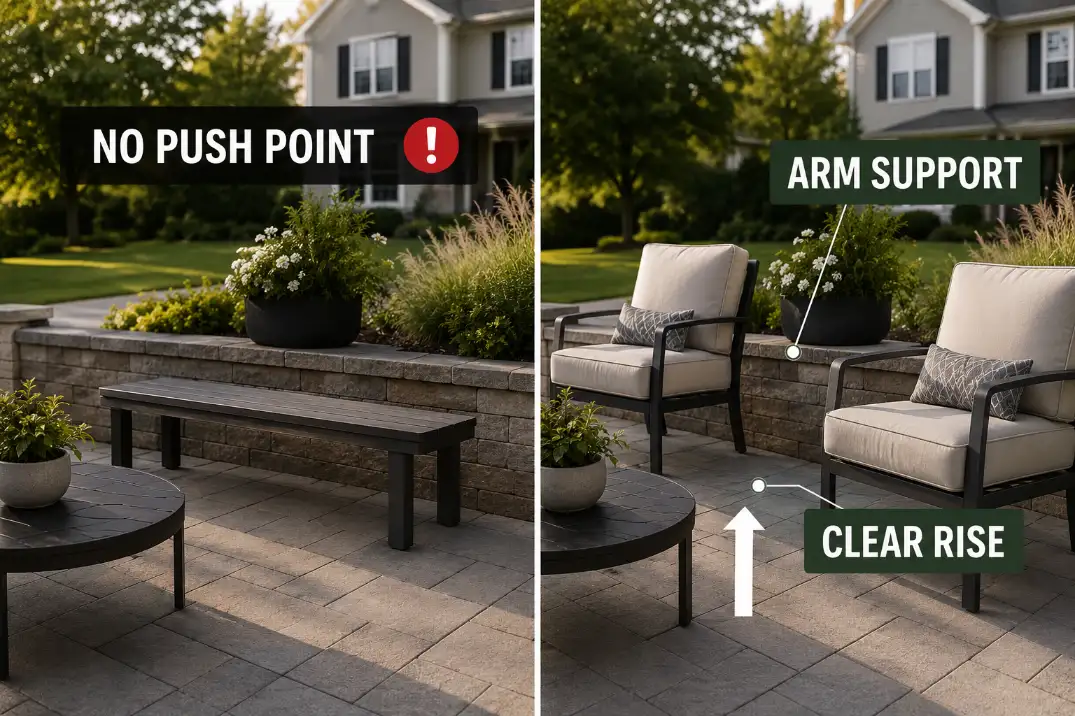
The best armrests are not always the sleekest ones. Thin armless chairs save visual space, but they remove one of the simplest support points on the patio.
If every seat is low, soft, and armless, the space may look open while becoming harder for real guests to use.
Armless seating should not be the only option
Armless chairs can still work well in tight spaces, especially around dining tables where side clearance is limited. The mistake is using them everywhere because they look lighter.
A better patio usually has at least one or two seats with real arm support. Those chairs become the seats people quietly choose when they need stability.
This is especially important when the patio is meant to welcome different ages and body types, not just fit a matching furniture set.
Support does not have to dominate the design. It can be built into a normal-looking club chair, upright lounge chair, or dining chair with simple arms.
That is the better version of accessible design: the furniture feels natural, but it gives people a way to move comfortably. This same principle carries through larger layout choices in Accessible Outdoor Space Ideas.
Dining Chairs Need Stability
Correct height still fails without pullback space
Outdoor dining chairs have a narrower job than lounge chairs. They need to let people sit upright, eat, pull back, turn, and return without fighting the surface. A seat height around 17–19 inches usually pairs well with a 28–30 inch dining table, but that relationship only works if the chair can move.
A dining chair can have the right height and still fail if it cannot pull back smoothly. As a practical threshold, 24 inches behind the chair is tight but sometimes workable. Around 30–36 inches feels much better when someone needs to pull out, stand, or pass behind another seated person.
This is where many patio dining sets disappoint. The table looks proportionate, the chairs match, and the set fits the patio footprint. But once people sit down, the chair backs hit a wall, planter, rail, grill, or door path. The issue is not the set’s style. It is the missing movement zone.
Stability matters more outdoors than indoors
Outdoor dining chairs also need to resist twisting. A chair that rocks when someone shifts weight makes the sitter cautious.
That caution changes how people use the whole dining area. They pull the chair less, sit more stiffly, and avoid moving around the table.
Before replacing a dining set, check the surface and clearance together. If the chair can pull back 30 inches and stay steady, the height may be fine.
If it catches, tilts, or cannot move without bumping another object, the patio has a clearance problem. That is why Outdoor Dining Chair Clearance is often a more useful fix than simply buying a different table shape.
| Seating choice | Common mistake | Better target | Quick test |
|---|---|---|---|
| Low lounge chair | Seat sits around 12–14 inches high | Use a firmer 16–18 inch seat for everyday use | Stand without rocking twice |
| Deep chair | Usable depth runs past 23–24 inches | Keep feet flat before rising | No forward scoot needed |
| Dining chair | Right height but trapped behind table | 24–36 inches of pullback space | Chair moves back smoothly |
| Armless chair | Saves visual space but removes support | Mix in at least one supportive armchair | Stand without grabbing table |
| Bench | Saves room but lacks support | 17–19 inch height with nearby support | Middle seat still feels usable |
Benches Are Not Always Easier
Benches save space, but they remove control
Benches look simple, and sometimes they are the right choice. They can work well for overflow seating, quick pauses, kids, garden edges, and narrow patios where individual chairs would crowd the route. The mistake is assuming a bench is automatically easier than a chair.
A backless bench with no arms may save inches, but it asks the sitter to balance, scoot, and stand without a clear push point. That is fine for short use. It is weaker for long meals, older guests, or anyone who needs a stable place to rise.
A practical outdoor bench usually works best around 17–19 inches high with a seat depth around 16–18 inches. Too shallow feels temporary.
Too deep creates the same exit problem as a lounge chair. If the bench has a back, arms, or a wall behind it, it becomes more supportive. If it is just a long flat surface, it may be less welcoming than it appears.
The middle seat reveals the truth
The best way to judge a bench is to watch where people sit. If everyone uses the ends and avoids the middle, the bench is not functioning as full seating. People choose the ends because they can turn out, brace on the side, or stand with less awkward shifting.
Adding cushions may make the bench softer, but it does not solve the support problem. Once cushions slide, compress, or lift the sitter above a stable edge, the bench becomes less predictable.
The better decision is to give the bench a specific job: short pause seating, overflow seating, or edge seating.
For main patio seating, individual chairs usually manage bodies better than a long bench. If you still want a bench for a small patio, choose it for firm height, shallow depth, and clear side access first; Best Patio Benches for Small Patios is the more useful next step after that decision.
Seating That Welcomes Everyone
Mix seating jobs instead of matching everything
The strongest patio seating plan usually does not use one chair type everywhere. It mixes jobs. One or two upright chairs handle conversation and easy standing.
A deeper lounge chair handles resting. A bench or side seat handles overflow. The point is not variety for decoration. The point is giving different bodies different ways to sit.
This is where matching sets can become a trap. A full set of low, armless, deep chairs may look calm and coordinated, but it repeats the same weakness across the whole patio. Four usable seats are better than six seats people avoid.
Before buying a complete set, make sure at least one seat passes the rise test, one seat works for dining or upright conversation, and one seat gives a guest real arm support.
If the easiest seat is tucked into the tightest corner, it is not really the easiest seat. Leave a clear approach zone near the most supportive chair or bench, not just a narrow path in front of it.
If the furniture also blocks routes, crowds doors, or forces awkward side steps, the seating issue may be part of the larger layout mistakes covered in Patio Furniture Mistakes in Small Backyards.
The final buying filter
Use this order before choosing outdoor seating: rise path first, stability second, clearance third, style fourth. Style matters, but it cannot fix a chair that traps people or rocks when they try to stand.
A good everyday patio seat should let most adults place both feet flat, lean forward without sliding, and stand without using the table.
If several guests need two hands, a forward scoot, extra rocking, or more than 3–4 seconds to rise, the chair is too low, too deep, too soft, too unstable, or too boxed in for the way the patio is actually used.
Outdoor seating should make the patio feel easier, not just fuller. When height, depth, arms, surface contact, and clearance work together, the space feels more generous even before anything gets bigger.
For broader outdoor accessibility guidance on benches and clear ground space, see the U.S. Access Board outdoor developed areas guide.