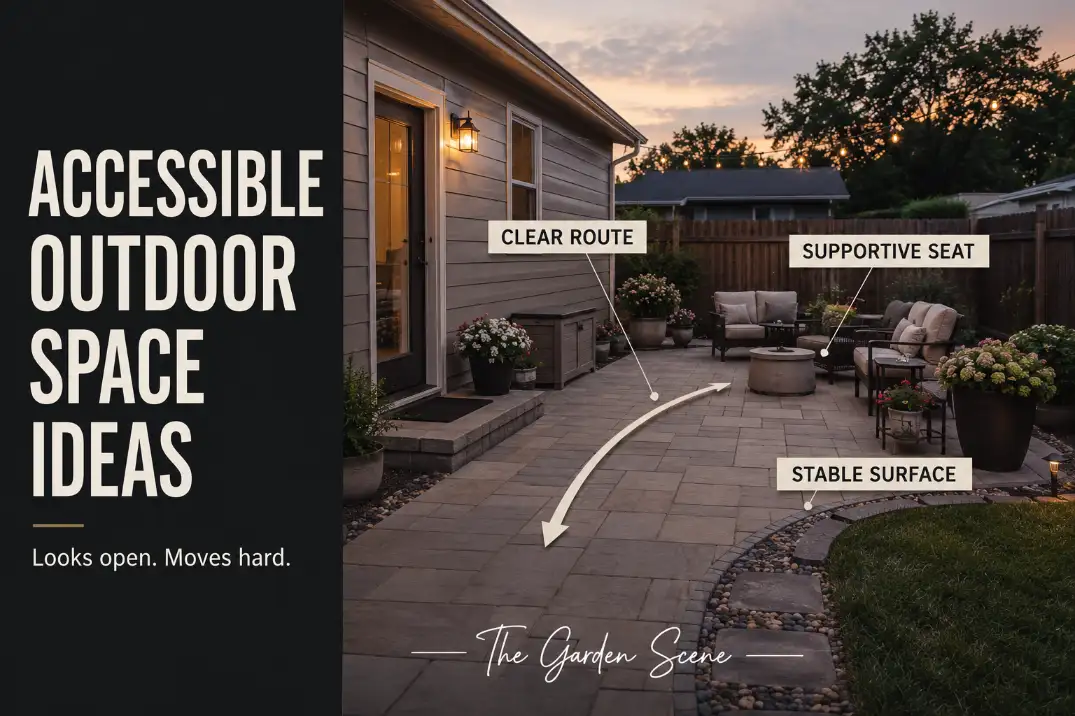
Accessible outdoor space ideas should start with the route people actually use, not the patio footprint shown when everything is tucked in.
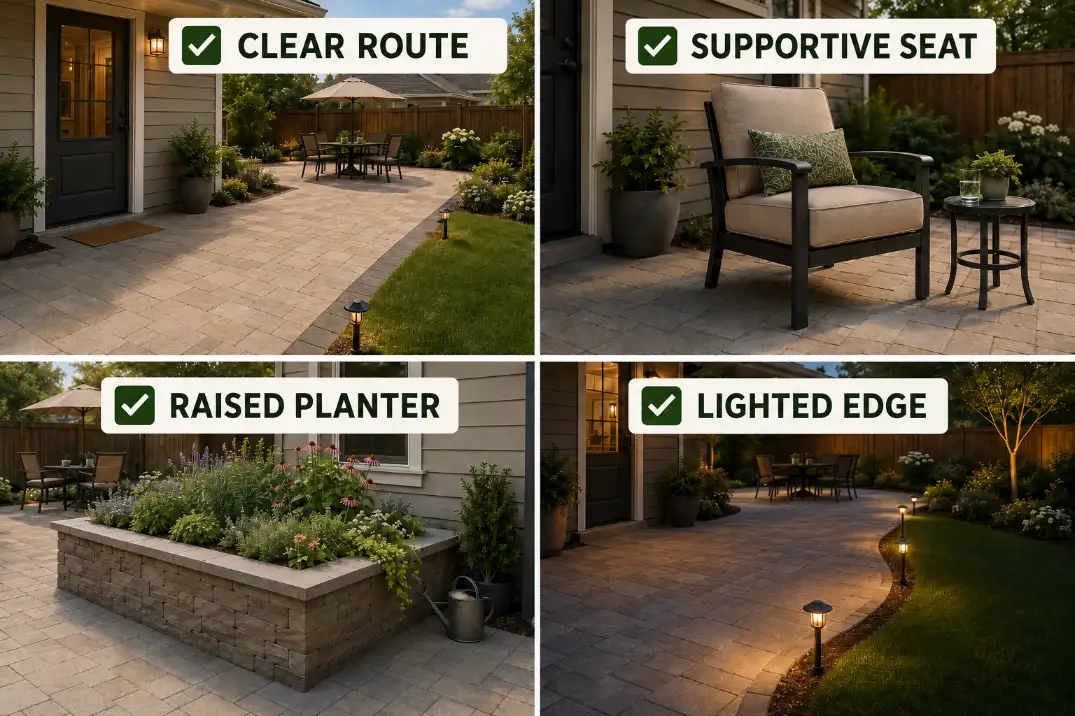
The fastest improvement is usually this order: clear the main route first, stabilize the surface second, choose supportive seating third, then use lighting and edges to make the path obvious.
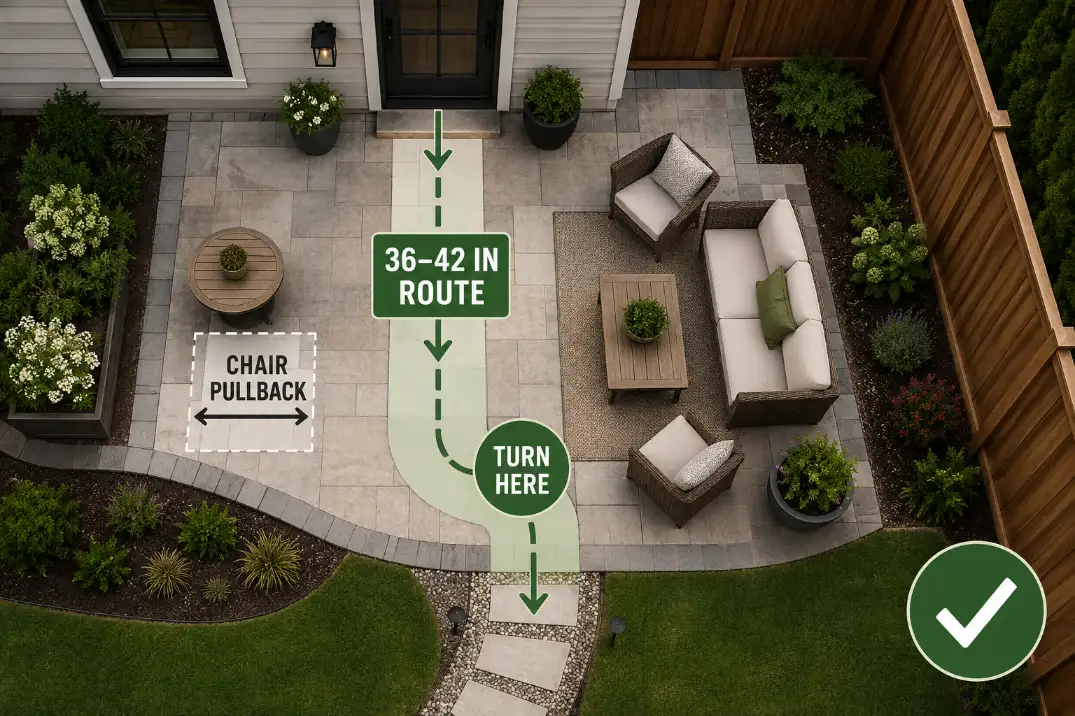
A practical first check is simple: can someone move from the door to the main seat on a 36-inch clear path without stepping around chair legs, planters, hoses, loose mats, or uneven joints?
If two people need to pass, someone uses a mobility aid, or chairs pull back into the route, 42 inches feels much more usable.
This article is homeowner design guidance, not a formal ADA compliance assessment, but the same basic idea applies outdoors: movement needs firm ground, enough width, and fewer surprises.
Easy Movement Comes First
The best accessible outdoor space is rarely the one with the most features. It is the one where the body does not have to keep negotiating obstacles.
Design for the Active Footprint
A patio can look open in a photo and still fail during real use. Dining chairs often pull back 18 to 24 inches. A side table shifts into the walking line. A planter that looked harmless near the door becomes the thing everyone steps around.
That is why the first design move is not buying new furniture. It is marking the active route from the door to the seat, table, yard, grill, or garden area. If the route disappears when someone sits down, stands up, or carries a tray, the layout is not actually accessible.
Entry zones deserve extra discipline. The door area should not ask someone to open a door, step down, turn, avoid a planter, and pass a chair in the same small space.
If the patio already has that problem, the same clearance logic in Keep Patio Entry Clear applies before any decorative upgrade matters.
Keep Turning and Pause Areas Clear
Width is only part of the experience. People also need places to turn, pause, steady themselves, and change direction.
A landing beside the door, a small open pocket beside the main seat, or a wider point where the path meets the patio can matter more than another accent piece.
A useful rule: if someone has to back up, shuffle sideways, or grab furniture for balance, the route is doing too much. The fix is usually subtraction before addition. Remove the loose items, then decide whether the surface, furniture, or slope still needs work.
The Path Must Feel Obvious
An accessible outdoor path should not need verbal explanation. People should be able to see where to go before they step outside.
Use Edges, Contrast, and Light
The best path cues are quiet: a clean paving edge, a slightly different surface texture, a visible border, low-glare lighting, or furniture arranged so the route reads naturally.
These cues help everyone, but they become more important for guests with low vision, balance concerns, or slower movement.
At night, the path has to reveal step edges and surface changes without glare. A small path light every 6 to 8 feet is often more useful than one bright fixture that washes out the whole patio.
If the route includes steps or sloped walkways, Path Lighting for Steps, Slopes, and Walkways supports the same idea: lighting should explain the route, not just decorate it.
Avoid Beautiful Detours That Make Movement Harder
Curved paths, staggered stepping stones, and offset planters can look intentional but still make movement harder. A gentle curve is useful when it avoids a real obstacle or softens a grade. It is less useful when it simply turns a direct route into a decorative detour.
This is one condition homeowners often overestimate: visual charm. A garden path can be beautiful and still make the outdoor space less accessible if it forces extra turns, narrow steps, loose footing, or unclear direction.
Pro Tip: Keep the most accessible route calm and predictable. Save decorative complexity for the edges, not the walking line.
Seating Should Help People Stand
Outdoor seating should support the moment of standing, not just the moment of sitting. This is where many attractive patio sets quietly fail.
Choose Seats With Real Support
A seat height around 17 to 19 inches works better for many adults than very low lounge seating. Firm arms matter because they give the body a stable place to press when standing.
A chair that is too deep, too low, too soft, or armless can make people lean, twist, and push awkwardly before they can get up.
This does not mean the patio has to look clinical. Upright lounge chairs, firm dining chairs, and compact benches with arms can look residential while still giving better support.
When the goal is a small but usable seating zone, Best Patio Benches for Small Patios can fit naturally because the right bench can create support without scattering chair legs across the route.
Leave Space Beside the Seat
A supportive chair still fails if it is jammed into a corner. People need side space to approach, turn, sit, and stand without scraping a wall, planter, table leg, or another chair. The better seat is not always the biggest one. It is the one that leaves usable approach space.
The common waste of money is buying “accessible-looking” furniture while keeping the same cramped layout. If the body still has to twist around a table or step backward into the route, the new chair has not solved the real problem.
Accessible Ideas That Change Daily Use
The strongest accessible outdoor spaces usually combine a few simple ideas rather than one dramatic feature.
| Accessible idea | What it improves | Watch this mistake |
|---|---|---|
| Clear back-door landing | Safer entry and exit | Filling it with planters or storage |
| 36–42 inch main route | Easier movement through the patio | Measuring only when chairs are tucked in |
| Supportive seat with arms | Easier standing and resting | Choosing deep low lounge chairs only |
| Raised planter zone | Easier gardening and reach | Making the planter too deep from one side |
| Low-glare path lighting | Better night movement | Using harsh light instead of edge visibility |
| Stable, low-slip surface | Better footing after rain | Treating slickness as only a cleaning issue |
Add Reachable Activity, Not Just Reachable Seating
Accessibility is not only about reaching a chair. A better outdoor space lets people participate. That might mean a raised planter near the patio edge, a reachable herb station beside the seating area, or a small side table placed where it does not block the path.
For one-sided access, a planter depth around 18 to 24 inches is easier to reach than a deep bed that forces leaning. If people can approach from both sides, the planting area can be wider.
The main point is not the exact planter style; it is whether someone can use it without stretching across wet soil, stepping off a stable surface, or blocking the route.
Slopes Change the Experience
Slope is one of the most underestimated outdoor accessibility issues because it can look harmless until someone has to move across it slowly, carry something, or stop halfway.
Small Slopes Can Feel Bigger Outdoors
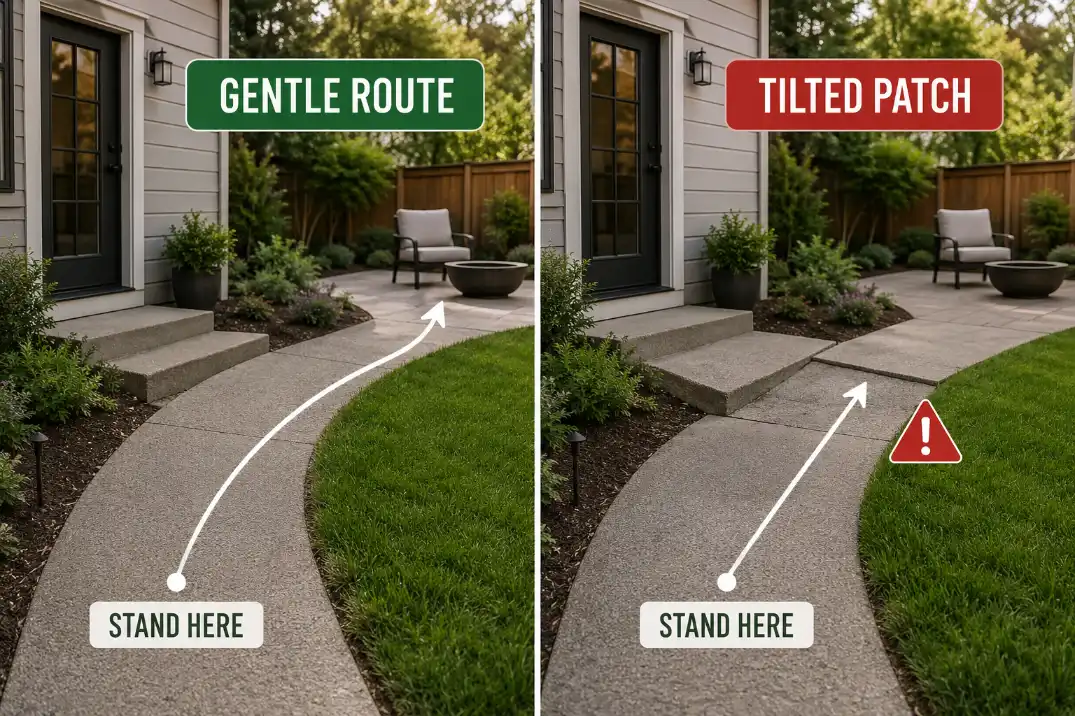
A mild grade may feel fine when the surface is dry and the person is empty-handed. It can feel very different after rain, in low light, with a walker, or while carrying food. Cross slope is especially easy to underestimate because it tilts the body sideways. Even a subtle tilt near 2% can feel noticeable for some users.
Furniture also changes on a slope. A chair on a tilted patio does not just look uneven; it can make sitting and standing harder because the body has to correct its balance before moving.
If people hesitate at the same tilted spot more than once, treat that as a design signal, not a personal weakness.
Fix the Transition Before Decorating Around It
Small steps, raised thresholds, sloped paver edges, and uneven lawn-to-patio transitions often get hidden with mats, planters, or furniture.
That rarely works. A mat can curl. A planter can narrow the route. Furniture can make the transition harder to see.
When slope and runoff are both present, the route can get worse over one rainy season instead of staying stable. Soil movement, washout, and water crossing the path can turn a tolerable grade into loose or slippery footing, which is why Yard Drainage Problems From Soil, Slope, and Runoff belongs in the same conversation as access.
Pro Tip: If the same spot causes hesitation, grabbing, shuffling, or avoidance, stop treating it as a minor inconvenience. That is the spot to redesign first.
Surface Stability Matters
The surface underfoot matters more than the material name. Concrete, pavers, decking, compacted gravel, and stone can all work or fail depending on stability, joints, drainage, texture, and maintenance.
Stable, Firm, and Low-Slip Beats Pretty
A usable surface should not shift, wobble, sink, or become slick during normal use. Loose gravel, wide paver gaps, raised joints, polished stone, slick sealed concrete, and aging deck boards can all create access problems even when they look attractive.
Surface trouble often appears after time. A patio may feel fine for the first 3 months, then begin rocking after poor base compaction, freeze-thaw movement, tree roots, or runoff.
Water that still sits on the walking surface after 24 hours is not just a cosmetic puddle. It can point to a low spot, drainage conflict, or surface choice that will become harder to use.
If the surface itself needs to be safer, Best Low-Slip Patio Surfaces for Family Backyards is a useful next decision because slip resistance is not only a family safety issue; it is also an accessibility issue.
Separate the Symptom From the Mechanism
The symptom is the wobble, slickness, puddle, or raised edge. The mechanism is usually water, movement, texture, weak base support, or edge failure. Treating the symptom alone is why quick fixes disappoint.
A cleaner, sealer, rug, or new chair may make the patio look better for a short time, but it will not solve a paver that lifts over 1/2 inch, a low spot that holds water, or gravel that rolls underfoot every time someone turns.
| Surface signal | What it usually means | Better priority |
|---|---|---|
| Chair rocks when someone sits | Uneven surface or weak base | Fix surface before furniture |
| Water sits longer than 24 hours | Poor drainage or low spot | Correct slope or runoff path |
| Gravel shifts underfoot | Surface lacks firm confinement | Add edging, grid, or choose another surface |
| Paver edge lifts over 1/2 inch | Base movement, roots, or freeze-thaw | Reset before it becomes a trip point |
| Surface feels slick after rain | Texture, algae, sealer, or shade issue | Clean, improve drainage, reassess finish |
Safe Without Looking Clinical
Accessible outdoor design does not need to look institutional. The best version feels calm, residential, and easy to use.
Hide the Work in Good Design
Wide routes can look intentional when framed with planting. Supportive seating can look relaxed with cushions and warm materials. A raised planter can feel like a garden feature, not an accommodation. Low path lighting can make edges visible without turning the patio into a parking lot.
This is the design balance that matters: do not hide safety by removing the features people need. Instead, translate safety into the visual language of the yard.
Use planted edges instead of warning clutter, warm lighting instead of harsh glare, and firm residential furniture instead of medical-looking pieces.
Make the Space Easier Before Making It Busier
The right improvements are the ones that reduce effort. A light fixture helps more after the route is already clear. A better chair helps more when there is room beside it.
A raised planter works better when it can be reached from firm ground. Each feature should make the space easier to use, not simply more complete.
The best accessible outdoor space does not announce itself as accessible. People simply know where to walk. They can sit without dropping too low.
They can stand without searching for support. They can cross the surface after rain without wondering if the next step will shift.
That is the real standard: not whether the patio looks open when empty, but whether it still works when people are tired, carrying things, visiting at night, moving carefully, or using the space longer than expected.
For official surface guidance, see the U.S. Access Board guide to floor and ground surfaces.