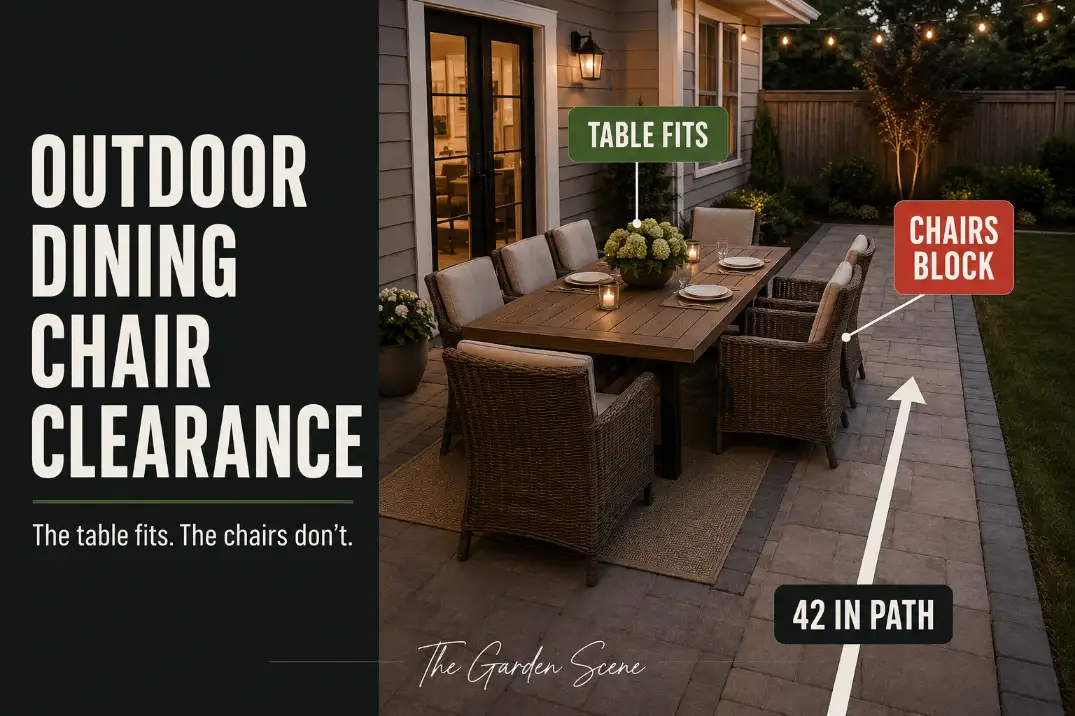
Outdoor dining chairs need about 36 inches behind them as a bare minimum, but guest-friendly layouts usually need 42 to 48 inches where people pass behind seated guests.
Near a back door, serving table, grill path, or party traffic lane, 54 to 60 inches can be the difference between comfortable outdoor dining and a patio that keeps getting interrupted.
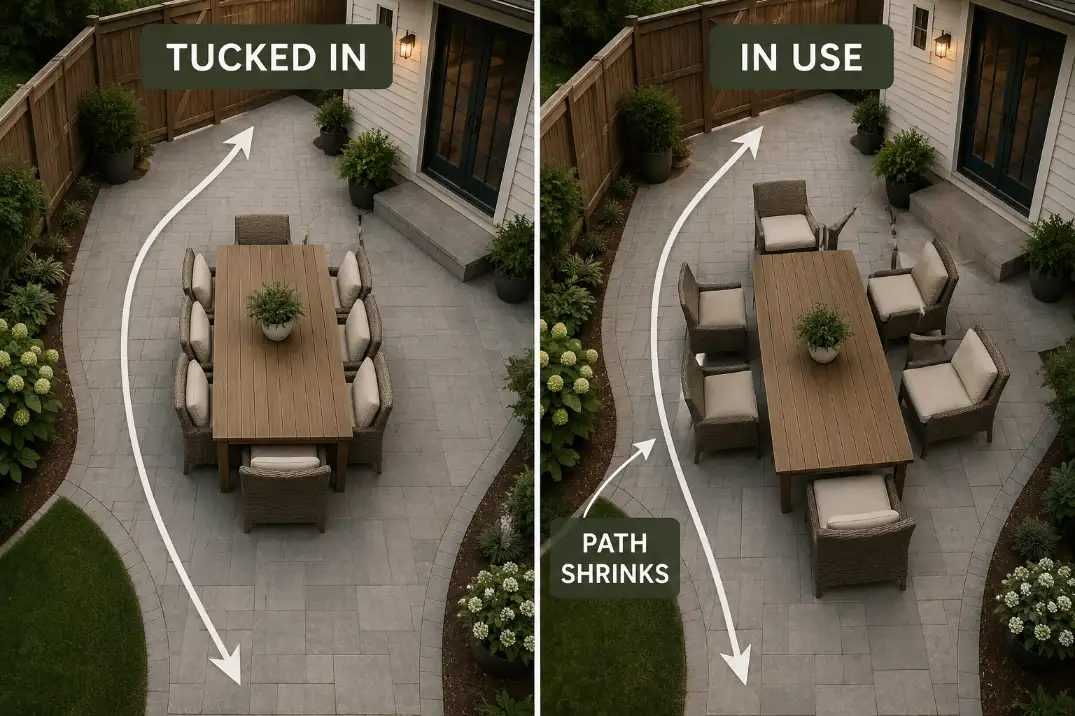
The mistake is measuring the table while every chair is tucked in. A dining set expands every time guests pull chairs back, stand up, carry plates, or move behind another seat.
The quickest check is simple: pull each chair back 18 to 24 inches, then measure the passing space that remains behind it.
If that leftover path drops below about 30 inches, the patio may look arranged but it will not feel usable during a real meal.
Chairs Need More Than Space
Measure the active chair, not the empty table
Outdoor dining clearance starts with the table, but it is decided by the chair in use. A 36- or 40-inch table may look reasonable on a small patio until the chairs move back and turn the walking lane into a squeeze point.
The table footprint is the quiet version of the layout. The pulled-back chair is the real version.
That is why the first useful measurement is not table edge to patio edge. It is pulled-back chair to wall, railing, planter, step, grill, or walking path.
A chair often needs 18 to 24 inches just for someone to sit and stand. If another guest has to pass behind that chair, the working zone needs more.
A layout with 42 to 48 inches behind active chairs usually feels much healthier than one with 30 to 34 inches. The smaller number can still look fine in a photo, but guests will turn sideways, bump chair backs, or wait for someone to scoot in.
For the base footprint before movement is added, Patio Dining Set Space is the better starting point than relying on the dining set’s product dimensions alone.
The common misread is cosmetic fit
The most common misread is thinking, “The chairs fit around the table, so the patio works.” That only proves storage fit, not guest fit. Outdoor dining is a movement problem before it is a furniture problem.
A good patio dining layout protects the seat, the stand-up space, and the path behind the chair. A failing layout protects only the table.
That difference usually becomes obvious within the first 10 minutes of a meal, when guests begin refilling drinks, serving plates, and walking behind seated people.
Pullback Changes the Path
Thirty-six inches is a minimum path, not a comfort target
A 36-inch path behind dining chairs is often treated as the answer. It is better understood as the minimum starting point.
It can work on the quiet side of a table where no one regularly passes. It is not the best target for the main walkway between the house and the patio, or for the side where people carry plates and drinks.
Use 36 inches only where traffic is light. Use 42 to 48 inches where guests pass behind seated people. Use 54 to 60 inches where the space carries serving traffic, party movement, or repeated door access.
| Active Chair Clearance | What It Means | Best Use | Warning Sign |
|---|---|---|---|
| Under 28 inches | Failing clearance | Avoid behind any used chair | Guests cannot pass without moving furniture |
| 28–34 inches | Tight squeeze zone | Only rarely used edges | People turn sideways or wait |
| 36 inches | Bare minimum | Quiet side of the table | Works only with low traffic |
| 42–48 inches | Comfortable guest path | Normal dining and passing | Usually enough for one person behind a chair |
| 54–60 inches | Party-friendly space | Door, serving, or grill side | Better when guests carry plates or trays |
Route position matters more than patio size
A 10-by-12 patio can work better than a larger patio if the dining set is shifted away from the main walking lane. The number on the patio plan matters less than where the pulled-back chairs land.
This is where many fixes waste time. Buying a chair that is 2 inches narrower will not solve a layout that needs 10 more inches of passing space.
The higher-value move is usually shifting the table, rotating it, removing one chair, or moving another object out of the traffic side. For size-based layout judgment, Patio Furniture Layout by Size helps connect furniture choice to real movement space.
Pro Tip: Measure the path with the chair pulled back and a person standing behind it. That test catches more clearance problems than measuring the empty table.
Guests Move Behind Seats
The pressure point forms behind the chair
Guests rarely move around a dining set in straight lines. They stand, angle out, step behind another chair, pause with a plate, and return to the table from the side. The main path forms behind active chairs, not beside the table edge.
The seat closest to the back door usually fails first. If that chair blocks the door-to-yard movement, every refill, bathroom trip, serving run, and cleanup pass becomes a small interruption.
The symptom is a crowded patio. The mechanism is repeated movement through a narrow active-chair zone.
A practical warning sign is repeated chair scooting. If someone has to pull in every 2 or 3 minutes so another guest can pass, the dining set is not just “a little tight.” The path is doing too much work for the clearance available.
Guest flow should decide the table position
Before changing the furniture, identify the path people actually use. On many patios, the important movement line is not centered.
It runs from the back door to the serving area, from the grill to the table, or from the table to the lawn. The dining set should step out of that line instead of sitting perfectly centered on the slab.
This is also why a patio can feel worse after adding helpful items. A cooler, serving table, plant stand, or extra chair may be useful by itself, but harmful if it sits behind an active dining chair.
For the broader traffic pattern between the house and outdoor space, Better Flow From House to Patio is the right companion issue to check.
Serving Needs Side Access
Do not put serving traffic behind the tightest chairs
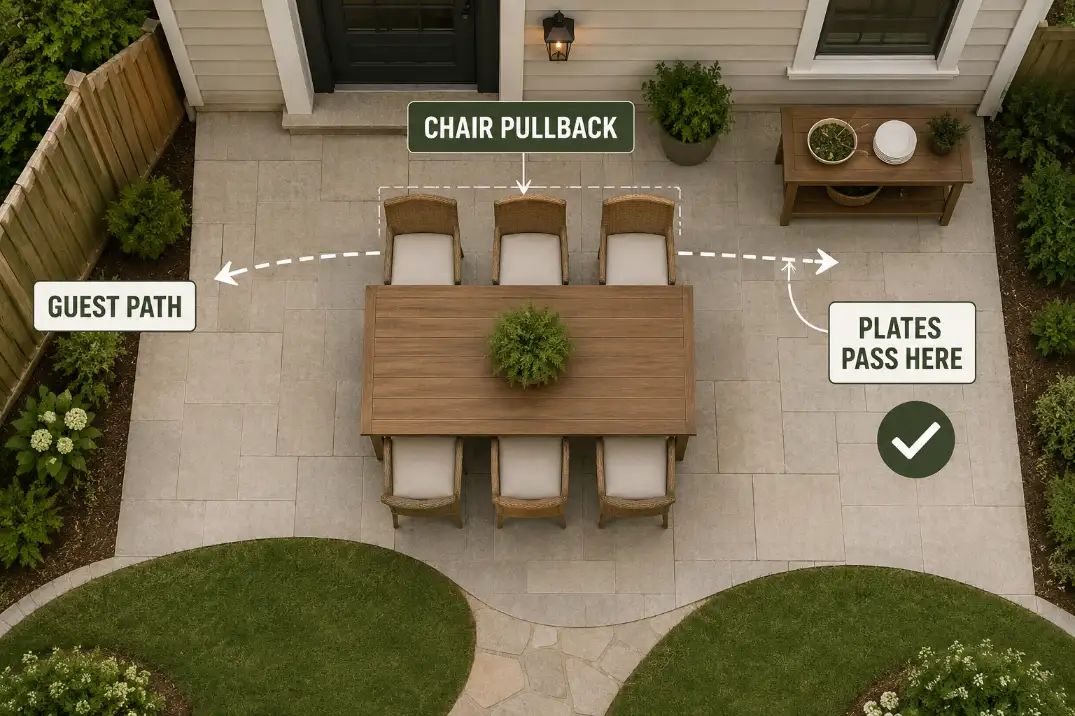
Serving creates more repeat movement than most people expect. Plates, trays, drinks, condiments, napkins, trash, and refills all move through the same few feet.
If that movement happens behind the tightest row of chairs, the meal feels crowded even when the table itself is the right size.
A better layout gives serving its own side. That may mean moving the serving table 3 to 5 feet away from the dining set, placing it near the patio edge, or choosing one approach side for plates and drinks while keeping the opposite side quieter.
The goal is not to make every side equally open. The goal is to protect the side that gets repeated traffic.
This is where the obvious fix often disappoints. A smaller serving table still creates friction if it sits in the wrong lane. The fix is not always a narrower object.
It is a clearer path. If the serving station keeps competing with chair pullback, Small Patio Serving Table Placement is the more precise problem to solve before buying new dining chairs.
The fix stops working when capacity is too high
There is a point where better placement cannot rescue too many seats. If the serving path stays under about 42 inches after the table is shifted, loose items are removed, and chairs are pulled back realistically, the patio is probably carrying too much dining capacity.
At that point, the stronger fix is reducing the number of active chairs, changing table shape, or using a bench on a fixed edge. Trying to preserve every seat usually keeps the same problem alive.
Pro Tip: Put the serving station where guests can reach it without passing behind the most crowded chair. One clean serving edge is better than three cramped access points.
Corners Get Tight Fast
Corner chairs need more room than side chairs
Corner seats fail before side seats because the guest does not simply move straight back. They angle out, turn around a table leg, avoid another chair, and step into the passing space. That movement takes more room than a normal side chair.
This is why a rectangular six-seat set can behave like a four-seat set on a compact patio. The table may hold six chairs, but the two corner positions may be the seats that constantly interrupt movement.
If both corner chairs require people to twist out or ask others to move, treat that set as a four-seat layout for that patio.
The issue is not only comfort. It is usability over time. During a 90-minute meal, a corner pinch point may be crossed dozens of times. A small annoyance at the start becomes the reason guests stop using that side of the table.
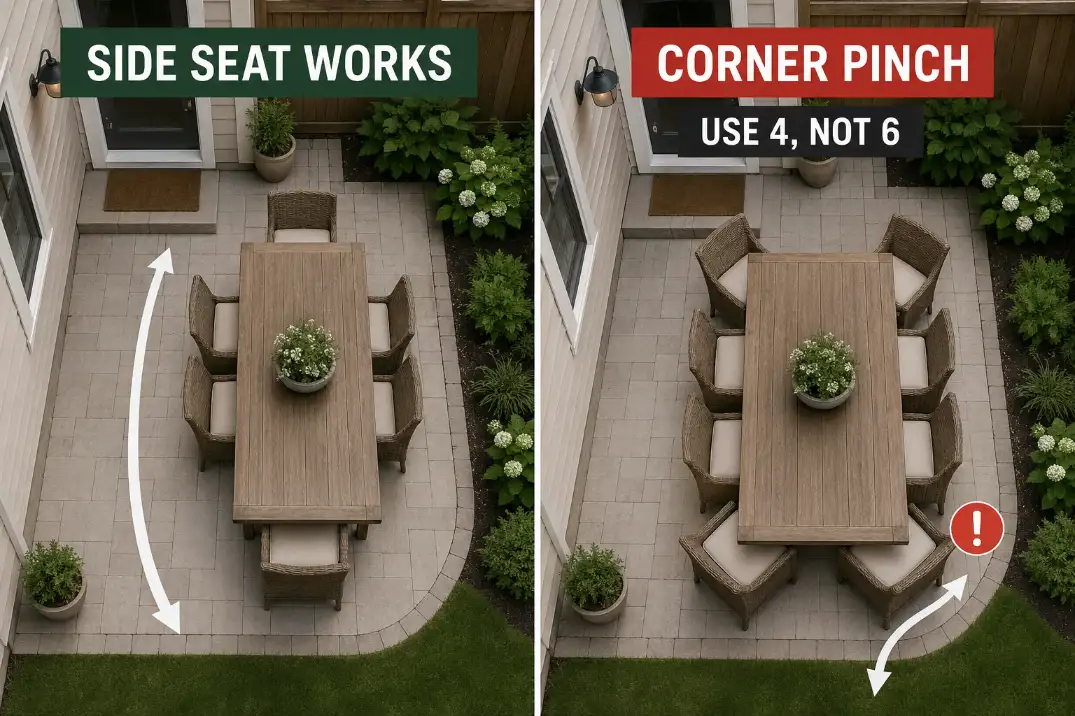
Table shape can solve what chair size cannot
When corners are the problem, downsizing chairs is not always enough. A round table, oval table, narrower rectangular table, or bench on one fixed side may change the movement pattern more effectively.
Round tables can reduce hard corner conflicts, but they are not magic. A round table that is too large still pushes chairs into the walking lane.
Benches can help along a wall or railing because they reduce chair pullback, but they work best when guests do not need to pass behind them.
For choosing the shape before the clearance problem starts, Best Patio Table Shapes for Small Spaces is a useful next step.
Comfortable Before It Looks Full
Stop adding chairs when movement changes
Outdoor dining should feel comfortable before the patio looks full. That is the opposite of how many layouts are built. People fill every visible side of the table, then wonder why the patio feels smaller once guests arrive.
The better test is movement. Add chairs only until the main path still works. If the fourth chair keeps a 42- to 48-inch passing space and the fifth chair drops it near 30 inches, the fifth chair is not extra hospitality. It is the start of the problem.
This is also where people commonly underestimate loose items. Cushions, bags, coolers, lanterns, plant pots, and spare chairs can quietly steal the same 6 to 12 inches the layout needed to work.
Before blaming the dining set, remove the extras and retest the pulled-back clearance.
Choose the seating style that protects the path
The best seating choice is not always the set with the most chairs. It is the one that keeps the most-used path open after everyone sits down.
On tight patios, that may mean four dining chairs plus a bench, a smaller round table, or a dining set that leaves one side intentionally quiet.
If the issue is mainly pullback, compare chair depth before buying. If the issue is corner movement, compare table shape.
If the issue is too many guests for the patio, use overflow seating away from the dining path rather than forcing every seat around the table.
For small-space dining purchases, Best Outdoor Dining Sets for Small Patios fits best after the clearance measurement is already clear.
The right dining setup is the one that still works after people sit, stand, serve, and pass behind each other. A patio that looks slightly less full but moves cleanly will usually feel more generous than a patio packed with every chair it can technically hold.
Quick clearance checklist
- Pull each chair back 18 to 24 inches before measuring.
- Keep about 36 inches only on quiet, low-traffic sides.
- Use 42 to 48 inches behind chairs on normal guest paths.
- Use 54 to 60 inches near doors, serving sides, grills, or party traffic.
- Watch the first 10 minutes for repeated chair scooting.
- Treat corner chairs as optional if they create angled pinch points.
- Remove loose patio items before replacing the dining set.
Questions People Usually Ask
Is 36 inches enough behind outdoor dining chairs?
Thirty-six inches can work behind a quiet chair, but it is a minimum. If people pass behind that chair, 42 to 48 inches is a better target.
Should I buy smaller chairs or remove one chair?
Remove one chair first if the path is badly pinched. Smaller chairs help only when the layout is close to working already.
Are benches better than chairs for outdoor dining clearance?
Benches can help when they sit against a fixed edge and do not need pullback space. They are less useful if people still need to walk behind them.
When is the dining set too large for the patio?
The set is too large when active chair clearance stays under about 42 inches on the main path after you remove clutter, shift the table, and test the chairs pulled back.
For official guidance on why continuous clear path width matters, see the U.S. Access Board.