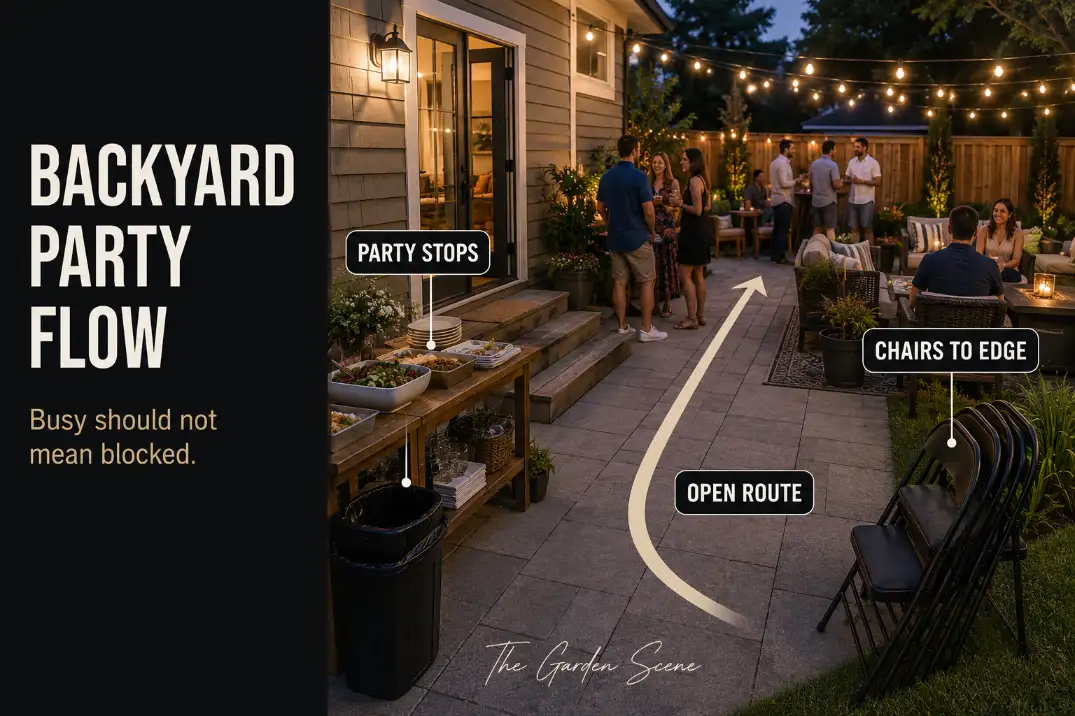
A backyard party usually feels cluttered for one reason: too many party functions land in the same few square feet. The first checks are simple but decisive.
Keep one 36-inch route from the back door to the main seating or yard, move serving beside that route instead of across it, and give trash a real stop instead of letting it drift onto tables.
If pulled-out chairs, a cooler lid, or a folding chair shrink that route to about 30 inches or less, the patio may still look fine in a photo but will behave like a squeeze point once guests arrive.
That is different from a patio that is merely small. A small patio can host well if stops are separated. A larger patio can still fail in the first 20 to 30 minutes if the food table, drink station, and extra chairs all collect near the same door corner. The real issue is not party size. It is flow overlap.
Parties Need Clear Zones
The backyard party flow loop matters more than extra furniture
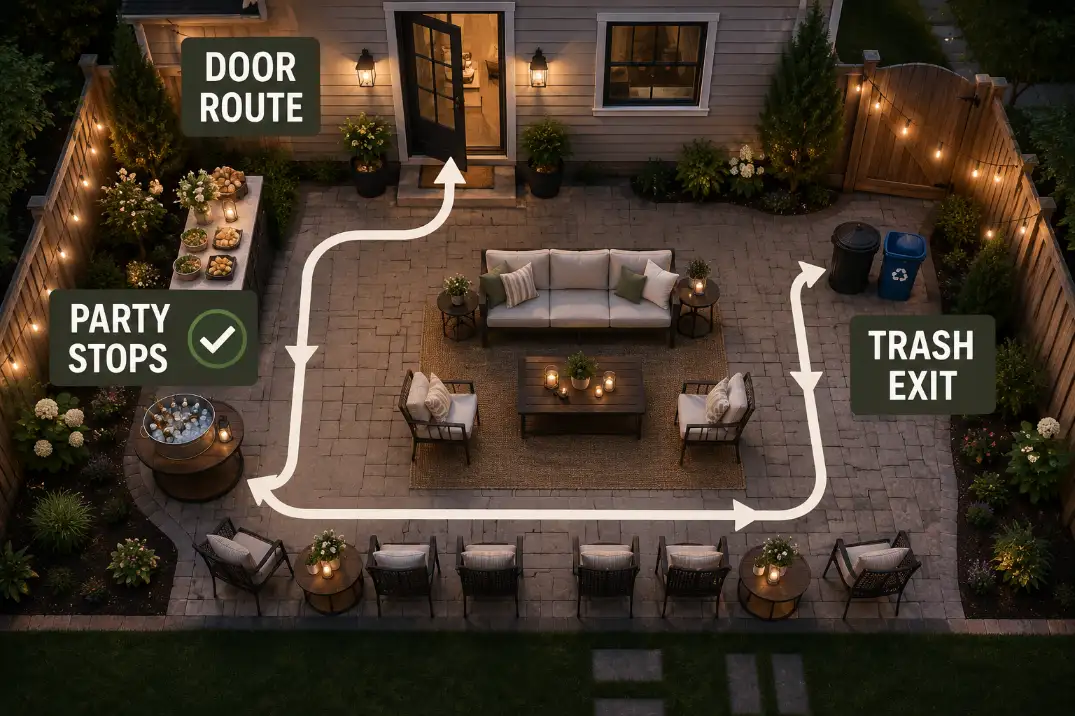
The most useful way to think about party layout is as a loop: people come out the door, stop for food or drinks, move to seating, throw things away, and then repeat the cycle. When one of those stops sits inside the main movement lane, every other part of the loop starts to jam behind it.
Clear zones should not mean vague decorating advice. Each zone needs a job. The door route is for passing through, not lingering.
The serving zone is for a short pause. The seating zone is for staying put. The trash stop is for quick disposal on the way out of eating or drinking, not for hovering beside the best chair.
On a working patio, a guest should be able to walk from the back door to the yard or seating area in roughly 5 to 8 seconds without asking someone to move.
If that short walk requires turning sideways, stepping around a cooler lid, or weaving through spare chairs, the layout is already showing its weak point.
What usually gets misread first
Hosts often overestimate how much open floor they have because they look at the patio before chairs are pulled out and before guests start stopping. Open-looking patios can fail fast once people are standing with plates.
Repeated movement is easier to miss. A guest may visit the food table once or twice, but drinks often create repeat traffic every 20 to 30 minutes.
Trash also becomes a movement issue earlier than expected because once cups and napkins start collecting, guests create improvised drop zones that clutter the space even more.
Here is the simplest way to audit the patio before guests arrive:
| Area | Better Condition | Early Warning Sign |
|---|---|---|
| Main route | 36 inches clear | Falls below about 30 inches after chairs move |
| Serving stop | Along a side edge | Guests stop in the doorway |
| Drink station | Off to one side | Cooler lid opens into the path |
| Trash station | Visible near the exit from food or drinks | Cups collect on tables |
| Extra chairs | Staged at the edge | Spare seats fill the center |
| Door landing | Open and easy to read | Bags, bins, or chairs gather outside the door |
Serving Creates the First Block
Serving belongs beside traffic, not inside it
The first real block at most backyard parties is the serving zone. It catches people early, and it catches them all at once.
During the first half hour, guests are arriving, greeting, setting things down, looking for drinks, and deciding where to stand. If the serving table sits directly outside the back door, it creates a pause point exactly where the patio needs free movement most.
A better serving station sits beside the route, not across it. That could be along a fence line, a wall edge, or the quiet side of the patio.
The key is giving one person enough room to stop while another person can still pass. On a small patio, even a table that projects only 18 to 24 inches into the wrong area can ruin the traffic line.
If the serving stop needs to move between food, drinks, and cleanup, Best Outdoor Serving Carts for Patio Parties is a better next step than adding another fixed table.
A cart only helps, though, when it supports the side-stop strategy instead of becoming one more object in the tightest part of the patio.
The fix people choose too quickly
A common reaction is to add a second small serving point, thinking it will reduce crowding. Usually it does the opposite.
Two weak stations create two places for people to stop, lean, and leave plates. One deliberate side station is usually stronger than several improvised surfaces spread around the patio.
Drinks need even more discipline because they create repeat traffic. If the drink stop shares the same corner as the door and dining chairs, people keep returning to the busiest point all evening. A side drink station, especially one on a shaded edge, helps break that repeat loop.
The best drink station is not the prettiest one. It is the one that keeps repeated stops out of the main traffic line while still feeling easy to reach.
For a deeper setup focused on drink movement, Backyard Drink Station Ideas pairs naturally with this flow-first approach.
The other thing serving tables need is time awareness. Perishable food should not sit outside indefinitely. As a practical hosting rule, try not to leave perishable items out longer than about 2 hours, and cut that to 1 hour when temperatures rise above 90°F.
That does not change the whole patio plan, but it does change why a controllable, shaded serving side is more useful than a sprawling display in full sun.
Pro Tip: If guests need to queue for food, let them queue along an edge, not toward the door.
Trash Needs a Real Place
Trash is a flow tool, not a cleanup afterthought
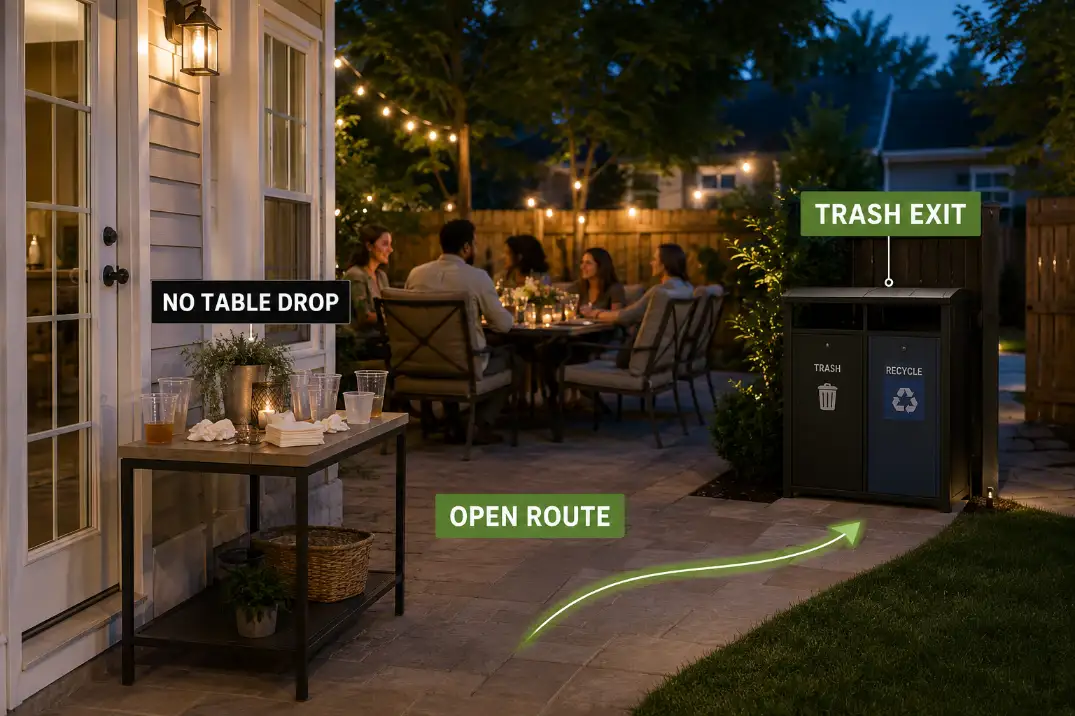
People often treat trash as a late-night cleanup issue. In reality, it affects movement within the first hour. When guests do not see a clear drop point, they start leaving cans, napkins, and paper plates wherever they happen to stop. That is when a patio begins to feel cluttered even before it is truly dirty.
The best trash station sits where guests naturally leave the food or drink stop. It should be easy to spot in 2 to 3 seconds and easy to use without entering the seating cluster.
That usually means near a side exit, a yard-facing edge, or the path away from serving, not next to the most comfortable chairs.
A clean version of that logic appears in Outdoor Trash Station Ideas for Parties. The underlying principle is simple: trash should catch movement leaving a zone, not create a new stopping point inside one.
What hosts underestimate about trash
Hosts often underestimate two thresholds. The first is visibility. A hidden bin does not behave like a bin; it behaves like clutter because it fails at its job. The second is fullness.
If the main trash bag is already about two-thirds full before guests arrive, change it. A nearly full bag turns into a lid problem, then an overflow problem, then an odor problem.
A useful party station is not fancy. One trash bin, one recycling bin, and possibly a small return tray for reusable items is enough. What matters is that it reduces drift. Once drift starts, even a neat patio begins to accumulate random objects in the center.
Extra Chairs Need Edges
Spare seating should wait, not occupy
Extra chairs are useful, but fully deploying them too early is one of the fastest ways to make a patio feel tight. The problem is not seating itself. The problem is putting unused seating into active movement space before you know whether it is needed.
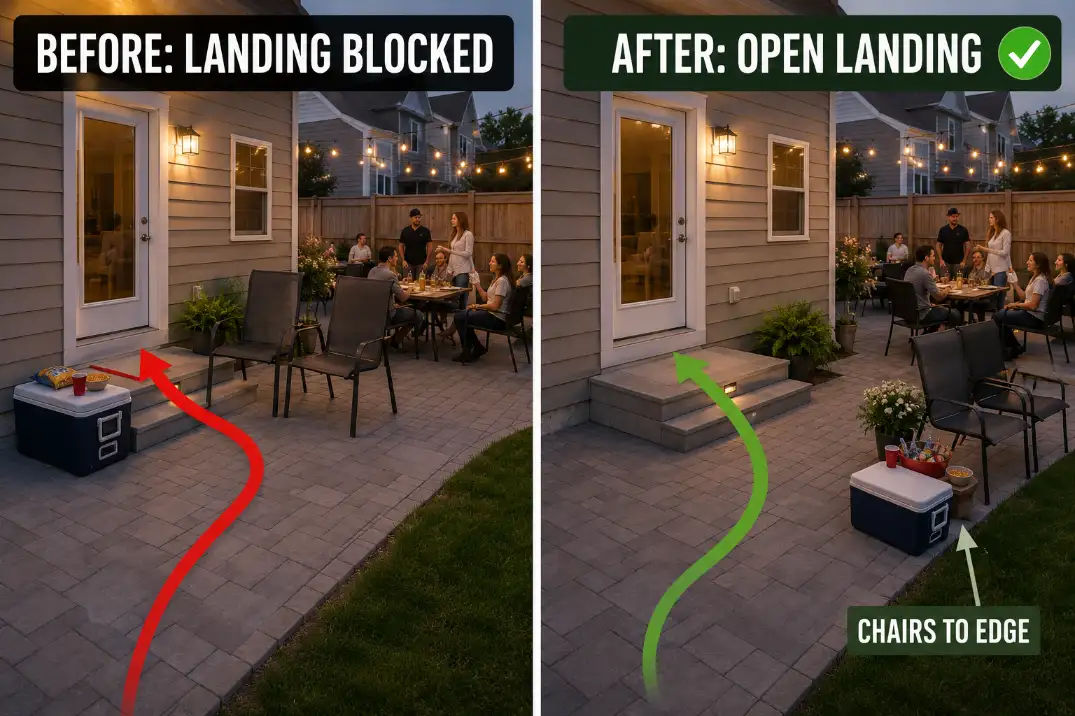
Stage extra chairs along a quiet edge until the guest count proves you need them. Fence lines, lawn edges, and broad wall sides usually work better than the center of the patio. They stay available without becoming the first thing people step around.
That is the real lesson behind Guest Seating Overflow on Small Patios. The question is not whether more seats technically fit. The question is whether unused seats can wait somewhere that does not steal the route.
When more seating stops making sense
People often think the solution to a full party is simply more chairs. Sometimes the better answer is fewer active chairs and more stand-friendly edge space.
Once spare chairs start reducing the center of the patio to a narrow weaving lane, they are no longer helping the party.
A shift of even 12 inches can change everything. A route that began at 36 inches can turn into a 24-inch squeeze once a chair is pulled out and someone leaves a bag behind it. Edge staging is not just neatness. It is a way to preserve flexibility.
Keep Steps and Doors Open
The landing outside the door is non-negotiable
A back door that feels adequate on a normal afternoon can fail during a party because people pause there. Someone comes out with food. Someone else waits to go in.
Another person stands on the landing to talk. That is why the door area deserves a stricter rule than the rest of the patio.
Treat the first 30 by 30 inches outside the door as landing space that stays open. After that, protect a 36-inch route leading away from it. Coolers, spare chairs, storage bins, and party bags should not live there, even if the placement looks temporarily convenient.
This is the same core logic behind Keep Patio Entry Clear: door clearance is not a finishing detail. It is the spine of the entire patio layout.
Where the usual “just tuck it closer” fix stops working
The routine fix is to push everything tighter to the wall. That works only until wall-side objects begin to block the landing, the handle swing, the route to steps, or the path to the yard. At that point, tighter packing is not a smart fix. It is a sign that too many active functions are competing in one zone.
One of the most useful pre-party checks is the chair-pull test. Pull every dining chair out as if people are already seated. Open the cooler lid. Imagine one person stepping out with a tray and another stepping in.
If the door zone still reads clearly, the patio is probably ready. If not, the layout is still depending on empty-chair assumptions.
Pro Tip: Do the final layout check 10 minutes before guests arrive, not while the patio is still empty and idealized.
Final 10-Minute Party Flow Test
A good party uses active edges and a calm middle
The strongest backyard party layouts usually feel lively around the edges and calm through the middle. Serving, drinks, trash, spare chairs, and return items belong near edges where they can support the party without interrupting the traffic line. The center should absorb movement, not store equipment.
That does not mean a patio needs to feel empty. It means every added object should justify itself. If an item reduces repeated movement problems, it earns space.
If it creates one more pause point in the route, it is part of the clutter problem no matter how useful it seemed at first.
This is where Reduce Patio Clutter Without Losing Function fits naturally. The strongest patios do not remove function. They separate it.
The final walk-through
Before guests arrive, check five things in order:
- Walk the main route from door to seating or yard. It should stay around 36 inches clear.
- Pull out dining chairs and confirm the route does not collapse.
- Open the cooler or drink station and make sure it does not spill into the path.
- Look for the trash stop from the seating area. It should be obvious without explanation.
- Scan the landing and steps. If anything sits there “just for now,” move it.
If the patio passes that test, it can feel active without feeling crowded. If it fails, the answer is usually not more organizing bins or more small tables. The answer is to protect the route and reassign the stops around it.
Quick Checklist
- Keep one 36-inch route from the back door to the main seating area or yard.
- Treat the first 30 by 30 inches outside the door as clear landing space.
- Put serving and drinks beside the route, not directly in it.
- Change any trash bag that is already about two-thirds full.
- Stage extra chairs along an edge until they are actually needed.
- Recheck the setup after the first 20 to 30 minutes of the party.
- Shorten outdoor holding time for perishable food, especially above 90°F.
Questions People Usually Ask
How wide should the main party route be?
A practical target is 36 inches clear. Once the route shrinks to around 30 inches or less after chairs are pulled out, the patio usually starts feeling tight and reactive.
Is it better to put the serving table right outside the back door?
Usually no. That placement feels efficient for setup, but it often creates the first bottleneck. A side serving station is usually easier for guests to use without blocking movement.
How many extra chairs should stay out?
Only the chairs you expect to need right away. Spare chairs usually work better staged along an edge rather than preloaded into the center of the patio.
Why does trash placement affect flow so much?
Because when guests cannot find a clear drop point, they create one themselves on side tables, chair arms, and ledges. That creates clutter in the exact areas that should stay usable.
Final Takeaway
Backyard party flow is not about making the patio sparse. It is about protecting the few places that everyone repeats: the door route, the serving stop, the drink stop, the trash exit, and the chair edges.
Once those are clear, the patio can handle real activity without feeling jammed.
For a practical benchmark on clear walking widths, review the U.S. Access Board’s guidance on accessible routes.