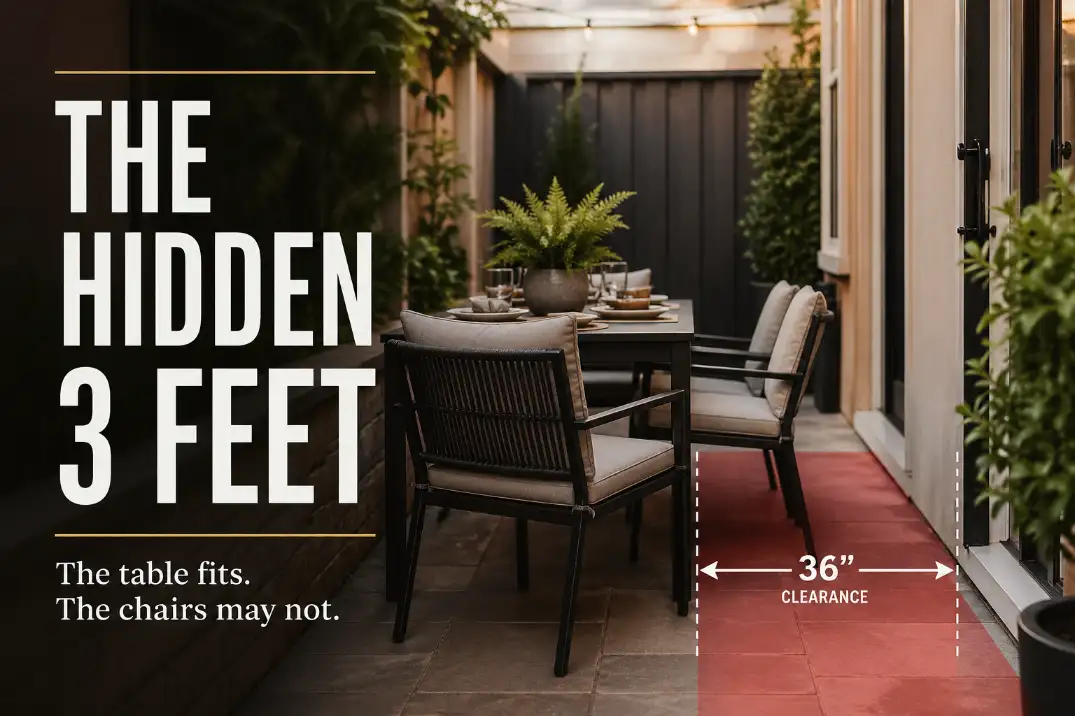
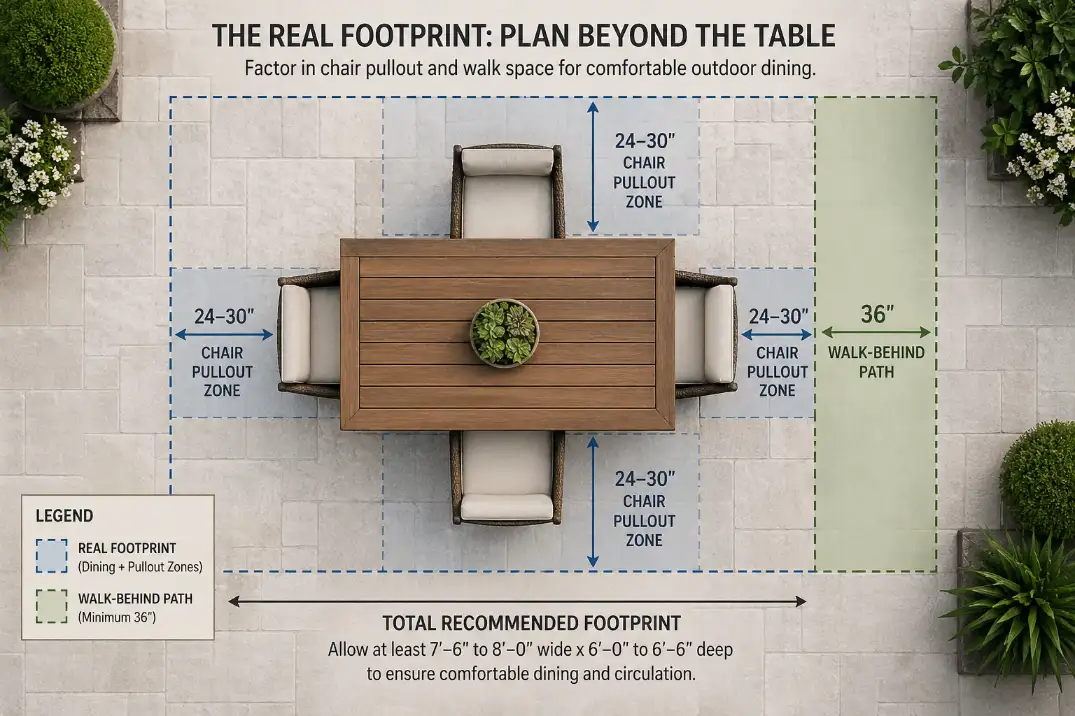
A patio dining set usually needs 24 to 30 inches behind each chair and about 36 inches where people need to walk behind seated guests. That means a table that is only 5 feet long can easily need a 9- to 11-foot working footprint once the chairs are in use.
As a quick rule, a 2-person bistro set usually needs about 6×6 to 7×7 feet, a comfortable 4-person dining setup often needs 9×9 to 10×10 feet, and a 6-person rectangular set usually needs closer to 10×12 to 11×14 feet.
The trap is judging the patio while the chairs are pushed in. That tells you whether the furniture can be stored there, not whether people can eat there. A patio dining set is sized by movement, not by furniture dimensions.
The Simple Formula: Table + Chairs + Path
The real size of a patio dining set is not the table size. It is:
table size + chair pullout zones + walking path where needed
That last part is the difference between a tight but usable patio and one that annoys everyone during dinner.
The table is the fixed part
A 36×60-inch rectangular table may sound compact. But if chairs sit on both long sides, add at least 24 inches on each side for basic chair movement. That turns a 3-foot table width into a 7-foot working zone before you even include a walking path.
If people need to walk behind those chairs, add another 36 inches on that side. This is why a “small” dining set can overpower a patio faster than expected.
The chair zone is the part people underestimate
Most outdoor dining chairs need 24 inches behind the table edge just to pull out and sit down. 30 inches feels noticeably better, especially with armchairs, cushioned chairs, or chairs with a deeper reclined back.
Below about 24 inches behind an occupied chair, this is no longer just a comfort issue. It becomes a layout failure. People have to turn sideways, push chairs in constantly, or ask others to move.
Quick Size Guide for Common Patio Dining Sets
Use these sizes as working space, not just furniture storage space.
| Dining set | Real usable patio size | Tight but possible | Avoid if… |
|---|---|---|---|
| 2-person bistro set | 6×6 to 7×7 ft | 5×6 ft | Chairs hit a wall, railing, or planter |
| 4-person round table | 9×9 to 10×10 ft | 8×8 ft | This is the only route to the yard |
| 4-person rectangular table | 9×10 to 10×11 ft | 8×10 ft | The short side becomes the main walkway |
| 6-person rectangular table | 10×12 to 11×14 ft | 9×12 ft | Long-side chairs block the house-door route |
| 8-person dining set | 12×14 to 13×16 ft | 12×12 ft | The patio must also handle lounging or grilling |
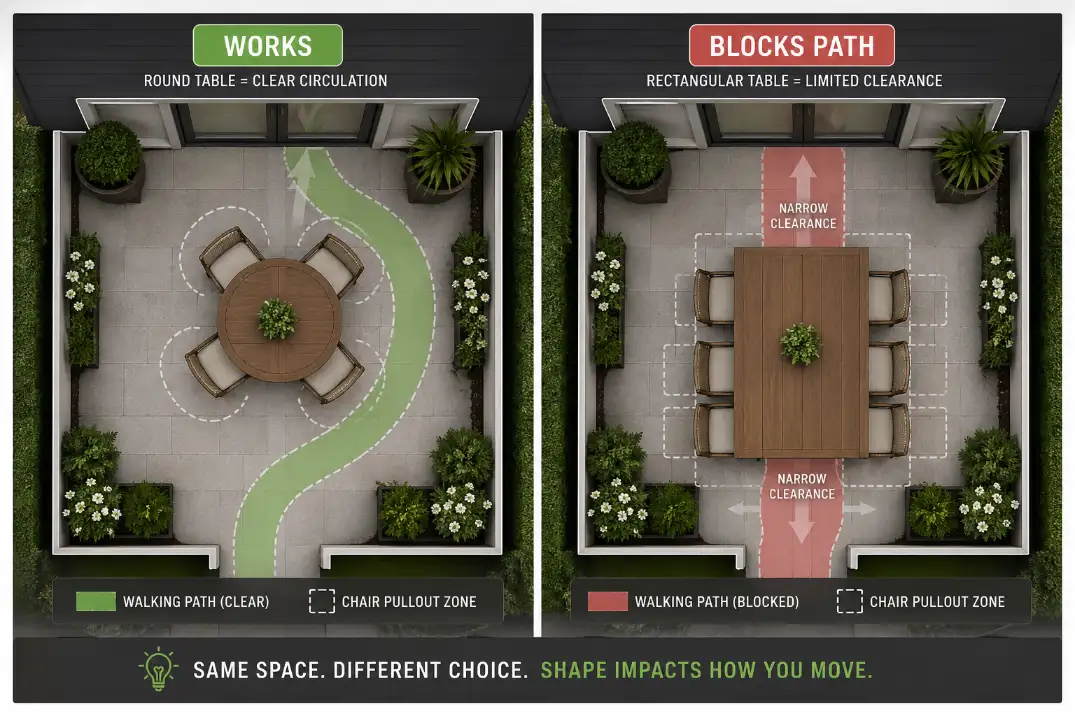
A smaller patio does not automatically rule out dining. It rules out the wrong dining geometry. A 4-person round table may work where a bulky rectangular set fails. A narrow rectangular table may work on a long patio where a round table wastes corner space.
If the patio also needs to function as a lounge area, the dining set should not be sized in isolation. Mixed-use patios fail when seating, dining, and circulation all compete for the same few feet, which is why layout logic matters as much as furniture choice in How to Choose Outdoor Seating for a Patio Used for Dining and Lounging.
What People Usually Misread First
Most people blame the table. More often, the chair depth is the real problem.
Chair arms steal more room than expected
Armchairs need more side clearance and more turning room. The difference may only be 4 to 6 inches per chair, but on a 9-foot patio that can decide whether the layout works.
Armless chairs slide in tighter, angle out more easily, and usually make a small dining zone feel less trapped. That does not mean armless chairs are always better, but they often solve more than switching from one similar table to another.
Deep cushioned dining chairs behave like lounge furniture
Large cushioned dining chairs look comfortable in product photos, but many sit deeper than the patio can support. If a chair projects 26 to 30 inches from the table before anyone even pulls it out, the patio loses its walking zone fast.
That is why simply buying a prettier set can waste money. The issue is not style. It is operating depth.
The same mistake shows up often in small backyard layouts where furniture looks proportional until people actually use it, a problem closely related to The Biggest Patio Furniture Mistakes in Small Backyards.
Shape helps, but it does not erase clearance
Round tables are easier to move around. Rectangular tables are better when the patio is long and narrow. Square tables can work on compact square slabs.
But table shape is not magic. A 48-inch round table still needs chair space on every active side. If the main path runs behind those chairs, the shape does not remove the need for about 36 inches of passage.
How to Measure Before Buying
Do not measure the patio once and trust the product dimensions. Measure the way the patio is actually used.
Remove the dead space first
A patio may measure 12×12 feet, but the usable dining area may be much smaller. Door swings, steps, grill clearance, posts, planters, sloped edges, and awkward corners can remove 12 to 24 inches from the space that matters.
The shortest usable dimension is usually the deciding one. A 12-foot-long patio that is only 8 feet deep may not handle a full 6-person dining set comfortably, even if the total square footage sounds generous.
Run the 10-minute chair test
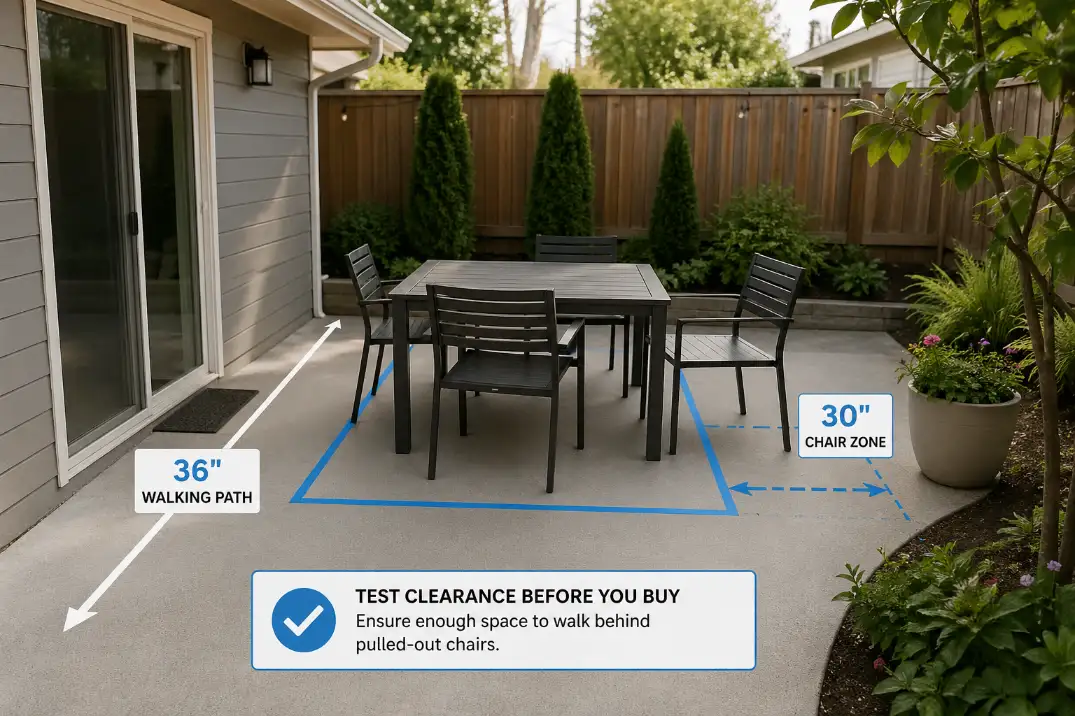
Mark the table footprint with painter’s tape, chalk, or a garden hose. Then place one real chair where the tightest chair would sit. Pull it out as if someone is seated. Walk behind it with a plate or tray.
If you have to twist your hips, brush the chair, or step off the patio, the layout is too tight. Leave the outline in place for 24 hours if the patio gets daily use. Morning coffee, dinner traffic, and evening grill use often reveal different pinch points.
Pro Tip: Measure with the chair pulled out, not tucked in. Product photos almost always show the smallest version of the footprint.
When a Smaller Table Is Not the Best Fix
The obvious fix is to buy a smaller table. Sometimes that helps. But if the route is blocked, changing the table size is secondary. Fix the path first.
A shallower chair may change more than a smaller table
Reducing a table from 42 inches wide to 36 inches wide saves 6 inches. Replacing deep armchairs with slimmer armless chairs may save more across the active chair zone and make sitting down easier.
A bench can also help on the least active side, especially against a wall, fence, or built-in edge. But it only works when people can enter and exit without trapping everyone else at the table. The choice between chairs and bench seating should be based on movement, not just seat count, as explained in Bench Seating vs Patio Chairs.
Below 24 inches, decorating fixes stop mattering
Once the space behind an occupied chair drops below about 24 inches on a side people need to use, small fixes become cosmetic. A thinner rug, different centerpiece, or smaller planter will not create a real walking route.
At that point, the decision is bigger: move the set, reduce the seat count, switch to bench seating on one side, choose a narrower table, or accept that the patio is primarily a dining space.
For compact patios, the best buying decision is often not the smallest possible set but the set with the least wasted movement space. That is where small-space-specific options in Best Outdoor Dining Sets for Small Patios become more useful than standard patio furniture categories.
Best Layout Choices by Patio Type
Small square patios
For an 8×8 or 9×9 patio, start with a 2-person bistro set or a compact 4-person round table. A rectangular set can work, but only if one side is low-use and the chairs do not block the main route.
A centered table may look balanced, but balance is less important than movement. If centering the table blocks every side equally, move it off center.
Long narrow patios
Use the length. A narrow rectangular table usually works better than a round table if the patio is long but shallow. Keep the table parallel to the long side and avoid placing chairs where they push directly into the narrowest dimension.
This is where table shape makes a real difference. A 36-inch-wide rectangular table can be more useful than a 48-inch round table because it protects the walking lane.
For more detail on this tradeoff, Best Patio Table Shapes for Small Spaces is the better next step than simply shopping by seat count.
Patios near doors, grills, and steps
Treat the route from the house to the yard as a real path, not leftover space. If the chair backs into that path, the layout will feel wrong every time someone carries plates outside.
Grills add another layer. Heat, smoke, lid swing, and serving traffic make tight dining placement feel worse than it looks on a floor plan. Even a few extra feet between the grill and the seating zone can make the patio feel calmer.
The Buying Rule That Prevents Regret
Before choosing a patio dining set, ask this: will the patio still work when every chair is occupied?
If the answer depends on people standing up, pushing chairs in, or squeezing sideways, the set is too large for normal use. A good layout has 24 to 30 inches for chair movement and about 36 inches where people need to pass. A weak layout may look fine in a product photo, but it starts failing the first time people sit down to eat.
Size the set for the meal, not the catalog photo.
For broader official guidance on clear accessible walking routes, see the U.S. Access Board Accessible Routes guide.