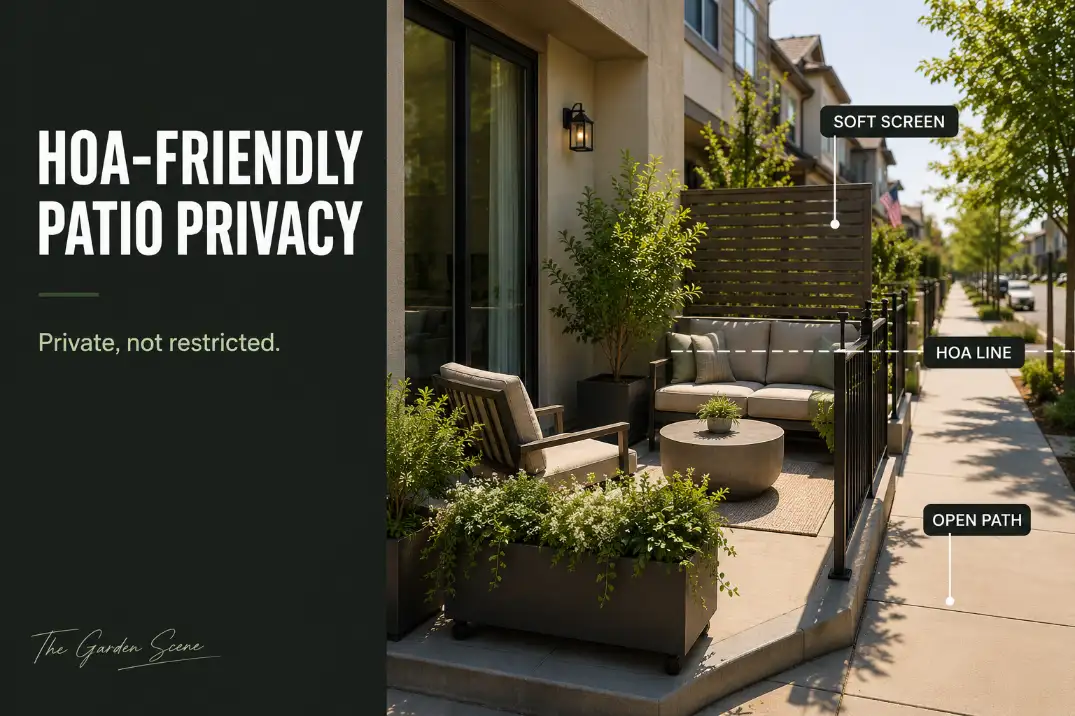
HOA-friendly patio privacy means using movable, clean-looking screens, planters, shade, or seating shifts that block chair-level exposure without attaching to shared exterior surfaces.
The best solution solves the view problem before it creates an approval-risk problem.
Before buying a screen, check whether your community rules control exterior changes, railing attachments, patio enclosures, visible screens, plant height, or containers in common-view areas.
Then measure the real privacy need: a 42- to 48-inch screen can often block a seated view better than a 6-foot panel placed at the wrong edge.
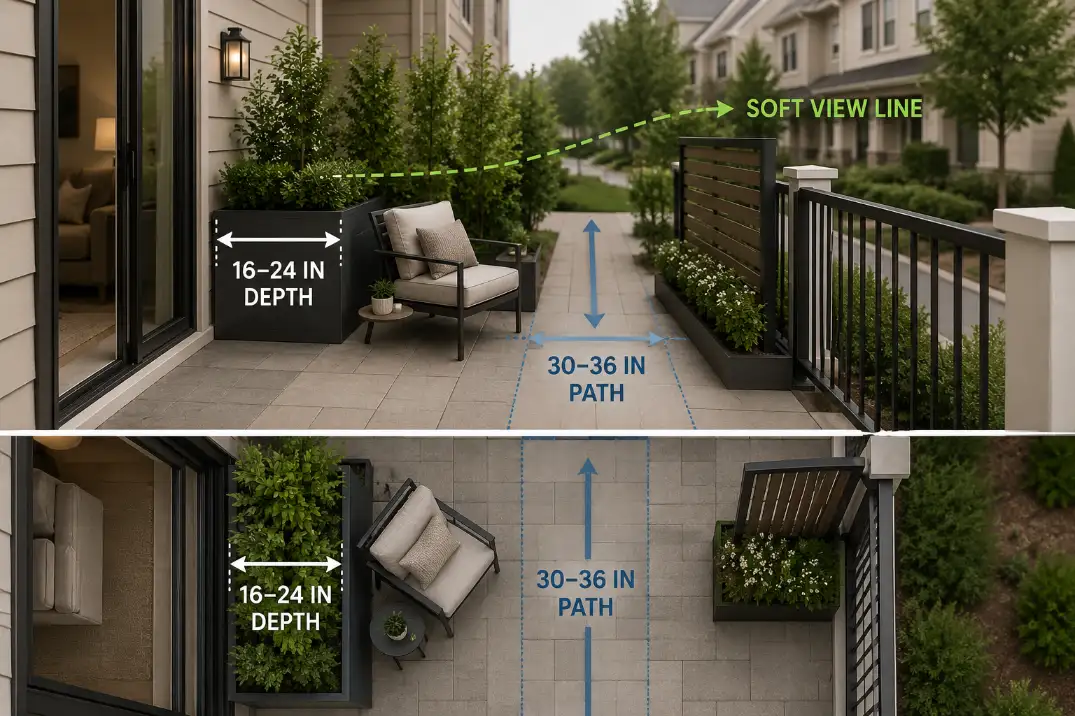
The first useful checks are simple: who can see the seating area, whether the solution looks permanent from 20 to 30 feet away, and whether a 30- to 36-inch walking route stays open from the door.
This issue differs from ordinary backyard privacy because the goal is not full enclosure. The goal is filtered privacy that looks neat, movable, and consistent with the community exterior.
Privacy Within the Rules
Read the rule before choosing the screen
Start with the language that controls exterior appearance, not with the product name. Many HOA rules do not say “privacy screen” directly.
They may use terms such as architectural change, exterior alteration, patio enclosure, common area view, railing attachment, fence, trellis, temporary structure, landscape container, or visible storage.
That wording matters because two privacy ideas can look similar from inside the patio but carry different approval risk. A freestanding planter beside a chair may read as movable landscape decor.
A bamboo roll attached to a railing may read as an exterior modification. The privacy effect may be similar, but the rule risk is not.
Exact rules vary by community, so treat this as layout guidance, not permission to install. If the patio is part of a condo, townhouse, or rental-style outdoor space, ideas that move without tools usually make more sense than anything mounted to a wall or rail.
That is why the best setups often overlap with temporary patio privacy ideas rather than full backyard screening plans.
Solve the view line, not the whole edge
The most common mistake is trying to hide the entire patio. Most patios do not need that.
They need one uncomfortable angle softened: a sidewalk view crossing the chairs, a neighbor’s patio looking into the dining spot, or a shared driveway angle that makes the seating feel exposed.
For sitting-height privacy, the useful zone is usually 4 to 6 feet wide around the chair or dining area. A low slatted screen, tall planter, or soft outdoor curtain can interrupt that zone without making the patio look sealed off. This is the difference between a privacy solution and a patio enclosure.
What people usually misread first
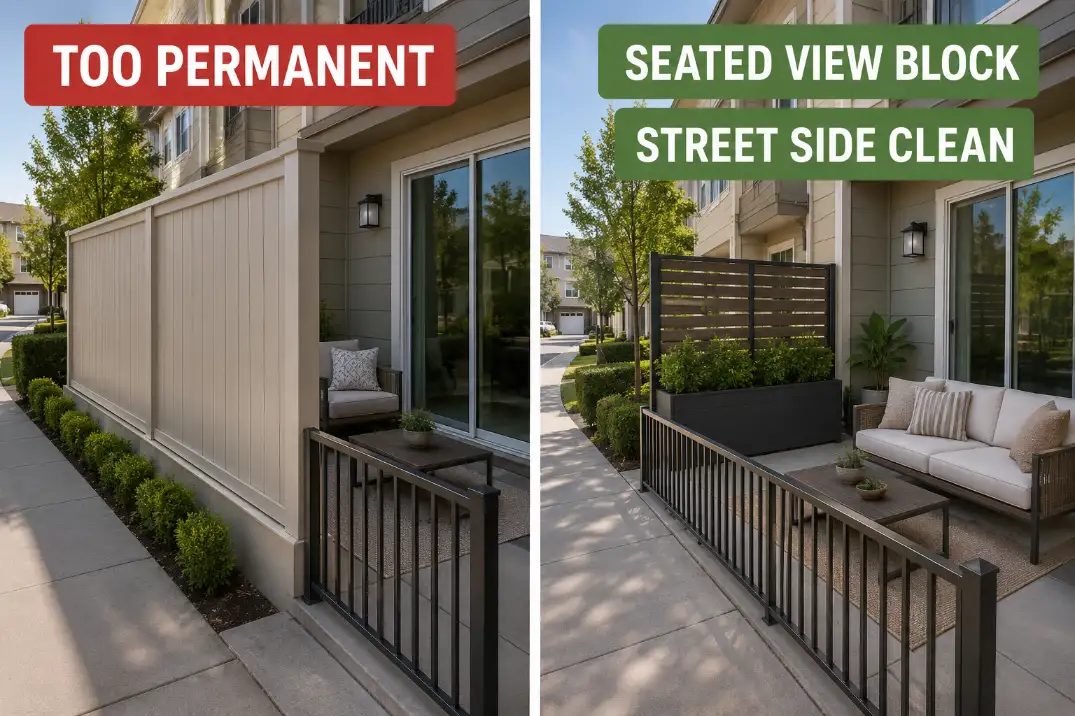
People often overestimate height and underestimate permanence. A 72-inch solid panel at the street-facing edge may look more suspicious than a 48-inch planter-backed screen placed closer to the seat.
The symptom is exposure. The mechanism is usually a direct sightline crossing the seating zone.
That distinction is what keeps the fix lighter. Once you know the actual angle, you can screen the view without turning the whole patio into a wall.
Height Limits Shape the Solution
Useful privacy height is not always the allowed height
HOA documents and local rules vary, but street-facing and front-facing outdoor edges are usually treated more strictly than private backyard edges.
Even when a taller fence is allowed somewhere on the property, that does not mean a 6-foot privacy panel belongs on a patio rail, shared exterior wall, or front-facing outdoor corner.
For most patio seating, useful privacy often lands between 42 and 60 inches. That range can screen chairs, small dining areas, and low lounge furniture without creating the visual weight of a fence.
A taller 72-inch screen should be a last step, not the first move, because it is more visible, more wind-sensitive, and more likely to look like an enclosure.
Measure from the seated position
A privacy setup should be judged from the chair, not from the property line. Sit where you actually use the patio and look toward the exposure point.
If the view crosses at shoulder height, a 48-inch screen may be enough. If people look down from an upstairs window, more height at the patio edge may still fail because the angle is too steep.
That is where many obvious fixes disappoint. People buy taller panels when the better answer is moving the seating, turning the chair angle 30 to 45 degrees, or placing a planter closer to the exposure point.
Height helps only when it intersects the real sightline.
If shade is also part of the problem, do not solve privacy and sun with two bulky structures. A freestanding umbrella or removable shade setup from no-drill patio shade ideas can add comfort without attaching hardware to the building or making the patio feel crowded.
| Privacy Need | Lower-Risk HOA Move | Higher-Risk Move | Why It Matters |
|---|---|---|---|
| Sidewalk view at seated height | 42–48 inch planter-backed screen | 6-foot solid panel on street edge | Lower screening solves the view without looking like a fence |
| Neighbor patio angle | Angled freestanding screen near seating | Full-length barrier across the patio | The angle matters more than total coverage |
| Shared exterior wall | Movable pieces with no fasteners | Mounted curtain track or fixed trellis | Attachments often trigger exterior-change rules |
| Railing exposure | Planters set inside the patio | Bamboo, fabric, or panels tied to railings | Rail changes are highly visible from outside |
| Narrow 8–10 foot patio | Privacy close to the chair | Tall screen at the outer edge | Edge screening can shrink the whole patio |
| Windy corner patio | Slatted screen with wide support | Lightweight solid panel | Solid panels catch wind and look unstable faster |
Portable Screens Work Differently
Portable still has to look controlled
A portable screen is most useful when it blocks a specific angle. It is less useful when it tries to act like a fence. A three-panel screen angled beside a chair can block a neighbor walkway while still leaving the door side open.
But portable does not automatically mean HOA-safe. If the screen leans, blows over, blocks a shared sightline, or looks like a permanent wall from the sidewalk, it can still become a problem.
Screens over 60 inches tall need more support than most people expect, especially on exposed patios or upper-level decks.
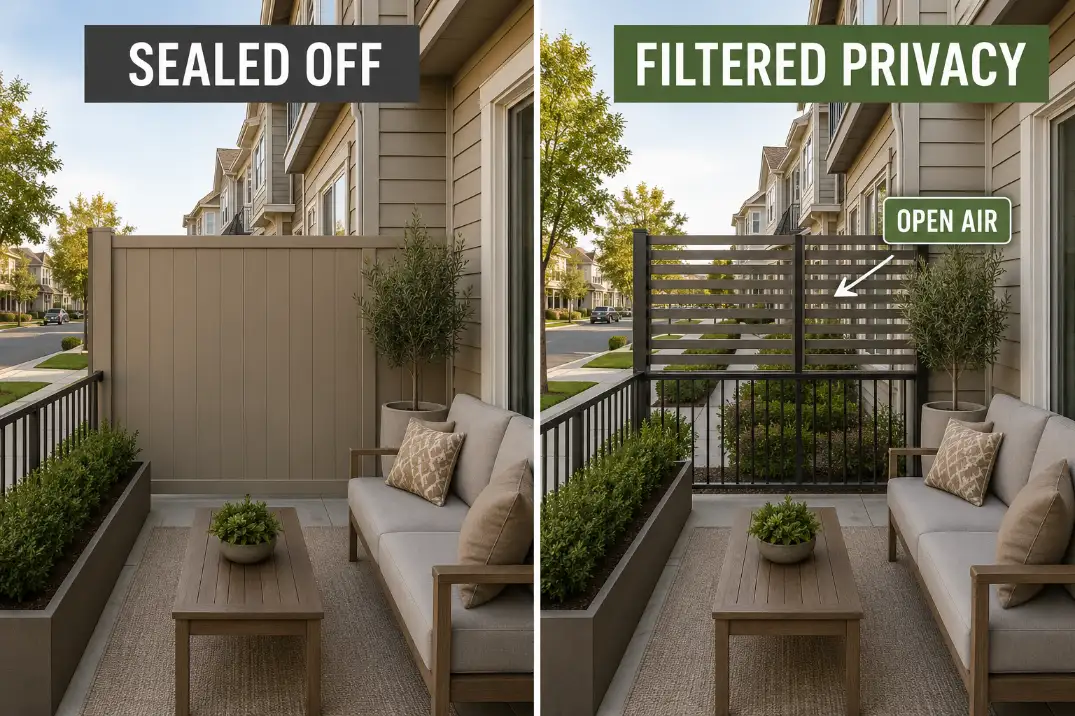
Slatted panels are usually easier to live with than solid panels because they let air through and look visually lighter. Solid fabric or resin panels can work in a sheltered corner, but they often feel heavier from the street side.
If the patio gets gusts in the afternoon or sits near an open drive, wider feet or planter-backed support matter more than decorative style.
A good portable privacy setup should also store cleanly. Folding screens, movable planters, and lightweight panels fit the same practical logic as renter-friendly outdoor space ideas: they improve the space while staying reversible.
Pro Tip: Tape the screen footprint on the patio for 24 hours before buying. If the taped area blocks the door route, chair pullback, grill access, or watering path, the real screen will feel worse.
When a screen stops making sense
A screen stops making sense when it needs to sit in the main circulation path to work. Below about 30 inches of open passage, everyday use starts to feel squeezed. Below 24 inches, the patio behaves more like a storage aisle than an outdoor room.
At that point, the smarter move is not a larger screen. It is usually a smaller seating group, a shifted chair angle, or a planter placed closer to the exposure point.
Planters Feel Less Permanent
Planters soften the rule question
Planters often work better than screens in HOA patios because they read as landscaping, not construction.
A long rectangular planter, a pair of matching tall containers, or a planter-backed screen can create privacy without looking like a fence substitute.
Depth is the practical detail that separates useful privacy from decoration. A 10- to 12-inch pot may hold seasonal color, but it usually lacks the weight and soil volume for stable privacy planting.
A 16- to 24-inch deep planter is more useful for compact shrubs, upright grasses, or layered planting that can soften chair-level exposure.
That is why privacy planters for front yards and patios often make sense in rule-sensitive spaces. They can be moved, trimmed, refreshed, or simplified without changing the building exterior.
Maintenance becomes part of compliance
The hidden weakness of planter privacy is not always the planter. It is the maintenance signal. A brown grass clump, a dry container, or a leaning shrub on a street-facing patio can draw more negative attention than a clean low screen.
In hot afternoon sun, small containers may need water every 1 to 2 days during peak summer. In freezing northern states, wet planters can crack or stain surfaces if drainage is poor.
In humid regions, dense planting pressed tight against a wall can trap moisture and look messy faster than expected.
The best HOA-friendly planting is not the tallest plant you can fit. It is the plant structure you can keep tidy for the full season.
Keep the Street Side Clean
Judge the patio from outside
On an HOA patio, the outside view matters almost as much as the inside comfort. A screen that feels cozy from the chair may look cluttered from the sidewalk, shared drive, or neighboring green space. This is especially true for corner units and front-facing patios.
The cleanest street-facing privacy usually uses one dominant material and one plant rhythm. Two or three matching planters look calmer than a mix of bamboo roll, fabric screen, lattice panel, curtain, storage box, and hanging decor across the same edge.
This is where fence thinking can lead the design in the wrong direction. If the patio truly needs fence-level coverage, compare that need against privacy fence options for suburban homes instead of forcing patio furniture to do a fence’s job.
Quick street-side audit
Use this check before ordering anything visible from outside:
- Can storage clutter be seen from 20 to 30 feet away?
- Does one material clearly dominate the patio edge?
- Is the street-facing side lower, cleaner, or softer than the private side?
- Are outlets, hose bibs, drainage points, gates, and service access still visible?
- Does the setup look movable without looking temporary or messy?
The strongest HOA-friendly setups usually pass all five. They do not look hidden. They look edited.
Private Without Looking Restricted
Aim for filtered, not sealed
The best HOA-friendly patio privacy ideas create a filtered edge. That may mean slats instead of solid panels, upright grasses instead of dense hedges, curtains tied back instead of stretched flat, or planters that frame the seating zone instead of closing every side.
This is the condition many homeowners underestimate: visual softness. Neighbors and HOA reviewers tend to react more strongly to hard enclosure than partial screening.
A patio can feel private from the chair while still looking open, cared for, and consistent with the community.
If the patio faces a sidewalk, driveway, or common street view, the same principle applies to front-yard privacy.
The goal is not to disappear behind a barrier; it is to soften the uncomfortable view while preserving the open, welcoming exterior logic explained in front yard privacy that still looks welcoming.
Use the least permanent fix that solves the view
The right order is usually simple: rotate the seating first, add planter mass second, add an angled portable screen third, and consider taller elements only if the view still crosses the seating area. That order keeps the solution smaller than the problem.
A routine fix stops making sense when it creates a bigger daily inconvenience than the exposure itself. If the screen blocks the route, the planter dries out constantly, or the street-facing side starts to look like storage, the patio may be more private but less usable.
Questions People Usually Ask
Do HOA-friendly patio privacy ideas need approval?
Sometimes. Freestanding planters and movable furniture-style screens are usually easier to defend than anything attached to a wall, railing, post, or shared exterior surface.
Still, if the item is tall, visible from common areas, or changes the exterior appearance, check the architectural rules before installing it.
Are outdoor curtains HOA-friendly?
Outdoor curtains can be HOA-friendly when they are freestanding, soft, tidy, and not mounted to shared exterior surfaces. They become riskier when they require permanent hardware, stay closed like a wall, or flap visibly from the street side.
What is the safest first privacy upgrade for an HOA patio?
The safest first move is usually a movable planter or angled screen placed near the seating area. It solves the real angle of exposure without making the patio edge look enclosed.
What privacy fix usually wastes money?
The most common waste is buying the tallest screen first. If the view comes from one angle, height may not solve the problem. Placement, angle, base stability, and exterior appearance usually matter more.
For broader official homeowner association context, see the Community Associations Institute HOA resources.