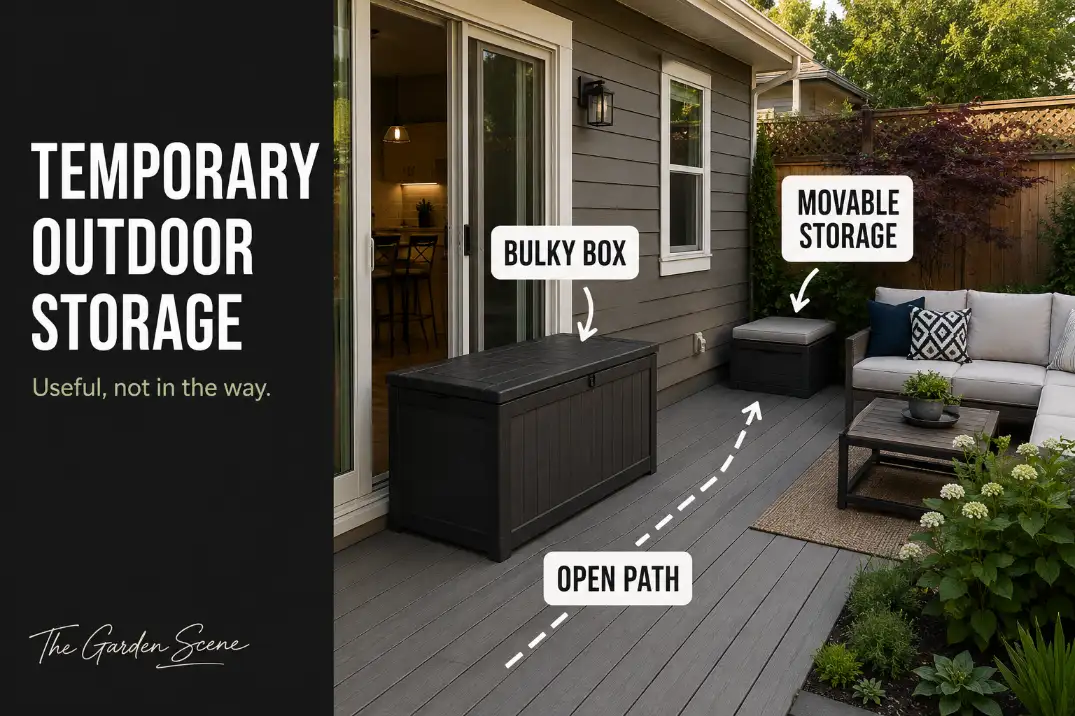
Temporary outdoor storage should solve clutter without becoming the object everyone walks around. The best setup is usually the smallest movable storage plan that protects daily-use items, leaves a 30–36 inch route from the door, opens without moving furniture, and can be cleared or relocated in under 10 minutes when the patio changes use.
That is what separates temporary storage from a small shed. A shed is meant to claim a permanent zone. Temporary storage should flex with renters, seasons, storms, guests, kids’ gear, cushions, or weekend projects.
The first warning signs are easy to spot: the lid opens into the walking path, the box holds unrelated items, fabric stays damp after 24 hours, or the patio looks cleaner but feels harder to use.
Storage That Can Leave
Temporary storage has to pass an exit test. If it cannot move, empty quickly, or shift to another edge of the yard, it is not really temporary anymore.
Start with the reason it needs to move
There are four common reasons homeowners choose temporary outdoor storage. Renter storage avoids drilling, anchoring, or permanent cabinets.
Seasonal storage handles cushions, covers, pool towels, or winter gear for a few months at a time. Event storage absorbs party supplies, toys, or serving pieces for a weekend.
Weather storage protects loose items before wind, heavy rain, or freezing conditions.
Those are different jobs. A rolling cart may be perfect for a Saturday cookout but weak for cushion storage. A lidded deck box can protect pillows but becomes annoying if you need garden tools three times a day.
A vertical shelf can hold tools well, but it should not be the place where soft fabric gets sealed against a damp wall.
If the patio is already overloaded, the better first move may be getting low-use items off the main outdoor living area entirely.
A layout that feels cramped often improves faster when bulky gear is relocated, which is why Store Things Off the Patio to Free Space fits this decision better than simply adding another container.
Separate daily, seasonal, and dirty items
The mistake is treating one outdoor box as a universal solution. Daily items need fast access. Seasonal items can sit farther from the door. Dirty items, such as hand tools, soil bags, hose parts, and muddy shoes, should not share storage with cushions or throws.
A temporary setup works better when each piece has one job. One small lidded box can handle soft items. One shallow vertical rack can handle tools.
One off-patio bin can hold bulk supplies. That usually beats one oversized box that slowly becomes a weatherproof junk drawer.
Pro Tip: If you have not opened a container in 30 days during the season it was meant to serve, it probably does not need prime patio space.
Keep the Door Path Open
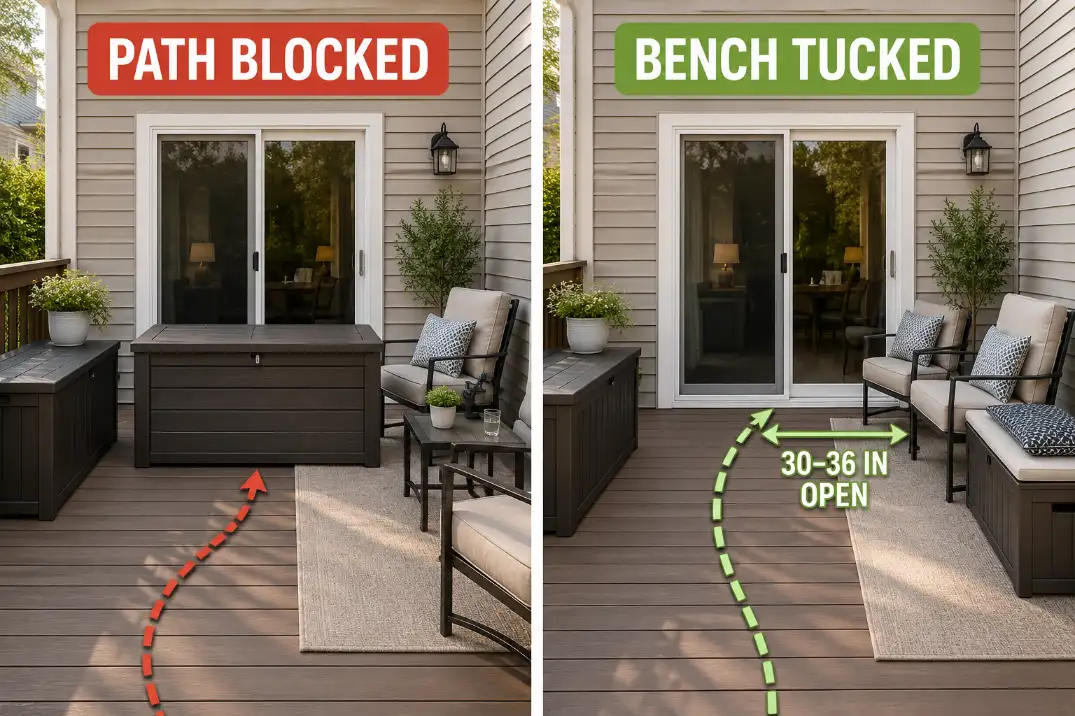
The door path is the first place temporary storage goes wrong. A storage piece may look harmless when the lid is closed, but it becomes a daily problem when someone has to step around it with food, laundry, pets, trash, cushions, or garden supplies.
Measure the route before the container
A 30-inch route is the practical minimum for one person moving through a patio. A 36-inch route feels much better near a back door, stair, gate, grill, or trash route. The storage piece itself is only part of the measurement. You also need to count the way people approach it, open it, and stand beside it.
The visible symptom is clutter. The real mechanism is interrupted movement. When a box, bench, cart, or shelf forces a sideways step at the door, the patio feels smaller even after the loose items disappear.
This is why storage should come after access, not before it.
The same path-first logic appears in Keep Patio Entry Clear, because a patio entrance is not leftover space. It is the part of the layout people use most often.
Check the lid swing and hand space
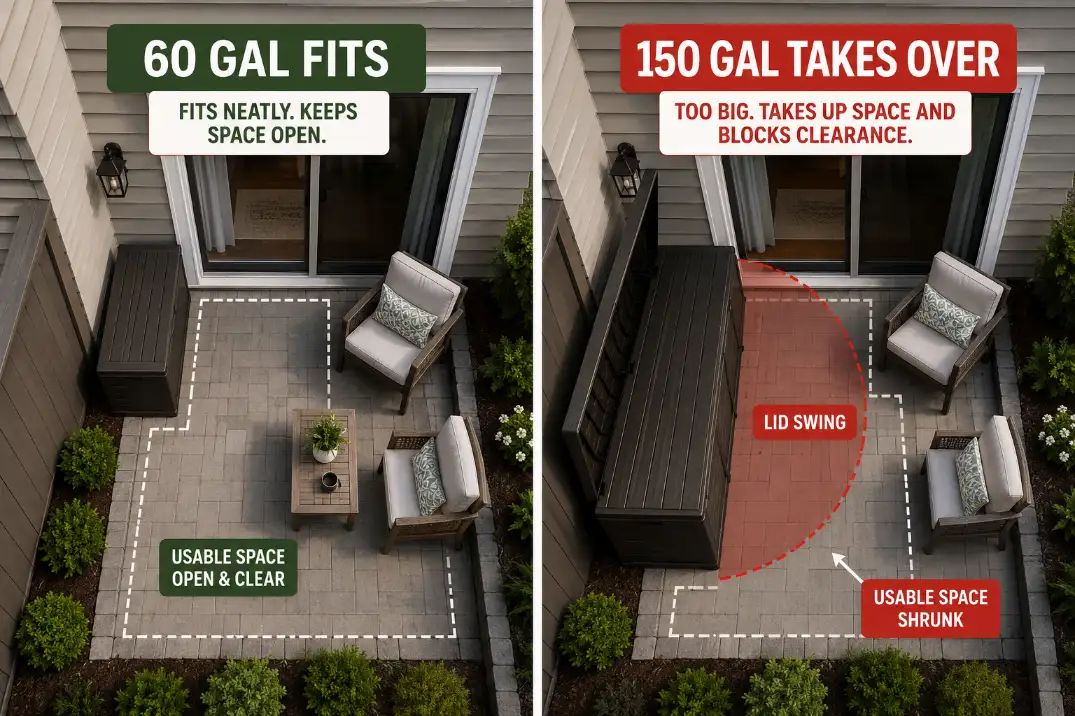
A deck box can have a tidy footprint and still fail in use. A 22-inch-deep box may need another 18–24 inches of clear space in front or above it so the lid can open comfortably. If a chair has to move every time you grab cushions, the storage is too awkward for that location.
This is where people overestimate capacity and underestimate access. More storage volume does not help if the container is annoying to open. A smaller box that opens freely is usually more useful than a larger one that traps itself behind furniture.
Deck Boxes Can Overwhelm
Deck boxes are not bad. They are just easy to overbuy. The larger the box gets, the more it behaves like a permanent object instead of temporary storage.
Choose deck box volume by patio scale
Small deck boxes work best when they support a clear outdoor activity. They should not become a substitute shed. On an 8×10 or 10×12 patio, a large 120–150 gallon box can eat into seating space, lid space, and walking space so much that the patio technically looks organized but feels less usable.
| Deck box size | Best use | Layout warning | Better choice when |
|---|---|---|---|
| 22–40 gallons | Small cushions, toys, towels, covers | Limited capacity | You only need daily-use storage |
| 50–70 gallons | Small patio cushion storage | Needs lid clearance | The box can sit along a dead edge |
| 80–120 gallons | Larger cushions or pool gear | Can dominate compact patios | You have a yard edge, not just a patio edge |
| 130–150+ gallons | Bulk seasonal storage | Behaves like a small shed | Items should move off the patio instead |
| Storage bench | Soft items plus seating support | Can crowd chairs if too deep | Seating and storage need to share one zone |
A practical way to judge this is floor share. If the box, its lid zone, and the access space around it consume more than about 20–25% of the usable patio floor, it is no longer a background storage piece. It has become one of the main layout objects.
Know when a bench beats a box
A storage bench often works better than a deck box when the patio already needs seating. It earns two roles from one footprint. But it only helps if the seat depth, lid access, and chair spacing still make sense.
A bench that forces people into the door path is not efficient. It is just a box with a cushion on top.
When the choice has narrowed to a compact bench, small deck box, or seating-storage hybrid, Best Outdoor Storage Benches and Deck Boxes for Small Patios is the stronger next step because the reader is already at a real buying threshold.
Avoid the oversized-box trap
The obvious fix is buying a bigger deck box. That often wastes time because the real issue is mixed storage, not storage volume. Cushions, grill tools, soil bags, toys, and watering gear do not belong in one container just because they all live outdoors.
The sharper fix is separation. Soft items go in dry lidded storage. Hard narrow items go vertical. Dirty or bulky supplies move away from the seating area. Daily items stay closest to the activity they support.
Vertical Storage Without Mounting
Vertical storage is the better choice when the clutter is tall, narrow, hard, or tool-based. It solves a different problem than a deck box.
Use vertical space for narrow items
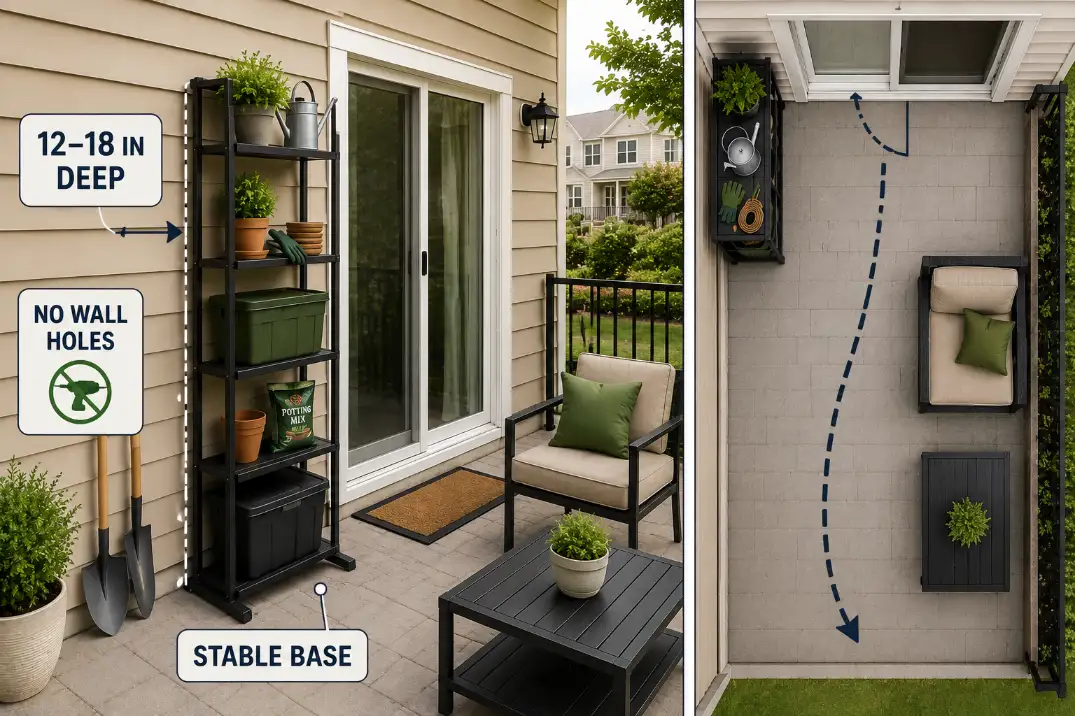
A shallow freestanding shelf, utility rack, or slim cabinet can organize watering cans, hand tools, gloves, small bins, folded mats, and lightweight garden supplies without claiming much floor depth. In tight outdoor areas, 12–18 inches of depth is usually enough.
Once vertical storage gets deeper than 20 inches, it starts acting like a cabinet. That may be fine beside a garage wall or side-yard utility zone, but it can crowd a small patio as much as a deck box.
The big advantage is no mounting. Renters, townhouse owners, and anyone avoiding wall holes can still gain order without drilling into siding, stucco, railing posts, or masonry. But freestanding does not mean careless. A tall 60–72 inch unit should sit on a level surface with a stable base, especially where wind funnels around a building corner.
Do not turn every wall into storage
A wall-adjacent shelf can still block use. If it narrows the door approach, crowds a grill, catches a gate swing, or forces people to reach over seating, it is in the wrong spot.
Storage should belong to a zone. Garden tools can sit near a hose or planting area. Grill supplies can sit near the cooking station. Pool towels can sit near the pool route. When everything lands beside the back door, the patio starts to feel like an outdoor closet.
If the goal is reducing visual mess rather than adding capacity, Reduce Patio Clutter Without Losing Function is the stronger lens. Sometimes the best storage fix is removing three loose objects from sight, not adding a large new organizer.
Hide Clutter Without Building
Temporary storage is not always about adding a box. Sometimes it is about hiding the right items in the right way without building a shed, screen wall, or permanent cabinet.
Screening is not the same as storage
A planter, folding screen, low fence panel, or outdoor curtain can hide a clutter zone, but it cannot make that zone function. If the hidden pile is wet, dirty, mixed, or hard to reach, the screen only hides the symptom.
Sort first. Daily items should be easy to grab. Seasonal items can go farther away. Dirty items need separation from fabric. Soft items need dryness more than concealment.
This matters because outdoor clutter often looks like one visual problem when it is actually three storage problems stacked together.
For tools and supplies, the strongest fix is usually a working edge rather than a decorative hiding spot. Hide Backyard Tools and Supplies Without Clutter supports that distinction, especially when hoses, tools, soil, and small equipment are making the living area feel unfinished.
Moisture decides what can be hidden
A tight lid can keep rain off but still trap damp air. If cushions, towels, or fabric covers still feel damp 24 hours after storage, the container is not breathing well enough for that use.
If they smell stale after 48 hours, treat that as a warning sign, not normal outdoor storage behavior.
In humid climates, sealed storage needs more caution. In dry, hot regions, sun exposure can become the bigger issue, especially with thin plastic lids, dark containers, and items stored against reflective walls.
The best temporary storage is not always the tightest seal. It is the container, shelf, or hidden zone that matches the material inside.
Useful Without Looking Temporary
Temporary storage can still look intentional. The trick is to place it where the outdoor space already has a visual edge instead of dropping it into the middle of the patio.
Give every piece a zone
A storage bench belongs near seating. A deck box belongs near cushions, pool towels, or covers. A slim shelf belongs near tools or watering supplies. A rolling cart belongs near a grill, serving area, or planting task.
Small placement choices change how temporary storage reads. A low bench tucked under a window can feel like part of the seating zone.
A shallow shelf beside a hose can look like a working garden edge. The same box placed between the back door and the chairs often looks stranded, even if it technically fits.
When storage supports a nearby activity, it looks planned. When it floats between the door and the chairs, it looks temporary in the worst way. The container does not need to disappear. It needs a reason to be exactly where it is.
Try removing the piece mentally. If the patio would look cleaner but become less usable, the storage is probably earning its place. If the patio would look cleaner and move better, the storage is either too large, too central, or holding items that should live somewhere else.
Know when temporary stops working
Temporary storage stops making sense when it becomes permanent overflow. If the same box stays packed through two seasons, the lid is hard to open, items stay damp, or the walking route feels tight every day, another container is not the answer.
That is when the layout needs redistribution. Soft items stay near seating. Dirty items move off the patio. Bulk supplies go to a garage, side yard, or utility edge. Daily items get the smallest storage piece that works.
The larger pattern matters in small backyards because storage competes with seating, access, shade, planting, and cooking zones. If the whole yard is starting to feel harder to use, Storage Mistakes That Make Small Backyards Harder to Use is the better next step.
Quick checklist before buying temporary outdoor storage
- Keep the main route at 30–36 inches wide.
- Check lid swing, not just the product footprint.
- Treat 20–25% of usable patio floor as a warning threshold.
- Use 12–18 inch deep vertical storage for narrow tools and supplies.
- Separate soft, damp, dirty, seasonal, and daily-use items.
- Choose pieces that can be emptied or moved in under 10 minutes.
- Avoid any container that keeps fabric damp after 24–48 hours.
Questions People Usually Ask
What is the best temporary outdoor storage for renters?
The best renter-friendly storage is freestanding, shallow, movable, and useful without wall holes. Look for small deck boxes, storage benches, rolling carts, freestanding shelves, or slim outdoor cabinets. Avoid anything that needs drilling into siding, railing posts, masonry, or shared exterior walls.
Is a deck box or storage bench better for a small patio?
A storage bench is usually better when seating is already needed. A deck box is better when cushions, towels, or covers need protected storage along an unused edge.
The wrong choice is the one that blocks the door route or needs furniture moved before it can open.
Can cushions stay in outdoor storage all season?
They can if the container stays dry and the cushions are not going in damp. If fabric still feels damp after 24 hours or smells stale after 48 hours, the storage is not working well enough.
Let cushions dry before storing them, and avoid packing soft items tightly against damp tools or soil bags.
For moisture-sensitive outdoor cushions and fabrics, the EPA’s mold guidance is a useful reminder that damp materials should dry quickly, especially within the 24–48 hour window described in A Brief Guide to Mold, Moisture and Your Home.