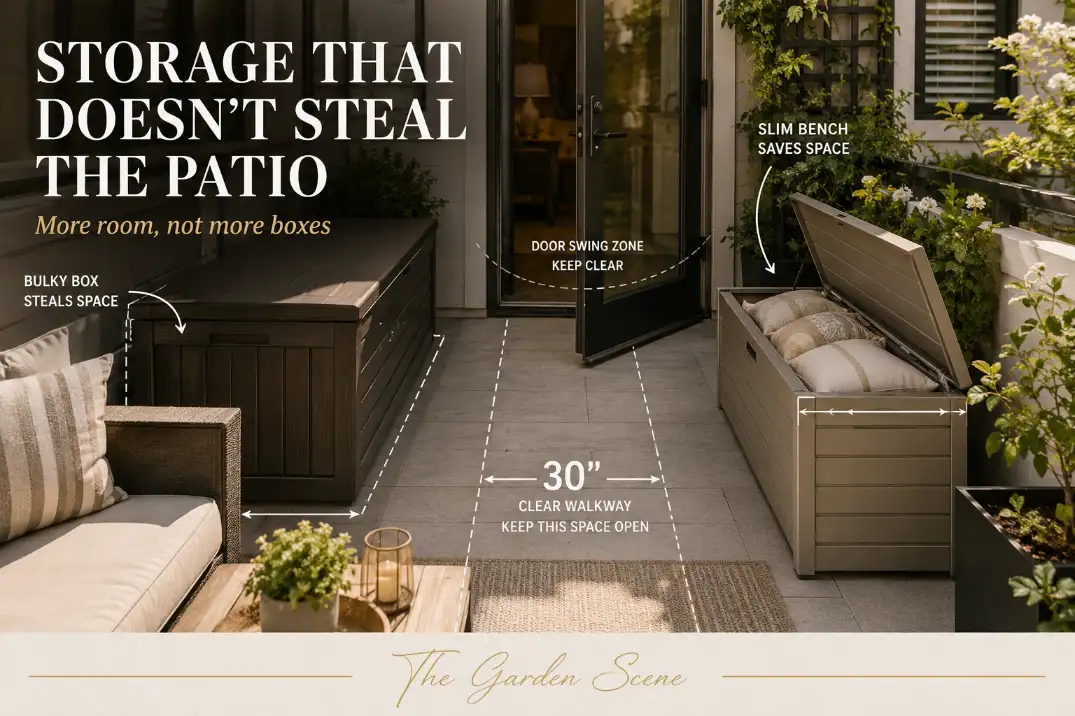
The best outdoor storage bench or deck box for a small patio is not the largest one that fits on the floor. It is the one that stores the right items while preserving the 30–36 inches of clear movement space you still need near the patio door, seating, grill, or dining zone.
For most small patios, start with a 70–120 gallon resin deck box if the main problem is cushions and loose outdoor clutter. Choose a 40–60 inch seat-rated storage bench only when it can replace chairs, not sit beside too many of them.
For narrow patios around 5–7 feet deep, a slim deck box or front-opening storage cabinet often works better than a deep top-opening trunk.
The mistake is buying “more storage” before deciding what the patio is actually missing: dry cushion storage, extra seating, faster cleanup, or better circulation.
Quick Answer: Which Storage Type Should You Browse First?
If your patio already has enough seating, browse medium resin deck boxes first. They give the most flexible storage per square foot and handle cushions, throw pillows, small tools, outdoor games, and grill covers without forcing another seating piece into the layout.
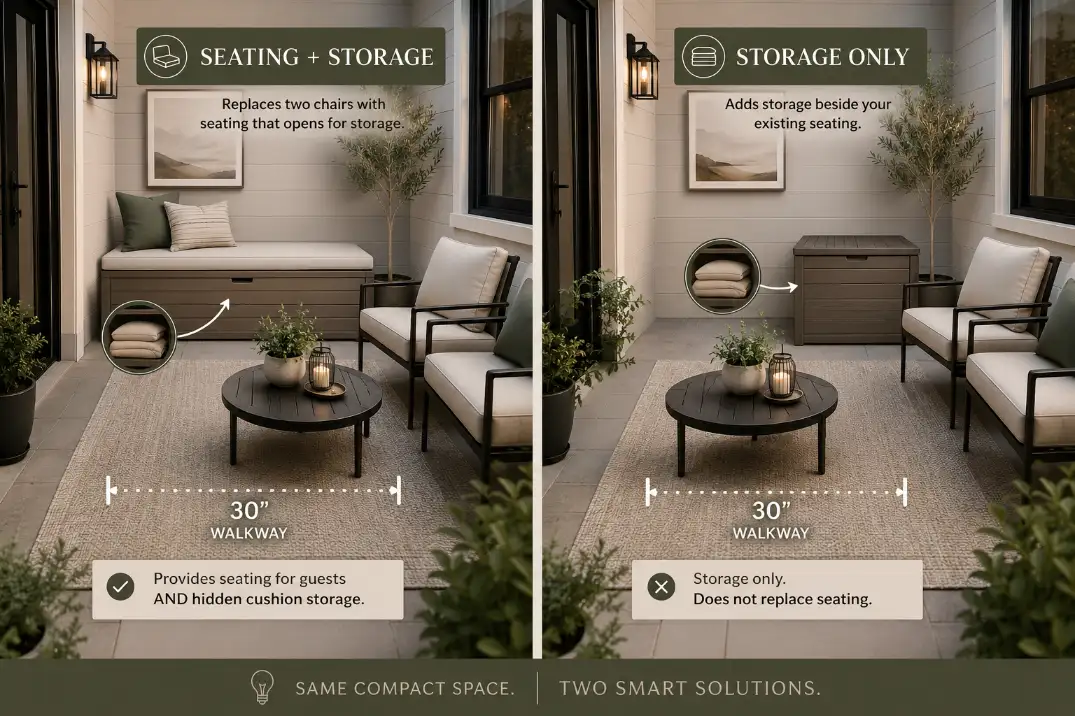
If your patio needs seating and storage, browse seat-rated outdoor storage benches. But the bench must replace chairs or form one clean seating edge. If it only adds another object, it is the wrong category.
If your patio is narrow, covered, or balcony-like, browse slim outdoor storage boxes or front-opening cabinets first. In tight layouts, lid swing and daily access matter more than total gallons.
The First Buying Decision Is Shape, Not Capacity
Outdoor storage is usually judged by gallon rating, but small patios are limited by shape, lid access, and walking paths. A 150-gallon deck box can look efficient online and still fail once it blocks the route from the door to the seating area.
When a Medium Deck Box Wins
A medium deck box is the best first choice when the patio’s main problem is loose, weather-sensitive items. Cushions, small garden tools, watering accessories, furniture covers, and outdoor toys all store better in one open cavity than in a bench with awkward dividers.
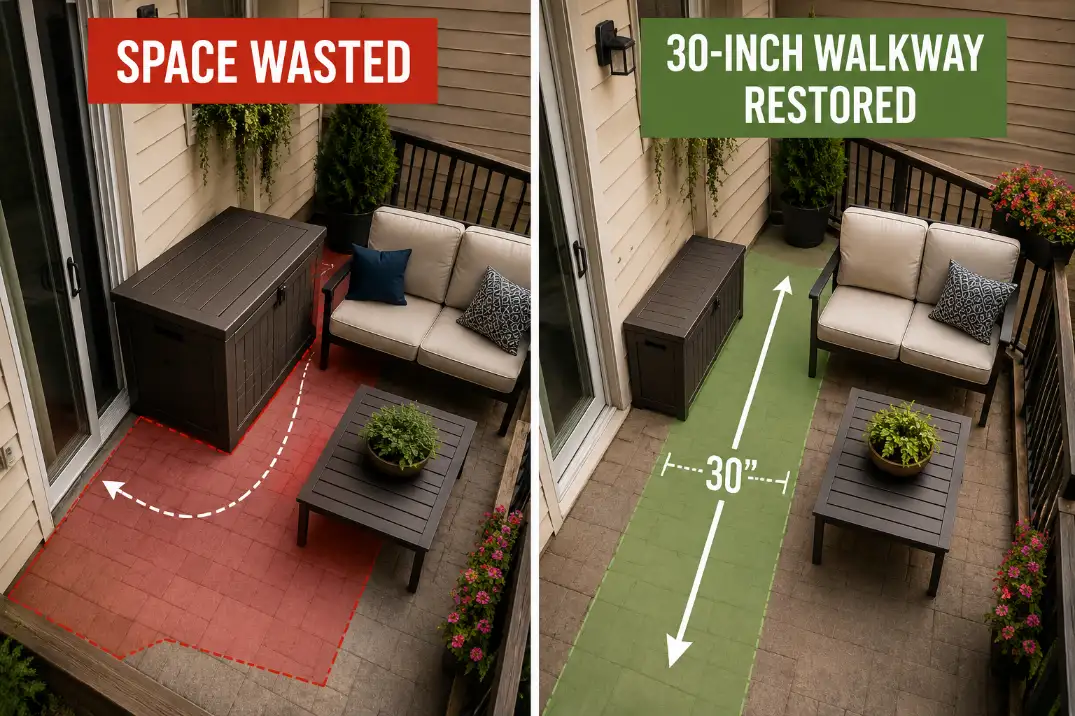
The practical range for many small patios is 70–120 gallons. That is usually enough for two to four chair cushions, several pillows, and a few small accessories. Go larger only if the box can sit along a wall, railing, or unused edge without narrowing the walkway below about 30 inches.
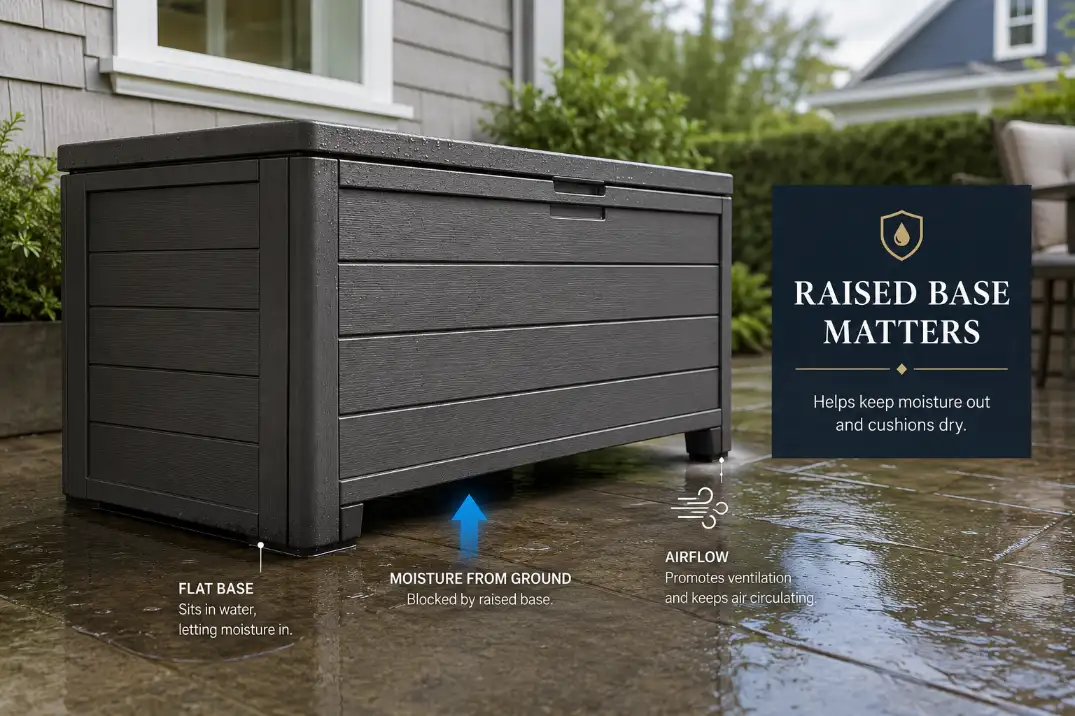
Look for a resin or polypropylene body, a slightly sloped lid, raised feet, and enough interior length for your largest cushion. The interior dimensions matter more than the advertised capacity if your cushions are thick or rigid.
If your patio already has chairs and the real problem is clutter, do not start with a bench. Start with a medium resin deck box that protects the walkway while taking cushions and loose gear out of sight.
BEST FIRST PICK FOR MOST SMALL PATIOS
Medium Resin Deck Box
Best for patios that already have seating but need cushion, tool, toy, or cover storage.
It fits the most common small-patio problem: clutter without adding another seat.
Look for 70–120 gallon capacity, raised feet, a weather-resistant lid, and interior dimensions that match your cushions.
When a Storage Bench Is the Better Buy
A storage bench works when seating is genuinely part of the problem. It is not the automatic upgrade over a deck box. It becomes useful when it replaces chairs, creates a clean wall-side seating edge, or gives a small dining nook one flexible side.
A good storage bench should feel like seating first and storage second. Seat height around 17–19 inches is usually more comfortable for adults than a low boxy bench. A 40–60 inch width is often enough for one to two people without dominating a compact patio.
Skip storage benches that are not clearly seat-rated if you expect adults to sit on them. Also skip benches that force people to sit in a traffic path. A bench in the centerline of a small patio usually makes the space feel tighter, not smarter.
If the patio is short on seating, a seat-rated storage bench is the only storage category here that can actually remove furniture instead of adding more. Buy it as a chair replacement, not as extra furniture squeezed into an already crowded patio.
BEST WHEN SEATING IS ALSO MISSING
Seat-Rated Outdoor Storage Bench
Best for small patios that need both hidden storage and one usable seating edge.
It works when it replaces loose chairs and keeps the center of the patio open.
Look for a 40–60 inch width, 17–19 inch seat height, clear weight rating, and a lid that opens without moving cushions.
What People Usually Misread Before Buying
The common buying mistake is treating a storage bench and a deck box as interchangeable. They are not. A deck box is storage that may occasionally support light use on top. A storage bench is seating that happens to hide items.
That difference matters once the patio is in daily use. If the box sits near a door, you need lid clearance. If the bench sits near a table, you need knee room. If either one forces people to step sideways every time they walk outside, the product is technically useful but spatially wrong.
A cramped patio usually needs fewer competing objects before it needs more clever storage. If the layout is already crowded, Remove Patio Furniture From a Cramped Space is the better place to start before adding another storage piece.
Capacity Is Easy to Overestimate
A gallon rating sounds precise, but it does not tell you how well the shape matches your items. Thick cushions waste space quickly. One deep lounge cushion can use 10–20 gallons depending on thickness and stiffness. Four chair cushions can fill a smaller box faster than expected.
The better check is simple: measure the longest cushion, then compare it with the interior length of the box. If cushions must be folded sharply every time, seams weaken and drying becomes harder.
Lid Swing Is Easy to Underestimate
A hinged deck box may need 3–6 inches behind it and enough vertical clearance above it. Against a wall, under a window ledge, or below a railing cap, that can be the difference between easy daily use and a lid that only opens halfway.
This is where slim boxes and front-opening cabinets become more valuable than they look. They may hold less, but they often function better in narrow layouts.
Best Categories by Small Patio Situation
| Patio situation | Best category | Why it wins | Skip it if |
|---|---|---|---|
| Cushions and pillows need storage | Medium resin deck box | Best flexible volume for soft goods | It blocks the main walkway |
| Seating is limited | Seat-rated storage bench | Replaces chairs while hiding clutter | It adds seating you do not need |
| Narrow balcony or 5–7 ft deep patio | Slim deck box or front-opening cabinet | Reduces lid-swing problems | You need to store long cushions |
| Wet patio slab or paver area | Raised-base deck box | Keeps storage floor away from puddling | Water stands under it after every rain |
| Covered patio with existing furniture | Low-profile deck box | Tucks along the edge quietly | It becomes another table-like obstacle |
Best for Cushion Storage
A medium resin deck box is usually the cleanest choice for cushions. Resin does not rot, is easy to rinse, and handles normal rain exposure better than most budget wood boxes.
The key filters are interior size, raised base, lid design, and ventilation. Weather-resistant is not the same as waterproof, so do not expect a deck box to protect cushions like indoor storage during months of storms, snowmelt, or high humidity.
A storage bench should also support the rest of the furniture plan, not fight it. If you are already choosing bench seating for a compact layout, Best Patio Benches for Small Patios gives a more focused way to compare bench width, comfort, and placement.
Best for Mixed Outdoor Clutter
Choose an open-cavity deck box rather than one with too many dividers. Mixed patio clutter changes by season: spring tools, summer pool gear, fall furniture covers, winter accessories. A simple open interior adapts better.
For families, the best box is often the one people can use in under 10 seconds. If storing toys or cushions requires moving two chairs first, the system will fail.
Best for Narrow Patios and Balconies
Slim deck boxes and front-opening outdoor cabinets are better when the patio is too narrow for a deep lid to open comfortably. This is common on apartment patios, townhome balconies, and compact covered patios where the walking path and door swing already compete.
Choose this category when access matters more than maximum capacity. Look for a depth that keeps the walkway near 30 inches, adjustable shelves if storing small items, and a stable base if wind is a concern.
For narrow layouts, the product that opens easily will usually beat the product that holds more. If a deep box makes you move furniture every time, browse a slim storage category first instead of chasing maximum gallons.
BEST FIT FOR NARROW PATIOS
Slim Outdoor Deck Box or Storage Cabinet
Best for balconies, narrow covered patios, and tight door-adjacent spaces.
It reduces lid-swing problems and keeps storage reachable without rearranging furniture.
Look for slim depth, front access or easy lid clearance, raised feet, and enough shelf height for your usual items.
🔴 SHOP slim outdoor storage boxes
Weather Resistance: The Detail That Separates Good Storage From Damp Storage
Most outdoor storage products are weather-resistant, not truly waterproof. That distinction matters in humid climates, storm-prone areas, and freeze-thaw regions where water sits, condenses, or refreezes around the base.
Raised Bases Matter More Than Decorative Walls
People often inspect the lid first. That is reasonable, but the base is where many small-patio storage problems begin. If the box sits directly in a low spot where water remains for more than 30 minutes after rain, the bottom stays damp long enough to affect stored cushions.
Raised feet, a slightly lifted floor, or a base that does not sit flat in water can matter more than a heavier-looking lid. On paver patios and older concrete slabs, small drainage imperfections are common.
If your patio already has standing water near the house or storage area, buying a better box may only hide the symptom. Patio Water Pooling Against House is the more important diagnosis when water repeatedly collects where storage needs to sit.
Ventilation Can Beat Over-Sealing
A little condensation after a humid night is not always product failure. A real failure is different: cushions still feel damp after 12–24 hours of dry weather, water beads inside the lid, or mildew odor appears within a week.
Sealing every gap can backfire if humid air gets trapped inside. For cushions, airflow and drying potential matter. In humid parts of the Southeast or coastal areas, breathable storage habits are often more important than trying to make a lightweight box airtight.
Pro Tip: Store cushions dry, not just covered. Even the best box struggles if damp cushions are packed tightly and left closed for several days.
Material Choices That Make Sense for Small Patios
Material choice should follow exposure, weight, maintenance tolerance, and whether the piece will be used as seating.
Resin Is the Safest Default
Resin and polypropylene are the practical default for most small patios. They are light, easy to clean, do not rot, and handle ordinary rain exposure well. For renters or people who rearrange furniture seasonally, resin is usually easier to live with than wood or metal.
The weakness is rigidity. Budget resin boxes can bow if overloaded, and not every flat lid is safe for seating. If the product is not seat-rated, treat it as storage only.
Wood Looks Better but Needs Better Placement
Wood storage benches can look more intentional than resin, especially beside planters, pavers, and natural furniture. But wood asks for airflow, periodic care, and smarter placement.
In humid areas or shaded patios that stay wet for 24–48 hours after rain, wood ages faster if pushed tight against a damp wall or placed where water sits. Cedar, teak, acacia, and eucalyptus are common outdoor options, but none performs well when the feet stay wet.
Wood makes most sense when appearance matters, the patio drains well, and you are willing to maintain the finish.
Metal Is Strong but Not Always Comfortable
Metal benches can be durable, but they are not always the best small-patio storage choice. Dark metal can get hot in full sun, especially in hot-arid regions.
Steel can rust if the coating chips, particularly near coastal moisture. Aluminum resists corrosion better but may feel less substantial unless the frame is well-braced.
Metal is usually more convincing as a seating frame than as the main answer for cushion storage.
Placement Rules That Make Storage Feel Intentional
Storage should sit on the edge of the patio, not in the path that makes the patio usable. The clearest rule is to protect the line between the door and the main seat. On a compact patio, that route may be only 3–5 feet long, so even a small obstruction feels large.
Keep Storage Out of the Centerline
Place deck boxes along a wall, railing, fence, or unused corner. If someone has to step around the box to carry food, water plants, or open the door, the storage is solving one problem by creating another.
A bench can work along the edge of a dining or conversation zone. It performs poorly when it floats in the middle like a waiting-room seat.
If deep chairs are already consuming the patio, storage is probably not the first fix. Deep Seating on Small Patios explains why oversized lounge proportions often make compact patios feel smaller than they are.
Make Access Fast Enough to Become a Habit
The best storage is easy to use. If cushions, toys, or covers can be put away in under 10 seconds, the patio resets naturally. If opening the box requires shifting chairs and lifting planters, loose items will return.
This is why a smaller, reachable box often outperforms a larger hidden one. Daily convenience beats theoretical capacity.
When Buying More Storage Stops Making Sense
A larger deck box stops helping when the patio is overloaded with too many functions. Dining, grilling, lounging, gardening, pet gear, kids’ toys, and storage cannot all dominate the same 80–120 square feet.
At that point, storage hides the symptom. The underlying issue is layout overload. A patio with one medium box and a clear purpose usually works better than a patio with two storage pieces and no open path.
If the whole patio feels crowded even after storage is added, Small Patio Design Mistakes That Waste Space is the better next step because the problem is no longer just where to put cushions.
What Buyers Overestimate
Lock value is often overestimated. A latch may keep the lid closed, but most lightweight deck boxes are not serious security for expensive tools. Treat them as convenience storage, not theft-proof storage.
Cushion protection is also overestimated. During long wet seasons or freezing winters, outdoor boxes are not a perfect substitute for indoor storage. If cushions will sit unused for months, breathable bags in a garage, shed, or closet are safer.
What Buyers Underestimate
Filled weight is underestimated. A large box packed with cushions, soil bags, tools, and covers becomes hard to move for cleaning. If leaves, dust, or pollen collect around the base, you will notice that quickly.
Heat is underestimated too. Dark resin and metal can become uncomfortable in direct sun, and heat-trapping boxes are not ideal for candles, soft plastics, or delicate textiles.
Final Verdict: Start With the Category That Protects Space First
Start with a medium resin deck box if the patio already has seating and the real problem is loose cushions, covers, toys, or small tools.
Move to a seat-rated outdoor storage bench only when it can replace chairs or create one useful seating edge. Choose slim outdoor storage when lid swing, balcony depth, or walkway clearance matters more than total capacity.
The wrong move is buying the biggest storage piece that fits. Small patios do not reward maximum storage; they reward the storage shape that keeps the patio usable, dry enough, and easy to reset after everyday use.
For broader official guidance on keeping outdoor living areas safer and easier to maintain, see the U.S. Consumer Product Safety Commission.