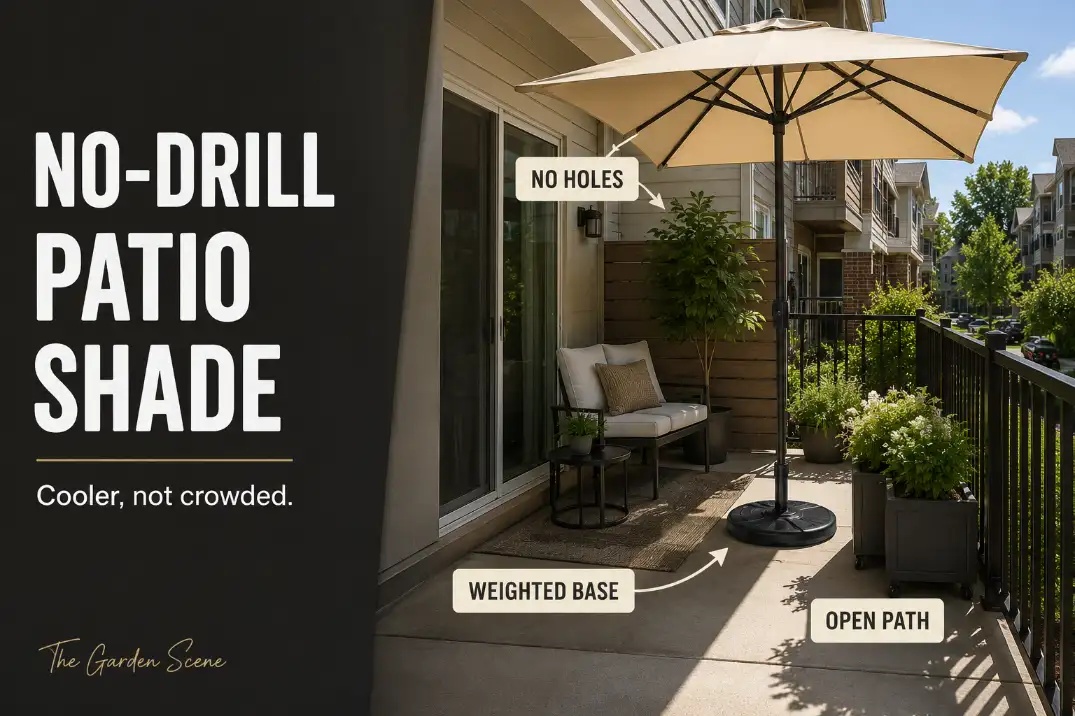
No-drill patio shade works best when it cools one useful zone instead of trying to cover the whole patio. The first checks are where the sun hits between 11 a.m. and 4 p.m., whether the shaded seat still leaves a 30–36 inch walking path, and whether the base, post, or frame will become the new obstacle.
This is different from a covered patio problem, where the structure already exists and the issue is often trapped heat or poor airflow.
With no-drill shade, the mistake is usually choosing the biggest cover before checking path space, wind exposure, renter rules, and the daily sun angle.
For most small patios, the strongest setup is not the widest canopy. It is a stable umbrella, edge-positioned shade, weighted planter support, or temporary canopy that cools the seat you actually use for 2–4 afternoon hours without closing off the door route.
Shade Without Holes
Start with shade that covers the use zone, not the whole patio. A no-drill setup fails when the shade object solves sun exposure but creates a new problem underfoot.
Pick the Smallest Shade That Solves the Real Heat Point
The right first question is not “How do I shade the patio?” It is “Where do people actually sit when the patio gets too hot?” A 10 by 12 foot patio does not need 120 square feet of shade if the uncomfortable spot is one 4 by 6 foot seating zone.
Stand outside during the hottest use window and watch where the sun lands. If direct sun only hits the main chair for 90 minutes in late afternoon, a full canopy is usually too much.
If the seating zone is exposed for 4–5 hours, a stronger freestanding setup starts to make sense.
| Patio condition | Best no-drill shade idea | Avoid first |
|---|---|---|
| Narrow apartment patio | 7.5–9 ft center-pole umbrella | Full canopy legs around the seating |
| Small lounge corner | Side-positioned cantilever umbrella | Light base with a large offset canopy |
| Renter balcony or condo patio | Freestanding or approved clamp shade | Wall anchors, siding hooks, or railing stress |
| Hot concrete or paver patio | Umbrella plus lighter floor layer | Only shading the air above the chair |
| Wind-exposed patio | Smaller vented umbrella or removable shade | Large sail or canopy left open overnight |
Keep the Door Route Clear
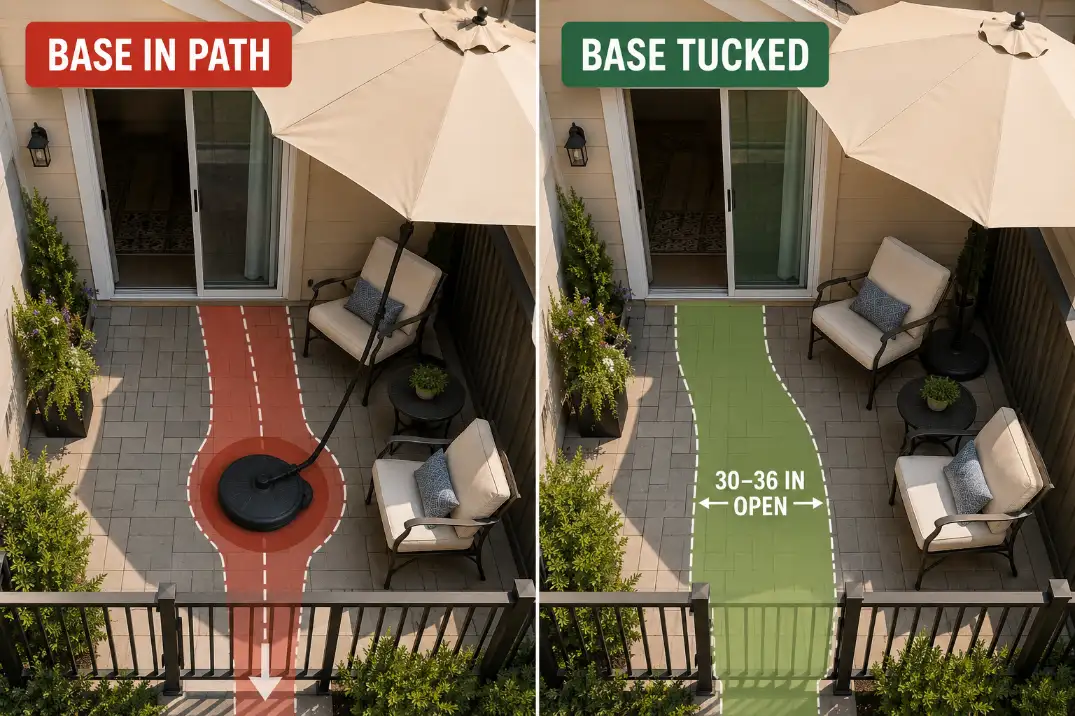
The non-negotiable number is the walking path. Keep about 30–36 inches clear between the sliding door, seating, base, and patio edge. On an apartment balcony or narrow townhouse patio, that route matters more than gaining a few extra inches of shade.
This is where many shade setups fail. The umbrella looks right from the chair, but the base lands in the door path, grill route, or serving line. If the shade makes the patio harder to enter, it is not a good shade solution.
For tighter layouts, the same access logic used in Add Patio Shade Without Blocking Walkways applies here: the shaded zone should protect the route, not sit on top of it.
Umbrellas That Actually Fit
Umbrellas are usually the most practical no-drill patio shade idea because they are movable, familiar, and easy to remove. The mistake is treating umbrella size as the main upgrade when placement is usually the real decision.
Center-Pole Umbrellas Are Usually Safer for Tight Patios
A center-pole market umbrella works best when a table, chair pair, or bench can sit around the pole without interrupting the walking route. It is usually the cleaner choice for compact dining zones and small two-chair patios.
A cantilever umbrella works when the pole needs to stay off to the side. That can help with lounge chairs or a seating pair near a wall, but the offset canopy asks more from the base.
The setup may need more floor area than a center-pole umbrella even though the pole is not in the middle.
For most small patios, start with the center-pole option unless side placement solves a real layout problem. Cantilever umbrellas make sense only when there is room for the base at the edge and the canopy does not sit in a wind corridor.
Do Not Buy More Canopy Than the Patio Can Use
For a small two-chair setup, a 7.5 to 9 foot umbrella is often enough. A 10 to 11 foot umbrella can work on a larger patio, but on an 8 by 10 patio it may bump railings, catch more wind, and force the base into the traffic lane.
The common overestimate is shade diameter. People picture the umbrella from above, but real shade moves during the day. A 9 foot umbrella does not shade a perfect 9 foot circle all afternoon. In low-angle late sun, the useful shade may shift several feet away from the seat.
Pro Tip: Before buying, place a broom or painter’s pole where the umbrella pole would go and walk from the door to the chair. If you have to turn sideways, the shade plan is already too tight.
Once the footprint is clear, Best Patio Umbrellas for Shade in Small Backyards is a better next step than jumping straight to the largest canopy available.
Weighted Bases and Small Patios
A no-drill shade setup is only as good as its base. The canopy gets the attention, but the base decides whether the patio still works.
The Base Is the Real Footprint
A base that is 20–24 inches wide can matter more than the umbrella canopy when the patio is small. On paper, a 9 foot umbrella sounds compact. In practice, the base may steal the exact square of floor needed for a chair leg, storage bench, or door route.
This is the symptom-versus-mechanism distinction: the patio may feel crowded after adding shade, but the canopy is not always the cause. The floor obstruction is often the real mechanism.
The best base positions are usually behind a chair, beside a planter, along a railing, or tight to a fence-side edge. The riskiest position is between the door and the seating zone, because that is where people walk without looking down.
When Extra Weight Stops Helping
More weight helps only when the base is in the right place and the umbrella is used within reasonable wind limits. A heavier base does not fix an oversized canopy in a wind channel. It also does not make the patio safer if the base becomes a trip point outside the door.
Wind is commonly underestimated because the patio can feel calm at sitting height while the umbrella canopy catches stronger air higher up.
If gusts twist the pole, make the canopy pulse for more than a few seconds, or push the umbrella toward the railing, close it.
For exposed yards, the failure pattern overlaps with Patio Umbrella Problems in Windy Yards: the shade object is not just shading the patio; it is also acting like a surface that catches force.
Temporary Canopies That Do Not Crowd
Temporary canopies can work well for meals, weekend projects, and short outdoor gatherings. They become a problem when they are treated like a permanent roof on a patio that does not have room for four legs.
Use Canopies for Defined Time Windows
A pop-up canopy is often best for a 2–6 hour use window, not as a summer-long patio structure. Leaving a temporary canopy up day after day exposes it to wind, rain pockets, UV wear, and frame stress. In rainy regions, even a small sag can collect water and pull the frame out of shape.
The practical test is simple: would you remove it before a storm, before leaving for the day, or before a windy night? If the honest answer is no, the canopy is probably being asked to do the job of a permanent structure.
For shoppers comparing removable overhead options, Best Shade Sails and Outdoor Canopies for Hot Patios fits better after the patio’s route, wind, and storage limits are already clear.
Keep the Legs Out of the Room
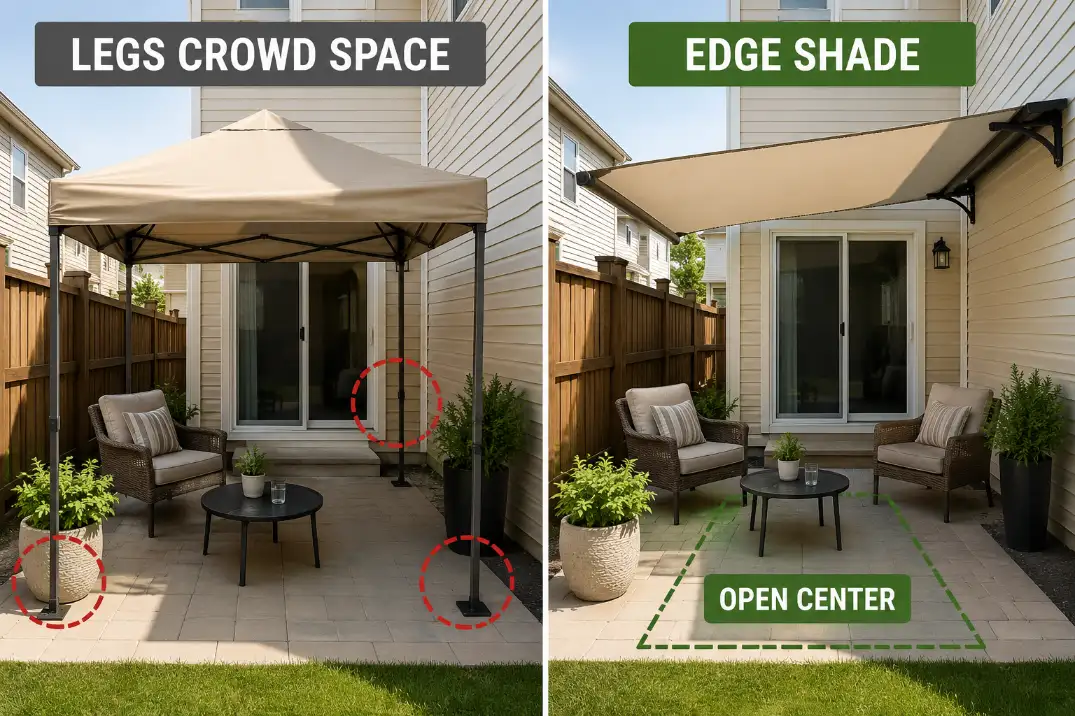
The usual canopy mistake is placing four legs around a patio that already has furniture, planters, storage, and a door. The shade improves, but the room becomes a cage. On a small patio, one leg in the wrong spot can break the entire layout.
A canopy works better over an open dining setup in a yard than over a tight apartment patio. If the patio is already narrow, choose shade that lives along one edge instead of a frame that surrounds the whole space.
Shade Sails Without Wall Damage
Shade sails are attractive because they look clean and architectural. They are also the no-drill idea most likely to disappoint when the anchor points are weak, temporary, or misunderstood.
A No-Drill Sail Still Needs Real Anchors
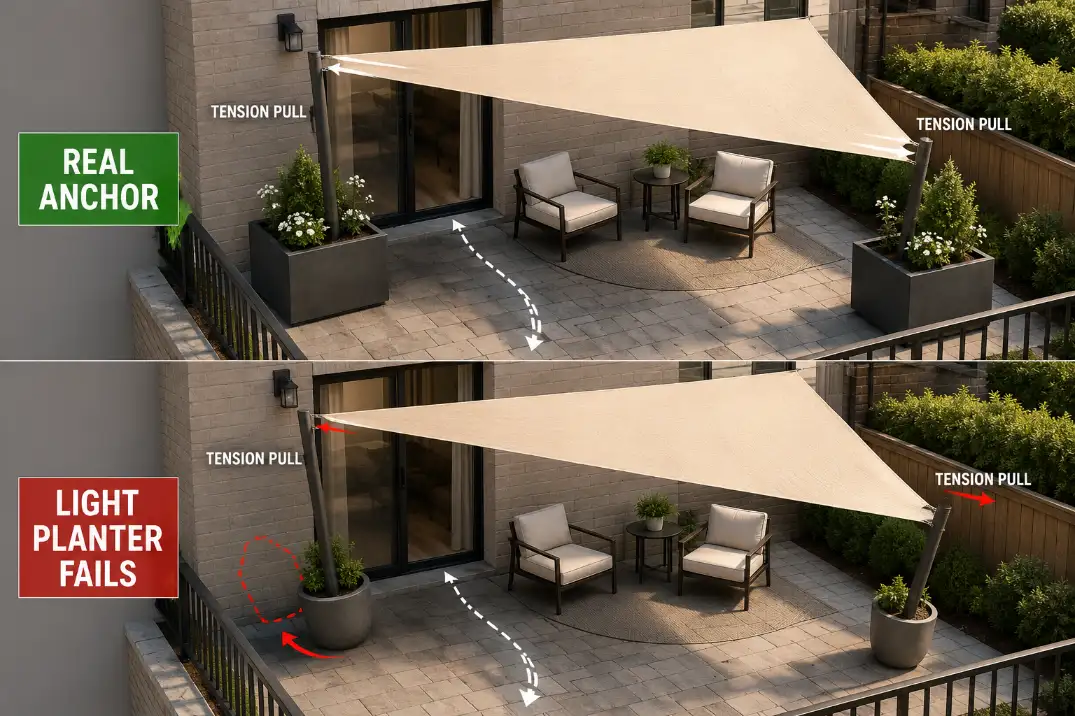
A shade sail does not become low-risk just because it avoids wall holes. A tensioned fabric panel still pulls against its supports, especially when wind gets under it. That pull has to go somewhere.
Good no-drill support usually means a freestanding frame, purpose-built posts, properly weighted masts, or large planter posts designed to resist movement.
Weak support usually means light decorative planters, railing ties, small bases, or improvised hooks.
The fix that often wastes time is trying to make a true tensioned sail work with objects that were never meant to resist fabric tension. Those supports may hold string lights or a soft curtain, but that does not make them suitable for a taut sail.
When a Shade Sail Is the Wrong Fix
Choose a no-drill shade sail only when the support points are stable enough to resist both pull and wind lift.
If the plan depends on small planters, thin railing ties, or lightweight bases, use an umbrella, removable canopy, or freestanding shade screen instead.
Without real anchor strength, a no-drill sail is not really a shade idea; it is a wind problem waiting to happen.
That is why a relaxed fabric panel may be more realistic than a true sail on a rental patio. It gives partial shade without pretending to be structural.
A flat sail is another common trap. Even a slight slope matters so rain can move off the fabric instead of pooling in the middle.
If the sail blocks airflow, hangs too low, or turns into a water pocket after one storm, it is too much structure for the support system.
Cooler Without Permanent Structure
No-drill shade should make the patio more usable, not just darker. A shaded patio can still feel hot if air stalls, heat reflects off concrete, or the furniture sits in a trapped corner.
Shade the Surface Under the Seat
A chair in shade feels better when the floor below it is also shaded. Concrete, pavers, and dark decking can keep radiating heat after the sun moves away.
On very hot afternoons, a surface that has baked for several hours can keep the seating zone uncomfortable for 1–2 hours after direct sun has shifted.
That is why the best no-drill setups often combine overhead shade with a lighter outdoor rug, movable planter, or small furniture shift. The shade blocks direct sun. The layout reduces stored heat around the sitting zone.
In dry hot climates, airflow can matter almost as much as shade. In humid areas, a fully enclosed canopy may feel heavy because shade does not remove moisture from the air.
The patio may be cooler by temperature but still uncomfortable if air cannot move.
Use Partial Shade Before Building a Temporary Roof
A patio does not need shade from edge to edge. Partial shade often feels better because it cools the seat while leaving air movement, light, and visual openness.
This is especially true on small patios where every freestanding item changes circulation. If the shade setup makes the patio feel boxed in, the problem may not be lack of shade.
It may be too much overhead coverage for a small outdoor room, which is the same pattern behind Patio Shade Setups That Make a Patio Feel Smaller.
A good no-drill shade setup should pass three tests:
- The main seat gets shade during the hottest 2–4 hours of normal use.
- A 30–36 inch path remains open from the door to the patio edge.
- The shade can be closed, moved, or removed before wind, storms, or off-season storage.
If it fails one of those tests, the setup is probably oversized, underweighted, or too permanent for the space.
Pro Tip: Test shade with a movable object for one afternoon before buying. A chair, folding screen, or tall planter can reveal whether the shade position helps comfort or just blocks the patio.
Questions People Usually Ask
What is the best no-drill shade for a very small patio?
A compact center-pole umbrella is usually the best first choice because it gives useful shade without adding a frame around the patio.
A cantilever umbrella can work when the base has a safe edge position, but it is not automatically better for tight spaces.
Can renters use no-drill patio shade?
Yes, but removable does not always mean allowed. Freestanding umbrellas, temporary canopies, and movable shade panels are usually safer renter-friendly choices.
Clamp shades, railing attachments, and anything tied to exterior building parts should be checked against lease, condo, or HOA rules first.
Are shade sails a good no-drill option?
Only when the supports are genuinely stable. A shade sail needs anchor strength, not just anchor points. If the plan depends on small planters, light bases, or railing ties, an umbrella or relaxed fabric panel is usually the better choice.
What should you avoid with no-drill patio shade?
Avoid oversized canopies, weak shade sail anchors, umbrella bases in the walking path, and shade pieces that cannot be removed before wind or storms.
The best no-drill setup should make the patio cooler without making it harder to use.
Because shade decisions also affect direct UV exposure during peak outdoor hours, see the EPA Sun Safety Tips.