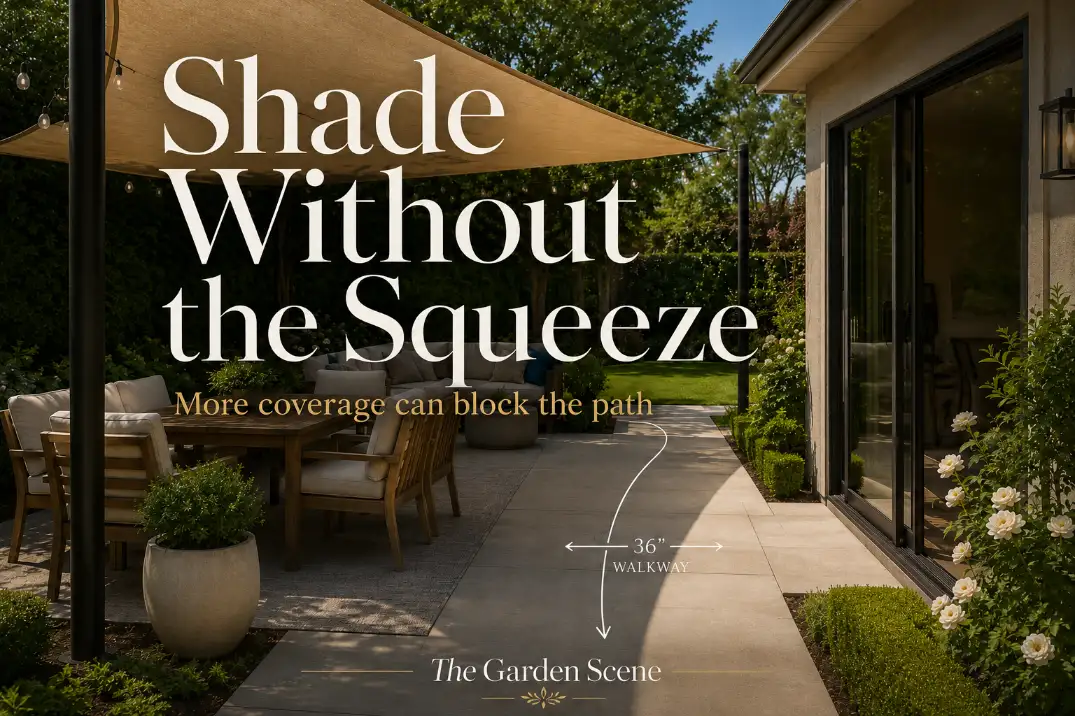
The best way to add patio shade without blocking walkways is to shade the sitting or dining zone while keeping the travel lane physically clear. Most failed shade setups do not fail because the canopy is too small.
They fail because the pole, base, post, screen, or chair pullback lands in the same 30–36 inches people need to move from the door to the grill, lawn, steps, or gate.
Start with three checks before buying anything: where people walk, where chairs move when occupied, and where the sun actually hits during the patio’s real use window, often between 3 p.m. and 6 p.m.
This is different from a patio that simply lacks shade. A patio can be shaded and still feel awkward if every trip across it requires stepping around a weighted base or ducking under a low canopy edge.
The 15-Minute Tape Test Before Buying Shade
Do this before choosing an umbrella, sail, awning, or pergola. It prevents the most common mistake: buying shade for the empty patio instead of the patio once people are using it.
Mark the walking route first
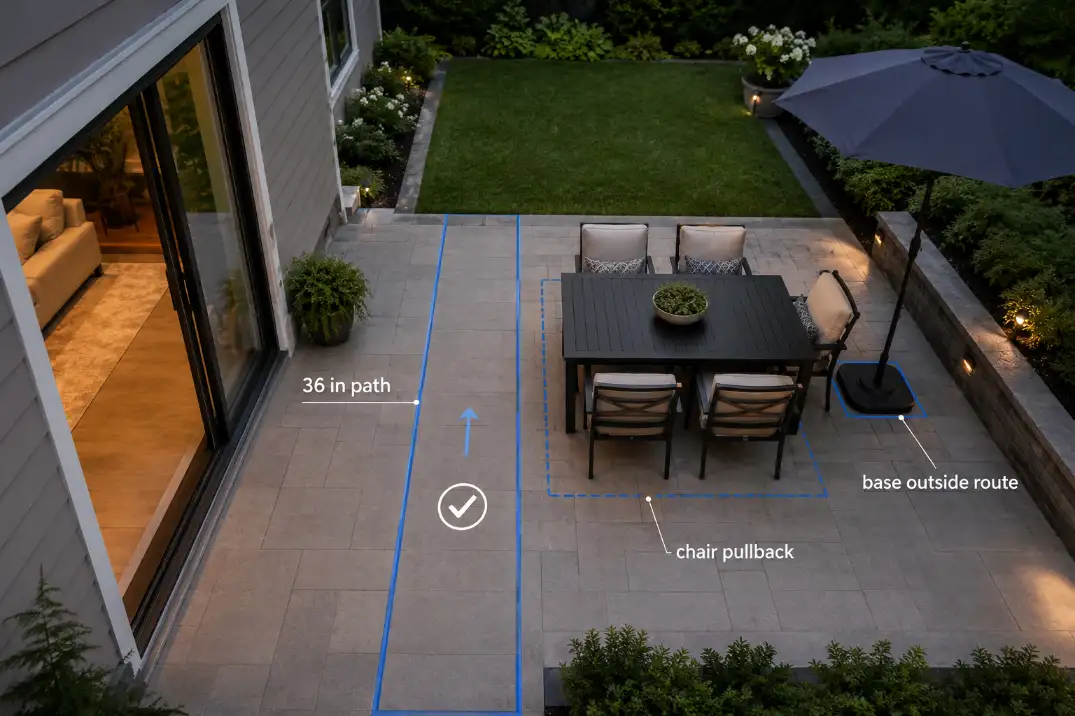
Use painter’s tape or chalk to mark the main route from the house to the yard, grill, gate, or steps. Keep this path at least 30 inches wide. If people often carry food, drinks, cushions, or grill tools, aim for 36 inches.
Do not measure the patio only wall to wall. Measure the usable route after furniture, chair pullback, storage boxes, planters, and shade supports are included. Around dining areas, chair movement matters. A chair often needs about 24 inches of pullback, and a walkway behind occupied chairs usually needs 36–42 inches to feel comfortable.
Add the shade hardware footprint
Next, tape the real footprint of the shade support. For an umbrella, that means the base, not just the pole. For a pergola, mark the posts. For a shade sail, include posts, anchors, or any tie-downs that could cross the walking route.
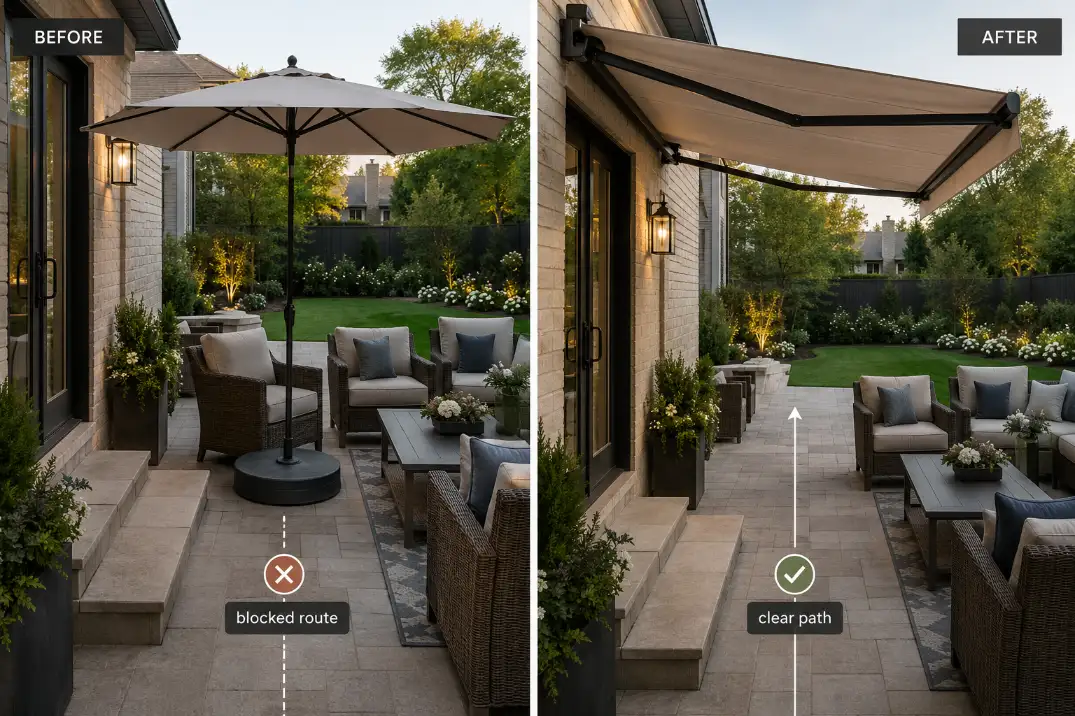
This is where many layouts fail. A 9-foot umbrella may look reasonable overhead, but a 32-by-32-inch base can ruin the only clean path through a small patio. If the route narrows below about 28 inches at any pinch point, the shade is no longer helping the patio function.
Walk it like you actually use it
Carry a tray, laundry basket, or grill tools through the taped route. Pull chairs out as if people are seated. Open the door. Turn toward the yard. This small test reveals problems that a clean overhead drawing misses.
Pro Tip: If you are considering permanent posts, leave the taped layout or temporary markers in place for 48 hours. If people keep clipping the same corner, the post belongs somewhere else.
The Main Mistake: Treating Shade Like Coverage Instead of Layout
The obvious fix is to add a bigger canopy. That is often the wrong move. Larger shade canopies increase coverage, but they also need larger bases, stronger posts, wider swing clearance, or more anchor tension. On small patios, that can make movement worse.
Heat is the symptom, not always the real problem
A hot chair is the symptom. The mechanism may be low-angle sun from the west, reflected heat off concrete, a dark surface radiating warmth, or an umbrella that shades the table while missing people’s shoulders. Buying more overhead shade does not solve all of those.
This is especially true in hot, dry places like Arizona, where hard surfaces can radiate heat well after direct sun moves away. In humid climates such as Florida, shade that blocks airflow can feel heavy even if it lowers direct sun. A shaded patio still needs air movement and an easy route through the space.
The base usually causes more trouble than the canopy
People look up when evaluating shade. In practice, the floor-level pieces cause more daily irritation. Umbrella bases, planter screens, pergola posts, rolling shade stands, and guy lines are the parts people hit, trip over, or walk around.
That is why the logic in Why a Patio Umbrella Is the Wrong Shade Solution matters for tight patios. A center-pole umbrella may shade the table, but if its base occupies the only route from the door to the yard, the patio will feel smaller every time it is used.
Best Shade Options When the Walkway Must Stay Open
The best option is not the one with the most square footage of shade. It is the one that puts support hardware outside the movement pattern.
| Patio condition | Best shade approach | Avoid |
|---|---|---|
| Main route crosses the patio center | Wall-mounted awning or edge-mounted sail | Center-pole umbrella |
| Narrow patio under about 10 ft wide | One-sided shade from wall, fence, or edge | Posts on both sides |
| West-facing patio after 4 p.m. | Side screen plus overhead shade | Bigger overhead canopy only |
| Rental or no-drill patio | Cantilever umbrella with base parked at edge | Permanent drilled anchors |
| Windy open yard | Fixed structure or properly rated awning | Lightweight freestanding canopy |
| Door-heavy patio | Shade beyond the landing zone | Base or post near the door swing |
Cantilever umbrellas work only if the base has a home
A cantilever umbrella can be a good solution because the canopy reaches over the seating while the post sits to the side. But the base still needs a dedicated home: against a wall, along a planting bed, near a railing, or at the patio edge.
If the base must sit in open floor space, it may not be the right solution. A heavy base that people must walk around several times a day becomes part of the layout problem.
Shade sails work best from outside the active patio
Shade sails are useful because the anchors can often sit beyond the patio’s main floor. They work especially well when the shaded area is a seating zone rather than the entire slab.
The lowest edge should usually stay around 7 feet or higher over walking areas, unless the manufacturer or local code requires more clearance. A sail also needs a noticeable pitch rather than a flat installation.
Check the manufacturer’s required slope, especially in rainy climates, because a flat sail can collect water, sag several inches after a storm, and suddenly feel much lower than it looked on installation day.
For patios where shade makes the area feel visually tighter, Patio Shade Setups That Make a Patio Feel Smaller is useful because the issue is often placement, not shade itself.
Wall-mounted awnings keep the floor clean
A wall-mounted or retractable awning is often the cleanest option when the patio sits directly outside the house. There is no base in the walkway, no center pole, and no loose stand to reposition.
The limitation is projection. A shallow awning may shade the door at noon but miss the chairs by late afternoon. For dining patios, judge shade at the hour people actually eat outside, not when the patio looks best in midday light.
If the shade attaches to the house, adds permanent posts, or behaves like a roof structure, check local building rules and HOA guidelines before ordering. This is especially important for attached awnings, pergolas, and anything that changes drainage near the house.
If you cannot drill into walls or fences
Renters, condo owners, and homeowners under strict HOA rules often need shade that avoids permanent anchors. In that case, the best options are usually freestanding but edge-weighted: a cantilever umbrella with the base parked beside a wall, a rolling umbrella stand that stores outside the main route, or a narrow freestanding side screen set parallel to traffic.
Avoid treating a pop-up canopy as a daily patio solution. It can work for a party or temporary afternoon shade, but legs, tie-downs, and storage usually make it clumsy for everyday circulation. Planter-based shade can work, too, but only if the mature plant width does not narrow the walkway later.
When the Problem Is Side Sun, Not Overhead Shade
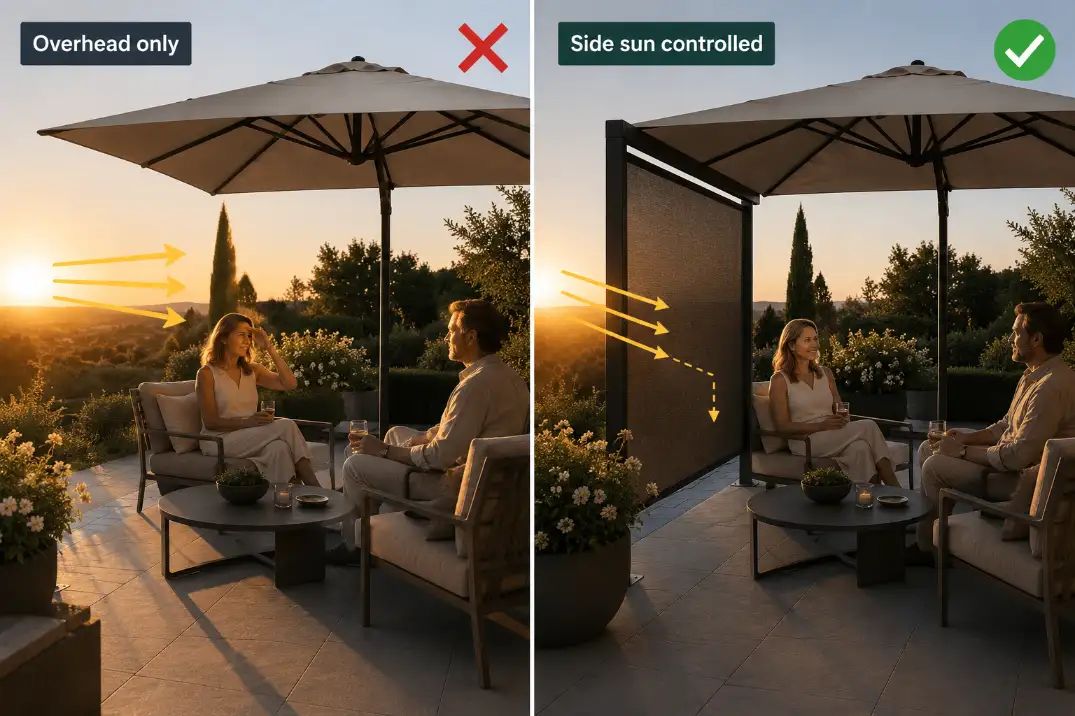
Low-angle afternoon sun is one of the easiest shade problems to misread. Homeowners often keep increasing overhead shade when the sun is actually slipping under the canopy from the side.
West sun needs a side strategy
If glare hits faces after 4 p.m., the problem is probably side sun. A larger umbrella may shade more floor area while still leaving the sitting position uncomfortable. In that case, an outdoor curtain, side roller shade, angled sail edge, or narrow planter screen may work better.
The key is orientation. Side shade should run parallel to the walking lane when possible, not across it. A screen that blocks sun but cuts off the route to the grill or gate simply trades one problem for another.
This is where readers often overestimate overhead shade and underestimate sun angle. For patios where the hottest window is late afternoon, Best Patio Shade Solutions for Afternoon Sun gives a more focused way to think about that exposure.
Do not block airflow to stop glare
Outdoor curtains and screens can solve glare, but they can also trap heat. That matters in humid regions, where stagnant air can make a shaded patio feel muggy. If the patio already feels still, use partial side screening rather than closing off an entire side.
Pro Tip: Leave at least one open side for airflow whenever possible. A shaded patio with no breeze can feel less comfortable than a partly shaded patio with clear air movement.
What Changes on Small, Narrow, and Door-Heavy Patios
Different patio shapes fail in different ways. The shade product matters less than the conflict it creates.
Narrow patios need one clear side
On long or narrow patios, shade should usually come from one side. A wall-mounted awning, edge-mounted sail, or cantilever umbrella parked along the long edge keeps the route readable.
Avoid alternating shade posts, planters, and furniture from side to side. That creates a slalom path. The better layout is often simple: one side for movement, one side for sitting.
This same principle shows up in Long Narrow Patio Furniture Layout Ideas, where preserving one uninterrupted edge can matter more than squeezing in another feature.
Square patios should avoid the center trap
Square patios tempt people to center the table, rug, umbrella, fire feature, and planters. That only works when there is enough room to circulate around all sides.
On a 10-by-10 or 12-by-12 patio, centered shade can make every route slightly uncomfortable. Bias the shade toward the sitting side and leave one side open. It may look less symmetrical, but it usually works better.
Door-heavy patios need a clear landing
The first 36 inches outside a sliding glass door or French door should stay as clear as possible. People pause there, turn there, and carry things through that space. A base, planter, or shade post in the door landing zone creates friction every time the patio is used.
This is especially important when the patio is also the route to the yard or grill. If doors and walkways already control the layout, Patio Layouts for Sliding Glass Doors and Walkways is a better planning reference than shopping by canopy size.
When the Standard Fix Stops Working
At some point, routine shade fixes stop making sense. The sign is not that the patio still has sun. The sign is that every additional shade piece makes the patio harder to move through.
A bigger umbrella is often the wrong upgrade
A larger umbrella may add coverage, but it can also need a heavier base and more clearance. In a windy open yard, that base may become bulky enough to dominate the floor.
If the old umbrella blocked the route, a larger one usually will not solve the underlying problem.
Switch support strategy instead. Use a wall-mounted awning, an edge-mounted sail, or a pergola with posts outside the active route.
Wind changes the support decision
Windy patios make shade selection less forgiving. Large freestanding umbrellas, lightweight pop-up canopies, and loosely tensioned sails may be manageable on calm days but irritating or unsafe when gusts pick up.
Bigger canopies usually need heavier bases or stronger anchors, and those supports can steal the movement space the shade was supposed to protect.
Guy lines should never cross the walking route. Temporary sails and pop-up covers should be removed before severe weather, especially on open lots, coastal patios, and exposed yards where wind has a clear run across the space.
Pergola posts must stay out of intersections
Pergolas look orderly, but their posts are permanent interruptions. A 6-by-6 post in the wrong place is more disruptive than a movable umbrella base because it cannot be nudged aside later.
Avoid placing posts where the door route meets the dining area, where steps land, or where people turn toward the grill. Posts belong on edges, not intersections.
Furniture depth may need fixing first
Sometimes the shade is not the main offender. Deep seating can project 34–40 inches from a wall. Dining chairs can add another 18–24 inches when pulled out.
If those dimensions already leave a narrow path, shade hardware will expose the layout problem faster.
Before adding another shade feature, make sure the furniture footprint still leaves a usable route. Patio Furniture Layout by Size can help sort out whether the patio is actually short on shade or simply overloaded.
Quick Checklist Before Installing Patio Shade
- Keep the main route at least 30 inches wide; use 36 inches for frequent movement.
- Include chair pullback space before placing bases, posts, or planters.
- Keep canopy edges around 7 feet or higher above walkways, unless instructions or local rules require more.
- Shade seated bodies during the real use window, not just the tabletop at noon.
- Handle low west sun with side shade, not only bigger overhead shade.
- Place supports on edges, not where people turn or carry things.
- Keep guy lines, rolling stands, and weighted bases out of the walking route.
- Check wind exposure before relying on large freestanding canopies.
The Layout That Usually Works Best
The strongest patio shade layouts do three things at once: they shade where people pause, keep the path obvious, and move support hardware to the edge. That is more important than whether the product is an umbrella, awning, sail, or pergola.
If shade coverage and movement are fighting each other, protect movement first. A patio with partial shade and easy circulation will usually get used more than a fully shaded patio that people have to navigate around.
The goal is not to shade every inch of the slab. It is to make the places people sit more comfortable while keeping the places people move open.
For broader official heat-safety context, see the CDC About Heat and Your Health guidance.