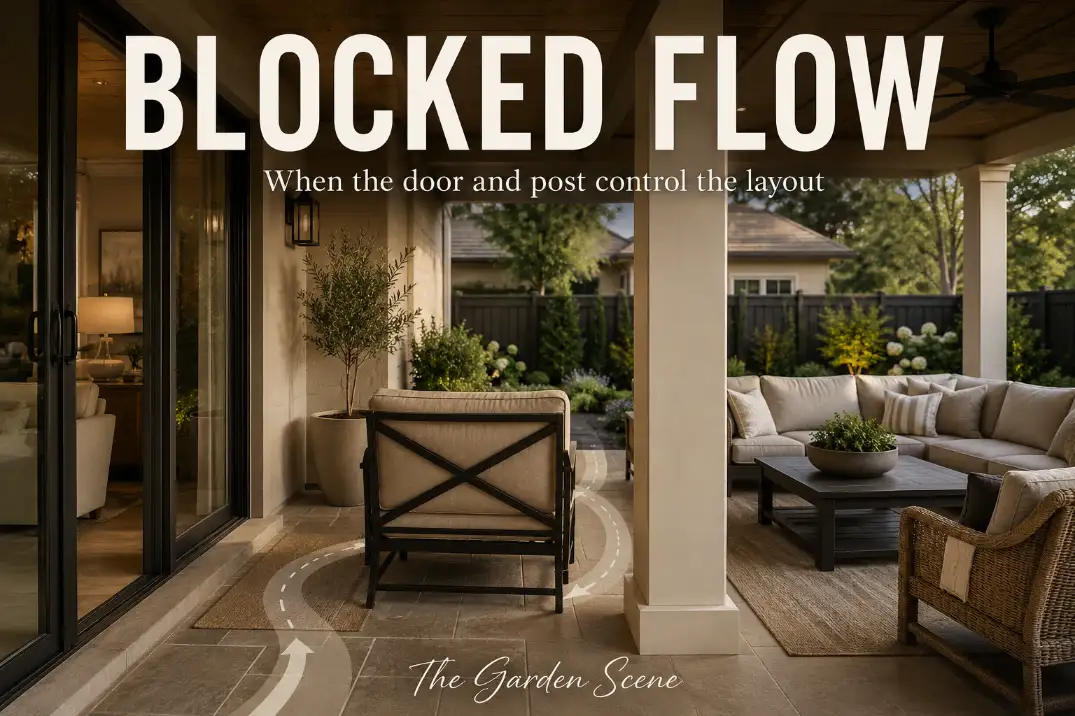
A covered patio usually feels cramped around doors and posts because the furniture is arranged for symmetry instead of movement. The table may look centered and the sofa may line up with the roof edge, but the layout can fail as soon as the door opens, a chair pulls out, or someone carries food outside.
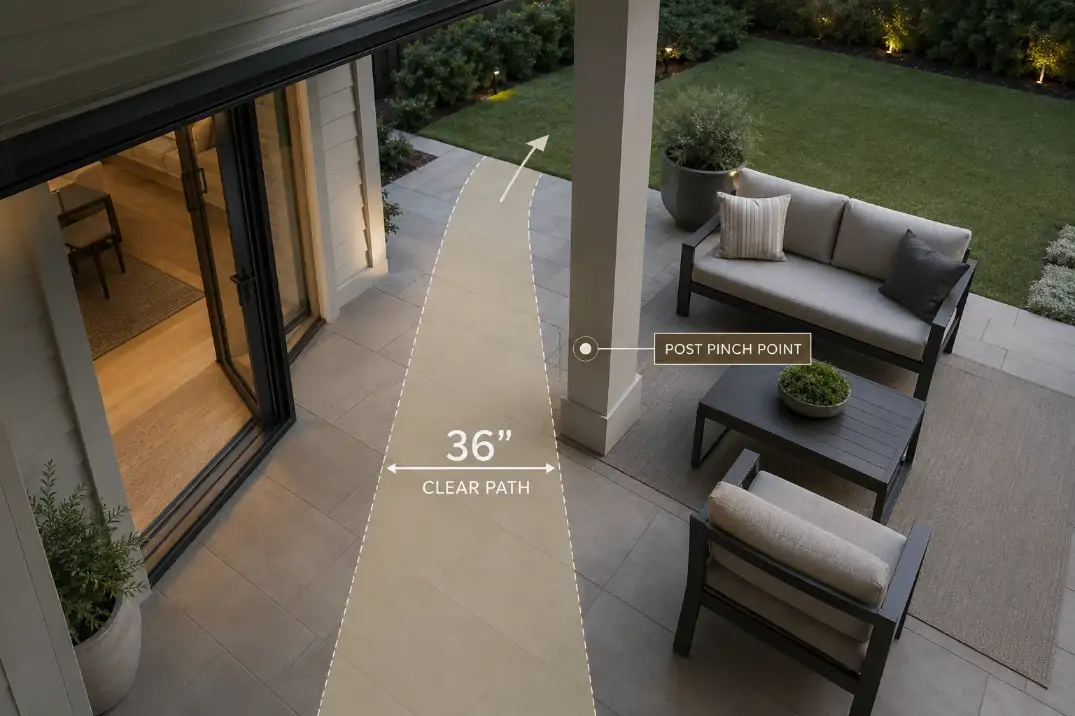
Start with three checks: keep the first 3 feet outside the door open, protect a 36-inch main walking route, and watch every spot where a post and chair back create a pinch point. If that gap drops below about 30 inches, most people will turn sideways to pass.
That is different from a patio that is simply too small. A small patio lacks square footage. A poorly arranged covered patio may have enough space, but the door landing, support posts, and furniture are all competing for the same route.
Start With the Door and Post Clearance Rules
The Door Landing Comes First
The first few feet outside the door are the most valuable part of a covered patio. That is where people step out, pause, turn, manage the screen door, carry plates, or wait for someone behind them.
Keep about 3 feet clear outside the active door opening. With sliding glass doors, that means the step-out and turn zone. With hinged or French doors, it also means the full swing arc. If furniture claims this area, the rest of the patio can look open and still feel awkward.
This is why pushing a sofa tight against the house often backfires. It saves space visually but can crowd the exact place where movement begins.
The Main Route Should Stay Around 36 Inches
A 36-inch lane is the practical target for the route people use most: door to grill, door to steps, door to yard, or door to dining table. A secondary route can sometimes work at 30 inches, but under 28–30 inches near a post, the space starts to feel pinched.
The symptom is “this patio feels crowded.” The mechanism is more specific: people are being forced to bend their route around fixed obstacles.
That same circulation-first thinking applies to rectangular patios. If your patio has a long wall and a door on one side, Small Rectangular Patio Layout Flow is useful because the best layout is usually offset, not centered.
Posts Act Like Fixed Furniture
A support post may be only 6 inches wide, but it behaves like a permanent furniture piece. The mistake is treating posts as background architecture instead of layout boundaries.
If a post sits 24–36 inches from the door path, do not place a loose chair, planter, or side table directly opposite it. That pairing creates the classic covered-patio squeeze: one fixed object, one movable object, and no clean route between them.
Pro Tip: On a sketch, mark posts as heavy chairs. It makes the layout problem obvious faster than drawing the patio as an empty rectangle.
Best Covered Patio Furniture Layout Ideas Around Doors and Posts
Side-Shifted Conversation Layout
Use this when the door sits near one side of the covered patio. Instead of centering the sofa on the whole space, shift the seating group away from the door landing.
Place a loveseat or compact sofa parallel to the house, at least 24 inches away from the active door zone. Add one or two chairs across from it or at a soft angle. A small round table or nesting tables usually work better than a large rectangular coffee table.
This layout gives the door a clear release path. The seating area becomes a destination, not an obstacle.
Post-Framed Lounge Layout
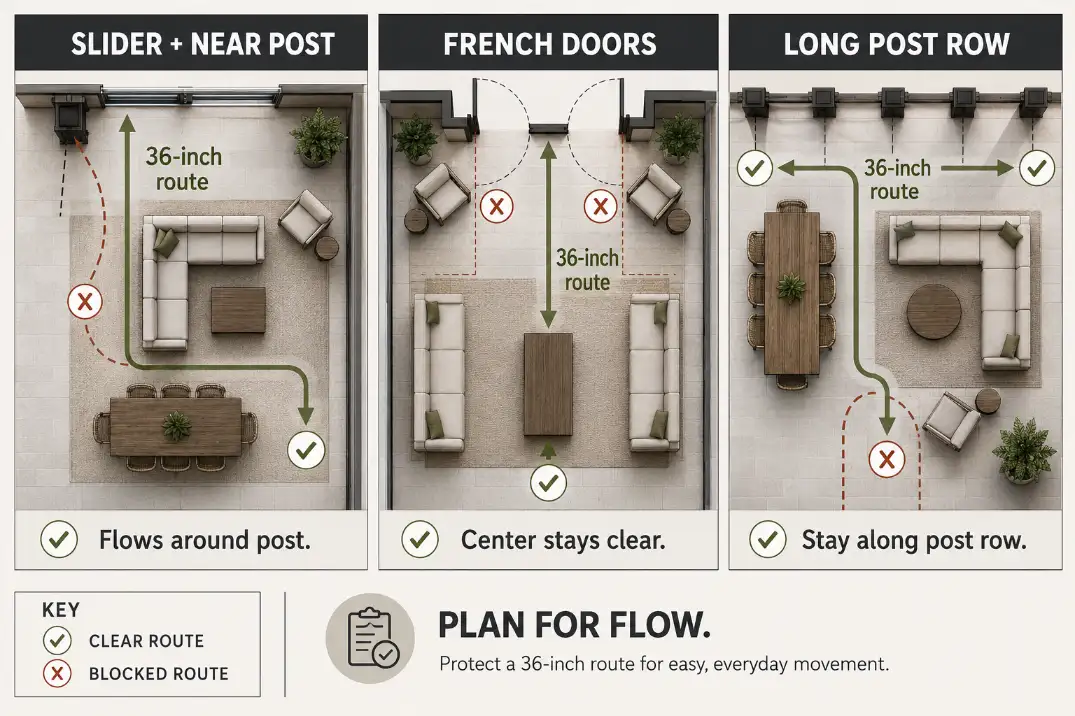
If two posts sit along the open edge, use them to frame the seating zone. Keep furniture clearly inside one bay or clearly outside the main route. Do not split the path with chair backs on one side and posts on the other.
The common mistake is arranging chairs symmetrically around posts. That may look balanced, but if one chair blocks the route to the yard, the layout fails in use. A slightly uneven grouping with a clean path usually feels better.
Wall-Bench Dining Layout
Dining near the door makes sense when food comes from the kitchen, but dining furniture needs more room than it appears to when chairs are tucked in.
A bench along the house wall can reduce chair-pull space on one side. Use chairs only on the open side of the table. Leave roughly 30–36 inches behind those chairs if people need to pass.
For tight patios, table shape matters more than style. A round table handles awkward posts better, while a narrow rectangular table works when the walking route runs cleanly along one side. The same tradeoff is covered in Best Patio Table Shapes for Small Spaces, where the table footprint matters more than its seating claim.
Long Covered Patio Zone Layout
Long covered patios often fail when every piece is lined up evenly along the house. Divide the patio into zones instead.
Put dining near the kitchen door if meals are the main use. Place lounge seating farther down, beyond the busiest route. Keep one continuous walking lane parallel to the house, ideally 36 inches wide.
This works especially well when posts run along the open edge. Let the posts define zone edges instead of becoming separate obstacles.
Two-Chair Coffee Layout
For a very tight covered patio, two chairs and a small table may work better than a loveseat, ottoman, and extra side chair.
Angle the chairs toward each other, place a small round table between them, and keep the door landing open. This layout is strongest for morning coffee, reading, and short daily use. A patio used every morning should be easy every morning, not arranged around a rare dinner party.
| Layout Idea | Best For | Avoid When |
|---|---|---|
| Side-shifted conversation set | Door near one side | Patio is under about 8 feet deep |
| Post-framed lounge zone | Two posts along open edge | A post sits directly in the door path |
| Wall-bench dining layout | Meals near the kitchen | Bench crowds the first 3 feet outside the door |
| Long patio zone layout | Covered patios 12–20 feet long | The walking route keeps shifting around furniture |
| Two-chair coffee layout | Small covered patios | The patio must seat four daily |
Choose the Layout by Door Type
Sliding Glass Door
A slider does not need swing clearance, but it still needs a landing and turn zone. Keep the active side open for the first 3 feet. If a support post sits close to that active side, shift seating away from the post instead of placing a chair between the post and the door.
French Doors
French doors create a wider active zone than people expect. Even if one side is used more often, avoid placing a dining chair, planter, or storage box in front of the less-used door.
Blocked door zones can also make a covered patio feel stuffier, especially in humid climates where airflow already matters. That connects to the same enclosure problems discussed in Covered Patio Ventilation Mistakes.
Single Hinged Patio Door
With a hinged patio door, the swing arc is non-negotiable. Keep furniture outside that arc first, then protect the route beyond it.
A pair of angled chairs often works better than a sofa facing the house because the chairs can leave a cleaner exit path.
Door Near a Corner
Corner doors compress the route from the start. Do not fill the open side immediately with a chair, console table, or planter. Let people move diagonally from the door into the patio before they reach the seating group.
What Usually Makes the Layout Fail
Furniture Gets Blamed Before Circulation
Oversized furniture can be a problem, but it is not always the first problem. A deep sofa can work if the walking lane is clean. Smaller chairs can still fail if they sit in the wrong route.
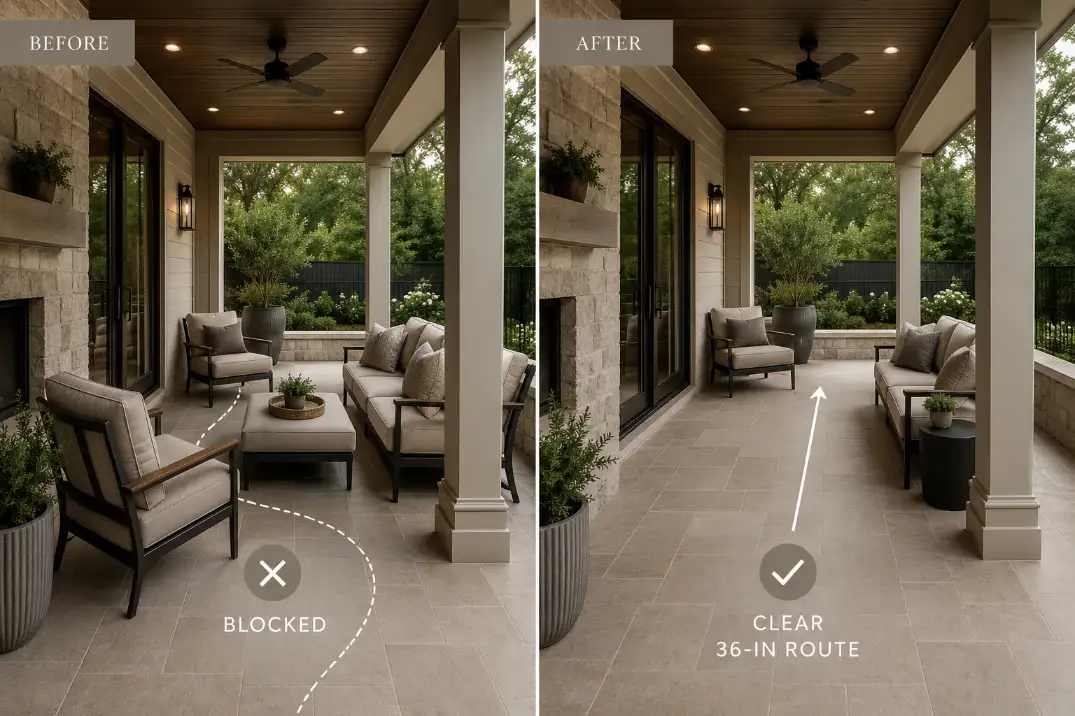
Walk from the door to each destination you actually use: grill, steps, yard, storage, or dining table. If that path cuts through the middle of the seating group, the layout is not arranged around real movement.
Buying smaller furniture without changing that route often wastes money. The patio looks less full, but the failure point stays the same.
Small Extras Steal Real Clearance
Planters, lanterns, cushion boxes, dog beds, and grill carts can break an otherwise good layout. A 16-inch planter beside a post can turn a passable route into a squeeze. A storage box near the door can claim the exact spot where people need to step out and turn.
Outdoor rugs can also mislead the layout. If the rug crosses the walking route, it visually invites chairs and tables into the path. The rug should support the furniture zone, not redefine traffic.
Symmetry Is Overvalued
Covered patios with posts tempt people into centered layouts: sofa between posts, matching chairs on both sides, table under the roof centerline.
That can look orderly, but patios are used in motion. Clear movement should come first. Visual balance can be restored later with a side table, planter, or wall light. You cannot decorate your way out of a bad pinch point.
The Covered Edge Is Not Always the Best Edge
The deepest covered area feels like the obvious place for furniture, especially where rain is frequent. In Florida or the Gulf Coast, that instinct can make sense. But if the covered edge is also where posts interrupt movement, it may not be the best place for the largest pieces.
In Arizona and other dry, hot regions, shade timing may matter more than rain coverage. In northern states, winter storage and snowmelt can change what belongs under cover. In coastal California, airflow around cushions may matter more than packing everything tightly under the roof.
The routine fix stops making sense when the protected zone makes the patio harder to use.
Furniture Choices That Work Better Around Doors and Posts
Round Tables Beat Corners in Pinch Zones
Round tables are forgiving around posts because people can move around them without catching sharp corners. For tight seating areas, a 30–36-inch round table usually works better than a wide rectangular coffee table.
For dining, round tables help when a post interrupts one side of the patio. But once a round dining table reaches about 48 inches, the pulled-out chairs can overwhelm a narrow covered space.
Benches Help Only on Safe Edges
Benches work well along a house wall, low perimeter wall, or outside edge of a dining zone because they reduce chair-pull movement.
They work poorly near the active door landing. A built-in bench that blocks the first 3 feet outside the door becomes a permanent mistake. Loose chairs can move; built-ins cannot.
If chairs constantly drift into the route, Patio Built-In Seating may be worth considering, but only after the door and post paths are mapped.
Sectionals Need a Clean Corner
A sectional can work on a covered patio, but it needs a clean corner or edge. It usually fails when it floats near a door or wraps around a post.
On patios under about 10 feet deep, a sectional often consumes the movement zone unless the door route runs clearly outside the seating area. A loveseat and two movable chairs are usually more adaptable.
More seats do not automatically make the patio more usable. Three comfortable seats with clear movement often beat five seats everyone has to squeeze around.
Nesting Tables Beat One Heavy Center Table
A large coffee table often occupies the exact space needed for walking. Nesting side tables, small drink tables, or one lightweight round table can give the same function with less blockage.
If you need to move furniture every time people come over, the layout is too fragile for daily use.
The 15-Minute Door-and-Post Layout Test
Before buying anything new, test the layout on the actual patio.
- Open the patio door fully, including the screen door.
- Mark the first 3 feet outside the active door with painter’s tape.
- Tape a 36-inch route from the door to the most-used destination.
- Mark each post as a fixed obstacle.
- Pull dining chairs out 24–30 inches as if people are seated.
- Remove anything that crosses the marked route.
If the patio immediately feels easier, the problem was layout priority. If the route is still below 30 inches at the tightest point, the furniture size, quantity, or table shape needs to change.
Pro Tip: Test the furniture in its “in use” position, not its tucked-in position. Dining chairs and ottomans cause problems when people are actually using them.
Layout Examples by Covered Patio Size
8×10 Covered Patio
Keep it simple. Two chairs and a small round table usually work better than a full dining set. If the door is centered, place seating to one side and leave the other side as the route.
A four-person dining table only works if chairs can pull out without entering the main door path. Most 8×10 covered patios cannot handle that comfortably unless the door is off to one side.
10×12 Covered Patio
This size can usually handle a loveseat, two chairs, and a small table if the main route stays along one side. It can also handle compact dining, but mixing dining and lounging often makes the space feel crowded.
Choose one primary use. If weeknight meals matter most, make dining work well. If lounging happens daily, skip the dining table and use movable side tables.
12×16 Covered Patio
A 12×16 patio can support two zones, but posts decide where those zones begin and end. Put dining near the kitchen route if food service matters. Place lounge seating farther from the door if that keeps movement cleaner.
Do not let the extra square footage encourage scattered furniture. Larger covered patios can still feel awkward if every post becomes a pinch point.
Long 6–8 Foot Deep Covered Patio
Depth is the limit here. Use furniture along one side and keep the walking route parallel to the house. Avoid deep lounge chairs facing the house if they leave less than 30 inches behind them.
For these shapes, zoning matters more than adding pieces. A narrow dining table near the door and a small two-chair setup farther down may outperform one large conversation set. The same principle applies in Long Narrow Patio Furniture Layout Ideas, where continuous flow matters more than filling length.
When Rearranging Stops Working
The Worst Pinch Point Is Still Under 30 Inches
If the tightest route around a post remains under 30 inches after rearranging, the layout is overfilled. Remove a piece or change the furniture type. A chair may need to become a bench. A coffee table may need to become nesting tables. A sectional may need to become a loveseat.
The Door Cannot Open Without Negotiation
If the door hits a chair, rug edge, planter, or storage box, the layout fails at the first step. The door should open fully without someone moving furniture. That is a function test, not a design preference.
The Patio Looks Finished But Still Feels Annoying
This is common. The rug fits. The pillows match. The planters look intentional. But everyone still walks around the same chair or avoids the same seat.
That means the design is polished, but the use pattern is broken. The fix is not another decorative layer. It is a cleaner route.
Final Takeaway
The best covered patio furniture layout around doors and posts is rarely the most symmetrical one. It is the one that keeps the door landing open, gives the main route about 36 inches of clearance, and treats support posts as fixed layout boundaries.
Protect movement first, then choose furniture. If the path opens up when you remove the center table or shift chairs off the door route, you do not need a bigger patio. You need a better hierarchy: door first, route second, furniture third.
For broader official guidance on clear walking routes, see the U.S. Access Board Accessible Routes Guide.