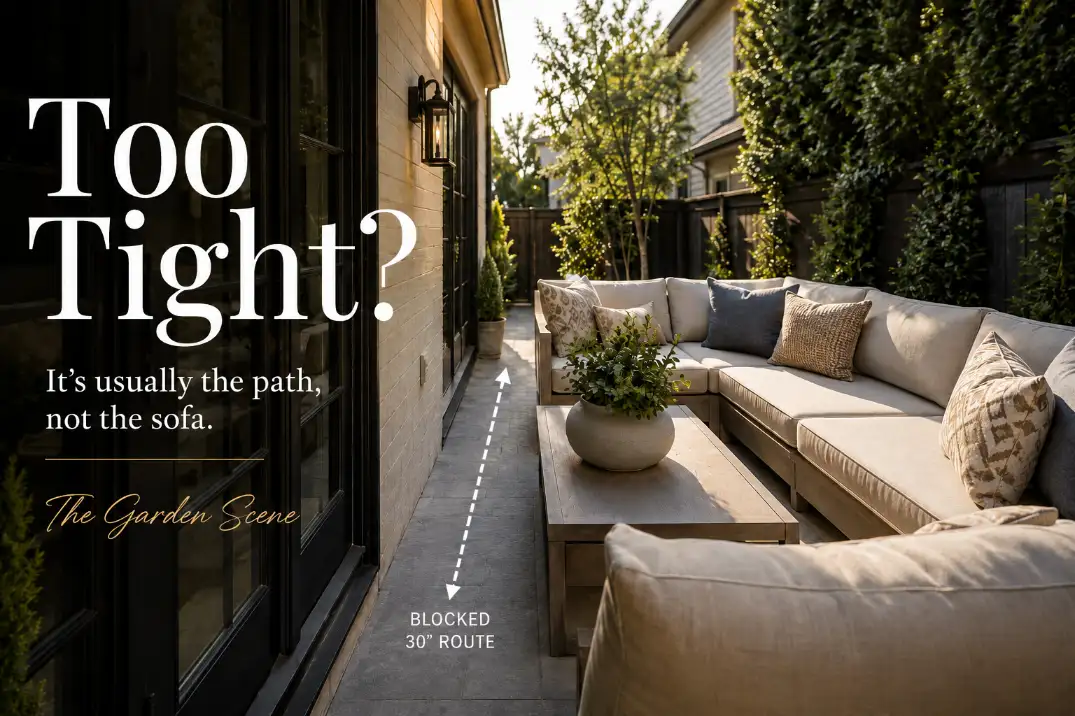
A small patio sectional works only when the sofa supports circulation instead of consuming it. The most common failure is not that the sectional is “too big” in total inches; it is that the chaise, corner seat, or coffee table lands in the one path people need every day.
Before changing the sofa, check three measurements: keep at least 30 inches for a normal walking lane, 36 inches if the path connects a door to stairs or a gate, and leave 16 to 18 inches between the sectional and coffee table so knees can move without shuffling sideways.
The key distinction is this: a sectional that looks tight in a photo may still function well if the traffic path is clean. A prettier layout with a blocked door, grill route, or chair pull-out zone will feel worse within a week.
Start With the Path, Not the Sectional
Most small patio sectional mistakes start with the sofa placed first and the movement pattern solved later. That order is backwards. On a patio under about 120 square feet, one blocked route can make the entire space feel smaller than it is.
The main path usually decides the layout
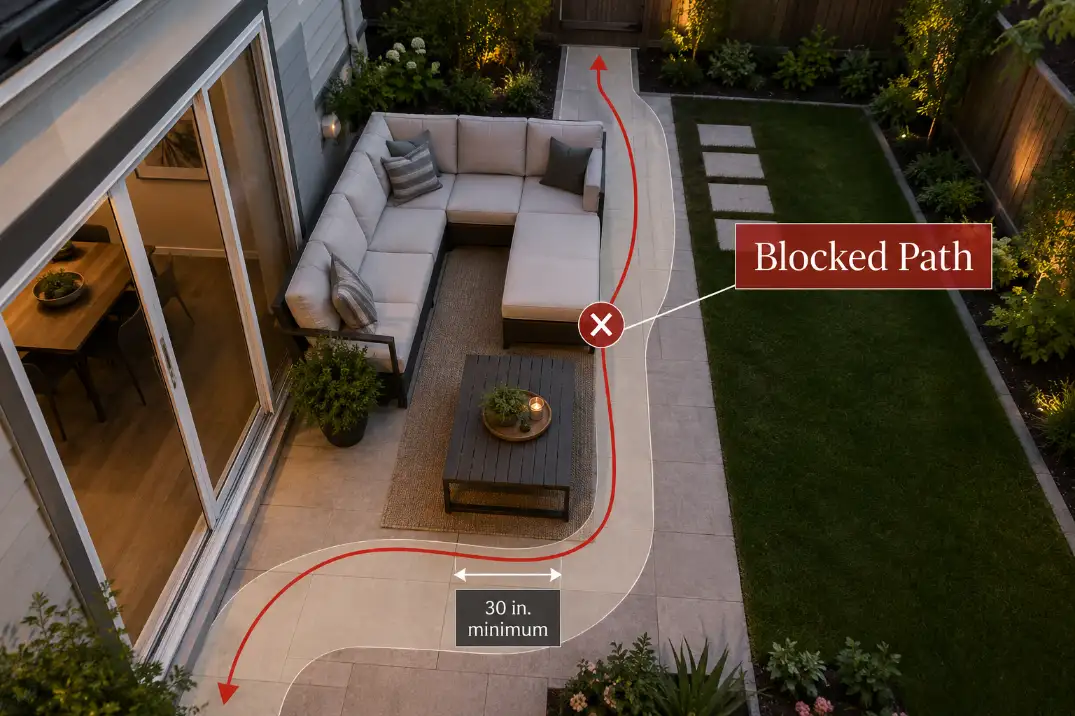
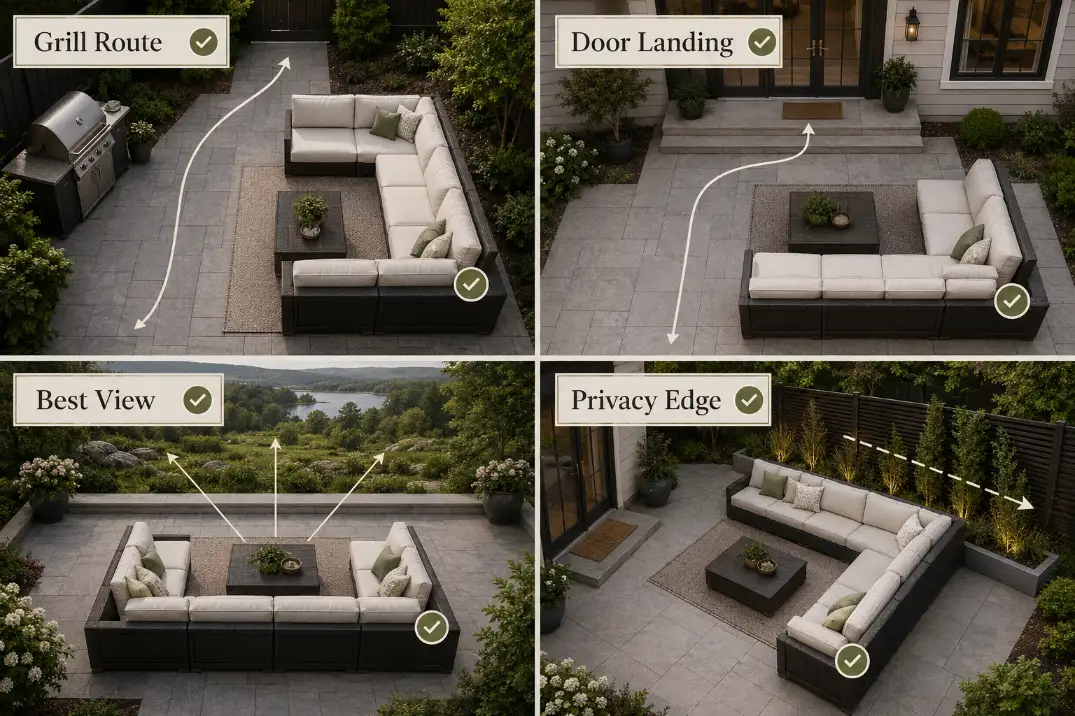
Find the route people actually use: back door to yard, slider to grill, kitchen door to dining area, or gate to seating. That lane needs to stay visually and physically open. For most patios, 30 inches is the minimum workable walking width. If people are carrying plates, using the route often, or passing behind seated guests, 36 inches is better.
A sectional should usually sit outside that route, not across it. If the chaise projects into the path, the layout will feel wrong even if the sectional technically fits the slab.
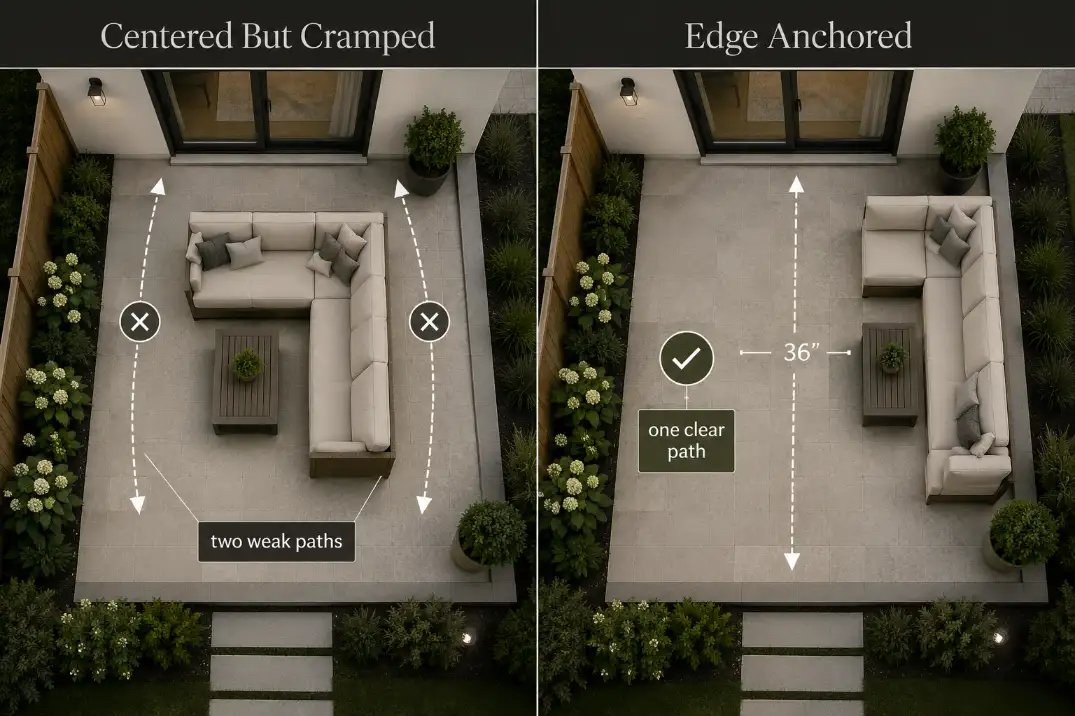
This is why small rectangular patios often benefit from anchoring the sectional along the long edge rather than floating it in the center, a pattern that also matters in small rectangular patio layout flow.
Door swings and sliders are different problems
A hinged door needs a clear swing arc plus landing space. A sliding door does not swing out, but it still creates a pause zone where people step outside, turn, close the door, or carry food. Treat that zone as active space, not decorative space.
For hinged doors, keep furniture outside the full swing path and avoid placing a chaise within about 36 inches of the threshold. For sliders, avoid pushing the sectional so close that guests step directly into a table corner or ottoman.
Sectional Layouts That Usually Work
The best layout depends less on style and more on which side of the patio needs to stay open. A sectional can be excellent in a small space because it reduces loose chair legs and creates a clear seating zone. It becomes a problem when the corner piece, chaise, and table all fight for the same circulation area.
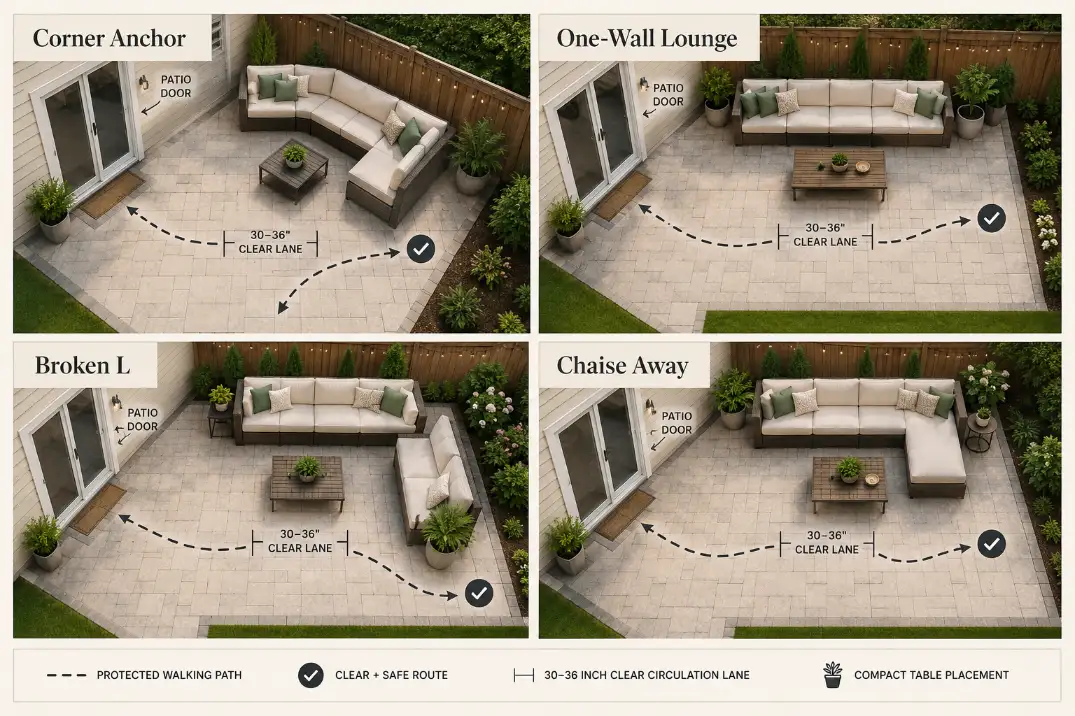
Corner sectional against two fixed edges
This is the safest layout for many patios between 8×10 and 10×12 feet. Put the sectional into the least-used corner, with the back of the sofa against a wall, fence, railing, or planting edge. This keeps the center open and lets the sectional behave like built-in seating without the cost or permanence.
It works best when the patio has one strong destination, such as a fire table, coffee table, or view. It works poorly if that corner is also the route to the grill, gate, or side yard.
Pro Tip: Tape the sectional footprint on the patio for 24 hours before buying. A layout that annoys you during the test will not improve once cushions and tables arrive.
Long-side sectional for narrow patios
On a long narrow patio, the sectional should usually run parallel to the long dimension. This keeps the walking route linear instead of forcing people to zigzag around a chaise. A left- or right-facing chaise can work, but only if the chaise points toward the dead end of the patio, not into the main route.
This is one place where homeowners often overestimate symmetry. Centering the sectional may look balanced from the doorway, but it often wastes the best walking lane. A slightly off-center layout that preserves a 30- to 36-inch corridor will feel better every day. For patios shaped more like a corridor than a square room, long narrow patio furniture layout ideas follows the same practical rule: one clean route beats two weak pinch points.
Modular sectional with a movable ottoman
For patios under about 90 square feet, a full fixed chaise is often the part that causes trouble. A modular loveseat, corner chair, and movable ottoman gives you sectional comfort without locking the patio into one posture.
Use the ottoman as a chaise when lounging, then pull it aside when people need to move through. This is especially useful on patios that alternate between morning coffee, kids moving through the yard, and casual evening seating.
Four layouts worth testing first
The most useful small patio sectional ideas are not the most decorative ones. They are the ones that solve a specific clearance problem. Before thinking about pillows, rug color, or string lights, test four basic arrangements.
A corner L-sectional works when two patio edges are already low-traffic space, such as a fence line and house wall. A long-side sectional works better on narrow patios because it keeps movement straight.
A modular sectional with a movable ottoman is the safest choice when the patio changes jobs during the day. A compact armless sectional is useful when armrests steal too much side clearance.
The layout to distrust is the one that looks balanced from the doorway but forces people to walk around the chaise. In a small patio, a slightly uneven layout with one clear 30- to 36-inch path is usually stronger than a centered layout with two awkward lanes.
What People Usually Misread First
The obvious assumption is that the sectional is too large. Sometimes it is. More often, one specific piece is doing the damage.
The chaise is usually the problem piece
A chaise projects farther into the patio than people expect. A typical outdoor chaise section often runs 60 to 70 inches deep, while a standard seat section may be closer to 30 to 36 inches deep. That extra 2 to 3 feet can erase the walkway, block the door landing, or make the coffee table unusable.
The fix is not always a smaller sofa. It may be changing the chaise direction, replacing the chaise with an ottoman, or choosing a sectional with a shorter return.
The coffee table can ruin a good sectional
A small patio sectional often fails after the table is added. If the table sits less than about 14 inches from the seat, guests have to fold themselves into the sofa. If it is more than about 22 inches away, it stops functioning as a usable surface.
The sweet spot is usually 16 to 18 inches. On very tight patios, two small nesting tables or a C-table may work better than one central coffee table.
This is where a lot of “make it cozy” advice wastes time. Adding pillows, a rug, or lanterns cannot fix a table that blocks the only place feet and knees need to go.
Layout Choices by Patio Size
| Patio size | Best sectional approach | Watch-out measurement | What to avoid |
|---|---|---|---|
| 8×8 feet | Loveseat sectional or two-piece corner | 30-inch clear route | Fixed chaise |
| 8×10 feet | Corner sectional with small table | 16–18 inches to table | Oversized arms |
| 9×12 feet | L-shape along long edge | 36 inches from door route | Center-floating layout |
| 10×12 feet | Modular sectional plus ottoman | 30 inches behind seating | Dining set squeezed beside it |
| 12×12 feet | Sectional with chair or pouf | 36 inches on main path | Too many matching pieces |
| 12×16 feet | Sectional plus separate zone | 42 inches between zones | One giant furniture island |
The useful comparison is not “small versus large sectional.” It is fixed bulk versus adjustable function. A slightly larger modular setup can outperform a smaller fixed chaise if the movable pieces let the patio breathe.
On a 9×12 patio, for example, the layout usually succeeds when one long edge carries the sectional and the opposite side stays open for circulation. The same size logic appears in 9×12 patio layout ideas for narrow spaces, where the usable lane matters more than the furniture count.
When the Standard Fix Stops Working
The standard advice is to “choose smaller furniture.” That helps only when the problem is scale. It does not help when the patio is trying to hold too many jobs.
A sectional cannot fix three competing zones
If the same 10×10 or 10×12 patio is expected to hold a sectional, dining table, grill, storage box, and planter cluster, the sectional will get blamed even when the real issue is zoning. A sectional needs a stable seating footprint. Dining chairs need pull-out room. A grill needs safe working clearance. Those needs overlap quickly.
A dining chair usually needs about 30 inches behind it to pull out comfortably. A grill area often needs several feet of active standing room, especially when someone is carrying trays or turning away from heat. Add those to a sectional and the math stops working fast.
If lounging is the main goal, commit to the sectional and use side tables instead of a dining set. If meals are the main goal, a sectional may be the wrong anchor. Outdoor seating, dining, and lounging is useful here because the best patio layout usually starts by choosing the primary use, not by squeezing every use into one slab.
Deep seating is comfortable until it steals the patio
Deep outdoor sectionals often run 34 to 40 inches from front to back. That can feel luxurious in a showroom and punishing on a small patio. The cushion depth is not the only issue; deep backs push the whole seating line forward, shrinking the space in front.
People commonly underestimate depth and overestimate how much they will use a full chaise. They also underestimate how much a 4- to 6-inch armrest matters when every side clearance is tight.
Once the remaining clear path drops below about 28 inches, routine fixes stop making sense. At that point, rearranging pillows, changing the rug, or swapping the table will not solve the underlying geometry. The sectional footprint needs to change.
Better Small Patio Sectional Moves
A good small-patio sectional layout usually has one strong move, not several clever ones.
Put the long side where people do not walk
The long sofa run belongs against the quiet edge: fence, wall, railing, planter border, or the side opposite the door. This gives the sectional a clear “back” and leaves the patio with a more readable open area.
Avoid placing the long side across the middle unless the patio is large enough to maintain circulation on both sides. On small patios, floating a sectional often creates two weak paths instead of one good one.
Replace one sectional piece before replacing the whole set
If the sectional almost works, target the piece causing the pinch point. Remove one armless middle chair. Swap the chaise for a standard seat. Replace the coffee table with two small movable tables. Try the ottoman on the opposite side.
This is more useful than immediately buying a smaller matching set. Many cramped patios improve when one rigid piece is removed rather than when every piece is scaled down. If the patio already feels overloaded, removing patio furniture from a cramped space can reveal whether the sectional is truly the problem or just the largest visible symptom.
Four small changes that make sectionals feel lighter
Once the sectional footprint is close to working, the smaller surrounding choices decide whether the patio feels open or packed. This is where many small patios improve without replacing the sofa.
Nesting tables keep surfaces available without locking the center of the patio. Wall-mounted lights or string lights remove the need for floor lamps. A slim planter screen behind the sectional can add privacy without pushing the seating inward. A movable storage ottoman gives you a chaise, extra seat, and clutter control, but only if it can slide out of the walking lane when not in use.
These changes are not decoration first. They are space management. If the main route is already under about 28 inches, these details will not rescue the layout. But when the basic footprint is sound, they can make a small sectional setup feel intentional instead of crowded.
Quick Layout Checklist
Use this before buying or rearranging:
- Keep the main walking path at least 30 inches wide, or 36 inches for door-to-yard routes.
- Leave 16 to 18 inches between the sectional and coffee table.
- Keep a hinged door’s full swing path clear, plus usable landing space.
- Avoid fixed chaises on patios under about 90 square feet unless the path is separate.
- Check whether the grill, dining chairs, or storage box steals the same clearance.
- Remove one sectional module before assuming the entire sofa is wrong.
Final Takeaway
A small patio sectional works when it behaves like a built-in edge, not a furniture island. The best layouts protect the main path first, then fit the sectional into the quiet side of the patio. In most failed layouts, the real problem is not the idea of a sectional; it is a fixed chaise, oversized table, or second activity zone competing for the same 30 to 36 inches of usable space.
Choose the route, choose the primary use, then choose the sectional shape. That order prevents most of the expensive mistakes.
For broader accessibility guidance on clear routes and usable space, see the ADA Standards for Accessible Design.