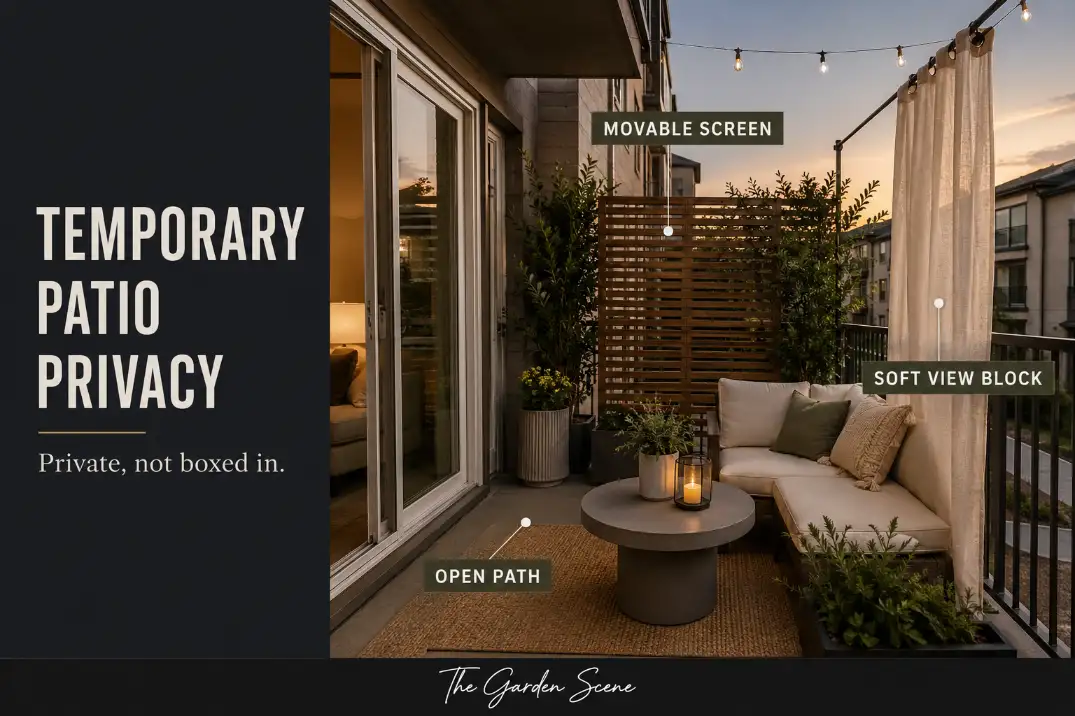
Temporary patio privacy should block the uncomfortable view line, not every open edge of the patio. The best first setup for most small patios is one vented freestanding screen, one weighted planter, and one open path back to the door.
Start by sitting where you actually use the patio. Look toward the neighbor window, balcony, sidewalk, parking space, or shared fence gap. Most small patios only need a 3- to 6-foot privacy zone placed at the right angle.
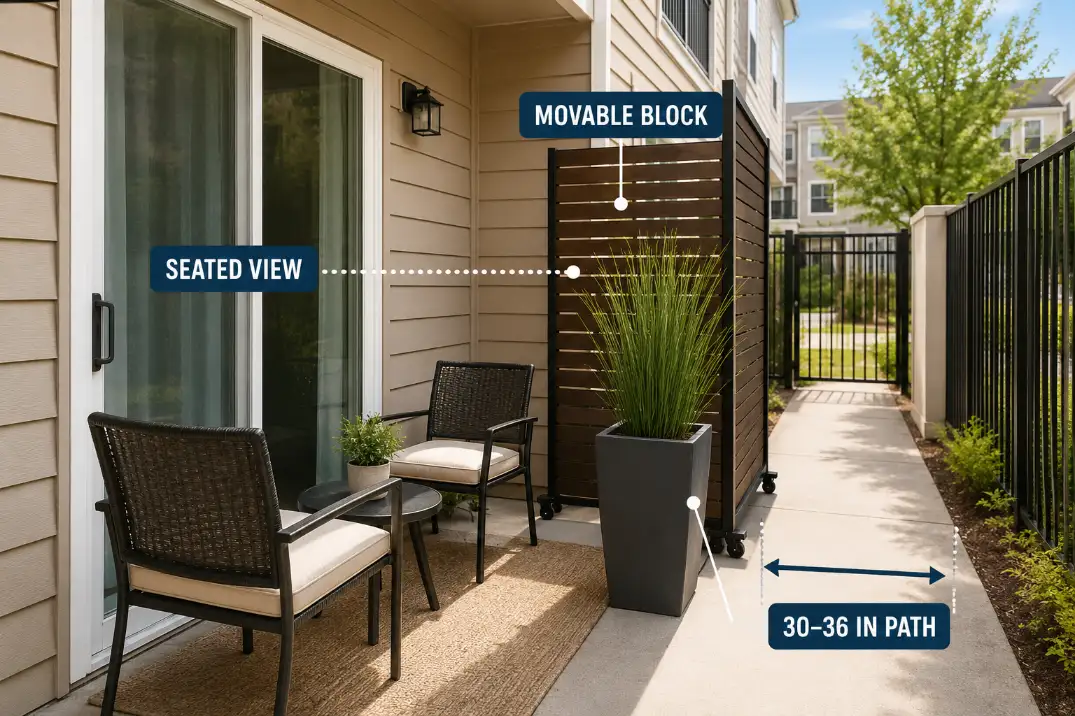
Keep the route from the door to the seating area at 30 to 36 inches wide. Once that path drops below 30 inches, the privacy fix has started creating a layout problem.
This is different from building a fence effect. Permanent screening can define a full boundary. Temporary privacy has to work after wind, watering, guests, storage, and seasonal changes.
Privacy That Can Move
Temporary privacy has to move because patio exposure changes. Morning sun, evening seating, upstairs windows, guests, and seasonal storage do not all create the same problem.
A fixed-looking wall may feel satisfying on day one, then become annoying the first time you carry food through the door or bring cushions inside.
Start From the Chair, Not the Property Line
The most useful privacy line is usually measured from a seated position, roughly 40 to 48 inches above the patio surface. A screen that looks too low while standing may block the view perfectly when you sit down.
That is why a 4-foot planter-and-screen combination can sometimes work better than a 6-foot panel placed too far away.
Pulling privacy pieces slightly inside the patio can also help. A freestanding screen placed 12 to 24 inches beside or behind a chair may block the same sight line while keeping the patio edge lighter.
For renters, that movable-zone approach fits the same logic used in Renter-Friendly Outdoor Space Ideas, where the outdoor room is built from pieces that can shift without drilling or permanent installation.
Keep the Exit Route Boring
A temporary screen that interrupts the door route will lose its appeal fast. The test is simple: can someone step outside with a tray, cushion, watering can, or laundry basket without turning sideways? If not, the patio is not becoming more private in a useful way.
The path does not need to be dramatic. It needs to stay obvious and open. Around sliding doors, steps, and chairs, 36 inches feels noticeably easier than a tight 30-inch squeeze.
Quick Temporary Privacy Check
- Sit in the main chair and identify the exact exposed view.
- Keep the main route from the door at 30 to 36 inches wide.
- Block the 3- to 6-foot view zone before adding full-edge screening.
- Keep heavy bases away from door tracks, stair routes, and chair pullback space.
- Choose pieces you can shift or fold within 5 minutes.
- Treat anything that tips in normal afternoon gusts as decor, not dependable privacy.
Screens Without Fence Posts
Freestanding screens are usually the fastest temporary privacy fix, but they are also the easiest to overuse. The panel is only part of the decision. The base, wind exposure, panel spacing, and angle decide whether the screen feels stable or like another chore.
Use One Targeted Screen Before Building a Wall
The obvious fix is to line screens across the whole exposed side. That is often too much. On a small patio, one 3- to 4-foot-wide screen placed at the main view angle can do more than three panels stretched along the edge.
Privacy is often directional. A neighbor’s upstairs window, one balcony corner, or one gap between fences creates the discomfort. Once that view is interrupted, the patio can feel private even if some side openings remain visible. For more permanent boundary decisions, Privacy Fence Options for Suburban Homes is the better comparison point; temporary patio privacy should stay lighter, more adjustable, and less committed.
Pick the Screen by Exposure Type
| Privacy problem | Best temporary fix | Avoid |
|---|---|---|
| One neighbor window | One angled freestanding screen with a planter beside it | A full wall across the patio edge |
| Apartment railing exposure | Tall planters or partial roll-up shade | Post-style kits that need drilling or anchors |
| Windy upper patio | Slatted or vented screen with a wide base | Solid lightweight panels |
| Covered side view | Outdoor curtain that stacks cleanly | Curtains on every open side |
| Tiny 8×10 patio | Partial screen inside the seating angle | Edge-to-edge privacy enclosure |
| Shared fence gap | Narrow screen plus container planting | Tall screen that steals the main door route |
Watch Wind Before Height
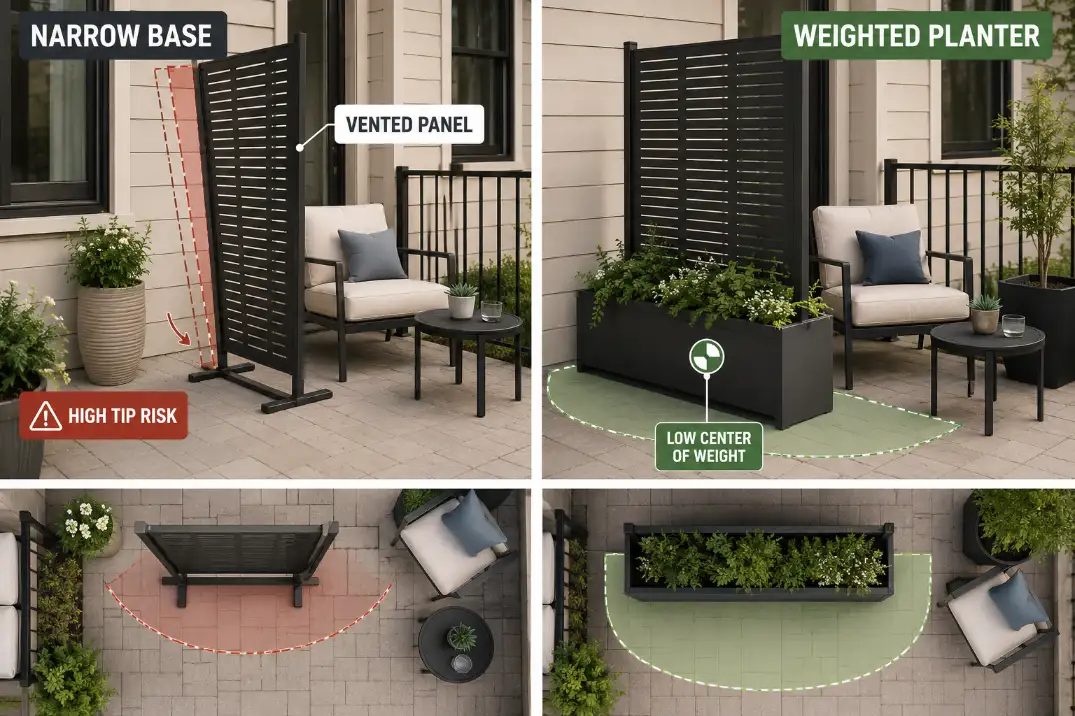
Wind is the condition people underestimate most. A 6-foot solid panel can look private in calm weather and act like a sail in 20 mph afternoon gusts. On upper decks, corner patios, and open townhouse lots, slatted, woven, or vented panels usually make more sense than flat solid screens.
A shorter screen that stays put is better than a taller one you fold down every breezy day. If privacy disappears whenever the weather changes, the setup is not flexible; it is fragile.
Pro Tip: If a folding screen has to close during wind, place it so the folded position still blocks part of the view instead of becoming useless.
Planters That Add Weight
Planters are the strongest temporary privacy pieces because they add mass at the bottom and softness at eye level. But a privacy planter is not the same as a decorative pot. It has to hold enough soil, resist tipping, drain properly, and support plants that stay full through heat, wind, and watering cycles.
Privacy Fails at the Base First
The visible privacy comes from the plant, trellis, or screen. The failure usually starts lower: too little soil, a narrow footprint, a dry root zone, or a top-heavy plant.
A tall narrow planter may look finished for a week, then lean, dry out, or need constant repositioning.
For real privacy work, containers around 18 to 24 inches wide and 16 to 20 inches deep are a more practical starting point than small porch pots. Larger shrubs, tall grasses, or trellis plantings may need more root room.
In hot summer weather, small containers can dry out in a single afternoon; larger soil volume gives the planting a better chance to stay dense enough to screen.
Choose the Plant Type by Job
Tall ornamental grasses are useful when you want movement and partial screening without a solid wall. Compact evergreen shrubs work better when you need year-round softness and more visual weight.
A narrow trellis with a vine can help where floor space is limited, but it needs a stable base and regular training. Faux greenery panels can work when maintenance is impossible, though they look flat if they cover too much area.
The common overestimate is height. The common underestimate is density. A 5-foot plant with thin stems may not block much, while a shorter, fuller planter placed at the right angle can do more privacy work.
For deeper planter placement logic, Privacy Planters for Front Yards and Patios gives a stronger framework for matching container size, planting density, and sight lines.
Let Planters Interrupt, Not Seal
A straight row of tall planters can make a small patio feel like a storage aisle. Staggering containers by 12 to 18 inches usually feels more natural. The gaps still interrupt the view, but they allow air, light, and depth to remain.
Test the arrangement for 7 to 10 days before buying heavier containers. If watering becomes annoying, the seating feels tighter, or the patio looks darker by the end of the week, the layout is probably too dense.
Curtains Without Permanent Frames
Outdoor curtains can be excellent temporary privacy on covered patios, balconies, and pergolas. They are weaker on fully open patios where there is no clean overhead support. Fabric needs structure, a place to stack, and enough protection from wind and rain to stay useful.
Use Curtains Where They Can Park
A curtain should have a parking position. When open, it needs 8 to 12 inches of side space where the fabric can gather without crowding a chair, planter, grill, or doorway. If the curtain bunches into the walking route, it will make the patio feel unfinished even when the fabric is attractive.
Covered patios are the best fit because the top support is already there. A curtain can soften a side view, reduce low-angle sun, and give evening privacy without creating a hard wall. On an open patio, a roll-up shade, slatted screen, or planter-backed panel is often cleaner.
Do Not Turn Fabric Into a Fake Room
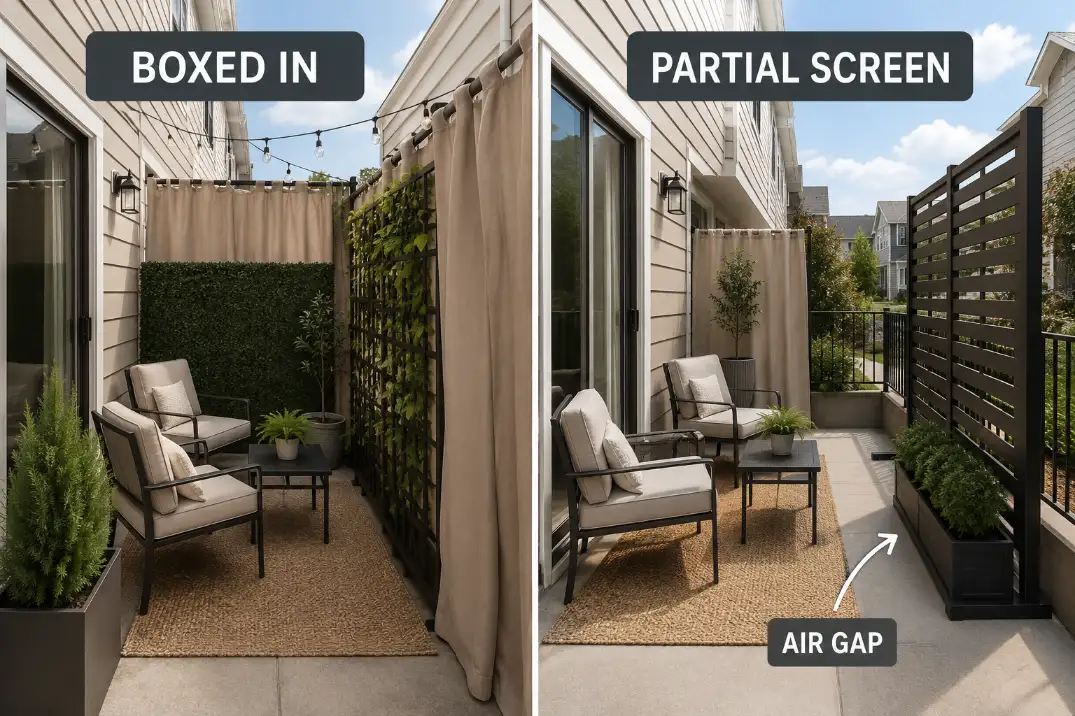
The fix that often wastes time is hanging curtains on every open side. It seems logical because more fabric means more coverage, but it can remove the light, airflow, and outdoor feel that make a patio comfortable.
In humid areas, fabric that stays damp for 24 to 48 hours can start looking tired faster than a screen or planter setup. In windy areas, curtains can slap, twist, or need constant tying.
If the curtain needs attention every time the weather changes, it is no longer a low-effort privacy solution.
That same access-first logic matters near doors. If the curtain, tieback, or weighted hem starts stealing the route from the house, the priority shifts from privacy to flow; Keep a Patio Entry Clear is the better next step before adding another layer.
Avoid the Boxed-In Feeling
The strongest temporary patio privacy setups leave one open direction on purpose. That may be the sky, a planting edge, a diagonal view across the yard, or the clean route back to the door. The patio feels private because the uncomfortable view is blocked, not because every side is covered.
Keep One Long View
On a 10-by-12-foot patio, even a small open diagonal can make the space feel larger. If every edge is screened, the patio loses depth. One long view toward the yard, a planting bed, or an open corner keeps the setup from feeling like an enclosure.
The symptom is feeling exposed. The mechanism is the view angle. Once those are separated, you stop buying privacy pieces for every side and start solving the actual line of sight.
This is where patio privacy and patio layout overlap. A screen that fixes the view but pushes chairs into the path has traded one problem for another.
If the seating itself is creating the exposure, a layout-first article like Patio Privacy Ideas for Secluded Seating may be more useful than adding taller barriers.
Do Not Overvalue Height
Height helps only when it meets the right sight line. A 7-foot panel in the wrong location can miss the neighbor’s view completely. A 4-foot planter placed closer to the seating angle can block more of what actually matters.
Before buying the tallest item, test the line for 10 minutes with a folding chair, cardboard panel, broom handle, or temporary fabric. Sit down, move the test piece, and check whether the view disappears. If a low test block works, you may not need a tall screen at all.
Private but Still Flexible
The best temporary patio privacy setup should survive ordinary use for a full season, not just look good for one weekend. It should water easily, fold or shift when needed, stay stable in normal weather, and leave the patio usable when guests arrive.
Test for Two Hours and Two Seasons
A privacy setup can look perfect during a 2-hour evening dinner and still fail as a seasonal system. Planters need watering. Fabric needs drying. Screens need wind tolerance. Heavy containers need a storage plan before freezing winters in northern states.
In dry Arizona-style heat, tall container plants may need daily summer watering. In coastal moisture, fabric and wood pieces need more breathing room.
That is where a routine fix stops making sense. If the screen has to be rescued every windy afternoon, the curtain needs constant tying, or the planter dries out before the end of the day, the setup is too demanding for everyday use.
Use the Three-Part Combination
For most small patios, the safest first setup is one vented freestanding screen, one weighted planter, and one open path back to the door. Add a curtain, vine, or fabric layer only where the patio already has support for it.
The screen gives structure. The planter adds weight and softness. The open path keeps the privacy from turning into a daily obstacle.
Skip permanent posts unless you own the space and already know the layout works. Skip light solid panels on windy patios.
Skip tiny decorative pots if they are expected to support tall privacy plants. Skip full-edge coverage unless the patio is large enough to keep a clear route, open air, and one longer view.
When wind is as important as privacy, the screen decision changes. A solid panel may block the view but make the seating area noisy, shaky, or uncomfortable; Best Patio Wind Screens is a better next step when stability matters as much as seclusion.
Temporary patio privacy should make the patio easier to use, not just harder to see into. When the screen blocks the right angle, the planter adds real weight, and the door route stays open, the space feels private without feeling trapped.
For container drainage, soil volume, and growing-media guidance that supports healthier privacy planters, see the University of Maryland Extension.