Last updated: April 19, 2026
A front yard on a busy street usually starts feeling exposed before anything looks obviously wrong. The lawn may be healthy. The shrubs may be in place. The border may look finished from inside the house. But that does not mean the yard feels settled once you step outside.
When the sidewalk or curb lane sits roughly 8 to 15 feet from the porch, the first planting layer stays below about 36 inches, and quiet gaps between passing cars rarely last more than 10 seconds during busy periods, the space often still feels open in the wrong ways.
That is the first distinction that matters. This is not always a size problem, and it is not always a planting problem. A compact yard can still feel protected. A deeper yard can still feel exposed if views, headlights, and sound move straight through it.
The first checks are practical: where eye-level sightlines land, whether the porch aligns with the walkway and street, and whether the same area keeps catching motion and light around dusk.
What to Check First
- The main seating area is still visible from the street without anything roughly 42 to 60 inches high interrupting the view.
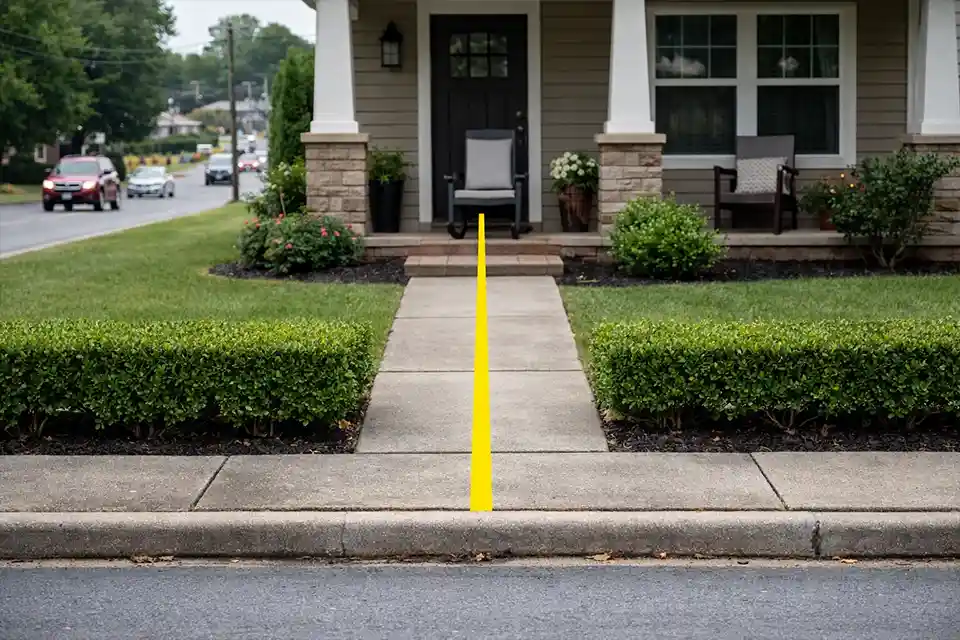
- The walkway, porch, and curb create one direct line for 10 feet or more.
- During busy hours, quiet gaps between passing cars are usually under 10 seconds.
- Planting looks dense from indoors but leaves clear openings at standing or seated eye level outside.
- Headlights regularly sweep the porch or front windows for 20 to 30 minutes around dusk.
If three or more apply, the problem is usually structural, not cosmetic.
What People Usually Misread First
You step outside with a coffee and sit down for a minute. Nothing looks especially wrong. Then a car slows at the corner. Someone walks past and glances over. You shift in the chair without really meaning to.
That reaction matters.
Most homeowners overestimate traffic volume and underestimate alignment. The street does not have to be packed all day to make a yard feel exposed. More often, the problem is repetition. A passing car every 20 to 40 seconds can wear on a front yard more than a short burst of heavier traffic followed by a real quiet break.
The yard is not fully public. It is constantly visible.
When the weakest point is the driveway-side sightline, tall planters for driveway privacy can help target that zone more cleanly.
Why low shrubs do not solve eye-level exposure
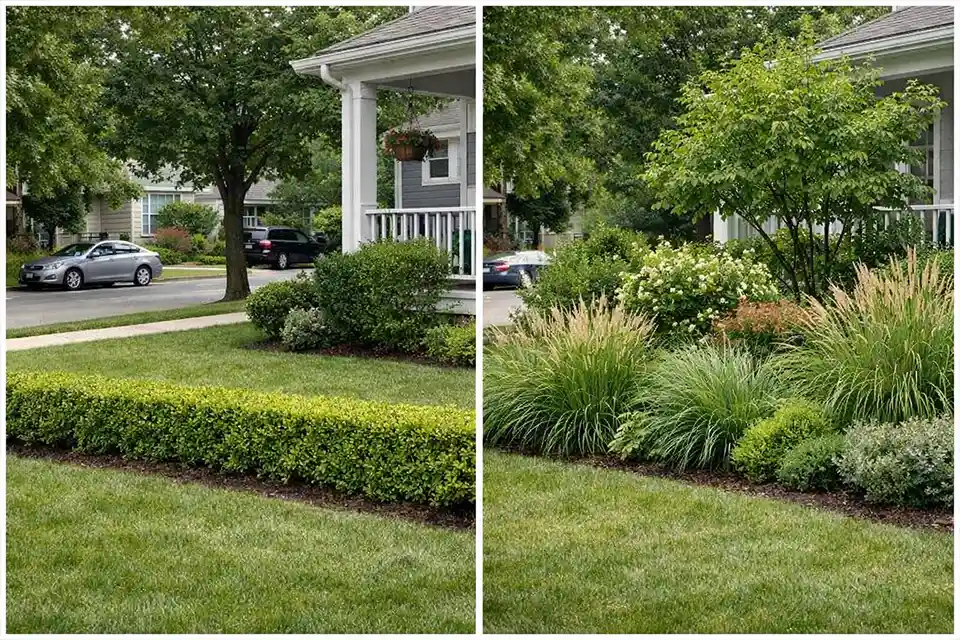
This is where a lot of wasted effort begins. A hedge that tops out at 30 to 36 inches may make the edge look cleaner, but it usually does not interrupt views from a sidewalk or car window. It defines the boundary without changing the experience of using the yard.
What matters more is whether the planting breaks the view where people actually look. If the porch chairs, front steps, or entry pause point are still readable in one glance, the yard will keep feeling exposed. That is why Front Yard Privacy Problems When the Sidewalk Runs Only a Few Feet From Your Windows overlaps so naturally with busy-street privacy. The issue is not just proximity. It is exposure at the wrong height.
Why traffic volume is often not the real problem
People often describe this as a noise problem first. Sometimes it is. But more often, the deeper issue is rhythm.
The constraint is not always volume. It is repetition.
If one car passes, then another, then another before the yard ever feels quiet again, the space starts to feel alert rather than calm. Hard surfaces make that worse. Concrete, gravel, and stone edging near the curb can reflect both sound and glare back toward the porch.
If front-facing windows are the main privacy issue, this guide on fixing front yard privacy when windows face a busy road breaks down the most practical next steps.
Why the Obvious Fix Fails
The most common time-wasting fix is adding more shrubs without changing the path of the view. More planting helps only when it interrupts the right height, angle, and opening. A narrow row that is 18 to 24 inches deep may look fuller after planting day, but it still behaves like a line, not a filter.
That same failure shows up around driveways. A driveway that opens directly to the street acts like a second visibility lane into the yard. Even decent planting at the sidewalk edge may leave that opening untouched, which is why the exposure still feels strong when you step outside. Front Yard Privacy Driveway Open to Street matters here because the problem is rarely the plants alone. It is the open corridor they never addressed.
One distinction matters more than most: visible planting is a symptom. Unbroken sightlines are the mechanism. If the mechanism survives, the yard still feels exposed.
What Actually Changes the Outcome
The front yards that improve usually do three things in the right order: break the direct line, add screening where eye level matters, and soften the edge where the street keeps entering the space.
Break the direct curb-to-porch line
This is usually the highest-value move. If the walkway, porch, and seating all face straight toward the street, the yard behaves like a corridor. Even a fairly deep lot can feel exposed when that alignment stays intact.
This is also why some front yards feel smaller than they are. The measurements do not change. The eye keeps getting pulled back to the curb.
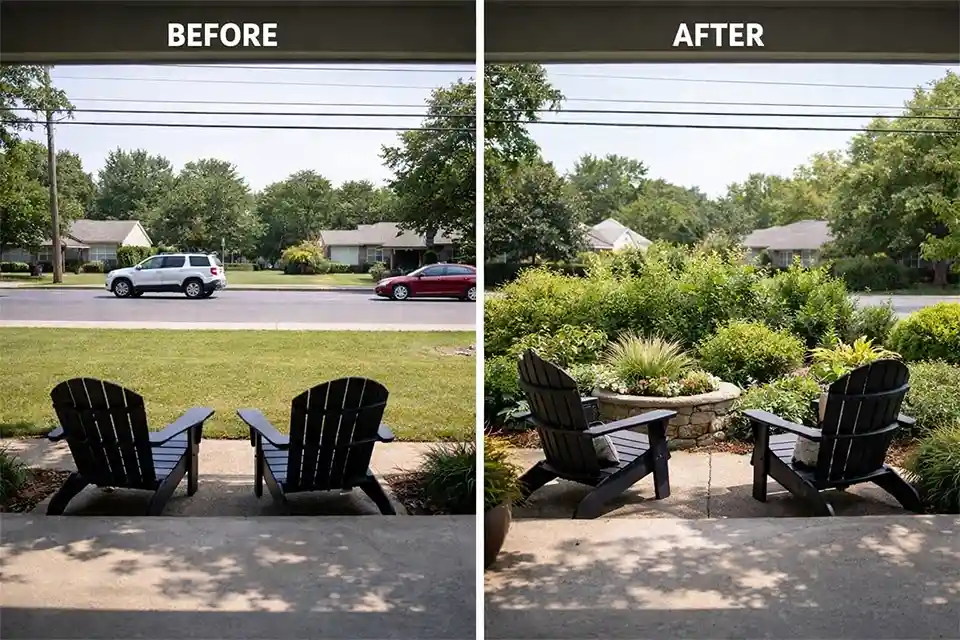
The first fix is often directional, not larger. Turn seating 10 to 20 degrees inward. Shift a bench so it no longer faces the curb directly. Place a planter where the eye currently moves without interruption. These small changes often do more than another row of low shrubs.
That same principle explains why How to Create Front Yard Privacy When Your House Sits Directly on a Busy Street Corner is usually harder than a straight-lot privacy problem. Street geometry can intensify exposure even when the yard itself is not especially shallow.
Add height where eye level matters
Once the direct line is broken, height starts doing useful work. Privacy improves when the yard has some interruption between about 42 inches and 6 feet, then improves again when a small canopy begins around 7 to 9 feet.
That does not mean the front yard needs a green wall. It means low plants alone cannot carry the load on a busy street.
A better screen usually comes from overlap: grasses or perennials near the edge, medium shrubs behind them, and one small tree or taller anchor where upper views remain open. Front Yard Landscaping for Privacy Without Fences is useful here because it treats privacy as layering, not just height.
Soften the hard edge near the street
Busy-street privacy is not only visual. The edge matters because that is where sound, glare, and movement first enter the yard. Replacing even a 2- to 4-foot strip of hard material with planted depth can make the space feel less abrupt.
The goal is not silence. It is steadiness.
Pro Tip: If a privacy fix only works in peak summer growth, it is probably underbuilt. On busy streets, privacy needs to hold up when foliage is thinner and the yard is easier to read.
A Better Way to Judge Progress
Do not judge improvement by whether the yard looks fuller from inside. Judge it by whether the porch still reads clearly from the curb.
| What you notice | What it usually means | Lower-value fix | Better move |
|---|---|---|---|
| People seem to look straight in | Eye-level views are still open | Add more low shrubs | Add layered screening at 42 to 72 inches where the view lands |
| The yard feels loud even when traffic is moderate | Sound gaps are too short and surfaces are reflecting noise | Assume the road is simply too busy | Soften the edge and break the straight path to seating |
| Headlights make dusk uncomfortable | Light is moving through an open corridor | Add brighter porch lighting | Catch the beam with planting or change the seating angle |
| The porch feels too close to the street | Walkway, porch, and curb align directly | Push everything farther back if possible | Offset the visual axis and interrupt the channel |
| Planting helped from inside but not outside | Density improved low down, not at viewing height | Keep adding the same shrubs | Layer heights and overlap openings |
When the Standard Fix Stops Making Sense
There is a point where “just plant more” stops being a smart first move. If the main seating area sits less than about 10 feet from the sidewalk, or the house faces a stop sign, curve, corner, or neighborhood entrance where drivers naturally slow and look in, planting alone often becomes inefficient.
When planting alone becomes inefficient
At that point, shrub-first thinking usually delays the real fix. Growth takes time. Exposure does not. If the yard is still readable from the street while planting matures, the space stays uncomfortable for another season or two without any guarantee that the result will be enough.
When layout matters more than added screening
This is where layout starts outranking planting. Seating angle, entry approach, partial screening, and threshold definition matter more because they change the experience immediately. The goal is not to make the front yard invisible. It is to stop it from being visually available in one uninterrupted pass.
Homeowners often worry that this will make the house feel closed off. Usually it does the opposite. A front yard feels more welcoming when it has a defined threshold and a little calm. Front Yard Privacy Still Looks Welcoming is useful if that balance is the real concern.
What People Usually Underestimate
They underestimate repeated light. A single headlight sweep is easy to dismiss. Repeated glare at dusk changes how long people stay outside.
They also underestimate how much a small angle shift can help. In practice, a chair turned slightly inward or one planted interruption near the entry often changes the yard faster than waiting for more hedge growth.
And they underestimate how physical the reaction can be. You sit a little closer to the house. You angle the chair inward. You stay outside for less time. The yard may have the same dimensions, but the usable center starts shrinking because the edge keeps taking over.
The Shortest Useful Path Forward
If you want the fastest way to judge what matters, start at the curb and trace the view to the porch, front windows, and favorite seat. Break that line first. Then add screening at the height where eyes and headlights actually land. Only after that should you decide whether more planting is still necessary.
That order matters because many busy-street front yards do not need dramatically more material. They need better placement, better direction, and a more convincing threshold between the street and the part of the yard meant for staying.
Once that threshold exists, the yard stops feeling like an extension of traffic and starts functioning like usable space again.
For broader official guidance on traffic noise and residential mitigation, see the Federal Highway Administration.