Last updated: July 7, 2026
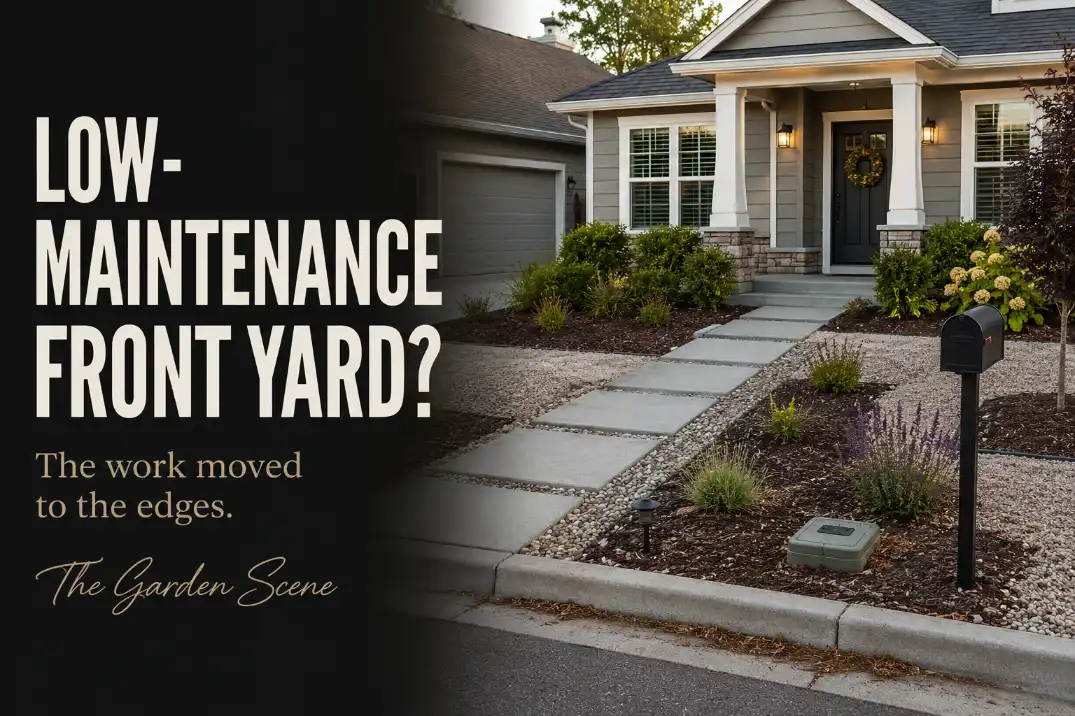
A low-maintenance front yard can fail even when it looks cleaner than before.
The problem is not always the gravel, the mulch, the shrubs, or the lack of lawn. The problem is that the front yard has to stay readable from the curb.
A thin mulch edge, a gravel strip drifting onto the driveway, one shrub crowding the entry, or weeds along the curb can make the whole yard feel unfinished because those flaws sit on the public face of the house.
The weak assumption is that fewer elements automatically mean less maintenance. Less lawn, fewer plants, wider gravel areas, and simplified beds can remove some chores. But they can also move the work into the most exposed parts of the yard.
The better test is not “How much did I remove?” It is whether the front yard stays visible, reachable, stable, and readable after weather, plant growth, foot traffic, and street debris start acting on it.
Low Maintenance Fails Differently in a Front Yard
A front yard becomes high-maintenance when small flaws land in places that define the house.
The driveway edge reads like a border around the property. The front walk decides whether the entry feels cared for. The foundation bed frames the house. The curb strip gets judged from the street. The mailbox or utility zone may be small, but it often sits exactly where trimming gaps, weeds, or bare soil are easiest to notice.
That is why low-installation and low-maintenance are not the same thing. A front yard can be easy to install because it uses broad gravel areas, simple shrubs, and open mulch beds. But if those surfaces move, expose weeds, collect leaves, or block access, the design has not reduced maintenance. It has changed the type of maintenance.
The front yard also has less tolerance for “almost clean.” A few leaves in a backyard bed may disappear into the setting. The same leaves caught in pale stone beside the front walk look like a task waiting to be done. A small bare patch near a private patio may not matter much. A bare patch in a foundation bed can pull attention away from the house.
That is the real front-yard problem. The yard does not have to be complicated to become demanding. It only has to place small repeat chores where everyone can see them.
For the broader version of this same maintenance-transfer problem, the general pattern is covered in why low-maintenance gardens often shift work instead of removing it. In a front yard, though, the pressure is sharper because the curb view exposes every weak edge.
The Work Usually Moves to Public Edges
When mowing or heavy planting care is reduced, the work often moves to the lines that make the front yard look intentional.
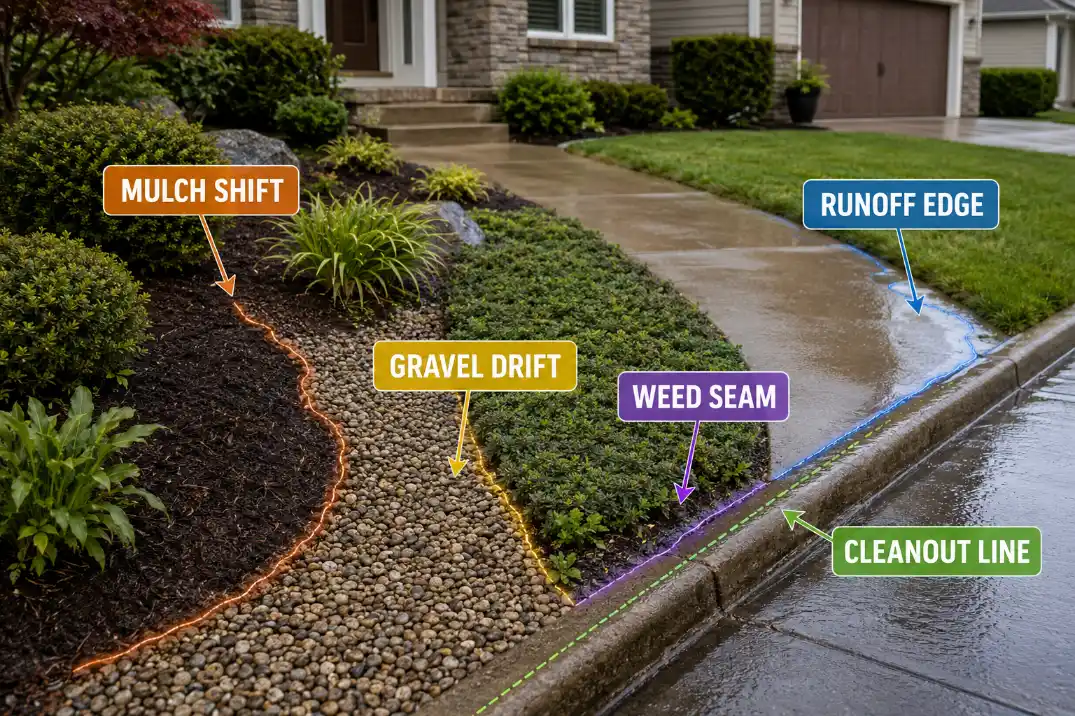
The driveway edge collects gravel, mulch, grass creep, dust, and tire-side debris. The walkway edge shows weed seams because people follow it to the door. The curb strip gets road grit, leaves, runoff, and foot traffic.
The foundation bed has to stay clean enough to frame the house without crowding windows or steps. The mailbox or utility area needs access, but it often becomes a trimming trap.
The edge is where “simple” gets tested
A simplified front yard usually has fewer broad tasks, but more line maintenance. Instead of mowing one connected lawn, the homeowner may now reset gravel, pull weeds from seams, sweep mulch from the walk, trim around awkward corners, and clean debris from open surfaces.
That is not always more work in total. But it can feel more frequent because the chores sit where the yard is supposed to look finished.
| Low-maintenance choice | Visible pressure zone | Repeat task created |
|---|---|---|
| Gravel beside the driveway | Driveway edge | Raking or sweeping stone back into place |
| Mulch along the front walk | Walkway edge | Clearing washout, weeds, and loose mulch |
| Sparse foundation planting | Foundation bed | Pulling visible weeds and filling bare gaps |
| Reduced curb-strip lawn | Curb strip | Cleaning road grit, leaves, and edge creep |
| Hidden utility or mailbox planting | Service access area | Trimming around tight access points |
The mistake is not using gravel, mulch, or fewer plants. The mistake is assuming those choices can hold a public edge without a plan.
Clean Ground Layers Become Visible Correction Zones
A ground layer in a front yard fails first where it touches something else.
Gravel, mulch, groundcover, and exposed soil often look clean on installation day. The problem begins at the seam: where gravel meets the driveway, mulch meets the walk, groundcover meets the lawn, or a bed edge meets the curb.
Gravel drifts onto hard surfaces. Mulch thins near slopes, downspouts, and curb edges. Groundcovers spread into seams or over the lawn line. Open mulch beds collect leaves and seed. Stone surfaces can trap debris that would have been less obvious in turf.
None of that means these materials are wrong. It means they need a containment logic. In a front yard, a ground layer is not just a surface. It is part of the public outline of the house.
The seam matters more than the surface
A gravel bed in the middle of a private garden may be acceptable if it gets a little uneven. A gravel strip beside the front walk has a different job. It has to look deliberate every time someone approaches the door.
The same is true with mulch. Mulch can help planting beds look finished, reduce exposed soil, and support moisture control, but a front-yard mulch bed that washes across the walk after rain creates a cleanup line. If that happens repeatedly, the “easy” material becomes a visible correction zone.
This is especially important when replacing lawn. A no-lawn front yard can work well, but only when the paths, edges, drainage, and planting structure are clear before the surface materials go in.
The same decision is explored more directly in designing a front yard without lawn around clear paths and edge control.
The better filter is simple: do not judge a ground layer by how clean it looks in the first week. Judge it by what happens at the edge after rain, wind, foot traffic, and leaf drop.
Sparse Planting Makes Small Problems Look Larger
Sparse planting reduces pruning pressure, but it also removes visual forgiveness.
That trade-off matters in a front yard. When there are only a few shrubs in a large bed, every weed gets more attention. Every gap looks intentional, even when it is just unfinished. Every stressed plant becomes a focal point. A thin foundation bed can make the house look exposed instead of clean.
The issue is not plant quantity by itself. The issue is whether the planting has enough structure to cover soil, soften edges, and frame the house without creating future crowding.
A front yard does not need to be packed with plants to look cared for. It does need enough coverage and rhythm that small seasonal messes do not become the first thing people see from the sidewalk. The strongest low-maintenance front yards usually use restrained planting, not empty planting.
Slow-Growing Plants Still Create Establishment and Size Pressure
A plant can be low-care later and still create work now.
Slow-growing, drought-tolerant, and compact plants are often treated as the easy answer for front yards. They can help, but they do not remove two major forms of work: establishment and mature-size pressure.
New plants still need attention while roots settle in. A plant that will be drought-tolerant later may still need consistent watering during its first season. A shrub that looks compact at planting time can still become too wide for a narrow walk, too tall for a window, or too dense near the porch.
Installation size is the wrong reference point
Many front yards become high-maintenance because plants were placed for how they looked on planting day. That creates a clean first impression and a pruning problem later.
The better reference point is mature spread. A shrub beside a walkway should not be placed where it will need constant shearing just to keep the path open. A foundation plant should not be chosen only because it fills a bare spot today. It should leave room for windows, siding, steps, and airflow to remain clear.
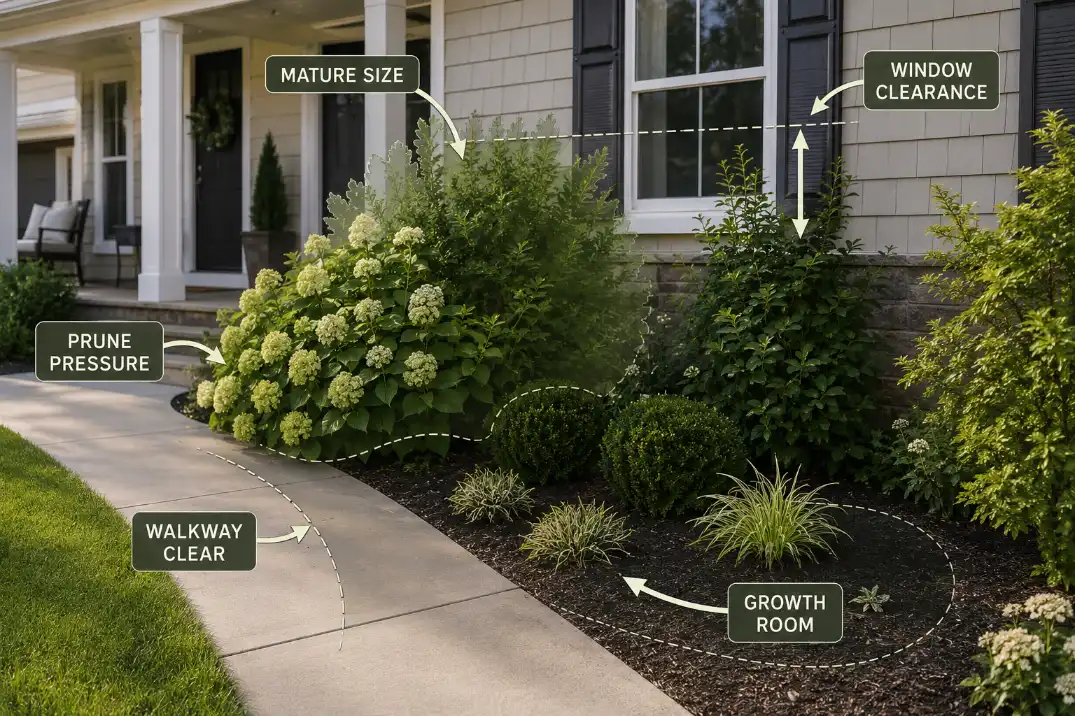
Layering also matters. A bed with one row of small plants can look thin and expose weeds. A bed with plants placed too tightly can become a clipping routine. The middle ground is structure with spacing, which is why layering plants so the front bed has structure without crowding is a more useful goal than simply choosing “easy” plants.
Low-maintenance planting is not plant avoidance. It is growth behavior planned before the bed fills in.
Entry Access Turns Simple Designs Into Work Zones
A front yard is only low-maintenance if people and tools can move through it without disturbing the design.
A yard may look clean from a design view, but if the easiest path to the door cuts through gravel, narrow stepping stones, loose mulch, or a planted strip, the surface will start showing use.
Guests take shortcuts. Delivery drivers follow the fastest line. Kids, pets, trash bins, and seasonal tools repeat the same paths. Over time, the route reveals whether the design actually works.
A low-maintenance front yard needs a clear, stable way to reach the door. For many homes, a main walk around 36 inches wide is a practical minimum, with more space feeling better near the entry or where two people may pass. The exact number matters less than the principle: the main route should not depend on people carefully avoiding the landscape.
Access is part of maintenance
Maintenance also needs a route. If the bed is simple but unreachable, every small task becomes annoying. If the utility area is hidden behind shrubs, it becomes a pruning issue. If equipment cannot pass through a small front yard without dragging over beds, the design has created friction.
This is why keeping small front yards maintainable when equipment access is limited matters as much as choosing low-care materials. A yard that cannot be reached easily will not stay easy, even if every individual plant or surface was chosen for low maintenance.
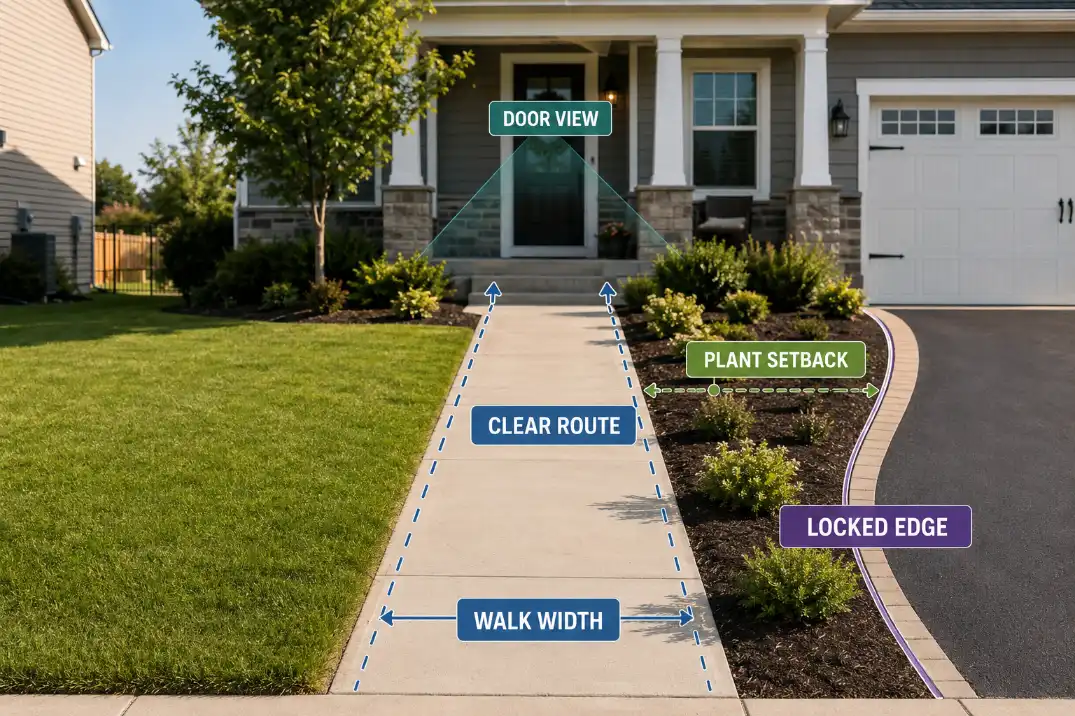
The entry route should be locked before surface materials and plants are treated as low-maintenance. Otherwise, the yard may look simple while forcing people and tools to disturb it.
Street Exposure Adds Cleanup the Design Did Not Count
Some front-yard maintenance is not created by the design. It is created by exposure.
Windblown leaves, road grit, curb debris, dust, seed drop, and neighbor-tree litter all land in the front yard first. A busy street can add more debris. A corner lot may receive more foot traffic and visual pressure. An HOA or neighborhood standard may make small imperfections feel more urgent, even when the task itself is minor.
Minimalist front yards often show this exposure faster. Lawn can absorb some visual mess. Fuller planting can hide a few leaves. Open gravel, pale stone, flat mulch, and sparse beds reveal debris quickly.
That does not make minimalist front yards a bad idea. It means they need cleanup zones. If every exposed surface is expected to stay perfectly clean, the design may ask for more attention than expected.
For homes with heavier street exposure, the issue becomes even more specific. Front yard maintenance near busy roads is not only about dirt; it is about whether the design gives dust, grit, and windblown material an obvious place to settle without making the whole yard look unfinished.
The practical correction is to stop blaming one material for every mess. Sometimes the material is fine, but the exposure is wrong for a highly visible open surface.
The Better Test Is Whether the Yard Stays Readable From the Curb
A low-maintenance front yard is not the one with the fewest pieces. It is the one whose pieces keep their job after the first clean week.
The entry route should stay obvious. The driveway edge should not need constant resetting. The foundation bed should frame the house without showing every small gap. Plants should have room to mature without becoming a pruning schedule. Water should move predictably instead of washing mulch across the walk. Service areas should remain reachable.
Use this field test before calling a front yard low-maintenance:
- Can someone see the front door route immediately from the curb?
- Do gravel, mulch, or groundcover have a stable edge where they meet walks, driveways, and curb strips?
- Will shrubs still clear windows, steps, siding, and walkways at mature size?
- Can the mailbox, utility area, hose, and maintenance points be reached without stepping through beds?
- After a light rain, does water move through the yard without creating washout or a cleanup line?
- Does the yard still look intentional if a few leaves, weeds, or seasonal gaps appear?
That test is stricter than “less lawn” or “fewer plants,” but it is more honest. A front yard has to stay readable from the street. If the structure is stable, simple materials can work beautifully. If the structure is weak, even the cleanest low-maintenance idea can become a set of small chores displayed in public.
The strongest front yards usually handle access, water, planting room, and edges before decorative choices.
That same priority order is useful when prioritizing drainage, access, privacy, and planting before decorative choices, because the front yard only feels easy when the practical structure is already doing its job.
Low maintenance is not invisible maintenance. It is predictable maintenance placed where it can be handled without constantly repairing the public face of the yard.
For neutral plant-care guidance on watering and mulch depth, see the University of Maryland Extension’s watering trees and shrubs guide.