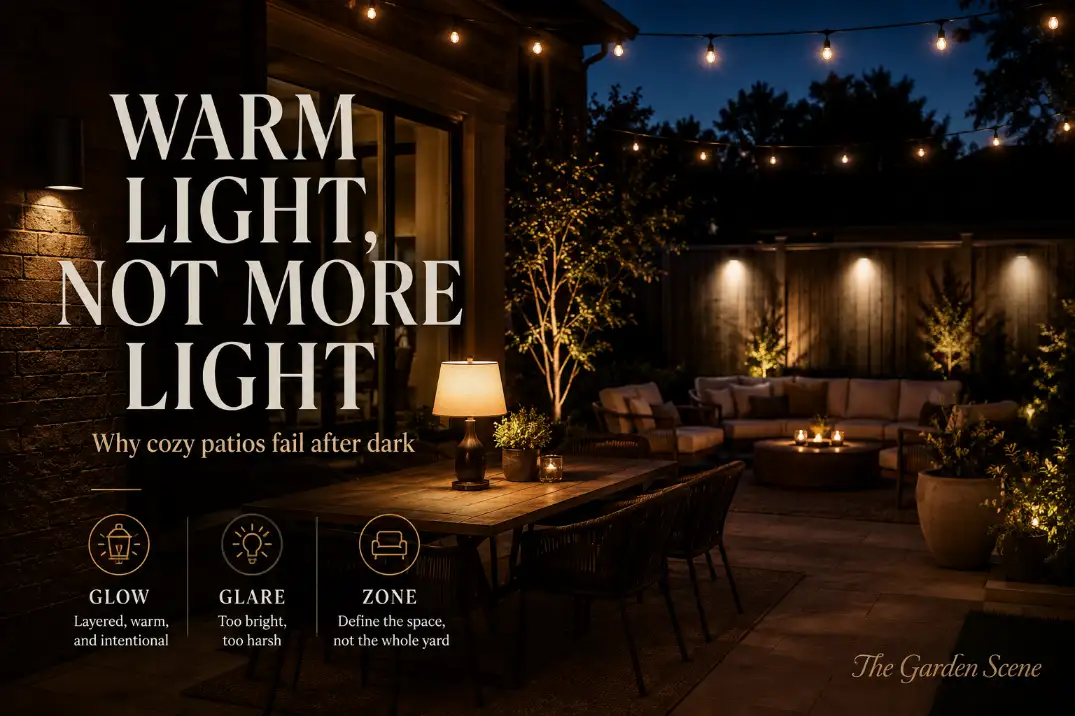
A patio usually feels uninviting at night for one of three reasons: the light is too cold, too exposed, or concentrated in the wrong place.
The fastest fix is rarely “add more lights.” It is usually to switch to warmer bulbs, reduce glare, and spread lower light across the places people sit, eat, walk, and cook.
Start with three checks: use bulbs around 2200K to 2700K, keep most light below seated eye level or softly diffused overhead, and separate mood lighting from task lighting. A patio can look dark even when it has plenty of brightness if one harsh porch light forces the rest of the space into shadow.
For comfort, many accent fixtures only need 50 to 150 lumens, while a grill or prep area may need brighter task light for 20 to 40 minutes during cooking.
The goal is not maximum brightness. It is controlled warmth that still feels good after people have been outside for half an hour.
Warm Patio Lighting Ideas by Feature
Choose the idea by what your patio is missing: table glow, seating comfort, edge safety, background depth, flexible light, or a softer transition from the house to the yard. The best warm patio lighting idea is not always the prettiest fixture. It is the one that fixes the weak spot without adding glare.
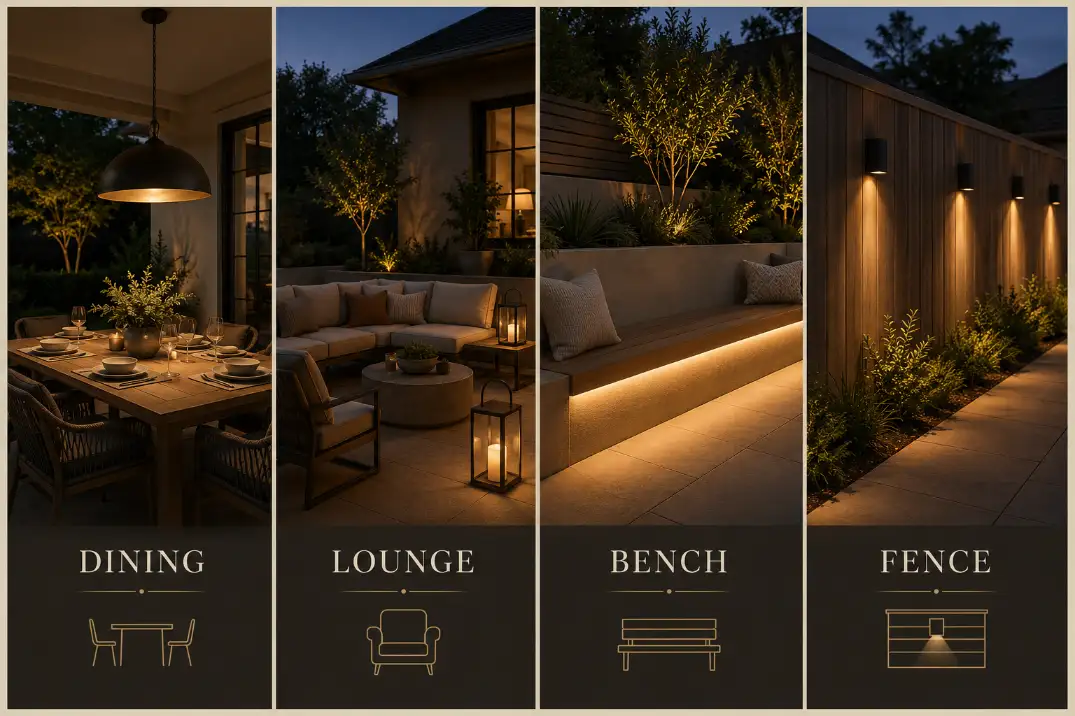
Over a dining table: one low warm pendant or two table lamps
A dining patio needs light that lands on the table without shining into faces. Under a covered patio, one dimmable warm pendant can work beautifully if it hangs low enough to define the table but high enough to avoid blocking sightlines. In open patios, two rechargeable table lamps usually do the same job with less installation.
For most dining setups, 2700K is the safer warm choice because food still looks natural. Very amber bulbs can feel cozy, but they can also make meals look dull.
If the table has a glass, polished stone, or glossy white surface, choose shaded or frosted lamps instead of clear exposed bulbs.
Around lounge seating: portable lanterns and side-table lamps
Lounge seating feels more inviting when the light is at human scale. A small lamp on a side table, a pair of portable floor lanterns, or a low cluster of candle-style LED lanterns can make chairs feel occupied before anyone sits down.
This is usually better than lighting the whole seating area from above. Overhead light can flatten cushions and cast shadows under people’s eyes. Low warm light does the opposite: it softens the zone and helps the patio feel calmer.
Under built-in seating: hidden warm LED strips
Built-in benches, low walls, and deck rails are good places to hide warm LED strips. The light should wash the surface below the seat or rail, not expose the strip itself. If the dots of the LED strip are visible, add a diffuser channel or move the strip deeper under the edge.
This idea works especially well on patios that already feel crowded. It adds glow without another floor lamp, stake light, or table fixture.
Along a fence: shielded mini sconces or a soft wall wash
A dark fence can make a patio feel smaller and more closed in. A few shielded mini sconces or one soft wall wash can create depth without lighting the entire yard.
The fixture should aim down, across texture, or toward the patio, not into a neighbor’s window. If the fence is close to the seating area, low output matters. A soft background glow is useful; a bright fence line can feel like a stage set.
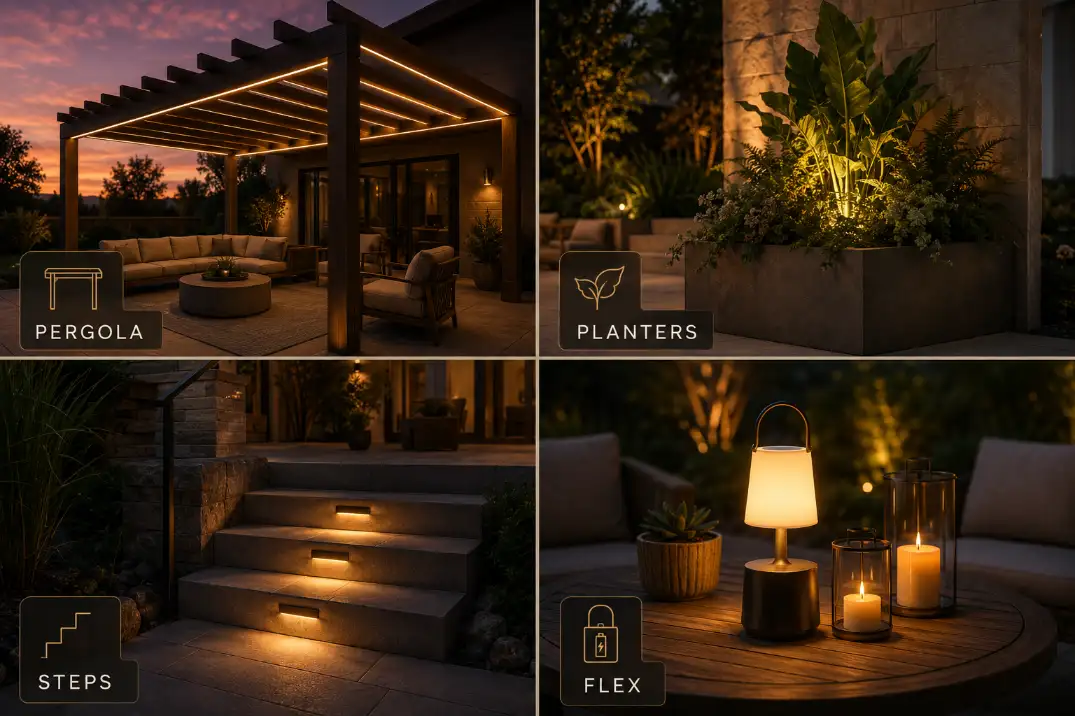
Under a pergola: dimmable strips along beams
A pergola gives you structure, which means you do not have to rely only on string lights. Warm LED strips tucked along the inside edge of beams can create a soft architectural glow. The best version is subtle: the beam glows, but the strip is not obvious.
Avoid running bright strips along every beam. That can make the patio feel busier, not warmer. One or two well-placed runs usually feel more premium than a fully outlined pergola.
Around planters: low-voltage uplights tucked behind foliage
Container plants can help warm lighting feel more natural. A small low-voltage uplight hidden behind a large planter can illuminate leaves, branches, or a textured pot without making the fixture visible.
This is a good fix for patios that feel flat at night. Instead of adding more brightness to the seating area, you give the background some depth. Warm light on greenery, terra-cotta, wood, or stone often looks softer than light aimed at bare concrete.
Near steps: recessed warm step lights
Steps and patio edges need light for safety, but they do not need to be bright. Recessed warm step lights, side-mounted deck lights, or low downlights can mark a level change without turning the patio into a walkway.
A practical threshold: the step should be visible within about 3 feet of approach. If someone only sees the level change once they are already at the edge, the light is placed too late or aimed poorly.
For sloped yards, walkways, or patio edges, the safety logic in Path Lighting for Steps, Slopes, and Walkways matters more than the decorative pattern.
Fire bowls and fire pits: emotional glow, not safety lighting
A fire pit, tabletop fire bowl, or outdoor fireplace can make a patio feel instantly warmer. Firelight adds movement and atmosphere in a way a fixed fixture cannot.
But it should not be the only light source. Firelight flickers, shifts, and leaves steps, food surfaces, and cleanup areas underlit. Treat it as the emotional layer, then keep a few steady warm sources for walking, dining, and getting back to the house.
For flexible evenings: rechargeable lamps and candle-style LEDs
Some patios need flexibility more than permanent fixtures. Rechargeable lamps and candle-style LED lanterns work well when seating moves, renters cannot add wiring, or the patio shifts between dinner, drinks, and quiet reading.
Use them as the adjustable layer, not the only layer. If they are responsible for steps, doors, and cleanup, they may disappoint once batteries fade. But as a warm table or lounge layer, they are one of the easiest ways to make a patio feel more inviting in a single evening.
How to Place Warm Light So the Patio Feels Inviting
Light the zones, not the whole slab
The most inviting patios are not evenly bright. They have small pools of light where people sit, eat, walk, and cook. The empty middle of the patio can stay softer.
That is why planning by use matters. A patio with dining, lounging, and grilling needs separate layers, not one overhead fix. The layout logic in Patio Lighting Zones for Dining, Lounge, and Grill Areas applies even if the fixtures are inexpensive.
A good warm lighting plan usually has three layers: a soft overhead or background glow, low light near seating, and clearer task light only where needed.
Keep grill lighting separate from mood lighting
Grill areas need brighter, clearer light than lounge areas. That does not mean the whole patio should get brighter. Put grill lighting on its own switch, timer, or motion setting so it can be used while cooking and turned down afterward.
A focused fixture over the grill or prep surface is more useful than a bright wall light that washes across the dining table. The grill zone may need stronger light for food safety, but once cooking is done, that same light often becomes the reason the patio stops feeling relaxed.
If the grill, table, and seating are squeezed together, fixture choice will not solve everything. Placement may need to be adjusted first, especially in tight layouts like those covered in Small Patio Grill Placement Near the Dining Area.
Aim light inward when neighbors are close
Warm light can still be annoying if it spills into the wrong place. On townhome patios, side yards, balconies, and small suburban lots, the better move is to aim light down and inward rather than across the fence.
Use shielded fixtures, lower bulbs, and timers. If a neighbor can see the exposed bulb from a bedroom window, the patio may feel cozy to you but intrusive to them. For close lots, a timer around 10 or 11 p.m. is often more neighbor-friendly than leaving string lights on all night.
This is also where warm color helps. A low 2200K to 2700K source aimed inward usually feels less harsh than a cooler white fixture aimed outward.
Open Patio vs Covered Patio Lighting
Open patios need edges and anchors
An open patio can feel exposed after dark because there is no ceiling or wall to catch light. String lights, lanterns, low path lights, and softly lit planting edges help define the usable area.
The key is to create anchors. A table lamp, a softly lit fence, and a few warm edge lights can make the patio feel intentional without lighting the lawn beyond it. In windy regions or exposed lots, avoid flimsy overhead runs that twist or pull against poles.
Covered patios need dimming more than drama
Covered patios already have structure, so they often need less decorative lighting and better control. Warm sconces, a dimmable pendant over a dining table, or recessed downlights can work well if they are not too bright.
The common failure is installing ceiling lights that shine straight down at full strength. That makes the patio functional but flat. Use dimmers, warmer bulbs, and fewer downlights than you think you need. If the ceiling is low, shaded fixtures are usually more comfortable than exposed bulbs.
Covered patios also trap reflections. White ceilings, glossy tile, stainless grill lids, and glass tables can bounce light back into people’s eyes, so the fixture output should be lower than it would be in an open yard.
What to Check Before Buying Warm Outdoor Lights
Match the fixture rating to the exposure
Outdoor lighting has to survive the site, not just match the patio furniture. A covered patio may only need a damp-rated fixture if it is protected from direct rain. Exposed patio walls, fence lines, steps, and open pergolas usually need wet-rated fixtures designed for direct weather.
When products list IP ratings instead of US wet/damp language, IP44 is a common splash-resistant baseline for protected areas, while IP65 is a better target for exposed fixtures, ground-level lights, or heavy rain zones.
In coastal parts of California, the Carolinas, Florida, and the Gulf Coast, corrosion is a real issue. Salt air and humidity can age cheap finishes quickly. Powder-coated aluminum, brass, stainless steel, and sealed outdoor-rated components usually hold up better than thin decorative metal.
Do not improvise the power source
For plug-in lighting, use an outdoor-rated extension cord only when temporary use makes sense, and keep connections off wet ground. A permanent patio setup should not depend on an indoor cord run through a door or window.
Outdoor receptacles should be GFCI-protected, and low-voltage systems should use an outdoor-rated transformer sized for the fixture load. This is not the glamorous part of warm lighting, but it is where a good-looking setup either becomes dependable or becomes a seasonal frustration.
Controls matter more than maximum brightness
A dimmer, smart plug, timer, or separate switch can make an average fixture much more useful. A beautiful patio light that only has one full-brightness setting may be annoying most of the time.
The best setups let you change the patio from cooking mode to dinner mode to late-evening mode without touching every fixture one by one. That control matters more than buying the brightest option on the shelf.
Solar is an accent choice, not the main layer
Solar lights are useful where they get enough sun and where failure is not a safety problem. They are less dependable under tree canopies, on north-facing patios, during cloudy Midwest stretches, or in northern winters with short days.
Use solar for secondary glow near planters or fence lines. Do not rely on it as the only light for steps, dining, or the route back to the house. A light that fades after the first hour may look fine in a product photo but disappoint during real evening use.
| Warm lighting choice | Best use | Watch-out | Better choice when |
|---|---|---|---|
| Dimmable string lights | Open seating or dining zone | Too bright without a dimmer | You need a soft overhead glow |
| Shielded sconce | Door or covered patio wall | Eye-level glare | The porch light is overpowering the patio |
| Rechargeable lamp | Tables, renters, small patios | Short battery life | You need flexible light without wiring |
| Step or deck light | Edges, stairs, level changes | Cold color temperature | Safety matters more than decoration |
| Low-voltage path light | Patio edges and walkways | Runway effect from tight spacing | You need dependable outdoor lighting |
| Warm uplight | Tree, fence, planter, wall texture | Visible beam aimed at seating | The patio lacks depth after dark |
What People Usually Misread First
A dark patio is often a contrast problem
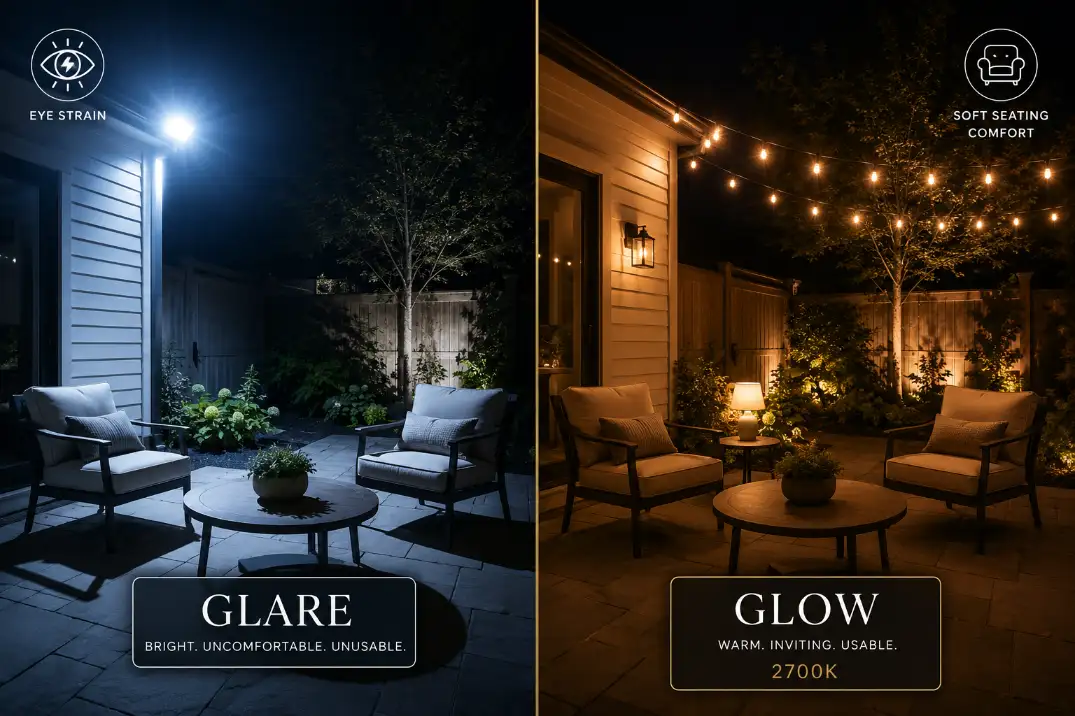
The symptom is darkness. The mechanism is usually contrast. A bright porch light near the door can make everything beyond it look darker because your eyes adapt to the strongest source.
A healthier setup has several softer lights with less contrast between them. A failing setup has one dominant light, hard shadows, and black corners. If the patio looks calmer when the porch light is off, that fixture is probably doing more harm than good.
This is the same pattern behind many layouts with shadowed seating areas and bright door zones. The issue is not always total light quantity; sometimes it is the way the light is distributed, as in Dim Backyard Corners and Layout Problems.
Bare warm bulbs can still glare
Edison-style bulbs look warm in photos, but they can be uncomfortable when they hang directly in the sightline from a chair. Warm glare is still glare.
If the bulb itself is the first thing you notice, dim it, shade it, raise it, or move it. On small patios, fewer visible bulbs and more reflected light usually feel better than a cluster of decorative exposed bulbs.
Warm light cannot fix a cluttered patio
Lighting can make a patio more inviting, but it cannot erase a crowded layout. If chairs, planters, cords, stands, and side tables already block movement during the day, warm lighting may simply highlight the clutter at night.
Small patios need especially quiet lighting. The guidance in How to Light a Small Patio Without Clutter is worth applying before adding another visible fixture.
Quick Diagnostic Checklist
Use this before buying another fixture:
- Bulbs are warmer than 3000K, ideally 2200K to 2700K for comfort.
- No exposed bulb shines directly into seated eye level.
- The porch light is not the brightest source by default.
- Steps, edges, and door thresholds are visible from both directions.
- Grill lighting can be turned off separately after cooking.
- Plug-in lights use outdoor-rated cords and weather-appropriate connections.
- At least one wall, fence, tree, or planter has a soft background glow.
- The patio still feels comfortable after 30 minutes, not just in a quick test.
When the Standard Fix Stops Working
String lights are not always the answer
String lights stop making sense when there is nowhere clean to hang them, when wind exposure makes them unstable, or when a small patio starts to feel visually busy. In those cases, a shielded sconce, table lamp, under-bench strip, or softly lit backdrop may do the job with less clutter.
The fixture style is less important than the effect. If the light feels warm, low, shielded, and well placed, it does not have to be a trendy string-light setup.
More fixtures stop helping when the house light dominates
If one exterior wall light is bright, cold, and aimed outward, every new warm fixture has to compete with it. That is the point where adding lights stops making sense. Fix the dominant glare source first.
Replace the bulb, add a dimmer, switch to a shielded fixture, or redirect the light downward. If glare is the recurring problem, Patio Lighting Glare Mistakes is a better next read than another idea list.
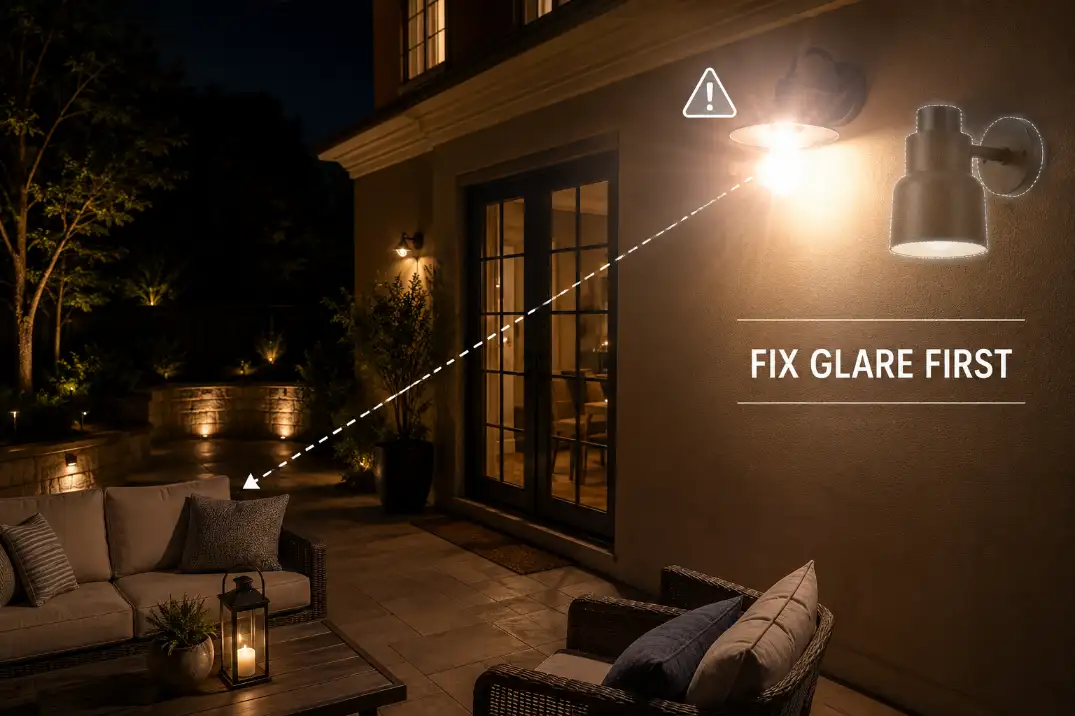
Warm patio lighting works best when it is selective. Light the table, faces, walking edges, and one backdrop. Keep grill lighting separate. Reduce the porch-light glare that often causes the problem in the first place.
A patio does not become inviting because every corner is bright; it becomes inviting when the right parts glow softly and the rest of the yard is allowed to stay calm.
Questions People Usually Ask
Is 3000K too cool for a patio?
Not always, but it is the upper edge for a cozy patio. 3000K can work near a door, grill, or prep area. For relaxed seating and dining, 2200K to 2700K usually feels more inviting.
Can I mix solar, plug-in, rechargeable, and hardwired lights?
Yes, as long as the color temperature and brightness feel coordinated. Use hardwired or low-voltage fixtures for dependable safety areas, rechargeable lamps for flexible seating, plug-in string lights for mood, and solar lights for secondary accents.
Should all patio lights match?
They should coordinate, but they do not need to be identical. Matching the warmth of the light matters more than matching every fixture style. A 2200K lantern beside a 5000K wall light will feel more mismatched than two different warm fixtures.
What is the most common wasted fix?
Adding another bright fixture to solve a patio that feels dark. Most uninviting patios need warmer color, better shielding, dimming, and smarter distribution before they need more total light.
For broader official guidance on matching light quality to function and using lighting controls, see the U.S. Department of Energy.