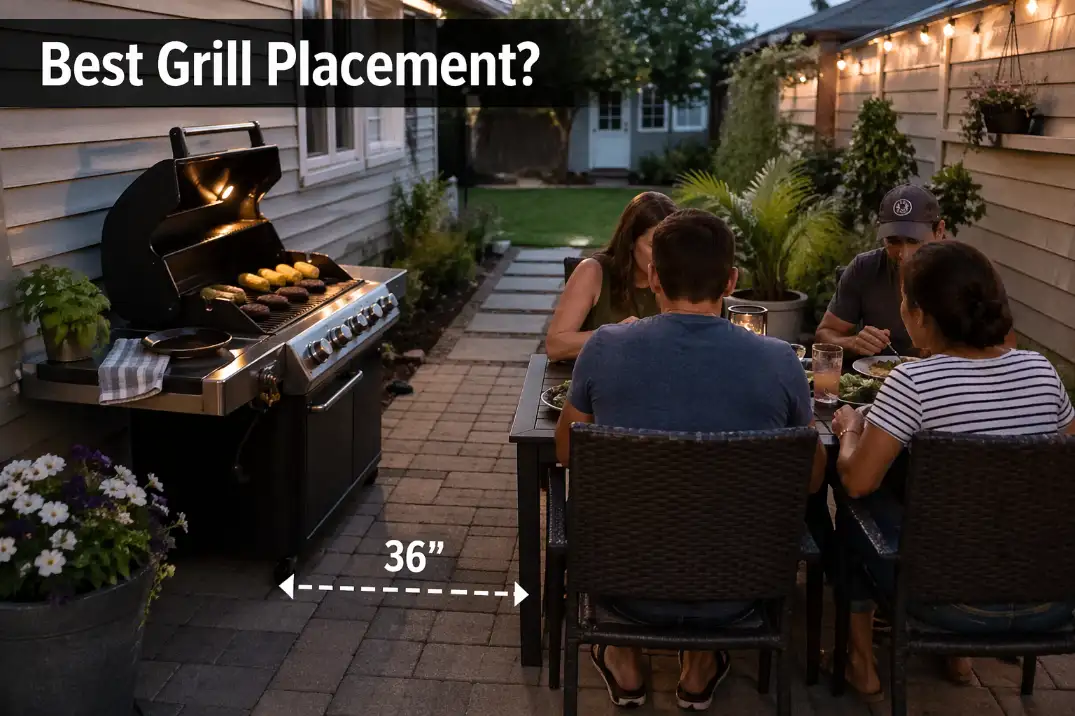
The best grill placement for a small patio with a dining area is usually along an open outer edge, offset from the table, with safety clearance checked before furniture layout. A grill is not just another patio object. It needs structure clearance, working room, lid swing, fuel access, smoke movement, and a cook who can step back without backing into a chair.
On most small patios, the first meaningful checks are whether the grill has at least 36 inches of clear working space, whether dining chairs can pull out 24 to 30 inches, and whether the main walkway avoids the hot zone.
This is different from a normal small-patio seating problem because the grill adds heat, grease, flare-up risk, and smoke drift. If the only available spot puts the grill under a low cover, beside a door swing, or inside the chair pullout zone, the patio needs rezoning before it needs new furniture.
The Clearance Stack: What to Measure First
Small patio advice gets messy because different numbers solve different problems. A grill can have enough room for a person to stand in front of it and still be too close to siding. A dining table can fit neatly when chairs are tucked in and still fail the moment people sit down.
The right order is simple: fire safety first, cooking function second, dining comfort third, and style last.
Structure clearance overrides the “best-looking” spot
Start with the grill manual and local rules. Gas, charcoal, pellet, and electric grills can have different clearance requirements, and attached homes, condos, apartments, and HOA communities may add restrictions.
Combustible materials matter: vinyl siding, wood railings, fabric curtains, cushions, lattice, fences, and low patio covers all change the decision.
This is where “just tuck it in the corner” becomes risky. A corner may look efficient, but if heat collects near a wall or smoke gets trapped under a cover, the layout is not actually working.
Covered patios deserve special caution because ventilation problems become more serious once heat, grease, and smoke are involved; the same airflow logic behind covered patio ventilation mistakes matters even more around a grill.
Working clearance is the usability test
Once safety clearance is satisfied, the cook needs room. About 36 inches in front of the grill is a practical minimum for standing, turning, opening the lid, handling tools, and carrying platters.
If furniture faces the grill, 48 inches is more comfortable because people can pass without brushing the cook or the hot zone.
Under 30 inches starts to feel pinched. That is the point where the grill may technically fit but daily use becomes awkward.
Dining clearance has to be measured in use
Dining chairs generally need 24 to 30 inches of pullout space. A 36-inch round table can end up needing close to a 7-foot usable circle once people are seated. That surprises homeowners because the tabletop itself looks small.
Measure the patio with chairs pulled out, not tucked in. A tucked-in dining set shows storage size. A pulled-out dining set shows dinner size.
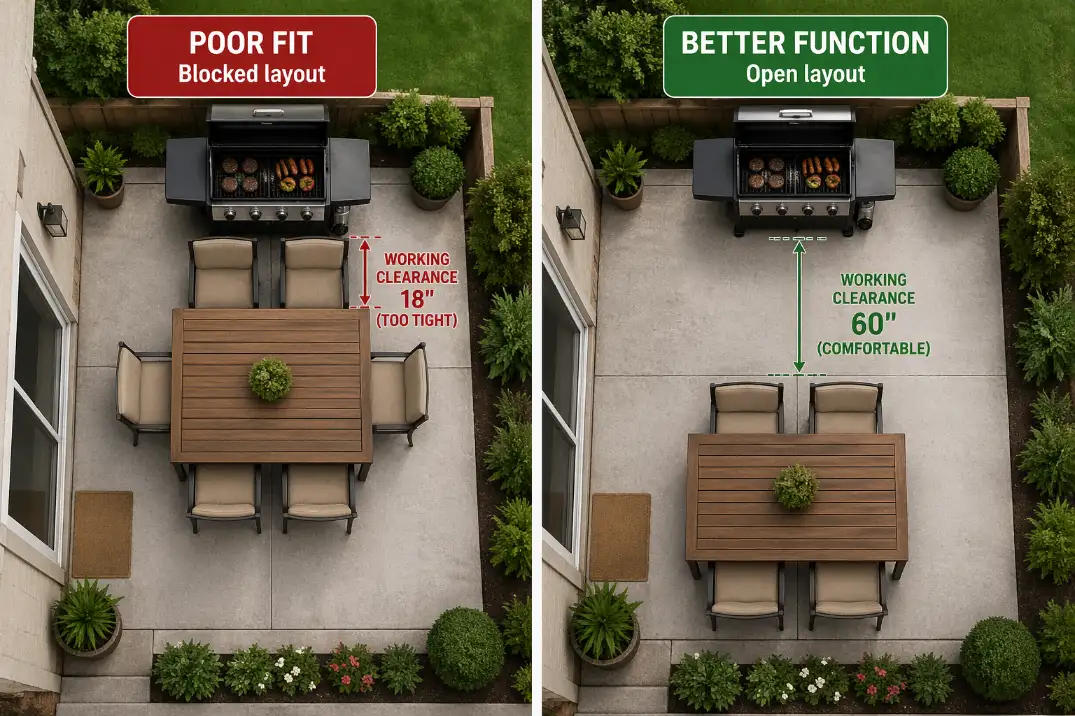
Best Grill Placement by Small Patio Size
The best layout depends less on décor and more on whether the patio has enough floor area to keep cooking, sitting, and passing from stacking on top of one another.
8 by 10 feet: reduce the dining footprint
An 8-by-10-foot patio usually cannot support a large grill and a full four-chair dining set comfortably. The better move is to place the grill on the most open edge and use a bistro table, narrow bench, or two-chair dining setup.
A bench against a wall can save 20 to 30 inches of repeated chair pullout compared with freestanding chairs on every side.
That is not a downgrade if the patio actually becomes usable. A smaller dining setup with a safe grill zone beats a full dining set that nobody can move around.
10 by 12 feet: offset the table instead of centering it
A 10-by-12-foot patio is often the sweet spot for a compact grill and a real dining area, but only if the table is not automatically centered. Place the grill along an open outer edge, then shift the table toward the house or toward the quieter side of the patio.
The center should remain a shared turning zone, not a decorative empty spot that disappears once chairs are pulled out. This is the same principle behind many patio furniture layout fixes that make a big difference: protect movement first, then decide what looks balanced.
12 by 12 feet: create one clean movement lane
A 12-by-12-foot patio gives more flexibility, but it can still fail if every route crosses the grill. The strongest layout usually has the grill on one edge, dining on another, and a clear movement lane between the door, table, and yard.
Do not use the extra space to add too many loose pieces. A prep cart, storage box, oversized chairs, and side tables can erase the advantage quickly.
Placements That Usually Fail on Small Patios
Some grill spots are tempting because they use leftover space. That does not make them good.
Directly beside the kitchen door
Near the kitchen is useful. Beside the door swing or slider track is not. A grill too close to the door can block traffic, send smoke indoors, and force people to step around the cook with plates or drinks in hand.
A better target is often close to the kitchen but offset from the direct walking path. Once the grill gets far from the door, everyday grilling feels less convenient, but crowding the doorway is the wrong fix.
Behind dining chairs
This is probably the most common small-patio failure. The layout looks fine with chairs pushed in, but once people sit down, the cook has no real working space. Anyone passing through the patio has to squeeze between chair backs and a hot grill.
That visible crowding is only the symptom. The underlying mechanism is overlapping clearance zones.
Under a low covered patio
A covered patio may feel like the obvious place to grill because it offers shade and rain protection. But low overhead cover, poor cross-ventilation, fabric shade panels, or nearby screens can turn a workable open-air location into a heat and smoke trap.
If the only grill spot is under a low cover or beside combustible surfaces, the better answer may be to move the grill off the patio rather than force the dining layout to adapt.
Jammed into a corner with no service access
A grill corner can work if the lid opens fully, the cook has standing room, and the grease tray or propane tank can be reached. It fails when the corner turns basic use into a shuffle.
If you have to move the dining table to change a tank, empty a grease tray, or clean behind the grill, the location is too tight.
Grill Type Changes the Best Placement
The word “grill” hides important differences. Fuel type affects smoke, heat, access, cooldown time, and whether a small patio is even the right place for that equipment.
| Grill type | Best small-patio placement | Main watch-out | When it makes sense |
|---|---|---|---|
| Gas grill | Open edge near, but not in, the kitchen path | Structure clearance and tank access | Most everyday patio cooking |
| Charcoal grill | Farthest practical point from seating and openings | Smoke, ash, sparks, longer cooldown | Open patios with good airflow |
| Pellet grill | Edge with airflow and safe outlet access | Smoke during long cooks | Low-and-slow cooking on roomier patios |
| Electric grill | Tight regulated patios where allowed | Outlet load and less traditional grilling | Condos, balconies, strict rules |
| Built-in grill | Only after testing the location for a season | Permanent placement mistakes | Larger planned patios or outdoor kitchens |
Charcoal is the type readers often underestimate. It may have a smaller footprint than a gas grill, but smoke, ash, sparks, and cooldown time can make it harder to live with near dining.
Electric grills are often overestimated in the opposite direction. They can solve some fuel-storage problems where allowed, but they do not magically fix a blocked walkway or cramped table.
Built-ins deserve the most caution. A built-in grill can look polished, but on a small patio it locks in smoke direction, traffic flow, prep space, and seating conflicts.
If you have not tested the placement through warm weather, rain, and normal dinner use, permanent construction is premature.
Many patio layout problems that make spaces hard to use come from fixing appliances or furniture before the movement pattern is proven.
How to Test the Layout Before You Commit
The fastest way to improve a small patio is to test real use, not the empty patio.
Tape the zones before moving heavy pieces
Use painter’s tape or cardboard to mark the grill footprint, open-lid area, chair pullout, and main walking lane. Do not mark the dining table with chairs pushed in. Pull them out 24 to 30 inches. Mark the cook position with at least 36 inches in front of the grill.
Then walk the sequence: kitchen to grill, grill to table, table to door, door to yard. If you have to turn sideways more than once, the layout is still too compressed.
Pro Tip: Test with a platter or sheet pan in your hands. A path that feels fine empty can feel too narrow when you are carrying hot food.
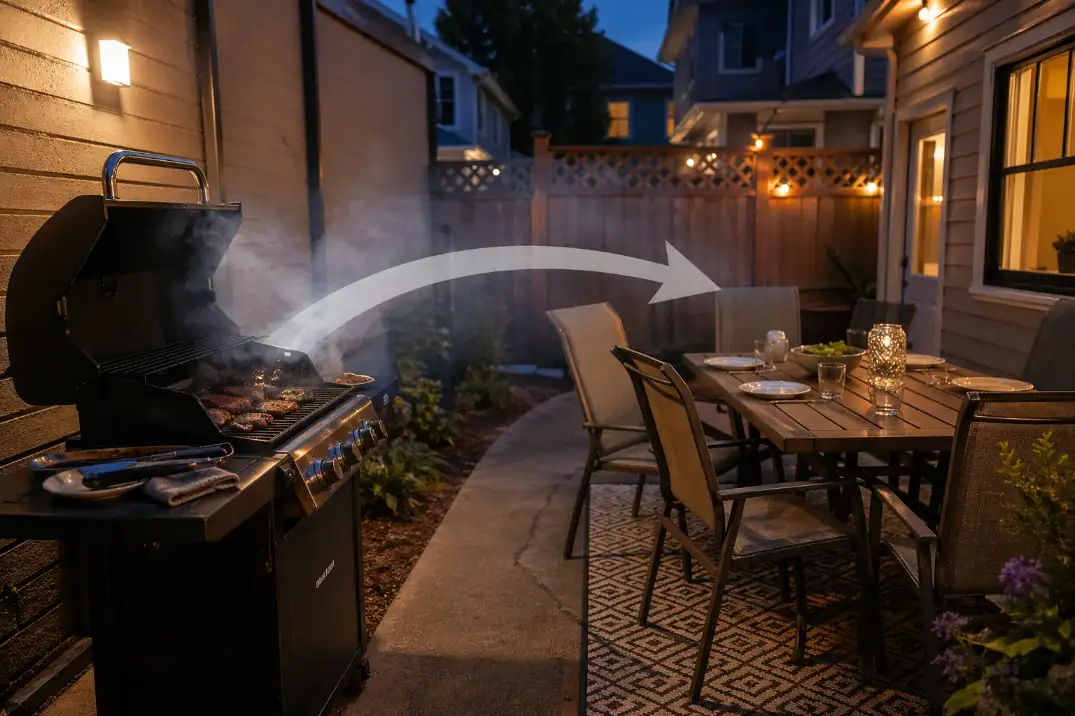
Watch smoke during the hour you actually cook
Smoke tests are more useful when they match your real schedule. Wind can shift between afternoon and evening, especially in coastal California, desert areas with late-day breezes, and open Midwest lots after weather fronts move through.
Watch one or two normal 15- to 20-minute cooks, not just a cold grill sitting in place. If smoke drifts toward the dining table more than half the time you cook, do not solve it with another chair shuffle. Move the grill path, table position, or fuel type.
Check cleanup and fuel access
A grill location is not successful if it only works while food is cooking. You still need to open the propane cabinet, remove the grease tray, brush grates, manage ash, or reach an outlet.
If those tasks require moving chairs every time, the patio will gradually stop functioning the way it was planned.
Small Fixes That Actually Help
The best fixes remove overlap. They do not add more objects.
Shift the grill to a perimeter edge. Turn a rectangular table so its narrow side faces the grill. Replace bulky dining chairs with slimmer ones. Use a bench against one wall if chair pullout is the main conflict. Add a small landing shelf within 2 to 3 feet of the grill if the cook has nowhere to set platters, but avoid carts that live permanently in the walkway.
A rug can make the dining area feel defined, but it will not fix unsafe placement. A privacy screen can reduce visual clutter, but it should not block airflow or sit too close to heat. If you are already fighting narrow clearances, adding decor often makes the patio worse.
This is where the obvious fix wastes time: buying a smaller table may help dining clearance, but it does not fix a grill that blocks the door, sits under a low cover, or sends smoke across the seats. If more than two clearance zones fail, the layout needs a new traffic pattern before it needs new furniture.
Quick Diagnostic Checklist
- Grill safety clearance follows the manufacturer’s instructions and local rules.
- Grill has at least 36 inches of clear working room in front.
- Dining chairs can pull out 24 to 30 inches without entering the cook zone.
- Main walking path stays close to 36 inches where possible and does not cross directly behind the cook.
- Smoke does not drift toward the table during most normal dinner-time cooks.
- Door swing, slider track, steps, and yard access stay clear.
- Fuel, grease, ash, or outlet access does not require moving the dining setup.
The Bottom Line
The best grill placement for a small patio with a dining area is usually on an open outer edge, offset from the table, with safety clearance handled first and at least 36 inches of practical cook space preserved. The dining area should adapt to the safe grill zone, not the other way around.
A small patio does not have to look perfectly symmetrical to work well. In fact, the best layout often looks slightly shifted: grill on the edge, table off-center, chairs given honest pullout room, and one clean path left open.
What matters is whether people can cook, sit, pass, and eat without competing for the same few feet of space.
For broader official safety guidance, see the U.S. Consumer Product Safety Commission.