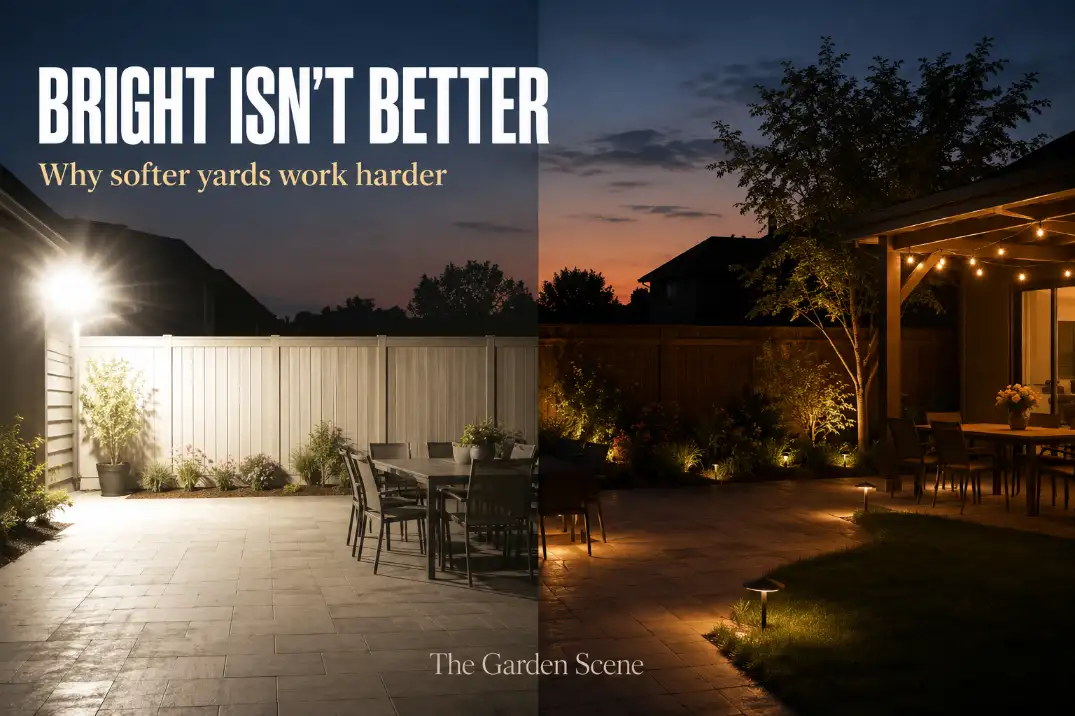
Backyard lighting works best when it follows one rule: light the task, hide the source, and leave the background dark. Overlighting usually starts when homeowners try to brighten the whole yard instead of making the important parts usable.
A safe path, a readable table surface, and a grill light do more than a bright fence, glowing lawn, or row of exposed bulbs.
Start with three checks. Can people see steps and route changes from at least 6 feet away? Can someone sit in the main chairs without seeing a bare bulb 10–15 feet away?
Is the patio surface brighter than the fence behind it? If the fence, shrubs, or neighbor-facing boundary are brighter than the places people walk, eat, or cook, the problem is not too little light.
It is light aimed at the wrong thing. Warm light around 2200K–3000K is usually enough for patios, while bright cool-white fixtures often make a backyard feel exposed instead of comfortable.
What Overlighting Really Means
Overlighting is not just “too many lights.” One high-output floodlight mounted on the house can overpower six low-voltage fixtures that are properly shielded and aimed downward.
The real problem is uncontrolled light: exposed bulbs, wide beam spread, fixtures pointed at eye level, and lights that stay on when the activity they support is over.
The symptom is glare; the mechanism is poor control
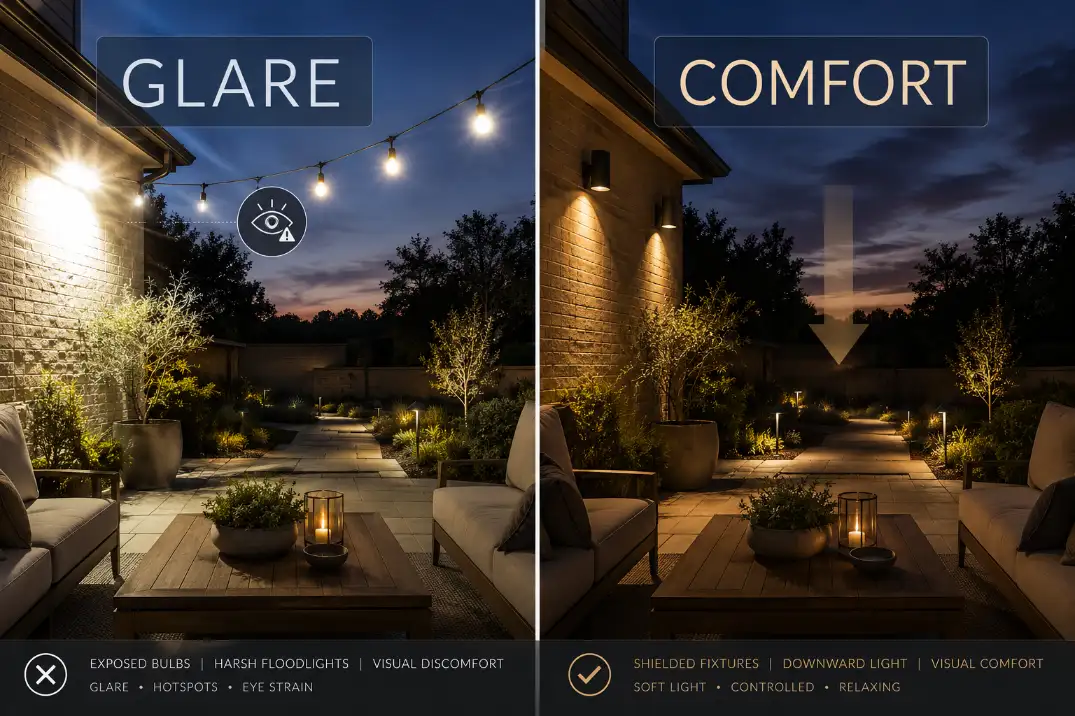
A backyard can look bright and still feel hard to use. Glare makes people turn away from the fixture, squint at the table, or avoid certain seats. That is a symptom. The mechanism is usually a visible light source or a beam crossing the normal sightline.
The most useful correction is often not adding softer lights nearby. It is replacing, shielding, dimming, or redirecting the harsh source first. A softer string-light layer will not fix a security floodlight that blasts across the patio all evening.
Some darkness is doing useful work
A well-lit backyard still has shadows. Dark lawn edges, quiet planting beds, and unlit fence sections help the patio feel calm and give the brighter areas shape. Trying to erase every dark patch makes the space feel flatter, not safer.
This is where many backyard lighting plans lose control. They start with a real need, such as a dark step or awkward path, then keep adding accents because the yard still has dark areas.
If the layout itself is confusing, compare the lighting issue with the broader patterns in Backyard Lighting Plans That Are Hard to Use before assuming more fixtures are the answer.
Light These Zones First, Then Stop and Recheck
The best lighting plan is not symmetrical. It is weighted toward the places where light changes safety, comfort, or use.
Walking routes and steps
The route from the house to the patio, grill, gate, stairs, or hot tub deserves the first layer of lighting.
On a simple straight walkway, path lights spaced about 6–10 feet apart are often enough, especially if they are staggered rather than lined up like runway lights.
Around curves, slopes, or uneven paving, spacing matters less than whether the next step or turn is obvious.
Steps need special attention. A low step light, shielded downlight, or fixture aimed across the tread is usually better than a bright light pointed outward. The goal is to show the edge, not flood the area.
If your route includes slopes, narrow turns, or uneven walkways, the same safety logic used in Path Lighting for Steps, Slopes, and Walkways applies here: mark changes before you decorate anything else.
Seating and dining
A lounge area needs lower light than most people expect. You need to see faces, chair edges, drinks, and the tabletop. You do not need every cushion, planter, and fence panel lit at the same level.
For dining, aim light at the table surface. A dimmable pendant under a covered patio, shaded wall sconce, low-output table lamp, or warm overhead string lights can work. Perimeter lights alone often create the wrong effect: bright edges with a dim table in the middle.
The more specific the activity, the more specific the light should be. A 6-foot dining table needs a controlled pool of light. A lounge chair needs soft side light. A whole patio does not need one uniform blanket of brightness.
Grill and prep areas
Grill lighting is task lighting, not mood lighting. It should be brighter than lounge lighting, but only where someone cooks.
A switched fixture, clip-on grill light, or focused downlight aimed at the cooking surface is usually better than raising the brightness of the entire patio.
People often overestimate what string lights can do near a grill. They create atmosphere, but they usually do not show whether food is browning, burning, or still undercooked. Treat grill light as a separate tool. Use it when needed, then turn it off.
The same zone-based thinking is useful when balancing cooking, eating, and relaxing areas; Patio Lighting Zones for Dining, Lounge, and Grill Areas goes deeper into that separation.
Fixture Choices That Prevent Overlighting
Fixtures should be chosen by job, not by style alone. The same fixture that works well in one zone can ruin another if it exposes the bulb or throws light too widely.
| Fixture type | Best use | Overlighting risk | Better rule |
|---|---|---|---|
| Path lights | Walkways, turns, garden routes | Runway effect from too many fixtures | Stagger and space by hazard, not symmetry |
| Step lights | Stairs, deck edges, level changes | Bright dots at eye level | Aim across or down onto the tread |
| String lights | Seating and dining mood | Exposed bulb glare | Use warm, dimmable, low-output bulbs |
| Floodlights | Temporary security or cleanup | Washes out the whole yard | Use motion, shielding, and narrow aim |
| Uplights | Trees or strong focal points | Every shrub becomes a spotlight | Light one feature, not the whole border |
| Sconces | Doors, patio edges, covered spaces | Eye-level glare | Choose shielded or downward-facing designs |
| Solar stakes | Low-stakes marking or testing | Weak, uneven, seasonal output | Use for accents, not critical steps |
Shielded fixtures beat brighter fixtures
A 100-lumen shielded path light can be more useful than a much brighter exposed bulb because the useful light lands on the walking surface.
The eye reacts strongly to visible light sources, especially when the surrounding yard is dark. That is why one exposed bulb can make a seating area feel uncomfortable even if the total light level is low.
If the patio already feels harsh, check for glare before buying anything else. Stand at the doorway, then sit in each main chair. If the bulb is visible from normal use positions, the fixture is probably part of the problem.
Patio Lighting Glare Mistakes is a useful follow-up when the light level seems reasonable but the patio still feels unpleasant.
Solar lights are useful, but not everywhere
Solar lights make sense for testing placement, marking low-risk garden edges, or adding temporary seasonal accents. They are less dependable for steps, grill prep, shaded side yards, and winter safety routes.
In northern states, shorter winter days and snow cover can reduce charging performance. In shaded backyards, solar stakes may look fine in June and fail by October. Use them where failure would be annoying, not dangerous. For critical movement areas, wired low-voltage lighting or a reliable hardwired fixture is usually the better choice.
Pro Tip: Use inexpensive solar lights for one week to test spacing and glare before committing to permanent low-voltage fixtures. Keep the locations that help movement and remove the ones that only brighten empty space.
Use Controls So Every Light Does Not Act Like a Main Light
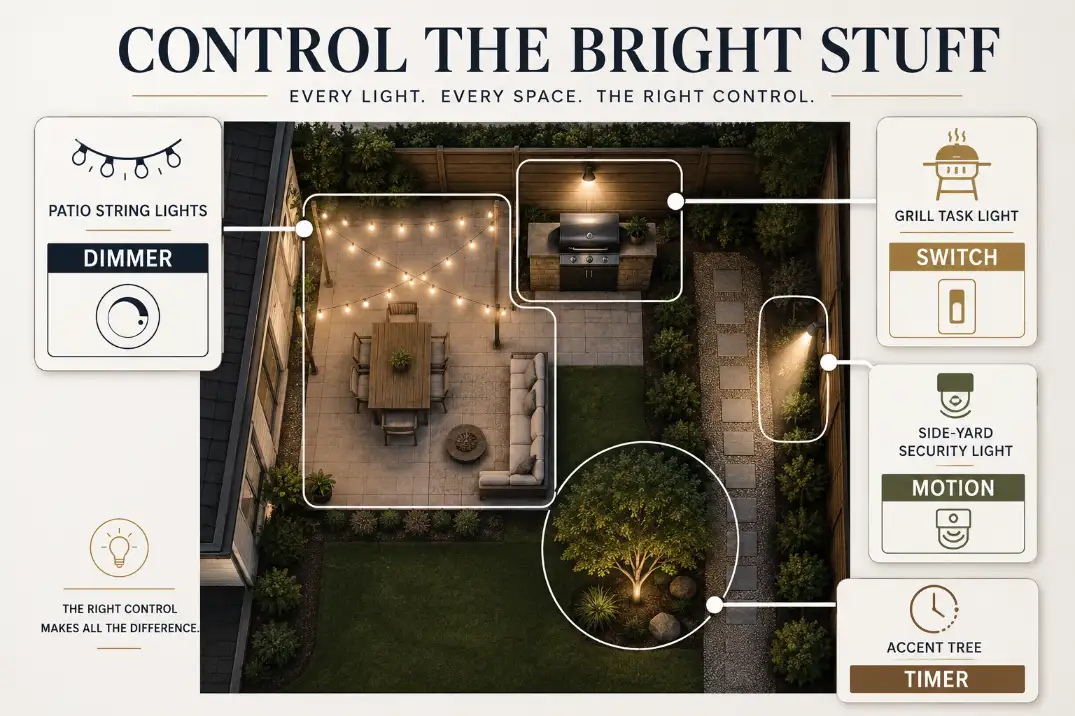
A backyard can have brighter lights without feeling overlit if those lights are controlled separately. The problem is wiring every fixture into one all-on setting.
Put temporary jobs on separate switches
Grill lights, cleanup lights, side-yard lights, trash-area lights, and security lights should not share the same control as patio mood lighting. If a light is needed for only 5–20 minutes at a time, it probably belongs on a separate switch, motion sensor, timer, or smart scene.
A dinner setting might use only 30–40% of the available lighting. Cleanup after guests leave may briefly need more. That range is normal. What feels wrong is forcing the cleanup level to stay on during dinner.
Use dimmers before adding more fixtures
Many patios are not missing lights. They are missing lower settings. Dimmable string lights, sconces, and pendants let the same zone shift from eating to conversation without adding another layer.
If one wall fixture is so bright that people stop using nearby lamps or string lights, change the bulb, add a dimmer if compatible, or replace the fixture with a shielded design. Adding more decorative light around an overpowering fixture usually makes the patio busier, not softer.
Check Spill, Reflection, and Neighbor Impact
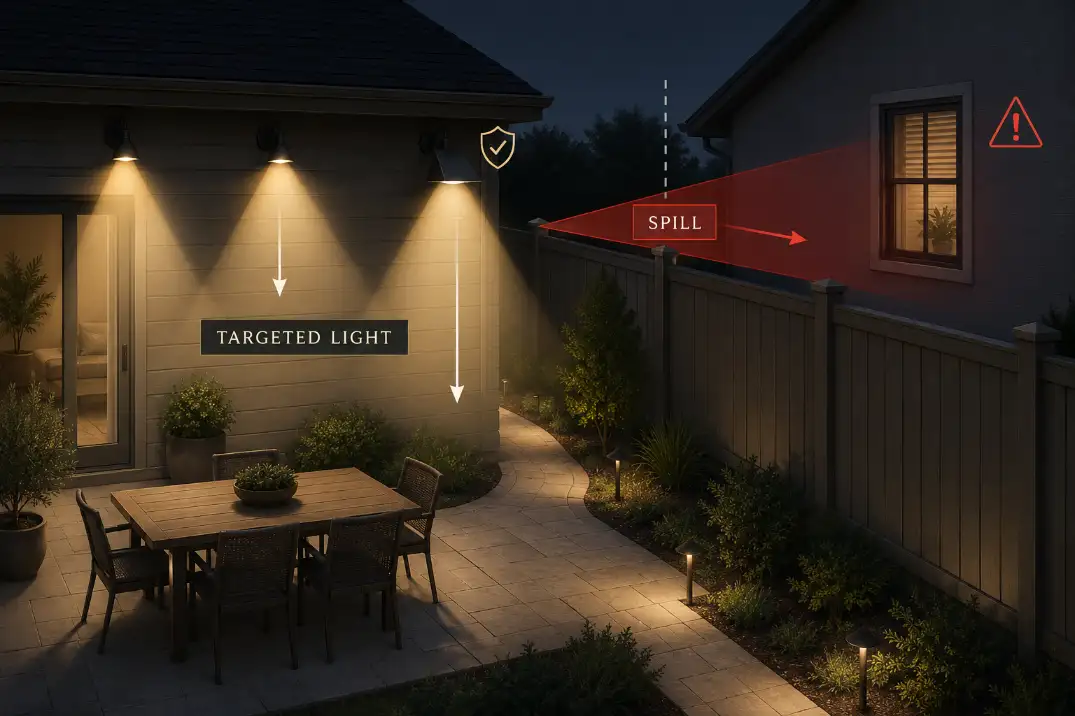
Overlighting is often easier to see from the edge of the yard than from the patio itself. After dark, stand near the fence line and look back toward the house. If you can see exposed bulbs, bright beams, or a glowing wall of light, your neighbors may see them too.
Use the fence-line test
A good fence-line test has three parts. First, look for bare bulbs. Second, check whether beams cross the property line. Third, look toward likely window heights, including second-story windows. Uplights and wall-mounted floods are the most common offenders because they throw light beyond the actual activity area.
The fix is usually simple: lower the output, aim the beam down, add a shield, change the fixture, or put that light on motion instead of leaving it on continuously.
Reflective surfaces make lights feel brighter
Pale concrete, wet pavers, pool water, glossy tropical plants, snow, and light-colored walls all bounce light back harder than dark mulch or weathered wood. A setup that feels subtle over dark gravel in Arizona may feel harsh on a Florida pool patio after rain. In northern states, snow can make path lights and wall lights feel much brighter than they did in fall.
This is one reason to install in passes. Add the safety layer first, live with it for 7–14 nights, then decide whether accents are needed. A yard that looks slightly dim on night one may feel just right after your eyes adjust.
When Adding More Lights Stops Making Sense
The routine advice to “layer outdoor lighting” is useful only until every layer is competing. Path lights, string lights, sconces, uplights, lanterns, and step lights can all be correct individually and still become too much together.
Replace harsh fixtures instead of balancing them
If one floodlight or exposed wall fixture dominates the yard, do not try to balance it with more lights. Replace or control the harsh fixture first. A motion-activated, shielded light with a narrower beam can still help with security without washing out the whole patio.
This is the point where the standard fix stops working: when new fixtures no longer solve a specific problem. If the path is clear, the table is readable, the grill has task light, and people can sit without glare, the next fixture needs a very strong reason.
Light dark corners only when they affect use
A dark corner is not automatically a problem. It matters if it hides a gate, step, seating edge, trip hazard, or awkward transition. Otherwise, it may simply be background darkness doing its job.
If one corner feels disconnected, use a low shielded marker or soft downlight rather than a bright flood. The goal is to reveal the edge, not spotlight the whole corner.
When a dark corner is really a layout issue, not a fixture issue, Dim Backyard Corners and Layout Problems can help separate the two.
Installation Boundaries That Matter
Most cosmetic lighting choices are forgiving. Electrical choices are not. Solar lights, rechargeable lamps, and some low-voltage kits are DIY-friendly, but anything involving new exterior boxes, hardwired line-voltage fixtures, or uncertain outdoor wiring should be handled by a qualified electrician.
Use outdoor-rated fixtures, weather-safe connections, and GFCI-protected outlets for plug-in lighting. Avoid indoor extension cords, improvised connections, or cable runs where people walk, mow, or drag furniture.
Low-voltage systems are safer to handle than line voltage, but they still need the right transformer size, protected wire runs, and connections that can handle moisture.
This does not need to make the project complicated. It just sets the boundary: experiment with placement freely, but do not improvise permanent electrical work.
Quick Diagnostic Checklist
Use this before adding another fixture:
- Are step edges visible from at least 6 feet away?
- Can someone sit in every main chair without seeing a bare bulb?
- Is the table, grill, or path brighter than the fence?
- Are bright task lights controlled separately from mood lights?
- Does any beam cross the property line or hit a neighbor-facing window?
- Do reflective surfaces make the patio feel brighter after rain or snow?
- Does each accent light improve orientation, depth, or a view from indoors?
Questions People Usually Ask
How bright should backyard lights be?
Use the lowest output that solves the job. Path lights often work in the 50–150 lumen range per fixture, while grill and cleanup lights may need more because they are task lights. The key is aim and control. A lower-output fixture in the right place usually beats a brighter fixture aimed broadly.
Are string lights bad for backyard lighting?
No. String lights can work well over dining or seating areas when they are warm, dimmable, and not directly in the seated sightline. They become a problem when the bulbs are too bright, too dense, or used as the only light source for steps and task areas.
Should backyard lights stay on all night?
Most should not. Patio, dining, grill, and accent lights should usually run only when the space is being used. Security or access lights can use motion sensors, timers, or lower-output fixtures. Leaving decorative lights on all night often adds spill and glare without improving usability.
What is the fastest way to make existing backyard lights feel softer?
Start by hiding visible bulbs, lowering bulb output, warming the color temperature, and separating bright task lights from mood lights. In many yards, changing one harsh fixture does more than adding three new soft ones.
Backyard lighting should make the space easier to use, not louder at night. Light the route, the steps, the table, and the grill first.
Shield the source, keep brighter lights on separate controls, and let the unused edges stay quiet. The strongest lighting plans do not brighten everything. They make the right places visible and leave the rest alone.
For broader guidance on responsible outdoor lighting, see DarkSky International.
For practical placement troubleshooting when outdoor lights miss the useful surface, see Outdoor Lighting Placement Problems.