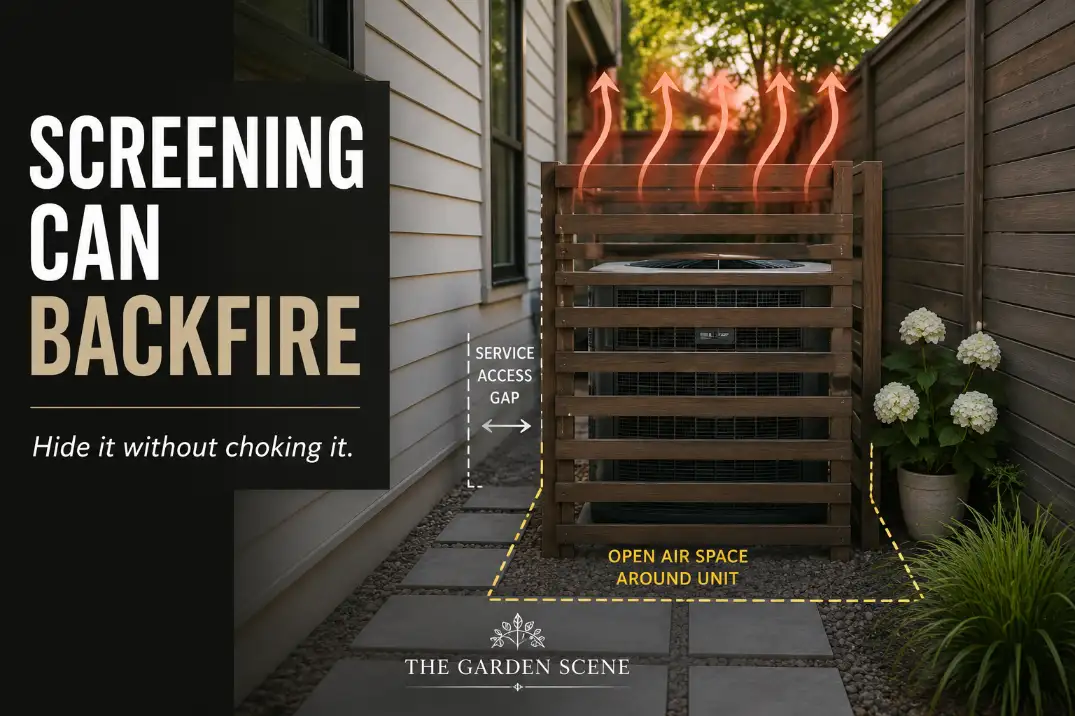
Screening a side-yard AC unit is not mainly a decorating problem. It is a heat-rejection problem that happens to be visible from the patio, driveway, or gate. The screen only works if the condenser can still pull in outdoor air, throw hot air away from the unit, and leave enough room for service.
Start with three checks before choosing any panel or plant: leave about 18–24 inches of open side clearance where possible, keep roughly 5 feet open above a top-discharge fan, and preserve about 30 inches of working space at the service panel.
The manufacturer’s installation manual always overrides general rules, but those numbers are a useful first filter.
If the unit already sounds louder on 85–95°F days, runs longer than usual, or makes the side yard feel hotter after a 15–20 minute cycle, the screen may not need to be taller. It may need to be farther away.
The Screen Can Backfire
The manual beats the landscape plan
A screen can look clean from the viewing side and still be wrong from the equipment side. That is the key difference between hiding an AC unit and screening it correctly.
The outdoor condenser is not passive clutter. It is working equipment. It pulls air through the coil, rejects heat, and needs room for a technician to reach the electrical panel, refrigerant lines, coil, and fan assembly.
If the screen blocks any of those jobs, the design has crossed from cosmetic improvement into mechanical interference.
General clearance advice is only a starting point. Some units need more open space than others, and side-discharge equipment does not behave exactly like a standard top-discharge condenser.
Before building a fixed screen, check the clearance diagram in the unit’s installation guide. If the screen violates that, the landscaping plan loses.
This is where many side-yard projects go sideways. The homeowner thinks the problem is visibility, but the real constraint is function.
That same issue appears in broader utility layouts, where a narrow side yard has to work before it looks finished. The principle is similar to Side Yard Utility Corridor Ideas: assign the working job first, then soften the view.
What people usually misread first
The most common misread is judging the screen from the patio or street only. From that angle, a full-height slat panel may seem perfect. From the condenser’s side, it may be too close, too solid, too tall, or too hard to remove.
A better first test is simple: stand beside the unit and ask what the screen blocks. If it blocks only the sightline, it may work. If it blocks side intake, top discharge, service access, or drainage around the pad, it is solving the wrong problem.
A screen should interrupt the view, not wrap the machine like a box.
Airflow Comes First
Match the screen to the fan direction
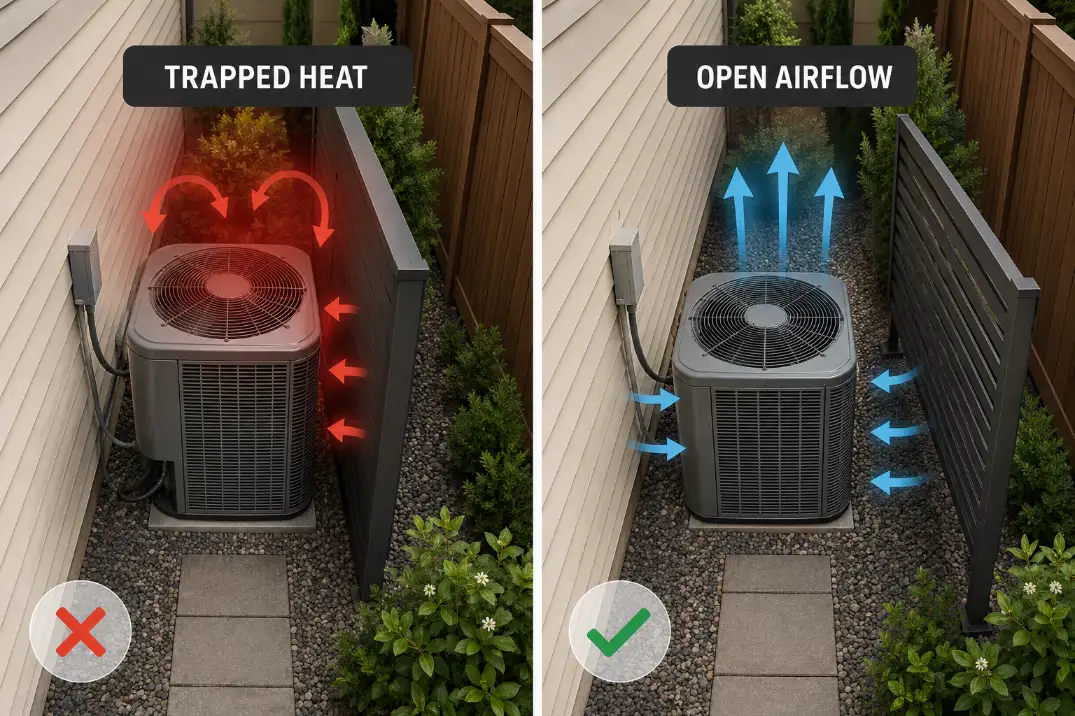
Most traditional residential condensers discharge hot air upward. For those units, the top opening matters as much as the side opening. A solid shelf, low cover, dense vine canopy, or decorative cap above the fan can push hot air back toward the coil.
Some mini-split and side-discharge heat pump outdoor units move air horizontally instead. Those need a clear path in the direction the fan blows. A screen placed directly in front of a side-discharge fan can be worse than a screen beside a top-discharge condenser because it blocks the exhaust path more directly.
The design rule is simple: follow the air, not the shape of the machine. If the screen catches the air the unit is trying to throw away, the screen is in the wrong place.
Symptoms are not the mechanism
A louder unit, hotter corridor, or longer cooling cycle is a symptom. The mechanism is restricted heat rejection.
That distinction matters because it prevents a weak fix. Adding more plants, a taller screen, or artificial greenery may hide the unit better while making the condenser work harder.
Shade can help the surrounding area feel less harsh, but shade does not compensate for trapped air. In hot climates, especially Arizona-style dry heat or humid Florida afternoons, trapped discharge air can punish the unit faster than the visual improvement is worth.
Pro Tip: If hot fan discharge hits the underside of a cover, vine mass, shelf, or nearby solid panel, treat that as a failed screen even if the side view looks open.
Keep Service Access Clear
A screen should not make maintenance harder
A screen that has to be dismantled every time the AC is serviced is too fussy for a working side yard. Annual maintenance, coil cleaning, electrical checks, and refrigerant diagnostics all need physical access.
The service side should usually have about 30 inches of clear working room, and more is better when the side yard allows it.
A technician may need to remove panels, kneel, place tools, or reach the disconnect safely. If the screen turns that into a tight squeeze, routine service becomes easier to delay.
That is not a small issue. A dirty coil, blocked airflow, or ignored service panel can slowly turn a visual upgrade into a performance problem. If the screen makes service annoying, it will eventually make maintenance easier to postpone.
Side-yard designs often fail this way: they protect the view while punishing maintenance. The same slow-compounding pattern shows up in Narrow Side Yard Problems That Get Worse Over Time, where small access compromises become bigger usability problems.
Hinged and offset screens beat fixed boxes
A fixed box around the condenser feels tidy, but it is usually the least forgiving option. It traps leaves, limits cleaning, blocks access, and often sits too close to the coil.
A better screen is offset from the unit and placed only where it blocks the real view. If the condenser is visible from the patio, one angled or L-shaped panel may be enough.
If it is visible from the street, a partial front screen with open sides may work better than a full enclosure. A hinged panel can help, but only if the swing path stays clear and the hardware can handle weather.
| Side-yard condition | Best screen move | Avoid |
|---|---|---|
| 4–5 ft narrow corridor | Use one offset vented panel along the view line | Boxing the unit on three sides |
| Unit near a gate | Keep the gate swing and service side open | A hinged screen that blocks the walkway |
| Visible from patio only | Screen the patio-facing angle | Enclosing sides nobody sees |
| Dead-end heat pocket | Leave more open air and reduce screen height | Tall solid panels that trap discharge |
| Heat pump used in winter | Keep airflow and defrost clearance open | Full covers or tight winter enclosures |
| Dense planting screen | Use disciplined plants set back from the coil | Fast shrubs that grow into clearance |
Heat in Narrow Side Yards
Tight corridors make heat recirculation more likely
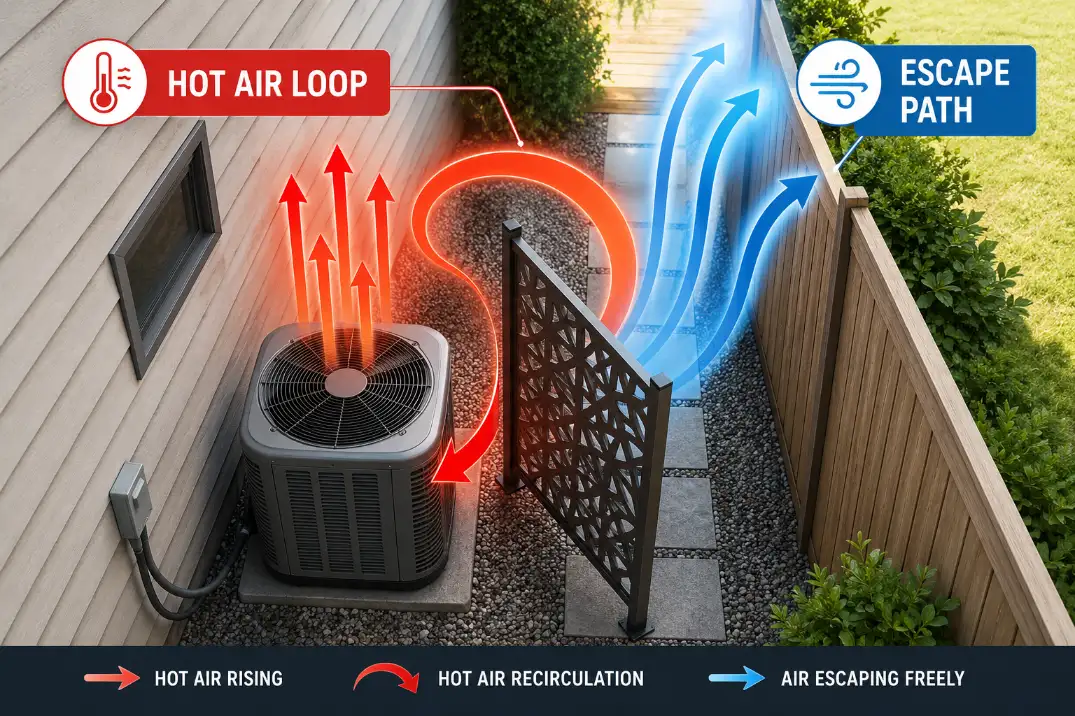
A narrow side yard changes the airflow problem. In an open yard, hot discharge air has room to disperse. In a 4–6 foot corridor between a house wall and fence, heat can bounce around the space and move back toward the condenser.
That is why a screen that works in an open backyard may be wrong in a side yard. Same panel, different air behavior. The tighter the corridor, the less room the unit has to recover from a poor screen choice.
The risk becomes more obvious during long cooling periods. On a mild 75°F day, a slightly crowded screen may not reveal much. On a 95°F afternoon, the unit has less margin. If the area around the condenser stays noticeably hotter after a 30-minute run, the screen and corridor may be holding heat instead of letting it escape.
The 30-minute heat pocket test
Before installing a screen permanently, mark the proposed panel location with stakes, cardboard, or painter’s tape. Run the AC during a hot part of the day for about 30 minutes.
Then check three things. Does the air around the condenser feel more stagnant than the rest of the side yard? Does hot discharge seem to curl back toward the unit instead of rising away? Are leaves, cottonwood fluff, grass clippings, or mulch collecting where the screen meets the pad?
You are not measuring exact performance here. You are catching a bad layout before it becomes permanent. If the temporary screen makes the corridor feel like a heat pocket, increase the distance, lower the screen, add open gaps, or move the screen farther down the view line.
Drainage belongs in the same decision. If water stands near the unit for more than 24 hours after normal rainfall, the issue is no longer just screening.
It is also a pad and drainage problem. For tight side yards where equipment, runoff, and access overlap, Side Yard Ideas for Drainage and Access supports the bigger layout decision.
Screen Without Crowding
Use the view line, not the unit outline
The smartest AC screen does not trace the condenser’s shape. It interrupts the view line.
First, identify where the unit is actually visible from: the patio door, driveway, gate, sidewalk, kitchen window, or neighbor-facing side.
Then screen that angle only. In many yards, one 3–5 foot wide panel placed several feet away from the unit hides enough without crowding the machine.
This also prevents privacy-screen creep. One panel looks good, so another gets added. Then a corner return. Then a taller section. By the end, the condenser is hidden, but it is also boxed into the tightest part of the yard.
If the side yard needs broader privacy, do not make the AC screen carry the whole job. A low, vented equipment screen near the unit and separate planting farther down the corridor is often safer than one heavy barrier around the condenser.
That logic fits with Best Side Yard Privacy Ideas for Tight Spaces, where privacy is created by controlling sightlines rather than closing the whole space.
Good screening materials leave gaps
Vented slats, open lattice, perforated metal, and spaced boards are usually safer than solid panels. The exact material matters less than open area, distance from the coil, and whether heat can escape.
Avoid tightly woven artificial greenery directly against the condenser. It looks soft, but once dust, pollen, cottonwood fluff, or leaves collect in it, it can behave more like a filter than a screen. In spring-heavy regions or Midwest yards with seasonal debris, that buildup can happen within a few weeks.
A screen that starts 4–6 inches above grade can help leaves blow through instead of collecting at the base. Keep mulch, gravel, plant stems, and storage items away from the coil. The condenser should not have to breathe through landscape debris.
Pro Tip: If the screen only works when plants are freshly trimmed, assume the real clearance will be worse by midsummer.
Let the Unit Breathe
When a routine screen stops making sense
A standard decorative screen stops making sense when the side yard is already too narrow to preserve airflow and service access at the same time. If the condenser sits in a 3-foot squeeze between the house and fence, a screen may not belong beside the unit at all.
The better move may be screening the view from farther away: near the gate, patio edge, or fence return. That may feel less satisfying because the screen is no longer wrapped around the equipment, but it usually works better.
This is the point where homeowners commonly overbuild. They try to solve an equipment-location problem with a prettier enclosure.
But if the unit is already boxed by the house and fence, another vertical surface is not a design upgrade. It is a mechanical penalty.
Planting can fail the same way. Shrubs that grow 12–24 inches per season can erase clearance quietly. A plant that looks harmless in April may brush the coil by August.
For narrow planting ideas that do not crowd utility zones, Narrow Planters and Privacy Screens for Side Yards can help shape the surrounding area, but the condenser itself still needs its own breathing room.
Heat pumps need winter breathing room too
If the outdoor unit is part of a heat pump system, it may run in winter as well as summer. That changes the screening decision in northern states where snow, ice, and drifting leaves are part of the yard.
A full winter cover or tight enclosure can interfere with operation if the unit needs to pull air and defrost itself. Snow protection should not become an airflow cage.
Keep the discharge path open, avoid panels that collect snow against the coil, and make sure any seasonal screen can be moved or opened for service.
The safer rule is simple: if the outdoor unit runs, it breathes. Do not treat it like stored equipment.
A sharper decision checklist
Use this before choosing a screen:
- Leave about 18–24 inches of open side clearance where possible, and follow the manufacturer’s required clearance.
- Keep the top discharge open, with no shelf, dense vine canopy, or solid cover above the fan.
- Preserve roughly 30 inches of technician access at the service panel.
- Screen the main view line instead of enclosing all sides.
- Avoid solid panels facing the coil in a narrow corridor.
- Recheck plant growth after 60–90 days during the growing season.
- Treat standing water after 24 hours as a drainage issue, not a screen issue.
The condenser is not yard clutter. It is working equipment in a visible place. Screening fails when it treats the unit like something to hide at any cost. It succeeds when it gives the machine air first, service access second, and decoration third.
That order may feel less exciting during design, but it is what keeps the screen from becoming the problem it was supposed to solve.
For broader official HVAC guidance, see the Department of Energy air conditioner maintenance page.