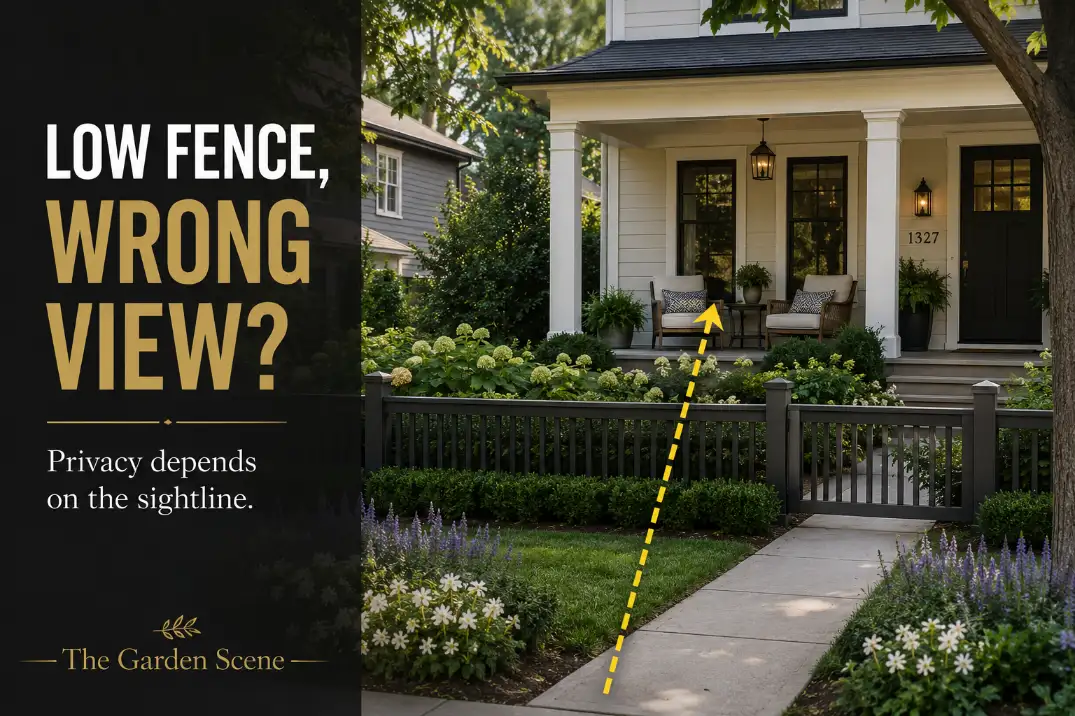
A low fence works for front yard privacy when it interrupts the view people actually use, not when it simply marks the property line. The first checks are simple: where does someone stand, what do they see at seated height, and does the fence leave a clear 30–42 inch eye-level gap above, beside, or through the planting?
A 3-foot fence can feel private near a porch if shrubs sit behind it, while a 5-foot fence can still fail if the open view runs diagonally from the sidewalk or driveway.
The difference from a full privacy fence matters. A low fence is not supposed to erase the house from the street. It should soften exposure, slow the eye, and protect the entry or seating zone without making the front yard look defensive. The most common mistake is treating height as the fix. In front yards, placement usually matters more than adding another foot.
Why Low Fences Work
They stop the eye before plants mature
A low fence gives instant structure while shrubs, grasses, and small trees grow into their screening role. That matters because many front yard privacy plantings take 2–4 growing seasons to close in. The fence handles the first visual stop; the plants provide softness, depth, and seasonal coverage.
The useful height range is usually 30–48 inches. Below about 24 inches, the fence often reads more like edging than privacy. Above about 48 inches, many front yards start to feel boxed in, and local fence rules may become stricter.
This is why low fence design belongs closer to Front Yard Landscaping for Privacy than to backyard enclosure thinking.
They work best against moving views
Low fences are strongest against sidewalk, street, and passing-car views because those views are brief and moving. They are weaker against fixed views, such as a neighbor’s second-floor window or a direct porch-to-porch line. In those cases, the fence needs help from shrubs, ornamental grasses, or a small tree canopy.
A useful field test is to sit where you want privacy for 5 minutes during the busiest part of the day. If the uncomfortable view comes from walkers or cars, a low fence can help. If it comes from a fixed elevated window, the fence alone is not the main solution.
Low Fence Styles That Actually Affect Privacy
Picket and rail fences need plant support
A picket, rail, or open metal fence can make a front yard feel finished, but it does not create much privacy by itself. Its main value is boundary cue, not visual blockage.
That can still be useful if people cut across the lawn or the yard needs a clearer edge, but it should not be confused with real screening.
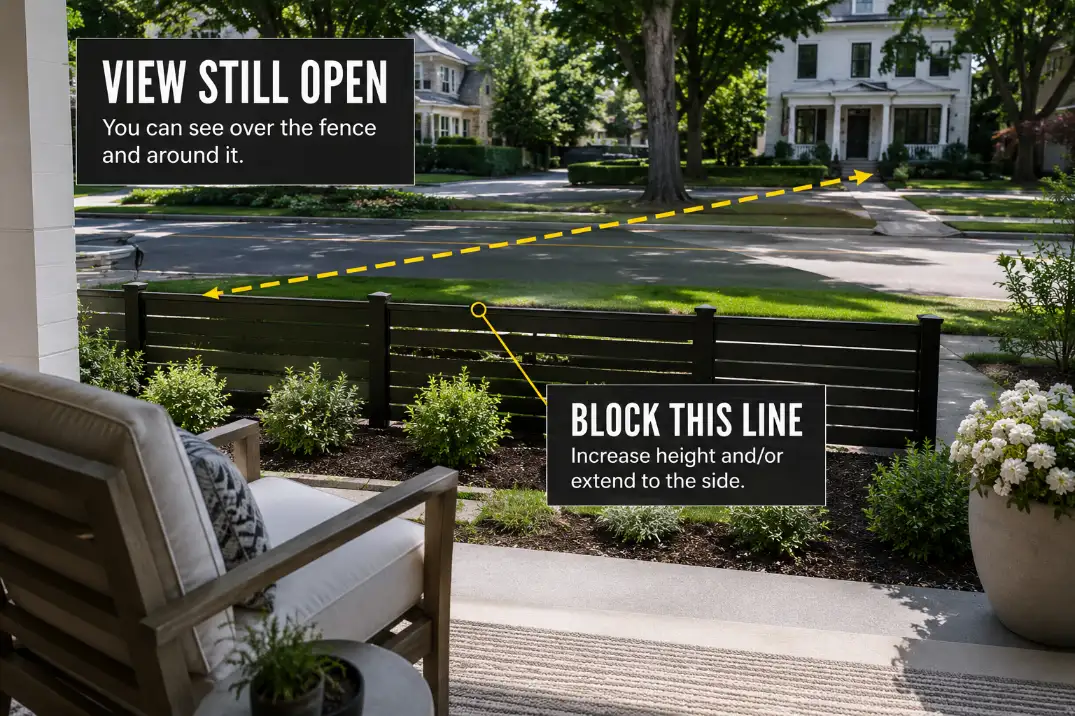
Homeowners often give the fence style too much credit and the planting layer too little. A 36-inch open fence may look charming from the street, but privacy comes from what sits behind it. If the gaps line up with the porch or front window, the fence is mostly decorative.
Horizontal slats and semi-solid panels cut stronger views
Horizontal slats, tighter pickets, and low solid panels interrupt views more aggressively. They are useful when the front porch, sitting area, or entry is clearly exposed. The tradeoff is curb appeal: the stronger the panel, the easier it is for the front yard to feel closed off.
For a suburban front yard, the best privacy fence is often not the tallest or most solid option. It is the one that blocks the specific view while still letting the home feel visible, cared for, and approachable.
That same balance is central to Front Yard Privacy That Still Looks Welcoming.
Best Spots for Low Fences
Near the porch, not automatically at the sidewalk
The strongest placement is often closer to the area being protected. A short fence set near the porch, entry walk, or small sitting area can block the view at the exact angle that matters. A fence pushed all the way to the sidewalk may look logical, but it can leave a wide open diagonal across the yard.
The property edge feels official, but privacy is created at the sightline, not at the lot line. For broader yard-wide screening strategy, Landscaping for Privacy is a better frame than thinking only in fence sections.
The small front yard rule
In a small front yard, a long fence run can make the space feel narrower before it makes it feel private. A short, offset fence near the porch or entry often works better than fencing the whole sidewalk edge. The goal is to protect the pause point, not shrink the whole lawn into a front enclosure.
Keep the main walking route at least 36 inches wide; 42–48 inches feels better near a primary entry. If the fence, shrubs, and mulch edge turn the approach into a channel, the design has solved one problem by creating another.
Pro Tip: Before installing, place two stakes and a string line at the planned fence height, then view it from the sidewalk, driveway, and porch. This 15-minute test usually reveals whether the fence is blocking the real view or only decorating the edge.
Low Fence With Shrubs
The shrub layer does the privacy work
The fence gives the line; shrubs give the mass. For most front yards, shrubs in the 3–6 foot mature height range are the practical privacy layer.
They should not be planted so tightly that they become a wall in year one. A 24–36 inch spacing may work for compact shrubs, while larger evergreen or flowering shrubs often need 4–6 feet between centers.
The mistake is buying plants for their nursery size instead of their mature width. A shrub that looks perfect in a 3-gallon container may double or triple in width after 3–5 years. That future width is what decides whether the fence looks intentional or crowded.
If the goal is privacy without a hard fenced-in look, the planting should overlap the fence line rather than sit in a rigid row. This matters especially when comparing a low fence plan with Front Yard Landscaping for Privacy Without Fences, because the best design may use the fence only where planting alone would take too long.
Choose plants by job, not category
Evergreen shrubs are best where year-round screening matters. Flowering shrubs soften the fence and improve curb appeal, but many lose privacy value in winter.
Ornamental grasses are useful for seasonal filtering, not full blockage. Small trees help with angled or upper views that a low fence cannot reach.
Near sidewalks and driveways, plant tolerance matters as much as appearance. Reflected heat, road salt, compacted soil, and snow piles can all weaken a planting strip. If the fence only works when the plants are perfect, the layout is too fragile.
Low Fence With Grasses
Grasses soften the fence but do not screen all year
Ornamental grasses are excellent for motion, seasonal softness, and partial screening. They are less reliable as year-round privacy unless the climate and species keep enough structure through winter.
In northern states, many grasses collapse under snow or look cut back for 2–4 months. In dry regions, they can look clean and architectural longer, but they still need seasonal maintenance.
Use grasses where privacy can be lighter: along a walkway, near a driveway edge, or in front of a porch where shrubs would feel too heavy. A mature height of 30–48 inches often pairs well with a low fence because the grass plume rises above the rail without blocking the whole yard.
The healthier comparison is density, not height
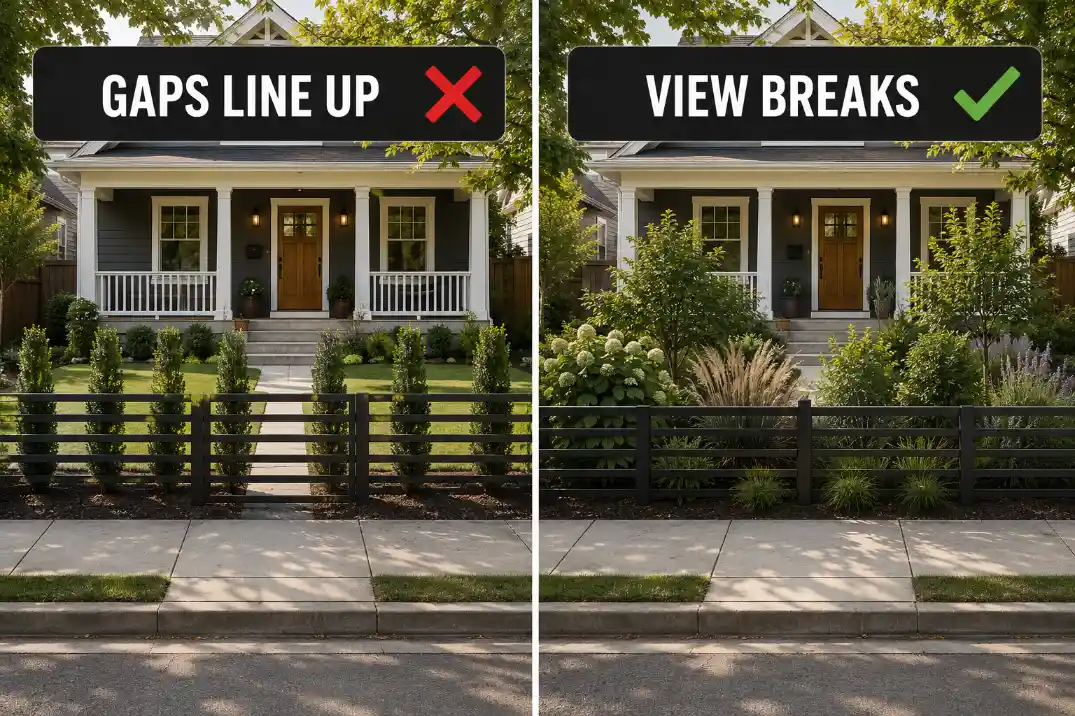
A healthy grass-and-fence layer looks semi-transparent but broken. A failing one creates vertical stripes where every gap lines up. If you can stand at the sidewalk and see a clean path between every clump, the layout is not screening; it is just repeating plants.
Low Fence With Trees, Planters, and Raised Screening
Use trees for angled and elevated views
Small trees help when the problem is not only at ground level. The fence can block the lower part of a sidewalk view, while a small ornamental or evergreen tree interrupts the upper or diagonal line.
This is useful near porch corners, side-facing windows, and wide front lawns where shrubs alone would need to become too bulky.
The tree should not sit directly in the driveway sight triangle or too close to the walk. A canopy that begins around 5–6 feet high can preserve visibility while adding privacy above the fence.
Dense branching from the ground up may be better near a porch, but it can become a problem near driveways and corners.
Planters help where digging is limited
Planters work well near porches, paved entries, narrow walkways, and HOA-sensitive areas where permanent changes are difficult. They can raise planting height by 12–24 inches without building a taller fence.
That extra elevation can make a compact shrub or grass read as a stronger screen.
Planters are not a cure-all. They dry out faster than in-ground beds, especially in hot Arizona-style conditions or reflected heat near pavement.
In summer, small containers may need water every 1–2 days, while larger planters with 18–24 inches of soil depth hold moisture longer and support healthier roots.
Entry and Walkway Privacy
Protect the pause point
The front entry needs privacy at the place where people pause: unlocking the door, sitting on a small bench, or standing under the porch light. A low fence across the whole yard may do little if the exposed moment is a 6-foot-wide angle near the steps.
For entry privacy, short fence returns often work better than long straight runs. A return that turns 3–6 feet toward the house can block a side view while keeping the front open.
This makes the entry feel protected without making guests feel like they are approaching a closed compound.
When the entry is the main issue, Front Entry Privacy Without Feeling Closed Off is the more precise design problem: the screen must protect the pause point while still guiding people to the door.
Keep the walk readable
A low fence should never make the front walk feel squeezed. For everyday comfort, keep the clear walking route at least 36 inches wide; 42–48 inches feels better near a main entry or where two people often pass.
If the fence, shrubs, and mulch edge reduce the walk to a narrow channel, the privacy gain is not worth the daily friction.
The symptom is a walkway that feels crowded. The mechanism is usually not the fence alone; it is the combined width of fence posts, plant spread, mulch mounding, and seasonal growth. Fixing only one piece often disappoints.
Driveway Edge Privacy
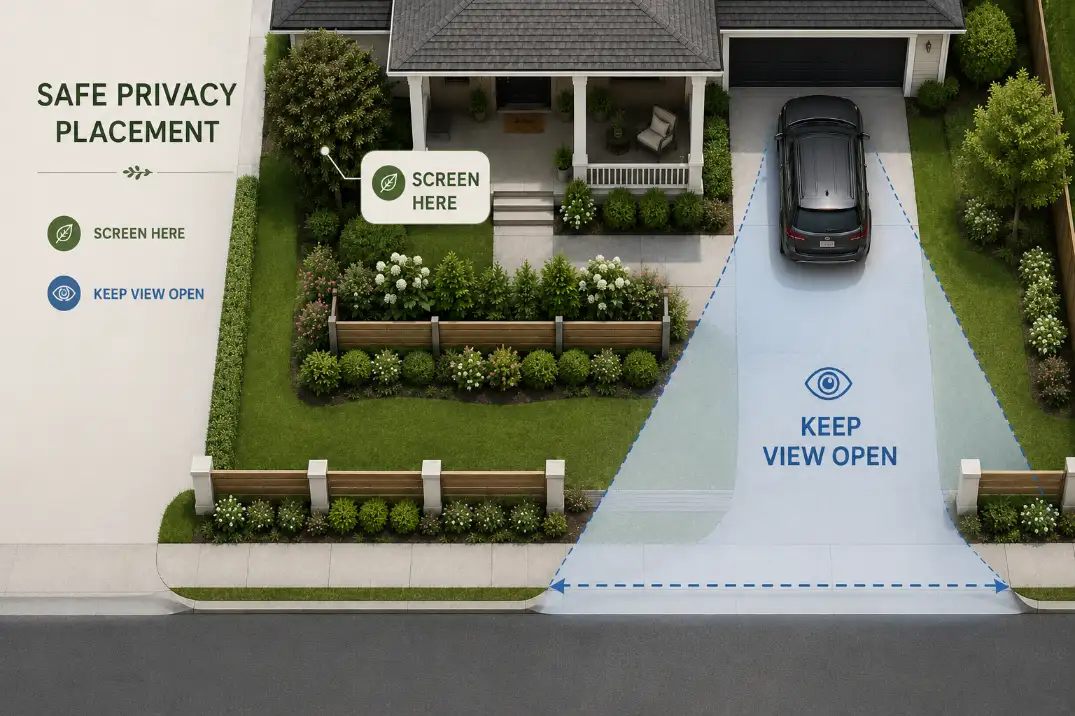
Keep visibility open near cars
Driveway edges are where low fence landscaping most often crosses from attractive to risky. A fence can screen the front yard from the street, but it should not block drivers backing out or pedestrians approaching the driveway.
Keep dense planting lower and more open near the first 10–15 feet of driveway visibility, especially where the sidewalk crosses the drive.
This is the point where a routine privacy fix stops making sense. If the fence needs dense shrubs right at the driveway mouth to work, the layout is probably wrong. Move the privacy layer inward, shorten the fence run, or use lighter grasses instead of solid evergreen mass.
Before choosing a fence style, compare whether the front yard actually needs a low decorative screen or a more substantial enclosure. Privacy Fence Options for Suburban Homes helps separate a front-yard soft screen from a true privacy fence decision.
Street View Screening
Break the view, do not erase the house
Street view screening is about interruption. The fence and planting should make the porch, seating area, or front windows less exposed, while still allowing the home to feel visible and cared for. If the entire front facade disappears, curb appeal usually drops.
A healthier screen has varied depth: fence in front, shrubs offset behind, and one small vertical accent where the eye needs to stop. A failing screen has one flat line that either does too little or looks too defensive.
| Front Yard Area | Better Low Fence Move | What Usually Fails | Practical Threshold |
|---|---|---|---|
| Porch seating | Fence plus shrubs at the main sightline | Fence only at property line | Block seated view at about 36–42 inches |
| Entry walk | Short fence return near pause point | Long fence with no entry logic | Keep 36–48 inches of clear walk |
| Driveway edge | Lower, open planting near visibility zone | Dense shrubs at driveway mouth | Preserve the first 10–15 feet of view |
| Street-facing lawn | Staggered shrubs behind fence | One straight hedge line | Avoid aligned gaps from sidewalk view |
| Small front yard | Short offset screen near exposure point | Full frontage fence that shrinks the yard | Protect the view without narrowing the entry |
HOA and Sightline Checks
Check rules before choosing the final height
Many US neighborhoods limit front yard fence height, materials, color, or setback. A 36-inch fence may be allowed where a 48-inch fence needs approval. Some areas also treat corner lots, driveway approaches, and front setbacks differently.
The rule problem is not only whether a fence is allowed; it is whether the fence plus plants creates a visibility issue.
Approval timing is easy to underestimate. HOA review, city permits, or neighbor-facing revisions can add 2–6 weeks before installation. If the design depends on a custom fence, confirm the rules before ordering materials.
For yards where rules, plant limits, and visibility overlap, Front Yard Design Constraints: HOA, Plants, and Setbacks is often the smarter planning step before committing to a layout.
Separate legal height from practical privacy
A fence can be legal and still ineffective. It can also be visually acceptable and still create a bad driveway condition. Treat code or HOA approval as the minimum filter, not the design answer.
Pro Tip: Photograph the proposed fence line from the driver’s seat, the sidewalk, and the porch. Those three views catch more privacy and visibility problems than a flat plan alone.
Low Fence Mistakes
Confusing a boundary cue with privacy
A 12–24 inch decorative border can signal “do not walk here,” but it rarely creates privacy. A 30–48 inch low fence begins to interrupt seated and street-level views. A 5–6 foot planting layer is usually what creates real eye-level privacy.
Those three jobs should not be blended together. If the goal is to stop people from cutting across the lawn, a low border may be enough. If the goal is to make porch seating feel less exposed, the fence needs height, placement, and planting depth.
Treating every side as equally exposed
The most exposed view usually comes from one or two angles, not the whole street. Screening every edge evenly wastes money and can make the yard feel smaller. Start with the strongest view into the porch, entry, or front window, then decide whether the rest needs only planting rhythm.
Choosing a design that needs constant correction
A low fence plan should still make sense 2–5 years after installation. If the shrubs must be clipped every few weeks to keep the walkway open, or grasses must be tied back to keep the entry usable, the design is asking maintenance to solve a layout problem.
If the front yard has already become too dense or closed-off, Front Yard Privacy Mistakes That Hurt Curb Appeal is the more relevant repair lens.
Simple Fence Layouts
The short porch screen
Use a 6–12 foot low fence section near the porch or front sitting area, with shrubs behind it. This works when the exposure is local and the rest of the yard can stay open. Avoid it when the privacy problem is actually a broad street-facing window or a second-floor view.
The entry return
Run a low fence along part of the entry approach, then turn it slightly toward the house. This protects the pause point without making the door hard to find. Avoid it on very narrow walks unless the clear path still stays at least 36 inches wide.
The driveway-aware offset
Place the fence and shrubs away from the driveway mouth, leaving the visibility zone open. This layout is usually better than trying to screen the entire driveway edge. It is the right choice when safety and privacy compete.
The layered street screen
Use a low fence as the front line, then stagger shrubs, grasses, and one small tree behind it. This is the best choice when the street view is broad but the home still needs to look welcoming.
Quick Checklist Before You Build
- Sit at the porch or entry for 5 minutes and identify the strongest view into the space.
- Test the planned fence height with stakes before ordering materials.
- Keep main walks at least 36 inches clear, preferably 42–48 inches near the entry.
- Avoid dense shrubs in the first 10–15 feet of driveway visibility.
- Choose plants by mature width, not nursery size.
- Confirm HOA, setback, and front fence height rules before installation.
- Use the fence to stop the eye, not to hide the whole house.
Final Takeaway
Low fence landscaping works best when it is selective. The strongest front yard privacy usually comes from a short fence placed at the real sightline, backed by shrubs, grasses, or small trees that break the view without closing the yard.
The weakest designs chase height, follow the property line blindly, or create a dense front barrier that solves privacy while damaging daily use and curb appeal.
For broader official guidance, see the University of Florida IFAS Extension landscape design guide.