Last updated: June 18, 2026
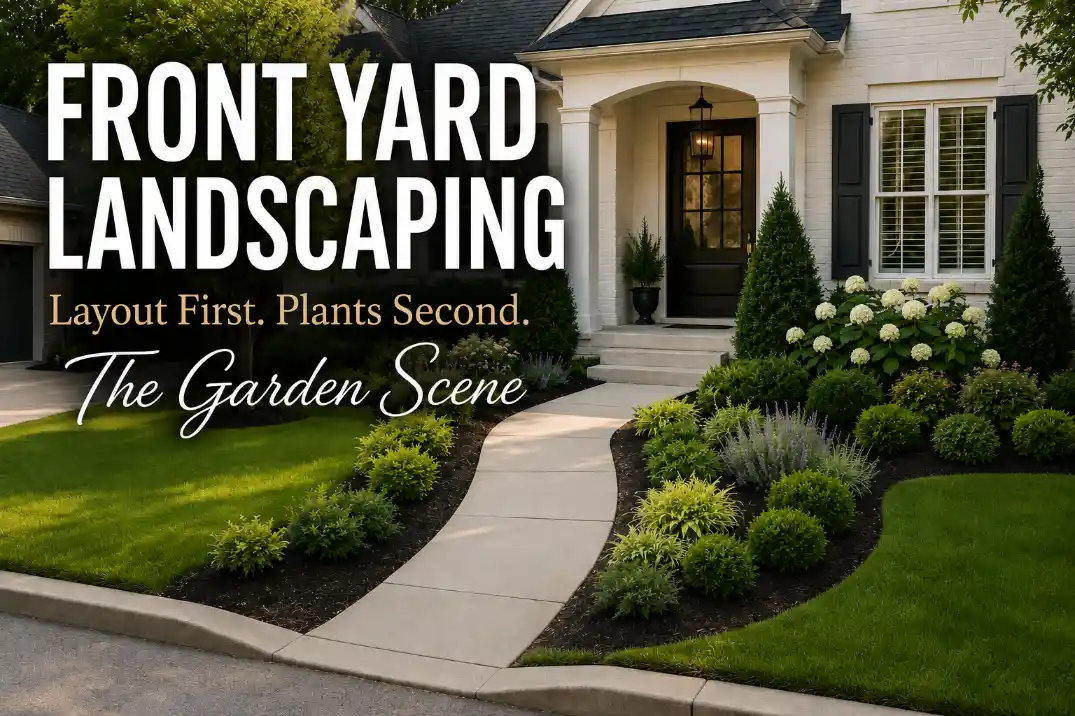
Front yard landscaping works best when it starts with structure, not plant shopping.
The first checks should be practical: can people read the path to the front door from 20–30 feet away, does rain drain out within 24 hours, and will the plants still fit when they reach mature size?
A main path should stay at least 36 inches wide, while 42–48 inches usually feels better near the entry. Mulch should usually stay around 2–3 inches deep, and most foundation beds need about 8–12 inches of workable soil if shrubs are expected to establish well.
That is what separates a front yard from a general garden. A backyard can hide weak circulation because it is private. A front yard cannot.
If the entry feels vague, shrubs crowd the windows, mulch keeps washing over the walk, or the same plants need pruning every 4–6 weeks in season, the issue is usually not style. It is the wrong order of decisions showing up as maintenance.
Best first move: clarify the route to the front door first, then fix drainage, then choose anchor plants by mature size. Most front yard landscaping mistakes happen when plants, mulch, or decor are added before access and water movement are solved.
What Front Yard Landscaping Needs to Do First
A good front yard has four jobs at once: guide people to the entrance, frame the house, fit the site conditions, and stay maintainable from the street. Curb appeal is the result of those decisions working together. It is not the first step.
The entry should read before the planting does
The driveway, sidewalk, porch, mailbox, and front door create the real framework of the yard. Plants should support that structure, not compete with it.
If guests step through mulch, drift across grass, or hesitate at the driveway, the yard is already telling you where the layout is weak.
Homes where the driveway dominates the front view often need route clarity more than more flowers. That is where Front Yard Design for Driveway and Front Door Access becomes the more useful supporting read than another generic landscaping list.
The house sets the scale
A low ranch, narrow townhouse, wide suburban home, and two-story colonial do not want the same planting pattern. One of the most common mistakes is borrowing a front yard look from a house with completely different proportions.
A 3-foot-deep foundation bed usually allows only one row of planting. A 5–7 foot bed gives you enough room for low edging, mid-height shrubs, and air between plants and siding. That difference often matters more than adding more plant species.
Empty space is often doing real work
Many homeowners overestimate how much of the front yard needs to be filled. Open lawn, gravel, or mulch is not automatically wasted space. It often makes the house feel calmer and the entry easier to read.
A small front yard especially benefits from breathing room, which is one reason Small Front Yard Design Ideas That Feel Spacious is such a natural companion to this pillar page.
Front Yard Landscaping Ideas That Usually Work
The strongest ideas are not the fanciest ones. They are the ones that solve a visible front yard problem without creating a long-term maintenance trap.
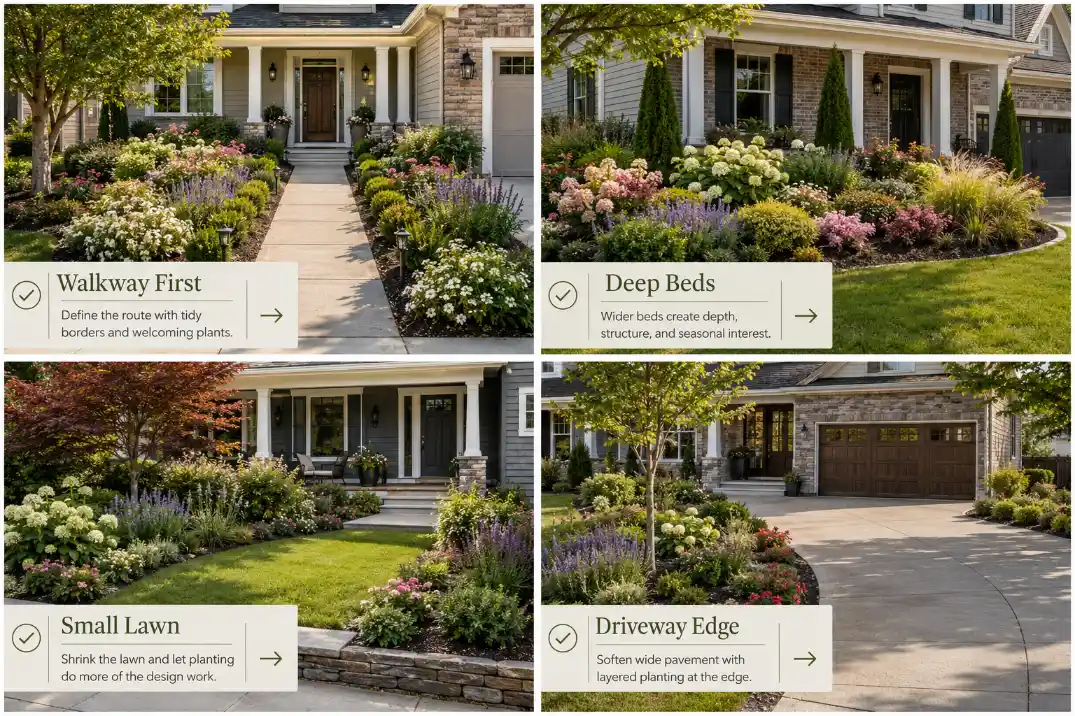
Walkway-first front yard
This is one of the most reliable ideas because it fixes the most visible mistake first: unclear access. The path becomes the lead element, and the planting supports it rather than wandering around it.
This works especially well when the front door feels visually lost from the street or driveway. If the route itself is the core problem, Front Yard Walkway Ideas That Feel Inviting helps extend that logic without turning the whole yard into a hardscape project.
Deeper foundation beds instead of thin strips
Thin beds often look skimpy because they cannot support mature plants. A deeper bed lets you layer the planting and reduce the flat line between house and lawn.
This idea is especially effective for wide blank facades or front walls that need more visual weight. It makes less sense where the yard is extremely tight, utilities interrupt the bed, or the side access route is already narrow.
Small lawn with stronger borders
A front lawn does not have to fill every open area. A smaller, cleaner lawn framed by better-shaped planting beds often looks more intentional and is easier to mow.
This is a strong middle-ground solution when you still want some green openness but do not want the front yard to feel empty or high maintenance.
Driveway-edge planting
Large driveways can visually swallow the front yard. A band of structured planting, lower shrubs, or repeated grasses along one edge can soften that hard surface without creating a crowded entry.
This works best when it restores balance rather than building a wall. The goal is to soften the driveway, not hide it so aggressively that access feels pinched.
Measure Before You Buy Anything
This is where a lot of front yard projects either become efficient or start wasting money. It is very easy to buy the right-looking plant for the wrong spot.
Measure the path, not just the yard
A front walkway that narrows below 30 inches almost always feels tighter than expected. Thirty-six inches can work, but 42–48 inches tends to feel much better near steps, porch landings, or the main entry.
Also pay attention to where people already walk. If a shortcut through lawn or mulch forms within a few days, that route is often more truthful than the plan on paper.
Measure sun in hours, not in guesses
“Sunny” is not specific enough. Full sun means at least 6 hours of direct light. Part shade usually means 3–6 hours. West-facing heat, reflected concrete heat, and bright afternoon exposure can be more punishing than a simple label suggests.
That is why Choosing Front Yard Plants for Blazing Afternoon Sun matters more than a generic plant roundup if the front of the house heats up late in the day.
Measure drainage after real rain
Do not judge drainage from a sprinkler cycle. Judge it after a real rain. Puddles that remain more than 24 hours, sticky soil that lingers for several days, or mulch that repeatedly migrates onto the sidewalk are the decision-useful signals.
If the problem starts near the house, Front Yard Water Pooling Near House Causes is a better next step than adding tougher plants and hoping they solve a grading issue.
Measure the soil resistance and bed depth
Push a screwdriver or soil probe into the bed after watering. If it stops hard in the top 4–6 inches, compaction is already part of the planting problem. For most shrubs and perennials, 8–12 inches of workable soil is a useful baseline.
Pro Tip: If the yard only looks convincing right after a fresh mulch refresh, the real issue is usually the underlying structure, not the mulch color.
Four Lower-Maintenance Front Yard Ideas
A front yard can absolutely look good with less work, but only if “low maintenance” is treated as a design logic instead of a slogan.
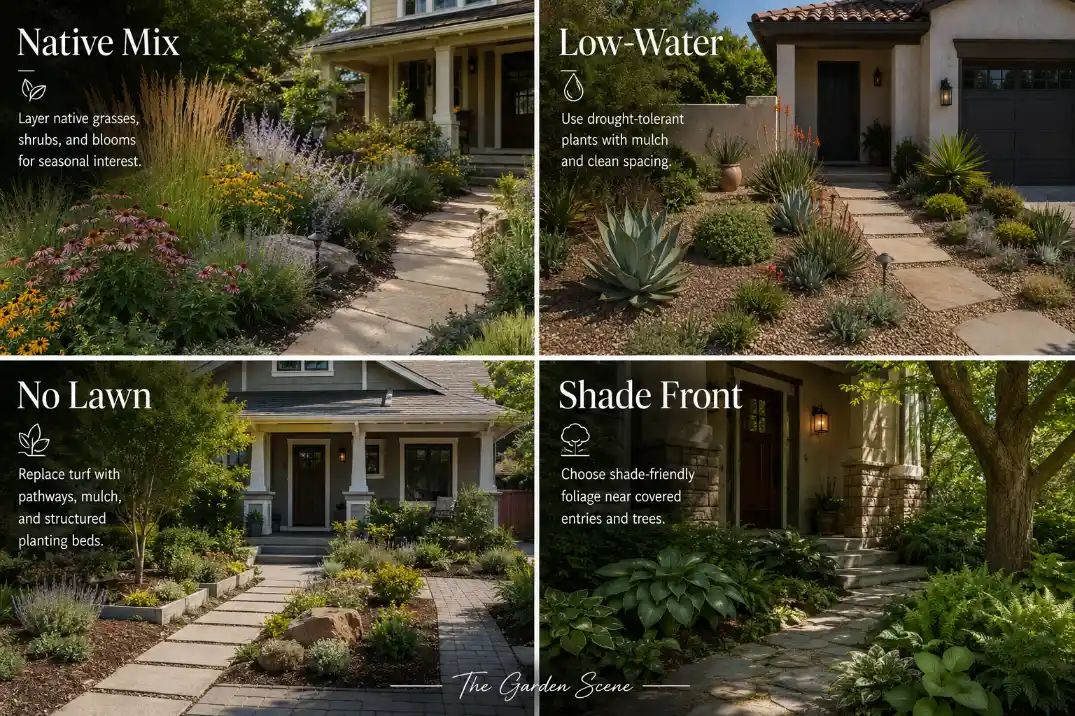
Native plant front yard
A native front yard can reduce long-term strain because the plants are better aligned with regional conditions. But “native” is not a style. It still needs structure, spacing, repetition, and a clear edge.
If you want that direction without the yard looking loose or unmanaged, Front Yard Landscaping Ideas Using Native Plants helps bridge the gap between ecology and curb appeal.
Low-water front yard
This is often the right move in dry climates, on restricted irrigation budgets, or where the front yard is simply too exposed to keep thirsty plants happy. The mistake is assuming low-water means no-care.
Low-water front yards still need weed control, spacing, establishment watering, and a plan for reflected heat. Low-Water Front Yard Landscaping Practical Solutions That Last becomes especially relevant when the goal is durability, not just a desert look.
No-lawn front yard
A lawn-free front yard can be one of the smartest choices where grass repeatedly fails from shade, slope, water restriction, or narrow awkward geometry.
But it still needs hierarchy: a readable path, anchor plants, controlled ground layer, and a surface that looks intentional.
If the yard is moving away from turf entirely, Front Yard Garden Design Without Lawn is the best follow-up because it solves the structure question, not just the planting question.
Shade-friendly front yard
A front yard under trees or on the shaded side of the house usually fails when homeowners keep trying to force sun-loving plants or perfect turf into the wrong microclimate.
Shade-friendly front landscaping often works better when the lawn is reduced, the bed lines are cleaned up, and plant texture does more of the work than flower color.
How to Choose Between These Ideas
The visible symptom is not always the underlying problem. A front yard that feels flat does not automatically need more flowers. A front yard that feels messy does not automatically need more mulch.
| If your front yard feels… | Start with… | Do not start with… |
|---|---|---|
| Flat | Deeper beds and stronger anchor plants | Random annual color |
| Crowded | Removing or spacing plants | Adding more shrubs |
| Messy | Sharper edges and clearer routes | Fresh mulch alone |
| Exposed | Targeted screening at key views | A full hedge wall |
| Dry or hot | Plant suitability and irrigation logic | Thirsty seasonal planting |
| Wet | Drainage and grading checks | New plant purchases |
| Too much work | Simpler beds and fewer plant types | Decorative add-ons |
One useful pattern here is that the better starting point is usually less glamorous than the homeowner expects. The more structural the problem, the less likely a cosmetic fix will hold.
Where to Spend First If the Budget Is Limited
A front yard does not need a full redesign to improve. It needs spending in the right order.
Start with path clarity and edge cleanup
These are usually the most underrated upgrades. If the path is readable and the bed edges are clean, the whole yard starts looking more settled, even before new plants go in.
Then pay for durable structure
That means anchor plants, bed reshaping, basic soil correction, and in some cases drainage. Those are the improvements that continue to matter after the first season.
Spend later on seasonal color and decor
Seasonal flowers, containers, and decorative accents can help, but they should support a front yard that already makes sense.
| Budget level | Best first move | Skip for now |
|---|---|---|
| $0–$250 | Cleanup, edge sharpening, simple pruning, route clarity | A mixed cart of impulse plants |
| $250–$750 | Mulch, a few anchor shrubs, entry containers | Complicated hardscape |
| $750–$2,500 | Bed reshaping, deeper planting zones, drip improvements | A full-theme makeover |
| $2,500+ | Drainage correction, walkway upgrades, structural planting | Decor-first upgrades |
If you are building confidence and need a simpler starting point, Simple Front Yard Landscaping for Beginners is the natural internal step down from this pillar page.
Four Front Yard Ideas for Harder Conditions
Some front yards are not just “plain” or “outdated.” They are genuinely constrained by slope, exposure, traffic, or visibility. Those yards need a more targeted idea set.
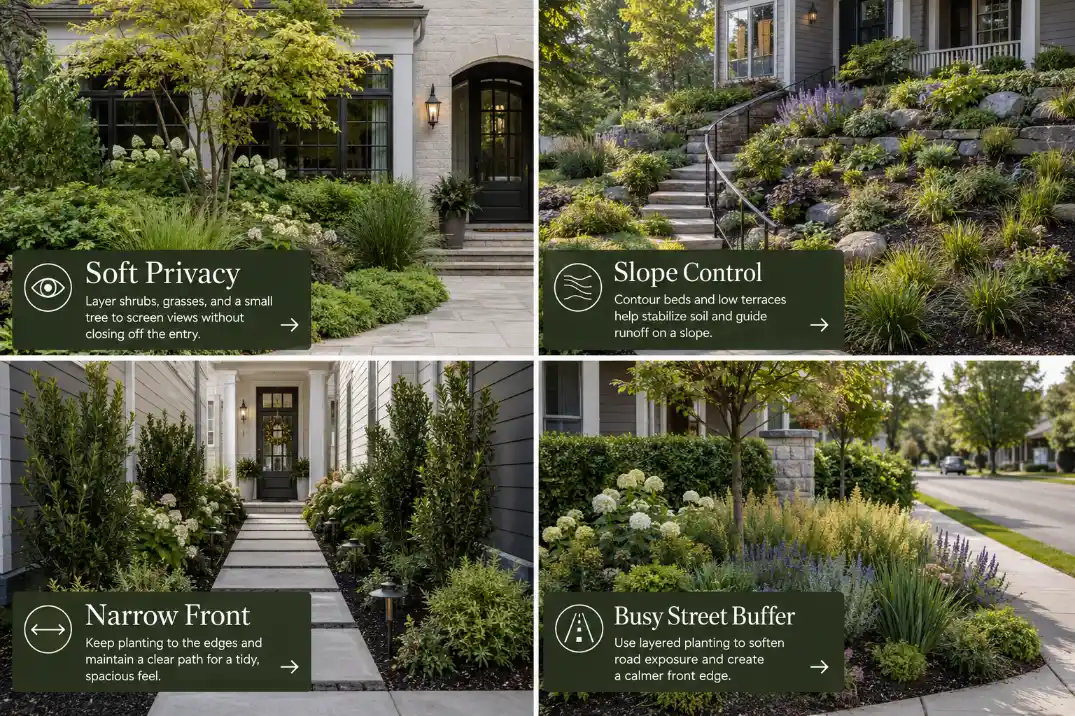
Soft privacy at the entry
This works when the problem is not the whole street but a specific sightline: a window close to a sidewalk, a porch exposed to parked cars, or a front room facing headlights.
A 3–5 foot layered planting zone often does more than a solid hedge. Front Yard Landscaping for Privacy Without Fences helps when privacy matters but the house still needs to feel welcoming from the street.
Slope control with planting and contour logic
A sloped front yard should never be treated as a flat yard with extra mulch. Water control comes first. On mild slopes, contour-friendly bed lines, deeper-rooted plants, and stable mulch may be enough. On steeper slopes, terracing, stone, or grading intervention becomes more realistic.
If the slope itself is the main condition, Front Yard Landscaping Ideas for Sloped Yards is the more specific cluster page to use.
Narrow-front restraint
A narrow front yard does not improve with more variety. It improves with one clear route, fewer bed interruptions, repeated plant masses, and less decorative clutter.
This is one of the places where discipline beats creativity. The yard should feel resolved, not busy.
Busy-street buffering
A front yard on a high-traffic street needs selective screening, not total shutdown. Dust, headlights, passing pedestrians, and noise all shape the plant strategy.
That often means tougher plants at the street edge, a softer transition toward the house, and enough openness near the entry that the yard still feels safe and readable.
How to Choose Front Yard Plants for Busy Streets can help narrow the plant list when exposure, dust, and traffic are part of the site.
Use Plants in Layers, Not in Crowds
A lot of front yards become harder to manage because the planting is treated like a shopping list instead of a composition.
Start with anchors
Anchor plants provide shape and visual weight. They should still make sense from the street when nothing is blooming.
Good anchors include compact evergreens, structured shrubs, small ornamental trees, durable native shrubs, or repeated grasses. The best choice depends on climate, house style, and mature size.
Add the middle layer carefully
This is where most of the shrub mass usually lives. It should support the house and path, not push into them.
A mid-layer plant that looks perfect in a nursery pot can become a constant pruning problem if its mature spread is ignored. If the tag says 4 feet wide, treat that as a real design number, not a suggestion.
Use the ground layer to finish, not to sprawl
Groundcovers and low edging plants should soften the edge, not creep into the walkway or swallow the lawn. If layering itself is the main weak point, How to Layer Plants in Front Yard Landscaping goes deeper into the structure.
What People Usually Get Wrong
This is where time and money often start leaking out of the project.
Flowers are usually the accent, not the structure
Seasonal flowers are useful, but they are not what makes a front yard hold together from the street, in winter, or after a storm. If the underlying layout is weak, flowers only delay the diagnosis.
If flower beds keep needing replanting after every season, the problem may be exposure, irrigation, bed structure, or plant choice rather than effort. Front Yard Flower Beds Keep Needing Replanting is the more specific troubleshooting path.
Constant pruning usually means the plant choice is wrong
Pruning is normal. Needing to cut the same shrubs every month during the growing season is usually a sign the plant is too large for the space or doing the wrong job.
This is where How to Design a Low Maintenance Front Yard becomes more valuable than simply buying “easy-care” plants. Maintenance level comes from the system, not the label.
Mulch is not a drainage fix
If mulch keeps washing onto the walk, the problem is usually slope, runoff direction, or bed shape. Replacing the mulch every storm is not maintenance. It is a sign the design is losing to water.
When mulch repeatedly moves more than a few inches from the bed after rain, Front Yard Mulch Washes Away Every Season is more useful than simply switching mulch color or texture.
Lawn is not always worth saving
A front lawn that repeatedly fails from shade, tree roots, heat reflection, or awkward narrow shape may not deserve another round of seed and fertilizer. Sometimes reducing the lawn is a smarter landscaping move than rescuing it.
Match the Front Yard to the House Style
The front yard should make the house look more settled, not more decorated. Style matching helps avoid plants and bed shapes that fight the architecture.
| House type | Better front yard direction | Avoid |
|---|---|---|
| Ranch | Horizontal layers, wider beds, low-to-mid shrubs | Tall narrow shrubs scattered everywhere |
| Colonial | Balanced entry framing, simple symmetry, structured shrubs | Random mixed planting with no center |
| Modern | Clean lines, limited plant palette, strong spacing | Busy curves and too many colors |
| Cottage | Layered flowers supported by evergreen or shrub structure | All-season flowers with no anchors |
| Townhouse | Vertical accents, containers, narrow structured beds | Oversized shrubs that swallow the entry |
| Craftsman | Natural textures, layered foundation planting, warm path materials | Sparse planting that leaves the porch floating |
The point is not to force a theme. It is to keep the yard from sending a different message than the house. For broader curb appeal direction, Front Yard Landscaping Ideas for Curb Appeal can help connect the landscape choices to the way the home reads from the street.
Quick Front Yard Landscaping Checklist
- The front door is visually obvious from the street or driveway.
- Main walkways stay at least 36 inches wide, with 42–48 inches preferred near the entry.
- Standing water does not remain longer than about 24 hours after rain.
- Foundation beds have enough depth for mature plant size.
- Mulch stays around 2–3 inches deep and is not piled against stems or trunks.
- Plants match the actual sun exposure, especially late-day heat.
- Privacy planting softens specific views without blocking the whole front yard.
- Seasonal color supports the structure instead of replacing it.
- The yard still makes sense when blooms are gone and mulch is faded.
Questions People Usually Ask
What is the best landscaping for a front yard?
The best front yard landscaping is usually the combination of a clear entry route, well-shaped beds, a few correct anchor plants, and site-matched planting that does not create future crowding or drainage trouble.
What should I do first when landscaping a front yard?
Start with the route to the front door. Then check drainage and bed depth before buying plants. If access and water movement are wrong, new plants usually become a cover-up instead of a real improvement.
Should I keep grass in my front yard?
Keep it if it is healthy, useful, and visually calming. Reduce it if it keeps failing in the same spots, narrows into awkward strips, or adds work without adding value.
How do I make my front yard look expensive on a budget?
Simplify first. Better edge definition, fewer stronger plants, and a clearer path often look more expensive than a crowded planting mix. A restrained upgrade usually ages better than a decorative one.
What should I avoid in front yard landscaping?
Avoid shrubs that outgrow the windows, privacy screening across the full frontage, narrow awkward paths, mulch used as a drainage bandage, and buying plants before measuring the site.
For a broader failure list, Front Yard Landscaping Mistakes to Avoid is the best direct follow-up.
The Front Yard That Ages Well
The front yard that holds up over time is not the one with the most ideas packed into it. It is the one that solves the right problem first. Access before plants. Drainage before mulch. Mature size before instant fullness. Structure before color.
That is also why the best front yard landscaping often looks calmer than expected. It has enough planting to frame the house, enough openness to keep the entry readable, and enough restraint that maintenance does not become the whole story.
For broader official guidance on soil testing and soil management, see Penn State Extension.