Last updated: July 7, 2026
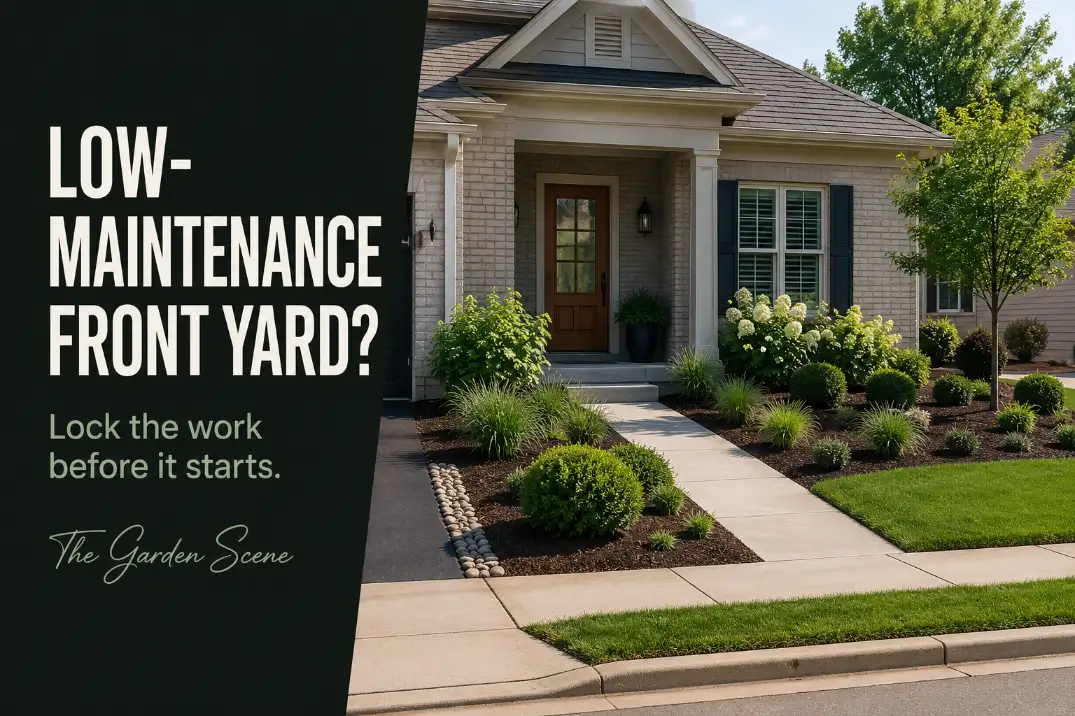
A low-maintenance front yard is not built by choosing “easy” materials first. It is built by deciding what must stay clear, stable, and readable before anything fills the space.
That order matters because the front yard is always on display. It guides visitors to the door, frames the house, handles daily access, and has to look intentional from the street even when nothing is blooming.
If the design starts with shrubs, gravel, mulch, or lawn removal before the route and edges are settled, the work usually moves somewhere else.
The front walk gets crowded. The driveway edge frays. Gravel drifts into grass. Foundation shrubs need constant clipping. A yard that looked simple on installation day starts asking for small corrections every weekend.
So the useful question is not, “What low-maintenance things can I add?”
The better question is: what parts of the front yard must stay open, contained, and easy to reach after the design matures?
That is the decision system. Lock the structure first. Then choose what fills it.
Start With What the Front Yard Must Keep Doing
The first setup decision is not style. It is function. Before choosing plants, mulch, gravel, or lawn alternatives, decide what the front yard must keep doing every day.
At minimum, it needs to:
- Make the front door easy to find.
- Keep the main route open.
- Frame the house without hiding it.
- Preserve driveway, sidewalk, mailbox, and utility access.
- Look intentional from the street, even in dormant seasons.
This is where many “easy” front yards become work. A shrub looks harmless when it is small, so it gets placed near the walk. A bed looks cleaner when it is filled tightly, so plants are spaced for first-year fullness.
A narrow lawn strip looks annoying to mow, so it gets replaced with gravel, but the gravel has no edge strong enough to hold it.
Each choice seems low-maintenance alone. Together, they create repeated correction.
Decide What Must Stay Visible
The front door should remain the strongest visual destination. The path does not have to be formal or perfectly straight, but the route should be obvious from the street or driveway. If planting, decor, curves, or bed expansion make visitors pause and wonder where to walk, the design is adding friction.
The same rule applies to house numbers, porch steps, railings, driveway transitions, and the edge between public and private space. Anything that has to be found quickly should not depend on seasonal pruning to stay visible.
Decide What Must Stay Clear
The main walk, driveway edge, mailbox, hose bib, meter, and utility area all need clearance. If the design works only while plants are young, it is not low-maintenance. It is delayed maintenance.
Mark those clear zones first. Then place planting and ground layers around them.
Decide What Must Still Work in Winter
A front yard that looks good only in spring bloom often feels messy or bare the rest of the year. Low-maintenance design needs some year-round structure: stable bed shapes, clear edges, a readable path, a few reliable plant forms, and enough open space that the yard does not look neglected between growth cycles.
This does not mean every plant must be evergreen. It means the front yard should still make sense when color drops away.
Read the Maintenance Pressure Zones Before You Design
The second setup step is to stop treating the front yard as one open area. Read it as a set of maintenance pressure zones.
Each zone creates a different kind of work. The front walk creates clearance pressure. The driveway creates wear and material movement. Foundation beds create pruning pressure. The curb strip creates heat, debris, foot traffic, or watering pressure. Mailboxes and utility areas create access pressure.
When those zones are ignored, maintenance moves into the weakest edge.
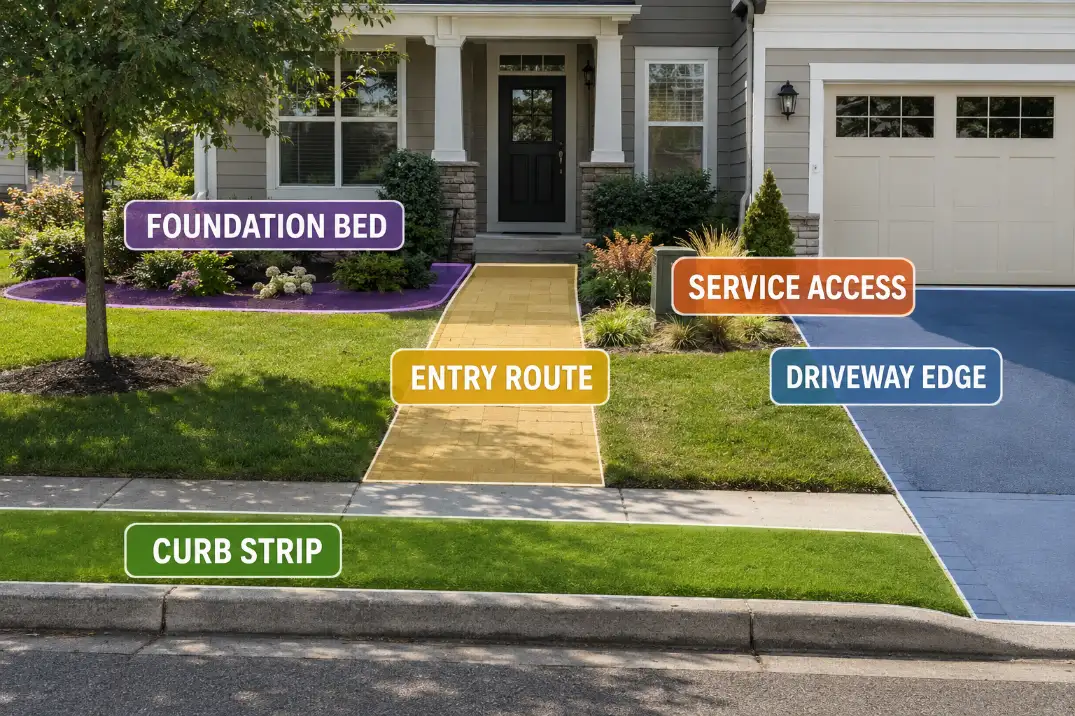
Use the pressure zones to decide the first design move.
| Front yard condition | First design move | Maintenance risk reduced | What not to do |
|---|---|---|---|
| Main path feels narrow | Widen or simplify the route | Edge trimming and plant damage | Add plants before fixing movement |
| Foundation bed is shallow | Set mature plant depth first | Constant pruning | Fill with shrubs that touch siding |
| Driveway edge wears down | Stabilize the border | Gravel drift and lawn damage | Use loose material without containment |
| Curb strip bakes or dries | Choose durable, low forms | Replacement and watering pressure | Treat it like a normal garden bed |
| Utility/mailbox area is awkward | Preserve service access | Trampling and blocked maintenance | Hide it with plants that need shaping |
This is the point where low-maintenance design becomes specific. A foundation bed does not need the same answer as a curb strip. A driveway edge does not behave like a front walk. A mailbox area should not be planted like a decorative island if people, mail carriers, hoses, or trash bins need to move through it.
If HOA rules affect plant height, edging style, lawn coverage, or visible materials, treat those rules as another pressure zone. Do not design first and check later. That is how simple front yards turn into repeated revisions.
Lock the Entry Route and Main Edges First
The first physical layer to lock is the route. If the path to the door is narrow, confusing, or squeezed by planting, every later choice has to compensate.
A front yard can have beautiful plants and still feel high-maintenance if the walk constantly needs trimming, sweeping, or visual rescue. The route is the spine of the yard. The edges are what keep the rest of the design from spilling into it.
A practical main walkway should remain comfortably clear. As a working rule, 36 inches is a minimum useful width for a main walk, while 42 to 48 inches near the entry feels more comfortable when space allows. The point is not to force a number into every yard. The point is to leave enough room for real movement after plants reach mature size.
If the route itself needs a deeper redesign, start with a front walkway that stays readable from the street before committing to planting around it.
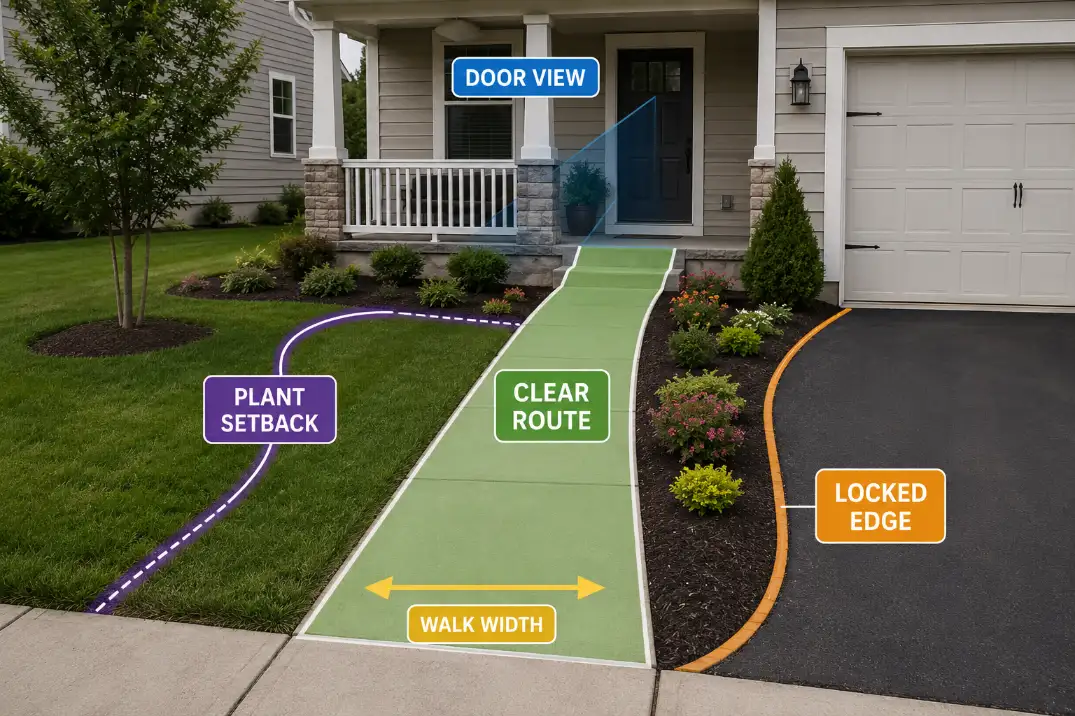
Lock these edges before adding loose or spreading materials:
- The edge between walkway and planting
- The edge between driveway and lawn or bed
- The edge between foundation bed and open yard
- The edge around curb strips or sidewalk planting
- The edge where mulch, gravel, lawn, and groundcovers meet
Edges matter because front yards reveal small disorder quickly. A loose mulch edge along a walk, a gravel strip beside a driveway, or a bed line that requires weekly trimming can make the whole yard look less maintained than it is.
Do not add gravel, mulch, or spreading groundcover until you know how the edge will stay contained. Loose materials are low-maintenance only when their movement is controlled.
Choose the Lawn and Bed Balance After the Structure Is Clear
The lawn decision should come after the route and edges are settled, not before.
The common mistake is assuming that less lawn automatically means less work. Sometimes it does. But a simple, healthy, easy-to-mow front lawn can be less work than a patchwork of gravel, mulch, groundcovers, and small beds that all need edging, weeding, refreshing, or cleanup.
Keep lawn where it is simple to maintain. Replace it where it creates awkward recurring work.
Good candidates to keep as lawn are open areas with clean mowing lines, easy mower access, and enough width that the grass does not feel like leftover filler. Awkward candidates for replacement include narrow strips along driveways, tiny isolated patches, steep corners, shaded weak areas, and slivers that require more trimming than mowing.
| Keep lawn when… | Replace lawn when… |
|---|---|
| The shape is simple to mow | The area is too narrow or broken up |
| The edge can stay clean | The edge needs constant trimming |
| Grass grows reliably there | The area is thin, shaded, or worn |
| It supports the house visually | It feels like leftover space |
If you are removing most of the turf, the decision becomes bigger than “less mowing.” You need a complete surface, planting, edge, and access plan.
That is where a dedicated front yard design without lawn makes more sense than trying to solve the whole conversion here.
Field Check: A lawn area is not high-maintenance just because it is grass. It becomes high-maintenance when its shape, access, shade, slope, or edge makes every mowing session turn into trimming and repair.
Size Plants for Their Maintenance Role, Not Their First-Year Look
Planting is the wrong place to start, but it is the place where earlier mistakes become visible.
Once the route, edges, and lawn/bed balance are clear, choose plants by the job they need to perform at mature size. A shrub near the walk has one job. A foundation plant has another. A plant near a meter, hose bib, mailbox, or porch step has to respect access before it adds fullness.
This is where many low-maintenance front yards lose the plot. The planting looks tidy in year one, then presses into the walk, covers windows, blocks the porch, hides utilities, or swallows the bed edge. The homeowner did not choose “high-maintenance” plants. The plants were asked to do the wrong job in the wrong space.
Start with mature height and mature width before buying, not the nursery container size. University extension guidance commonly frames this as choosing the right plant for the right place, including mature size and site conditions; the University of Minnesota Extension notes that planting locations near structures should account for mature height and width. Source: University of Minnesota Extension
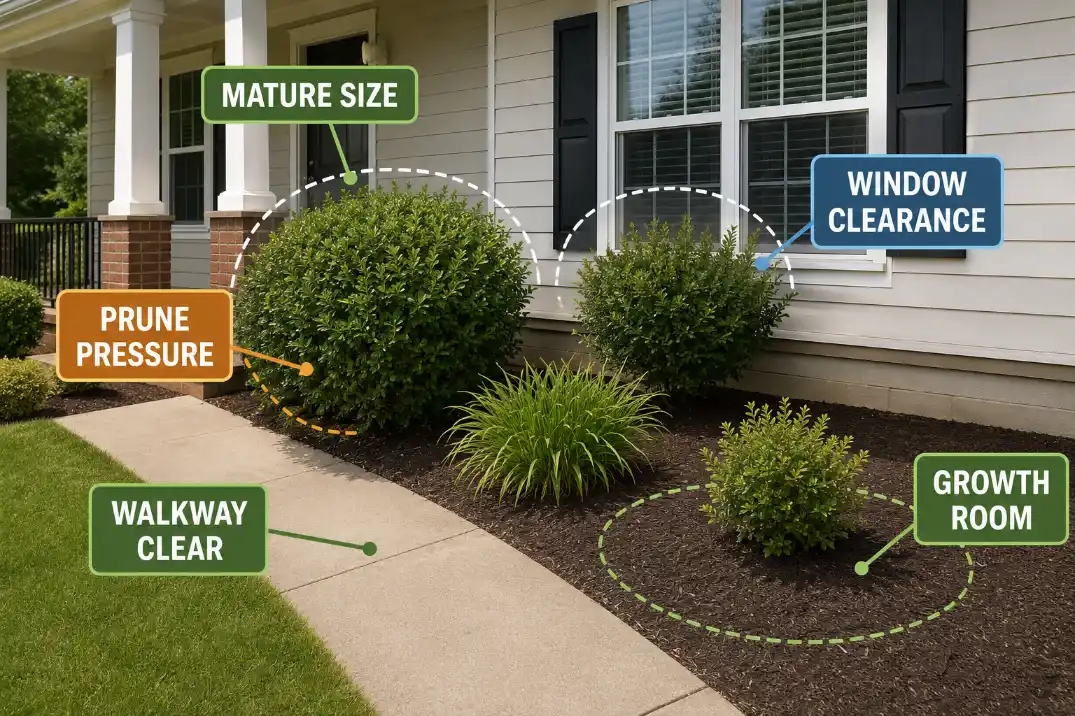
Use plants in roles:
- A few structural plants hold the design together.
- Lower plants keep visibility open near walks and windows.
- Repeated forms reduce visual clutter.
- Seasonal plants add interest without carrying the whole design.
- Ground-level plants should not invade the route.
A front yard does not need every space filled immediately. Open soil can be mulched. Young plants can be spaced for maturity. Small gaps can be intentional if the bed shape and edge are clean.
If you want a more ecological planting direction, use native planting that still reads as intentional from the street as the next layer, not as the first decision.
The setup-order mistake is simple: planting for instant fullness creates future pruning pressure. Planting for mature fit creates a front yard that can settle in instead of needing constant correction.
Pick the Ground Layer by How It Behaves at the Edges
Choose the ground layer last enough that you know what it has to contain.
Mulch, gravel, groundcovers, lawn alternatives, and exposed-soil coverage all behave differently where they meet a walk, driveway, curb, slope, or planting bed. A surface that looks calm in the middle of a bed may become work at the edge.
Mulch is forgiving and useful around plants, but it needs containment and periodic refresh. It can wash down slopes, spill onto walks, or thin out near downspouts and driveway edges.
Gravel can look crisp, but it moves. It drifts into lawn, collects leaves, traps debris, and grows weeds at seams if the base and edging are weak.
Groundcovers can reduce bare soil, but they are not automatically low-maintenance. Some spread into walks, lawn, and bed edges, creating a different kind of work. If that is already your main concern, the deeper issue is groundcovers that spread into walkways and lawn.
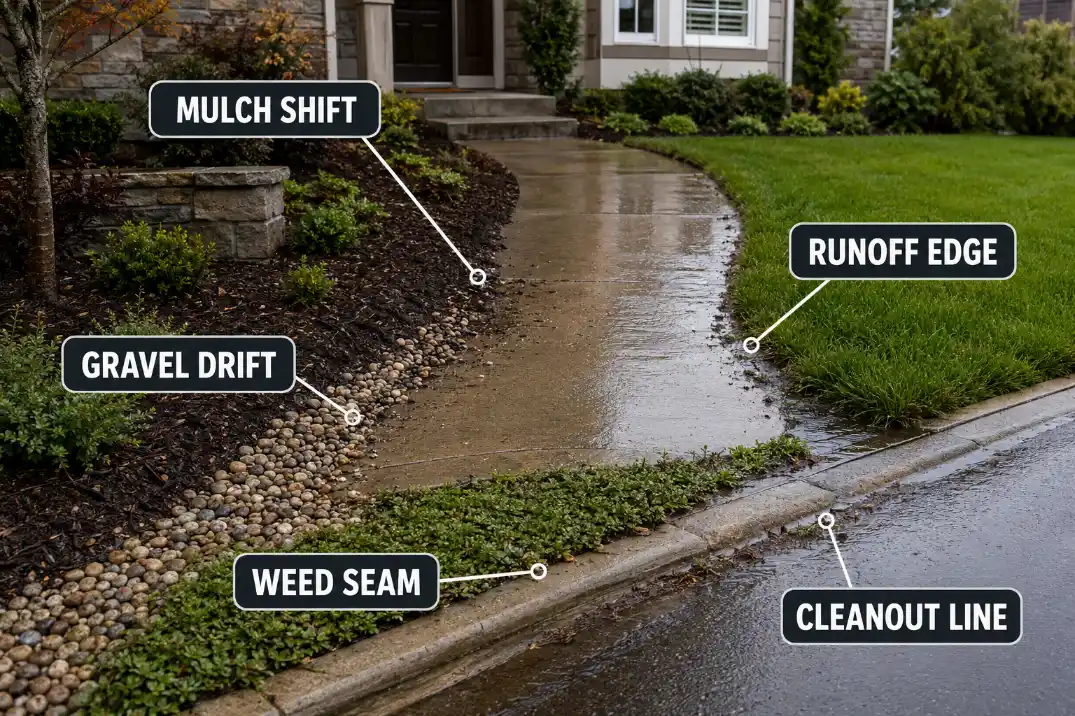
Before committing to a ground layer, check:
- Will this material stay where I put it?
- Can I clean leaves and debris from it?
- Will it move after heavy rain?
- Will weeds appear along seams?
- Does the edge need trimming, sweeping, or resetting?
- Will it overheat a planting bed near pavement?
- Can I reach across it without stepping into plants?
The lowest-maintenance surface is not always the hardest surface or the emptiest bed. It is the surface that matches slope, runoff, cleanup, plant spacing, and edge control.
Design Access So Small Tasks Stay Small
Access is the quiet part of low-maintenance design. If you skip it, small tasks become awkward tasks.
Even a well-designed front yard needs small corrections: pulling a few weeds, trimming a stray branch, refreshing mulch, clearing leaves, checking irrigation, cleaning the walk, reaching a meter, or working around the mailbox. The goal is not to remove every task. The goal is to keep small tasks small.
Leave enough room to reach behind or around foundation planting where possible. Keep hose bibs, meters, vents, cleanouts, mailbox posts, and utility boxes reachable. Do not hide them behind plants that need repeated shaping just to preserve access.
Think through ordinary movement:
Can a mower turn without chewing up an edge?
Can a rake or blower clear leaves from the bed?
Can someone reach the front window, porch step, hose, mailbox, or utility area without stepping through plants?
Can mulch or gravel be refreshed without dragging material across delicate planting?
Can weeds be pulled before they become a full reset?
Tiny inaccessible pockets are a common front-yard problem. They appear between shrubs and siding, behind decorative rocks, beside porch steps, along fence returns, or where a bed wraps around a driveway corner. They look finished at first, then collect leaves, weeds, and debris because no one can comfortably reach them.
Access is not empty space. It is maintenance insurance.
Keep Low-Maintenance Separate From Clean, Simple, and Low-Water
This page is about reducing recurring corrections, not solving every version of “easy front yard.”
A low-maintenance front yard limits repeated pruning, edging, weeding, surface drift, blocked access, and seasonal rescue work.
A clean and simple front yard is more about visual order: fewer distractions, easier cleanup, calmer surfaces, and a tidy public face. If that is the main problem, focus on keeping a front yard clean and simple rather than rebuilding the whole design system.
A low-water front yard reduces irrigation demand and drought stress. That is important in many regions, but it is a different decision layer. A yard can use very little water and still be high-maintenance if gravel drifts, weeds fill seams, plants crowd the walk, or bed edges constantly need correction.
If water demand is the real driver, move into low-water front yard landscaping that lasts after the basic structure is clear.
Quick judgment: Low-maintenance does not mean bare, waterless, or paved over. It means the front yard has fewer places where small problems keep returning.
Stress-Test the Plan Before You Install Anything
The last step is a pass/fail test. Before buying plants, ordering material, cutting new bed lines, or removing lawn, check whether the plan will still work after growth, weather, and daily use start pressing on it.
Use this checklist:
- Can the front door still read clearly from the street?
- Can the main route stay open after plants reach mature size?
- Can each lawn, bed, gravel, mulch, or groundcover edge stay contained?
- Is there a plan for weeds, runoff, leaves, and surface debris?
- Can tools reach the places that will need attention?
- Does the yard still look intentional in the dormant season?
- Are you reducing work, or just moving it from mowing into pruning, weeding, edging, and cleanup?
If the plan fails one of these questions, adjust before installing. Move a shrub farther from the walk. Simplify a bed edge. Keep a mowable lawn area instead of replacing it with a fussy surface. Add access space near utilities. Choose a lower plant form near the entry. Strengthen the driveway edge before adding loose material.
This is also the right point to branch into broader design inspiration. Once the low-maintenance structure is locked, front yard landscaping ideas that stay easy to maintain become easier to judge because you know what the yard must protect.
A low-maintenance front yard is not a plant list, a gravel bed, or less lawn by default. It is a sequence: keep the entry clear, read the pressure zones, lock the edges, choose the lawn and bed balance, size plants for maturity, control the ground layer, preserve access, and test the plan before anything becomes permanent.
That order is what keeps the work from hiding in the design.