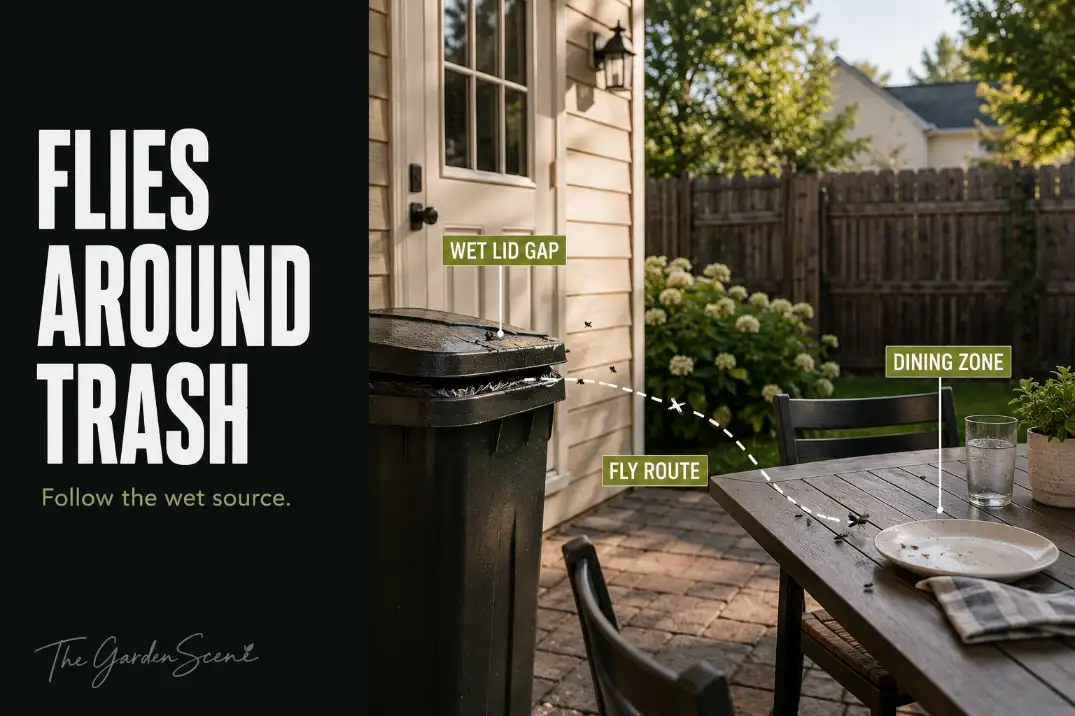
Flies around outdoor trash and dining areas usually mean a wet food source is close enough to the seating zone that flies can move between waste and people without much effort.
Start with the source, not the fly trap. Check for a loose lid gap, sticky liquid under the bin, food bags sitting longer than 24 hours in warm weather, and flies gathering near the back door before they collect at the table.
This is different from a general “buggy patio” problem. Mosquitoes usually point to standing water and shade. Ants usually trace a surface route to sugar or grease.
Filth flies point more directly to decomposing organic material, spilled drinks, pet waste, compost, grill residue, or warm trash surfaces.
If flies return within 30–60 minutes after the dining table is wiped clean, the table is probably only the landing zone. The active source is still nearby.
Trash and Food Zones
Start with the wettest food source, not the most visible fly cluster. A dining table may be where flies annoy people, but the strongest source is usually a trash bin, bagged party waste, compost pail, grill scrap container, pet bowl area, or sticky drink station.
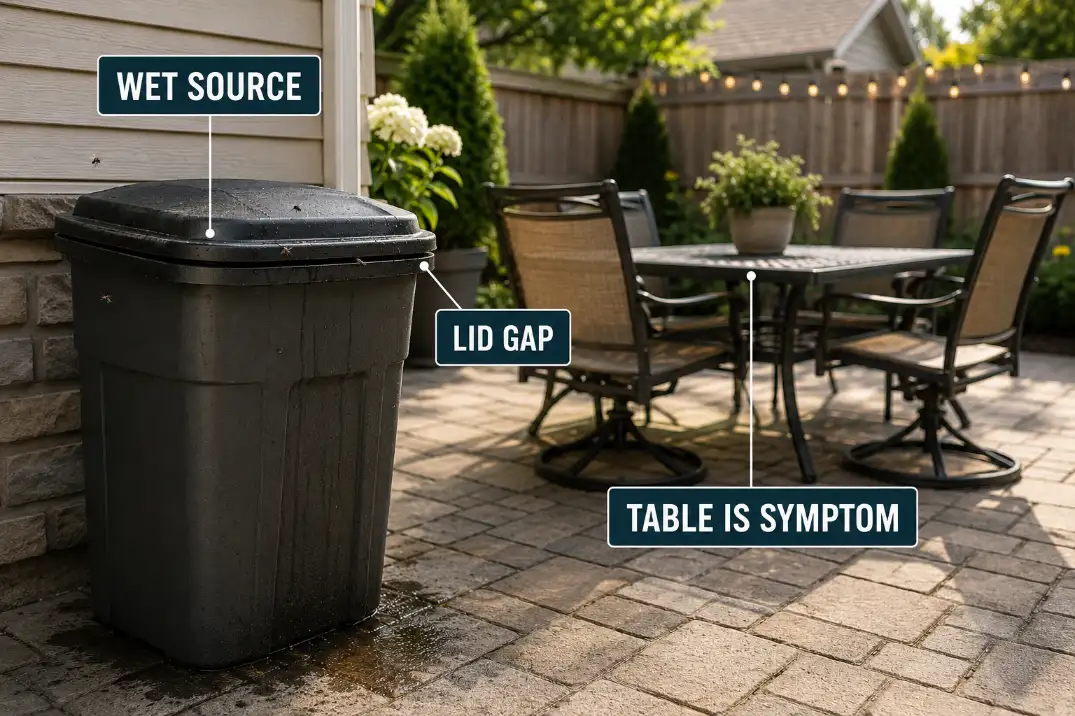
The table is the symptom
A clean table can still receive flies if the trash station is close, damp, and active. Flies follow odor and residue first, then land on nearby surfaces. That is why wiping the table may help for a few minutes but fail by the next plate of food.
The practical difference is simple: a dirty table creates a small landing problem; a damp bin or food-waste area creates a source problem. Source problems keep renewing themselves until the wet organic material is removed, sealed, dried, or moved out of the dining route.
For the broader pattern of pests gathering around outdoor meals, Outdoor Pest Pressure Around Patios and Dining Areas is the closest companion topic because it separates fly pressure from ants, birds, rodents, and other food-zone issues.
When trash becomes active
In warm weather, food trash should not sit loose outdoors overnight. Once daytime temperatures stay above about 75°F, meat scraps, fruit peel, dairy residue, seafood packaging, sauce, and sugary drink containers can sour quickly.
A bag that seemed harmless after lunch can become the strongest fly source by evening.
A tied bag helps, but it is not a full seal if the lid has a 1-inch gap, the rim is sticky, or liquid has leaked into the bottom of the bin. The outside of the bin may look fine while the lid seam, handle, hinge, or base is doing the real work.
If larvae or maggots are present inside the bin or beneath a leaking bag, treat the area as an active breeding source, not just a landing zone. At that point, routine wiping, candles, and patio sprays are not enough.
The bin needs to be emptied, washed at the rim and base, dried, and kept closed before new food waste goes back in.
The Doorway Cluster
A fly cluster near the back door often gets blamed on the door itself. Sometimes that is fair, especially if the screen does not close or the door stays open during meals. More often, though, the doorway is only the route amplifier.
The trash-door-table triangle
A back door creates a transition zone. Warm air moves through it. People carry plates in and out. Trash may sit nearby because it is convenient. A grill, cooler, pet bowl, or compost pail may also be within the same 6–10 feet.
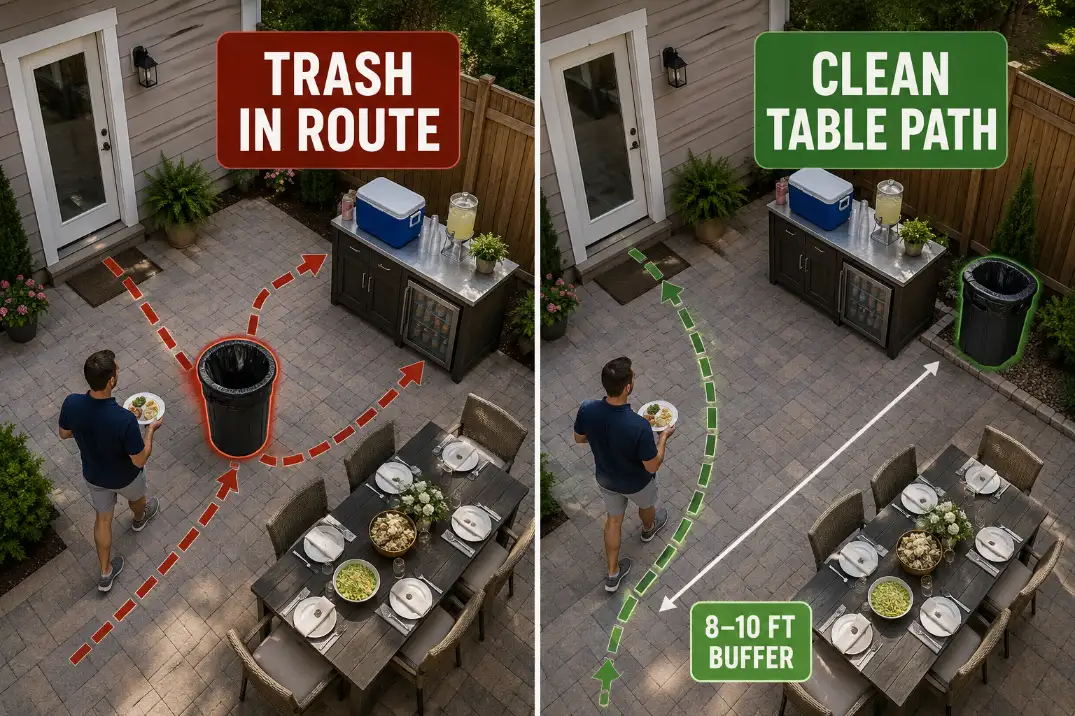
That creates a tight fly route. If the bin is within about 8 feet of the door and the dining table is another 8–12 feet away, flies do not need to search. The whole area behaves like one connected food zone.
The fix is not simply “move the bin far away.” A bin that is too inconvenient can backfire because guests leave plates, cans, and napkins on the table. The better fix is to break the direct line: keep waste reachable, but not in the same route people use between the kitchen door and seating.
Screen gaps still matter
Door exclusion becomes important when flies are also getting indoors. A loose screen, weak latch, torn mesh, or gap at the bottom of the door can turn an outdoor source into an indoor problem.
A 14–16 mesh screen is a useful baseline for common fly exclusion, but the screen only helps if it closes fully after repeated use.
During parties, the door may open 20–30 times in an hour. If food waste is staged directly outside that traffic path, the doorway becomes a repeated odor and movement corridor. In that situation, the first priority is still source placement. The screen is the backup layer, not the main fix.
For temporary gatherings, Outdoor Trash Station Ideas for Parties is useful because the best trash setup is not just hidden; it has to be easy enough that guests actually use it without dragging waste through the dining path.
Compost Too Close
Compost is not automatically a fly problem. A balanced compost bin should smell earthy, not sour. The problem is exposed wet scraps sitting close to where people eat.
Compost is not the enemy
Fruit scraps, melon rinds, coffee filters, wilted greens, and food-prep waste can pull flies toward a patio long before the entire compost bin smells bad. The issue is usually moisture and exposure, not composting itself.
A better working distance is usually at least 10–15 feet from regular dining seats when the yard allows it. The lid or opening should face away from the table, not toward the seating zone. In small backyards where distance is limited, the control point becomes cover and balance.
Fresh food scraps should be buried under 4–6 inches of dry browns such as leaves, shredded paper, or dry plant material.
If wet scraps remain visible after every use, the bin is acting more like an open food pile than a compost system.
When the compost location should change
Routine compost fixes stop making sense when the bin stays wet, smells sharp within a few feet, and releases flies every time the lid opens. If that is happening beside a patio, the placement is part of the failure.
Do not move compost only because flies pass through the yard. Move it when the bin itself is the repeat source.
In tight lots, Compost Bin Placement for Small Backyards fits this problem better than generic composting advice because the real question is whether the bin can stay useful without becoming part of the dining zone.
| Fly pressure sign | More likely source | What changes the outcome |
|---|---|---|
| Flies at bin lid seam | Residue on lid, rim, or hinge | Wash contact points and tighten closure |
| Flies under bin | Leaking bag or liquid in bin base | Rinse bin base and dry before reuse |
| Larvae in bin or under bag | Active breeding source | Empty, wash, dry, and reseal the waste area |
| Flies at back door | Trash-door-table route | Move waste off the doorway line |
| Flies near compost | Exposed wet scraps | Cover with 4–6 inches of dry browns |
| Flies return after spray | Source still active | Remove wet organic material first |
Drink Stations and Spills
Drink stations create a different kind of fly pressure from trash. They may not produce the strongest odor, but they create repeated sugar landings: soda drips, juice rings, beer residue, fruit slices, cocktail mixers, and melting ice that carries sugar across the table or pavers.
The quiet spill trail
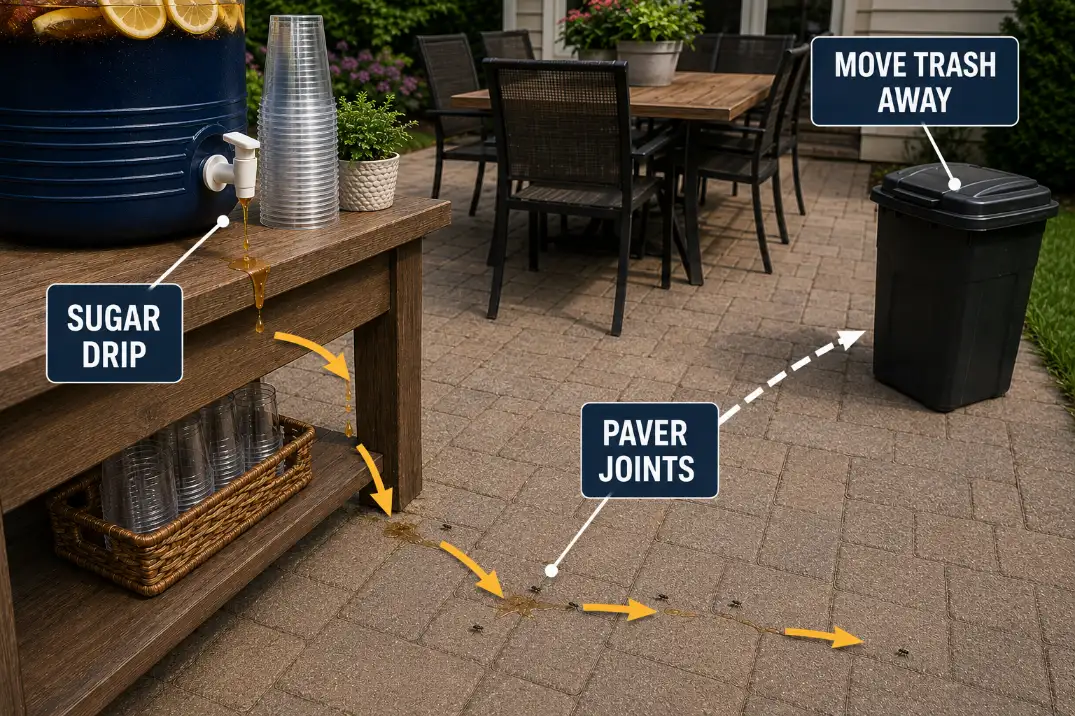
A drink station can look clean from standing height while still feeding flies. The problem is often below the cooler spout, around table legs, under the ice bucket, or in the paver joints beneath the serving area. A sticky spill that dries on top but remains in joints or cracks can keep attracting flies and ants for hours.
This is where flies and ants overlap. Flies show up quickly on exposed liquid and odor. Ants may establish a more organized route later. If you see both, clean the surface first, then check joints, seams, and the area under the table.
For that follow-up pattern, Ant Trails on Patio Pavers and Joints helps because sugar and grease trails often continue after the visible spill is gone.
The drink station should not sit beside trash
A trash bin next to a drink station seems practical, but it can combine sugar, wet napkins, cans, fruit slices, and open food waste in one small landing zone. During a party, that zone can become more attractive than the dining table.
A better setup is to keep drinks on a wipeable surface and place trash slightly beyond the main serving path. Rinse sticky spill areas within 1–2 hours during gatherings, especially around cooler spouts and paver joints.
Pro Tip: Put the drink station on a washable mat or tray during parties. It is easier to rinse one controlled spill zone than to clean sticky liquid from multiple paver joints.
Airflow Around Bins
A hidden bin is not always a better bin. If a trash can is tucked beside a fence, wall, gate, or back door with little air movement, moisture lasts longer and odor lingers. That can make a small amount of residue behave like a bigger source.
Hidden is not the same as dry
A clean, dry bin in a quiet corner is usually fine. A damp bin in that same corner is not. Moist organic residue breaks down faster when it stays warm, shaded, and protected from drying airflow.
The best bin location is shaded enough to avoid heat buildup, open enough to dry after rinsing, and separated enough that odor does not move straight toward the back door or dining area.
If the ground under the bin stays wet for more than 2–3 hours after rinsing or rain, that corner is slow to dry and likely to hold odor.
A sealed storage setup can still fail if the bin itself is dirty. A locking lid helps with raccoons, pets, wind, and tip-over risk, but it does not remove food residue.
If wildlife has also been part of the trash problem, Raccoon-Proof Trash Storage for Side Yards gives the stronger storage angle, but fly control still starts with moisture and food residue.
What to clean first
Do not spend most of the effort on the outside wall of the bin. Clean the rim, handle, hinge area, lid seam, and bottom interior first. Those are the places where food residue touches hands, bags, and airflow.
After washing, let the bin dry open in sun or moving air when practical. Then close it before food waste goes back in. A weekly rinse during hot fly season is more useful than one deep clean after the problem has already spread across the patio.
Dining Farther From Waste
The strongest layout is not the one that hides trash the best. It is the one that separates clean eating, wet waste, and traffic.
Build a clean-to-dirty route
A better outdoor dining setup has a simple sequence: food serving, seating, drink station, trash, then compost or utility waste. The dirty end should not sit between guests and the back door. It should be easy to reach, but not central.
For everyday use, try to keep trash at least 8–10 feet from dining seats when space allows. For larger gatherings, a little more separation helps, especially if guests are carrying sticky plates, cans, and napkins. But maximum distance is not the goal. Useful separation is the goal.
If the bin is so far away that people stop using it, plates and cans stay on the table longer. That creates a new source exactly where people are eating.
When the standard fix stops working
If the bin is clean, compost is covered, drink spills are rinsed, and trash is no longer in the dining route, but flies still return in large numbers within 24 hours, stop polishing the patio and start tracing the source.
Check pet waste, grill grease cups, fish or meat packaging, leaky bags in a side yard, dead organic material under shrubs, nearby dumpsters, or a neighbor-side waste area.
Flies often reveal the active source when disturbed. Walk the yard once in the morning and once in late afternoon. If one corner consistently lifts more flies than the table, inspect that area first.
A Practical Fix Order
Start with source control before comfort products. Fly traps, candles, and sprays may reduce adult flies for a short time, but they do not fix wet organic material.
- Remove food trash the same day during warm weather, especially meat, fruit, dairy, seafood, and sauce residue.
- Wash the bin rim, lid seam, handle, hinge, and bottom interior rather than only hosing the outside.
- Let the bin dry before adding new food waste, especially if the storage corner stays damp for 2–3 hours.
- Move trash out of the doorway-dining route, even if the change is only 8–10 feet.
- Cover compost scraps with 4–6 inches of dry browns or relocate the bin if it remains sour.
- Separate drink stations from trash and rinse sticky spill zones within 1–2 hours during gatherings.
- Recheck after 24 hours; fewer flies means the source was reduced, while fast return means something active remains.
Pro Tip: Do the recheck before adding traps. If fly numbers drop after source cleanup, traps are optional support. If numbers do not drop, traps will only hide an unfinished diagnosis.
Questions People Usually Ask
Are flies around outdoor trash just normal in summer?
A few flies near outdoor trash in warm weather is normal. A cluster that returns every day, moves toward the dining table, or gathers near the back door is not just seasonal background pressure. It usually means wet food residue is close, exposed, or slow to dry.
Do fly traps solve patio dining fly problems?
Fly traps can help reduce adult flies, but they should not be the first fix beside a dining area. Some traps use attractants, which can pull flies toward the same zone where people are eating. Remove wet organic material first, then place traps away from seating if they are still needed.
Should outdoor trash be in sun or shade?
Partial shade is usually better than hot full sun, but deep still shade can keep bins damp. The best spot avoids heat buildup, dries after cleaning, and does not send odor toward the back door or dining area.
For broader university extension guidance on fly control around homes, see Purdue Extension’s Fly Control Around the Home.