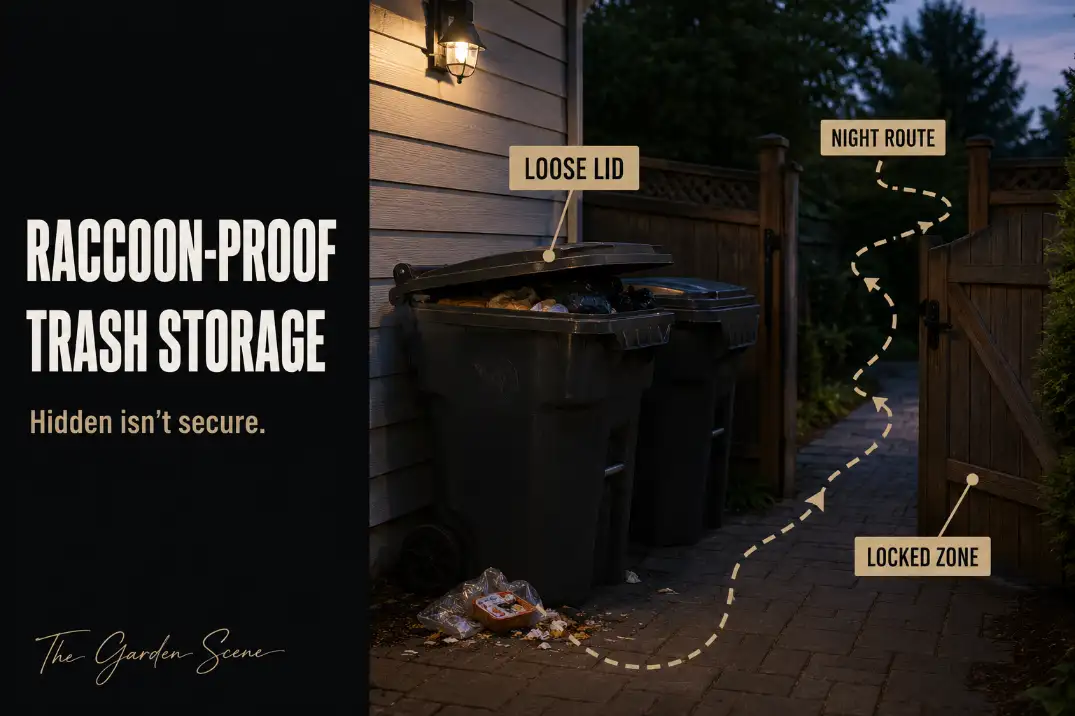
Raccoon-proof trash storage starts with three checks: what is inside the bin, whether the lid truly closes, and how long the trash sits outside before pickup.
A clean-looking side yard can still invite raccoons if greasy food bags press the lid up, the cart can be tipped from the wheel side, or bags go out the night before collection and sit there for 8–12 hours. If trash is scattered again within 24–48 hours after cleanup, the issue is no longer just odor. It is access.
This is different from ordinary patio pest pressure. Ants and flies usually follow crumbs, moisture, and residue. Raccoons add strength, memory, climbing, and leverage.
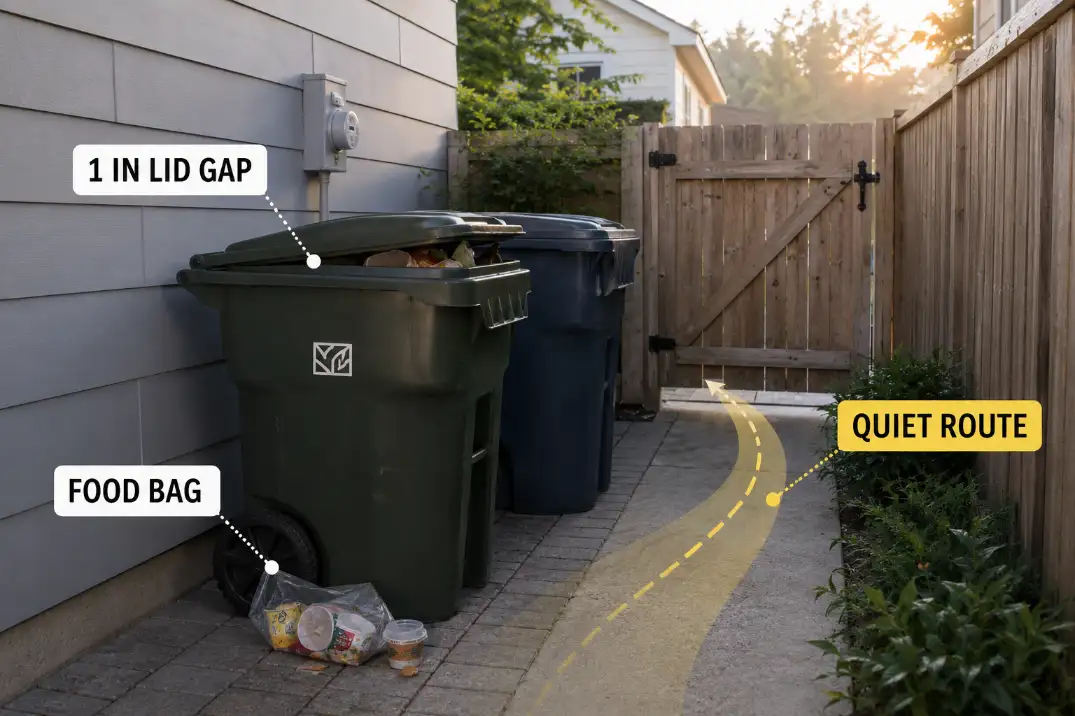
A bin area can look hidden and tidy while still failing if the lid lifts 1 inch, a latch can be worked upward, or a gate gap gives them a quiet way in.
Trash Becomes the Invitation
Food-heavy trash comes first
The most likely cause is not simply “too many raccoons.” It is food waste that creates a reliable reward. Greasy takeout bags, meat packaging, pet food cans, grill scraps, bird seed, fallen fruit, and party trash matter more than ordinary dry household waste. Once raccoons find that reward, the side yard becomes a remembered stop instead of a random visit.
Odor cleanup helps after a spill, but it is not the main fix. The scattered trash is the symptom. The underlying problem is a container that still gives animals a way to reach the bag.
If the lid can be lifted, bowed, tipped, or pulled open, deodorizing the bin only makes a weak setup smell slightly better.
Quick raccoon-proofing check
- Food-heavy trash sits outdoors overnight before pickup.
- The lid lifts more than 1 inch when the cart is full.
- The bin can be rocked or tipped from the wheel side.
- Loose bags are left beside the cart “just for tonight.”
- A gate gap, fence rail, stacked item, or wall gives raccoons leverage.
- Pet food, bird seed, grill grease, or fallen fruit stays nearby.
- A loose bungee crosses the lid but still lets one corner flex.
A loose bungee is one of the most common fake fixes. It looks like control, but if the cord slides, stretches, or leaves a corner loose, the lid still opens enough to matter.
A tight shock cord, locking strap, or latch can help, but only if the lid sits flat against the rim when the cart is full.
Bin Location Matters
A farther bin is not automatically safer
Moving trash 10 or 20 feet away from the patio may reduce smell near seating, but it does not make the bin raccoon-proof. A loose-lidded cart in a quiet back corner is weaker than a slightly closer cart that stands level, stays visible, and locks properly. Distance helps only when it removes cover, climbing aids, or easy entry.
A better comparison is this: a bin 20 feet away with a lifted lid and stacked clutter beside it is still vulnerable; a bin 6 feet closer with a flat lid, latch, clear floor, and no side leverage is usually stronger.
Location should reduce animal confidence, not just move the mess out of sight.
A side yard is especially tricky because it often combines convenience for people with cover for animals. A fence on one side, a house wall on the other, and a gate at the end can turn the bin area into a protected corridor.
If the trash spot is also hidden from the kitchen window or patio door, raccoons get more time to work without being noticed.
Pickup timing is part of storage
The collection routine matters more than many homeowners expect. Food-heavy trash left outside the night before pickup gives raccoons a full overnight test window.
When raccoon pressure is active, the stronger routine is to keep bags fully inside a secured cart and move the cart out as close to pickup time as your schedule allows.
That does not mean the system has to be inconvenient. It means the permanent storage zone should be easy enough to use that nobody starts leaving bags outside the cart.
The access logic in Trash Bins in Narrow Side Yards applies here too: when a bin location is awkward, people eventually work around it, and those shortcuts often become the real animal invitation.
Pro Tip: Test the bin setup when the cart is full, not empty. Many lids look secure until the top bag pushes against them.
Lids, Walls, and Access
The lid is the first security layer
A raccoon-resistant setup begins with the lid, not the screen. A decorative enclosure can hide trash from the patio, but if the cart inside has a warped lid, broken hinge, or weak strap, the enclosure is only cosmetic.
The lid should sit flat, the latch should require a deliberate release, and the cart should not tip easily when pushed from the side.
This is where tidy storage areas often fail. The bins are hidden. The fence panel looks intentional. The ground is clean. But the lid has a gap or the whole cart rocks forward when pulled. Raccoons do not need a perfect opening. They need leverage.
| Storage detail | Weak condition | Better condition | Why it matters |
|---|---|---|---|
| Lid fit | Lifts 1 inch or more | Sits flat under load | Removes paw access and scent leakage |
| Latch or strap | Loose bungee or sliding cord | Locking latch or tight strap | Stops simple upward lifting |
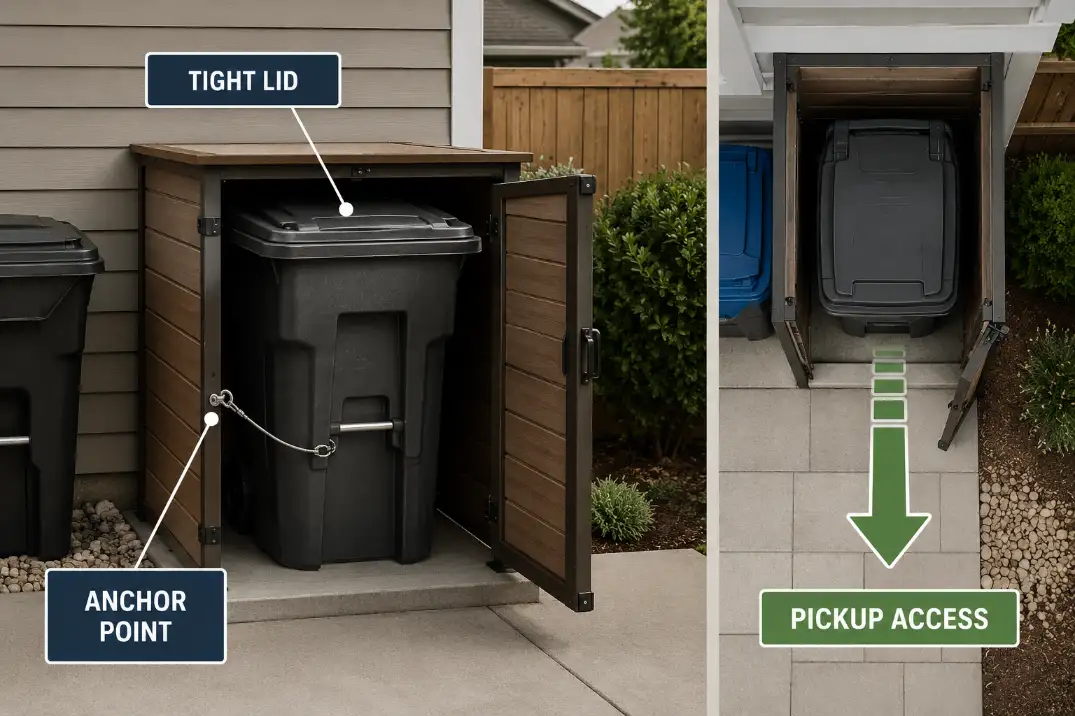
| Tip-over control | Cart rocks or rolls | Stable pad or anchor point | Prevents the cart becoming leverage |
| Side gaps | Reachable 2–3 inch openings | Protected edges or tight enclosure | Stops pulling bags from the side |
| Pickup access | Locked so crews cannot use it | Secure but serviceable | Prevents skipped collection or daily unlocking |
Restraint matters when raccoons tip the cart
There are two different failures: lid lifting and cart tipping. A lid strap helps the first problem. It may not solve the second. If the bin is repeatedly found on its side, the fix needs a stable pad, wall stop, rack, post, or enclosure that keeps the cart upright.
A simple anchor point can be more useful than a bigger screen. The goal is not to trap the cart in place forever; it is to stop raccoons from using the full bin as a lever.
In a small backyard utility zone, that usually means a level base, a controlled front opening, and enough side protection that the cart cannot be rolled or pulled over easily.
This is also where storage and general outdoor organization overlap. A trash bay that collects tools, hoses, buckets, and party supplies becomes harder to inspect and easier for animals to work around.
The cleaner service-zone logic in Outdoor Utility Zone Ideas fits raccoon-proofing because the area needs access, visibility, and control at the same time.
Side Yard Routes
Keep the route usable before adding storage
A narrow side yard cannot be treated like leftover space. If the area is only 4–5 feet wide, trash carts, gates, hoses, drainage, and mower access all compete with each other.
A heavy enclosure may secure the bins but make daily use worse. Once that happens, bags start getting left outside the cart, and the raccoon problem returns through behavior instead of hardware.
Keep about 30–36 inches of clear walking width where people need to carry bags, move a mower, or reach the gate. That clearance also lets you sweep behind the bins, check the latch, and see whether scraps or paw marks are appearing.
If you cannot see the floor, you cannot manage the storage area well.
Mud makes this worse. A damp side yard with leaf litter and dog traffic can turn the bin area into a messy service corner where food scraps, water, and shelter overlap.
The same problem shows up in Side Yard Mud Control for Dogs, Bins, and Access: once the access path deteriorates, every routine task gets sloppier.
Gate gaps deserve attention when pressure is active
A gate beside the trash zone is useful for pickup, but it can also be the easiest animal entry point. Do not panic over every small gap in a yard with no raccoon activity.
But if trash has already been opened, a 4 inch gap under or beside the gate becomes worth correcting, especially when the bins sit just inside that opening.
Look for climbable helpers near the gate: stacked firewood, spare pavers, low shelves, planter boxes, or fence rails. These details may look harmless during the day, but at night they create a working path.
The fix is not always a taller fence. Often it is simply removing the step, tightening the gate latch, and moving the bin away from the easiest corner.
Lighting and Visibility
Lighting is inspection support, not animal control
A motion light may startle raccoons once or twice, but it should not be treated as the main defense. If food remains accessible, raccoons can learn that the light is not a real barrier.
Lighting is useful because it helps people check the latch, see the ground, and notice small failures before the storage spot gets rewarded again.
Aim light at the job, not the whole yard. Around 700–1,200 lumens is usually enough for a side yard or backyard service zone if the fixture points toward the bin face, gate latch, and walking surface. More brightness can create glare without making the lid or ground easier to inspect.
The lighting mistake is the same one that appears in Backyard Lighting Safety and Flow Mistakes: brightness does not matter if it misses the task.
A dim but well-aimed fixture near the latch can be more useful than a wide floodlight that washes the fence and leaves the bin edge in shadow.
Visibility beats decorative darkness
A trash area that is too hidden can become a private work zone. The goal is not to display the bins in the center of the yard, but the latch, lid, base, and ground should be easy to check from a normal route.
Small warning signs matter: a shifted lid, scuffed dirt, paw prints, torn packaging, or scraps under the cart.
Catching those signs within 24 hours is a different situation than discovering torn trash after a week. A quick reset can work after one missed latch. Repeated failures mean the setup is still giving raccoons an opening somewhere.
Hidden but Secure
Screening should not create shelter
The best raccoon-proof trash storage is not always the most invisible one. A slatted screen, cabinet, fence return, or storage bay can make the yard look cleaner, but it should not create a dark, den-like corner around the bins. Keep the floor visible, the lid reachable, and the front access controlled.
A practical setup has five traits: the bin stands level, the lid sits tight, the front closes securely, the cart cannot tip easily, and the surrounding space stays clear enough to inspect. That is usually stronger than a larger, prettier enclosure that blocks the route and hides the failure points.
This is the key difference between hiding trash and securing trash. Hiding solves the view from the patio. Securing solves the animal’s path to the food.
Other attractants can undo a good bin setup
Trash storage alone will not hold if the rest of the area keeps offering food. Pet bowls left outside overnight, bird seed under feeders, suet cakes, fallen fruit, greasy grill tools, and open compost can all keep raccoons interested in the same part of the yard. If the bin has been improved but raccoons still return, check those sources before blaming the enclosure.
Party nights are a common trigger. One food-heavy gathering can overload the household cart, leave bags beside the bin, and restart a route that had been quiet for weeks.
For that situation, a temporary contained trash station near the activity zone can keep food waste controlled before it moves to the permanent bin area.
The setup ideas in Outdoor Trash Station Ideas for Parties are useful when the problem is occasional volume rather than everyday storage.
Know when the standard fix stops making sense
After one mild incident, cleanup plus a tighter lid may be enough. After two or three repeat incidents, move beyond odor control and inspect the latch, strap, lid fit, gate route, and tip-over risk.
If trash keeps getting opened for 7–10 nights after those changes, either the container is still vulnerable or another food source nearby is keeping raccoons interested.
Avoid the overcorrection of building a bulky enclosure that blocks the side yard. A smaller locked bin bay on a stable pad often works better than a large decorative screen that makes collection harder.
The right fix is the one that stays secure on a normal weekday, not only when everything is freshly cleaned and perfectly arranged.
Do not corner, handle, or try to scare raccoons at close range. If raccoons appear sick, aggressive, unusually bold during the day, or seem to be denning inside a structure, shift from storage fixes to local wildlife guidance.
Questions People Usually Ask
Will vinegar, bleach, or ammonia keep raccoons away from trash?
Odor cleanup can help after a spill, but repellents should not be the primary fix. Rain, heat, and repeated food rewards weaken scent-based deterrents quickly. Fix access first, then clean the area so the old route is less reinforced.
Is a locking strap better than a bungee cord?
Usually, yes. A locking strap or tight shock cord is better when it keeps the lid flat and cannot slide off the corners. A loose bungee that still allows the lid to bow upward is mostly cosmetic.
Should trash bins stay in the garage?
Garage storage can work if pickup access is manageable and odors are controlled. During hot weeks, food trash sitting indoors for 5–7 days can create smell problems, so sealed bags and tight lids still matter.
What is the first fix to try?
Start with no loose bags, a flat tight lid, a stable cart base, and a latch or strap that cannot be opened with a simple upward lift. If raccoons return within 48 hours, inspect the gate route, tip-over risk, and nearby food sources.
If raccoon activity continues after food sources and access points are controlled, the University of California Integrated Pest Management Program gives broader guidance on managing raccoons around homes.