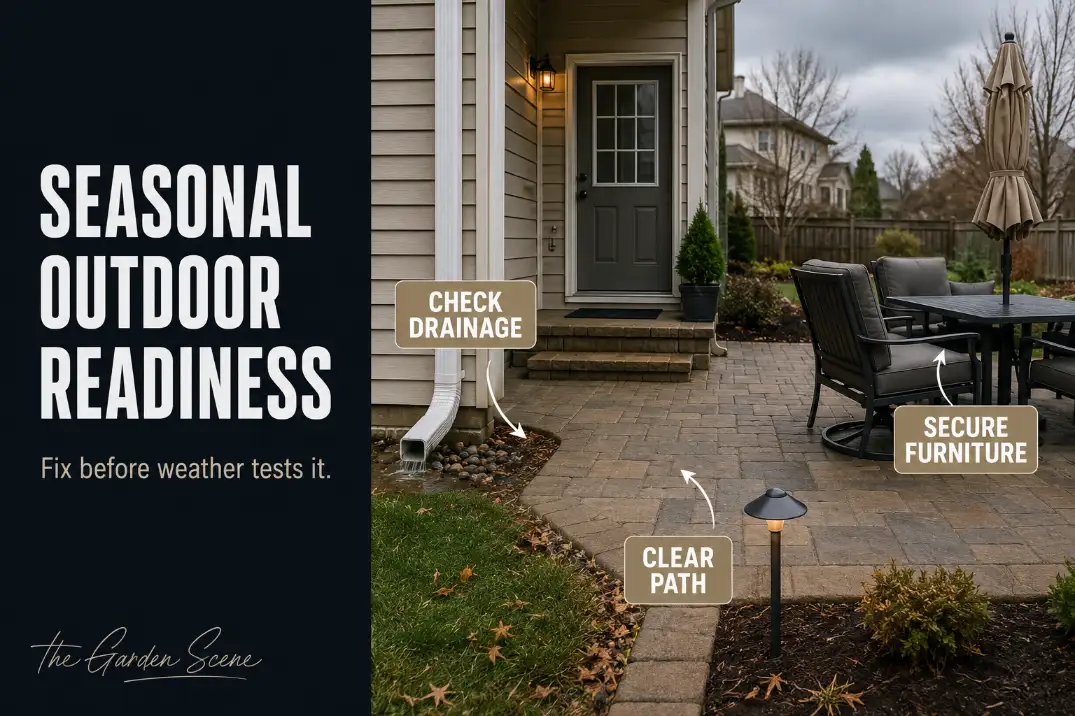
A seasonal outdoor readiness guide should not begin with decorating, deep cleaning, or buying more outdoor storage. It should begin with the parts of the yard that fail when weather changes: water routes, walking surfaces, loose furniture, and visibility after dark.
If water still sits on a patio or path more than 24 hours after rain, if a main route narrows below about 36 inches, or if lightweight furniture can slide in a normal gust, the space is not season-ready yet.
The useful distinction is between a yard that looks unfinished and a yard that is not ready. Faded cushions, scattered leaves, and tired mulch may look messy, but they do not always change how the yard works.
Standing water, blocked routes, unstable chairs, and dark steps do. Seasonal readiness is about catching those weak points before the next 30 to 60 days of weather make them harder to ignore.
Start Before Problems Show
Start with the stress points, not the whole yard. Seasonal prep works best when it checks the places where weather, movement, and daily use overlap before they become visible damage.
Check the next weather test
A yard does not need the same inspection every month. It needs the right inspection before the next seasonal test. Spring usually exposes drainage and soft edges. Summer storms test loose furniture and shade structures.
Fall brings darker evenings, wet leaves, and clogged drainage points. Winter makes trapped water and uneven paths more serious.
That seasonal trigger keeps the work focused. A patio may need drainage attention before spring rain, not a full furniture reset. A side path may need lighting before fall evenings, not new edging.
A covered seating area may need dry cushion storage before humid weather, not another decorative piece.
| Season shift | First outdoor failure to expect | Check first | Skip for now |
|---|---|---|---|
| Spring rain or thaw | Pooling water, soft soil edges, washed mulch | Downspouts, low spots, patio slope | Cosmetic mulch refresh |
| Summer storms | Loose chairs, umbrellas, damp cushions | Wind lanes and dry storage | New decorative pieces |
| Fall darkness and leaves | Hidden steps, clogged drains, slick paths | Route lighting and debris points | Broad full-yard cleanup |
| Winter freeze risk | Ice-prone low spots and uneven walking edges | Standing water and step visibility | Surface color upgrades |
Use a short first pass
The first pass should be quick enough that it actually happens. Walk the yard after rain, after full dark, and before the next heavy-use weekend. Those three moments reveal different failures.
Rain shows water movement. Darkness shows visibility gaps. Pre-use inspection shows blocked access and furniture conflicts.
Pro Tip: Do not clean everything before the first inspection. Normal clutter, puddles, shifted furniture, and awkward walking lines show where the yard is weak.
Watch the repeated problem
The most useful seasonal signal is repetition. One wet corner after an unusually hard storm may not mean much. The same wet corner after three ordinary rains is a pattern.
One chair out of place after a storm may be chance. The same lightweight chair moving every windy week should be treated as a placement problem.
Season-ready means the same outdoor problem does not return after every rain, storm, gathering, or dark evening.
Drainage After Weather Shifts
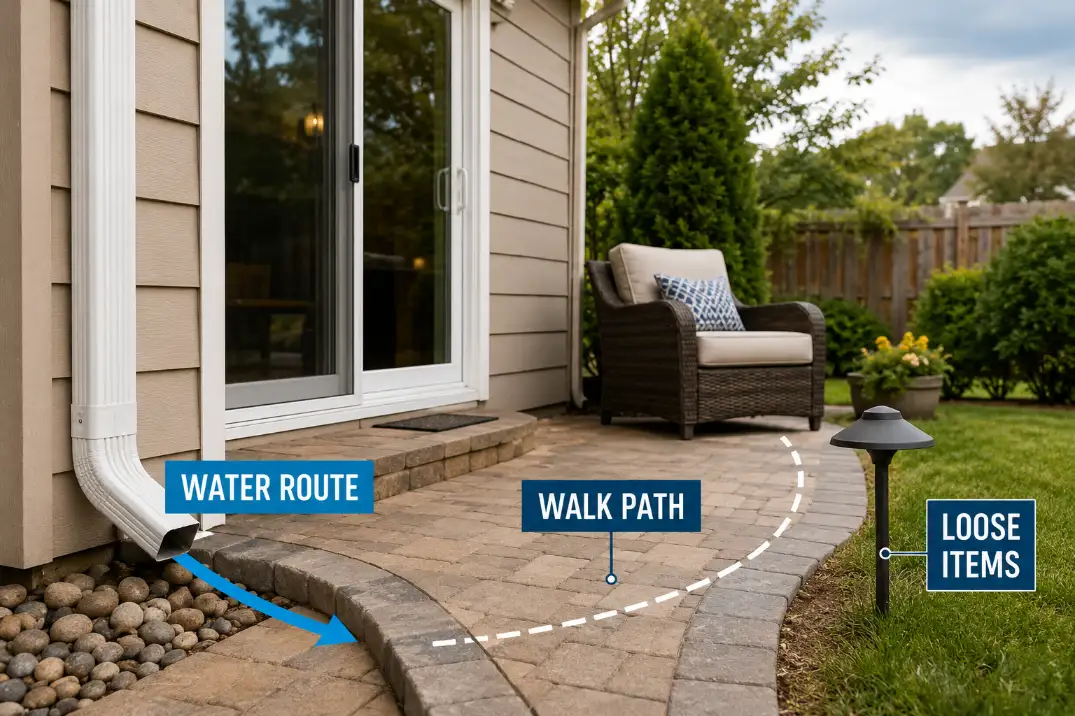
Check drainage before surface appearance. Water is the seasonal issue most likely to turn a small layout weakness into a larger outdoor problem.
Separate wetness from drainage failure
A wet patio after rain is normal. Standing water that remains after 24 hours in mild weather is different. That delay usually points to slope, soil saturation, blocked discharge, low paver areas, or runoff arriving faster than the surface can move it away.
The symptom may be dirty pavers, wet mulch, algae at an edge, or soil splashed onto a walkway. The mechanism is water taking the wrong route or staying too long in one spot.
If the same patio edge, planting bed, or walkway keeps collecting water, the broader pattern in Yard Drainage Problems From Soil, Slope, and Runoff is more useful than treating each puddle as a separate cleanup job.
Check discharge before refreshing beds
One of the most common seasonal mistakes is refreshing mulch before checking where roof water, patio runoff, or slope water actually goes. New mulch may hide a splash zone for a few weeks, but it will not change the water route.
If a downspout releases water less than 5 feet from the house, sends water across a walkway, or empties into a bed that already stays wet, start there. A longer extension, cleaner discharge route, or better outlet may matter more than anything planted around it.
Know when cleanup has stopped working
Cleaning leaves from a drain or patio edge is normal seasonal maintenance. Repeating the same cleanup every 7 to 10 days during wet or leafy periods is different.
That usually means the drain opening is catching too much debris, the surrounding grade is sending sediment toward it, or one small outlet is being asked to handle a larger runoff pattern.
At that point, the routine fix stops making sense. Seasonal readiness means changing the route, reducing the debris load, or correcting the low spot instead of clearing the same mess again.
Paths Before Heavy Use
Clear the main route before judging the whole surface. Heavy use reveals route problems faster than it reveals design problems.
Prioritize pinch points over cosmetic flaws
Small cracks, stains, and faded pavers are easy to notice, but they are not always the first seasonal priority. A blocked or narrow walking route usually matters more.
If the main path from the door to the patio, grill, gate, trash area, or seating zone drops below about 36 inches of clear width, people start stepping onto grass, wet soil, planting edges, or uneven joints.
That is where seasonal wear starts. More traffic does not create the issue; it reveals that the route was already too tight.
Judge the route by its busiest use
A path that feels fine on a dry weekday afternoon may fail during a weekend gathering, a delivery-heavy season, or a dark evening. Guests carrying plates, kids moving between the house and yard, and delivery drivers approaching the front door all need a route that reads quickly.
Before heavy use, the question is not whether the path looks attractive. It is whether people can move without guessing where to step. For entry areas that see visitors, packages, and repeated foot traffic, Front Walkway Safety for Visitors and Deliveries fits this same readiness logic.
Stop moving the same obstacle
A planter that looks good beside the door may still be in the wrong place if it gets moved every time people arrive. The same is true for hoses, bins, side tables, folding chairs, and storage boxes.
If an item repeatedly has to be shifted out of the walking line, the problem is not tidiness. It is placement.
That is where seasonal prep should become a small layout correction. Move the object to a side edge, reduce its footprint, or create a dedicated drop zone so the main route stays open.
Furniture Before Storms
Secure what can move before worrying about what simply looks exposed. Storm readiness is mostly about weight, wind direction, and what a loose item can hit.
Treat wind movement as the first risk
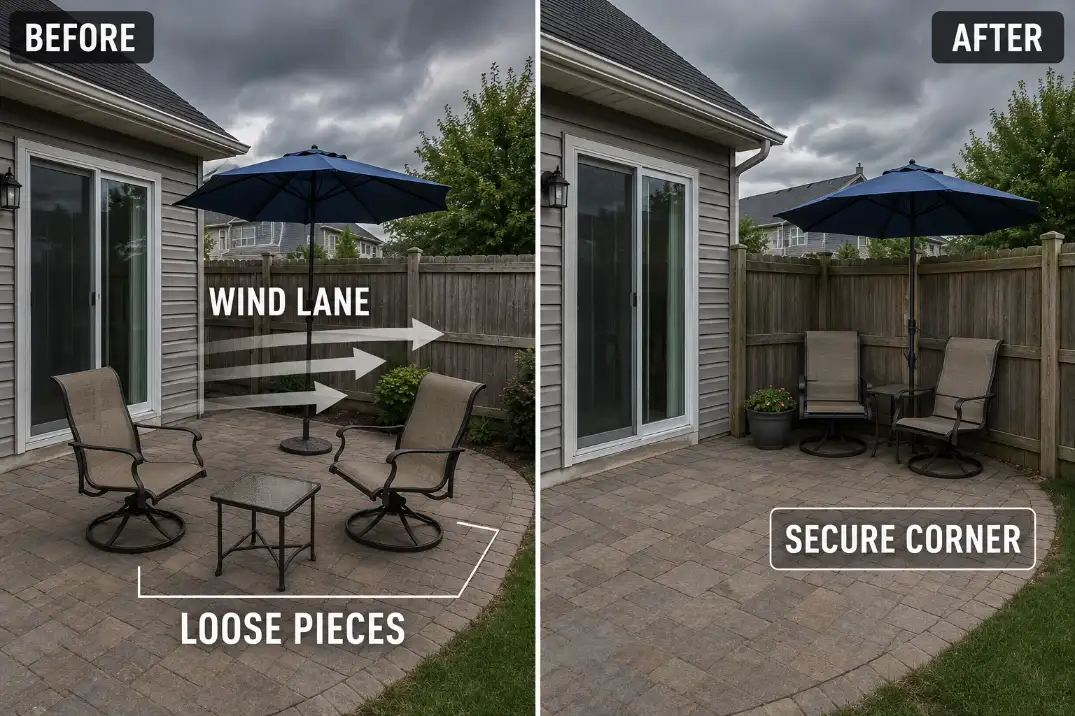
Rain exposure gets most of the attention, but wind usually causes the faster outdoor furniture problem. Lightweight chairs, umbrellas, small tables, empty planters, loose covers, and stacked cushions can shift long before heavier dining pieces do.
A simple push test helps. If a piece slides several inches with light hand pressure, it should not sit loose in an open wind lane before a stormy stretch.
That does not mean everything has to go indoors. It means the lightest pieces should be nested, weighted, tied down, folded, or moved into a protected corner.
Move loose pieces away from damage targets
The same chair has a different risk depending on where it sits. A lightweight chair in the middle of a lawn may be annoying after a storm. The same chair beside a glass patio door, pool edge, railing, grill, or planting bed can cause damage.
This is why storm prep is also layout prep. If wind repeatedly rearranges the same seating zone, the first fix is usually placement, not replacement.
The decision logic in Wind-Resistant Patio Furniture Layout is more useful than immediately assuming every piece needs to be heavier.
Protect cushions before replacing them
Cushions, covers, and fabric pieces often fail before furniture frames. A metal or wood frame can handle a wet week better than a cushion trapped against a wall or stacked on damp concrete. If cushions stay wet for 48 hours or longer, odor, staining, and mildew risk rise quickly.
The wasteful fix is buying new cushions while keeping the same storage habit. If fabric pieces always land in a damp corner, under a leaky edge, or on a floor that collects water, replacement only resets the clock.
A dry, easy-access storage habit matters more than another seasonal cushion purchase, and Best Patio Storage Ideas for Easy Use can support that choice when the problem is storage behavior rather than furniture quality.
Dark Evenings and Visibility
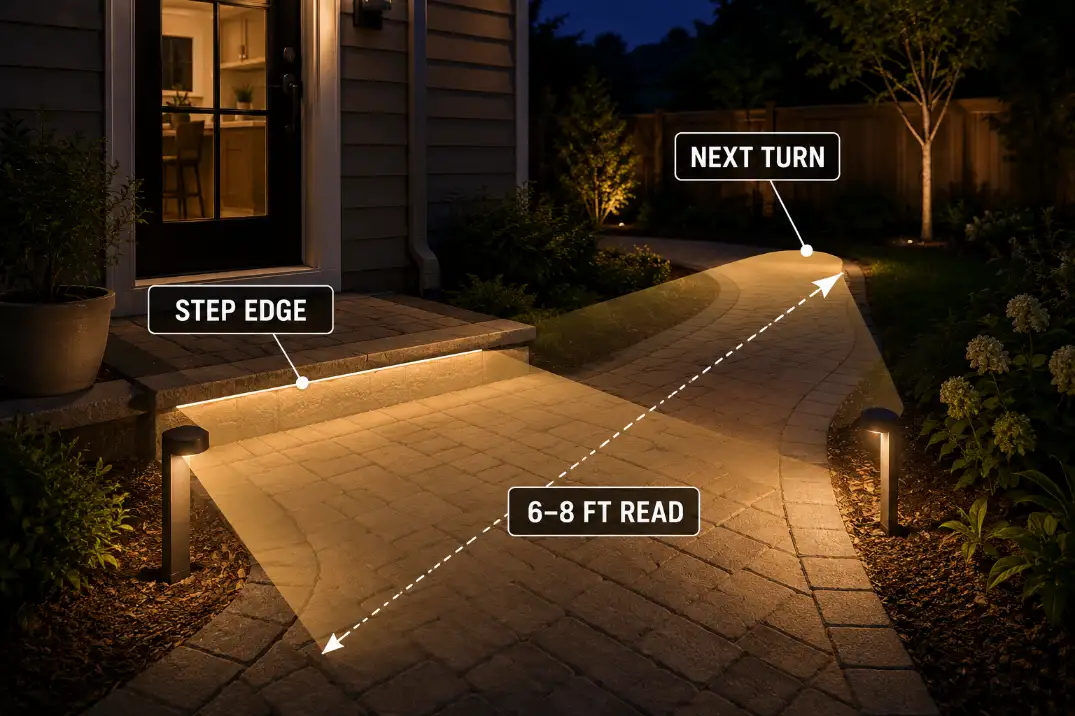
Light the decision points, not the whole yard. Seasonal darkness makes the same outdoor space feel less usable because steps, turns, edges, and thresholds become harder to read.
Visibility is not the same as brightness
More light is not automatically safer. A bright fixture aimed into someone’s eyes can make a step harder to judge. A wide glow over the patio may still leave the stair edge dark.
The useful target is readable movement: where the path starts, where it turns, where the level changes, and where the door threshold sits.
A main step, landing edge, or path turn should be readable before someone reaches it. As a practical threshold, the next change in level or direction should be visible from at least 6 to 8 feet away on the main route. If it appears only at the last second, the yard is not ready for darker evenings.
Walk it after full dark
Do not judge outdoor lighting at dusk. Dusk makes weak lighting look better than it is. Check the route after full dark from the driveway, side gate, back door, patio seating area, and trash or utility zone.
If you slow down sharply at the same step, hesitate at the same turn, or cannot tell where the path edge ends, the issue is not confidence. It is visibility. That is where Backyard Lighting Safety and Flow Mistakes becomes more useful than simply adding another bright fixture.
Fix glare before adding fixtures
The common overestimate is assuming a brighter yard is a safer yard. The common underestimate is how much one dark step, one shadowed landing, or one glare-heavy fixture can change movement.
If the fixture is bright but the edge is still unreadable, adding more of the same light will not solve the problem. Re-aim the light, lower the glare, or place a small cue closer to the actual level change.
Ready Without Overworking
Seasonal readiness should make the yard steadier, not busier. The goal is fewer repeated corrections after weather, traffic, and darkness change.
Use the first-failure rule
Ask which part of the yard would fail first if the next two weeks brought heavy rain, wind, guests, and darker evenings. That question usually beats a long seasonal checklist.
If the answer is water, handle drainage before surfaces. If the answer is foot traffic, clear the main route before styling the edges. If the answer is wind, secure loose furniture before buying new pieces. If the answer is darkness, fix steps and turns before adding decorative lighting.
Skip fixes that hide active patterns
Some seasonal jobs feel productive but do not change the outcome. Fresh mulch over runoff, new cushions stored in the same damp place, brighter lighting aimed into glare, and decorative planters placed in an already narrow route all hide the real problem for a short time.
The better standard is simple: if the same wet edge, moved chair, damp cushion, cleared drain, or warning to guests keeps returning, the yard is not asking for more effort. It is asking for a better first fix.
Keep the routine small enough to repeat
A strong seasonal routine can be short. Walk the main route after rain. Check the same route after full dark. Move or secure the lightest loose items before storms. Look for water that remains after 24 hours, cushions that stay damp for 48 hours, and routes that pinch below 36 inches.
That small routine catches more real problems than a full-yard cleanup done once and forgotten. A yard is season-ready when weather no longer exposes the same weak point over and over again.
For broader official guidance on severe weather readiness, see the National Weather Service severe weather safety guide.