Last updated: June 18, 2026
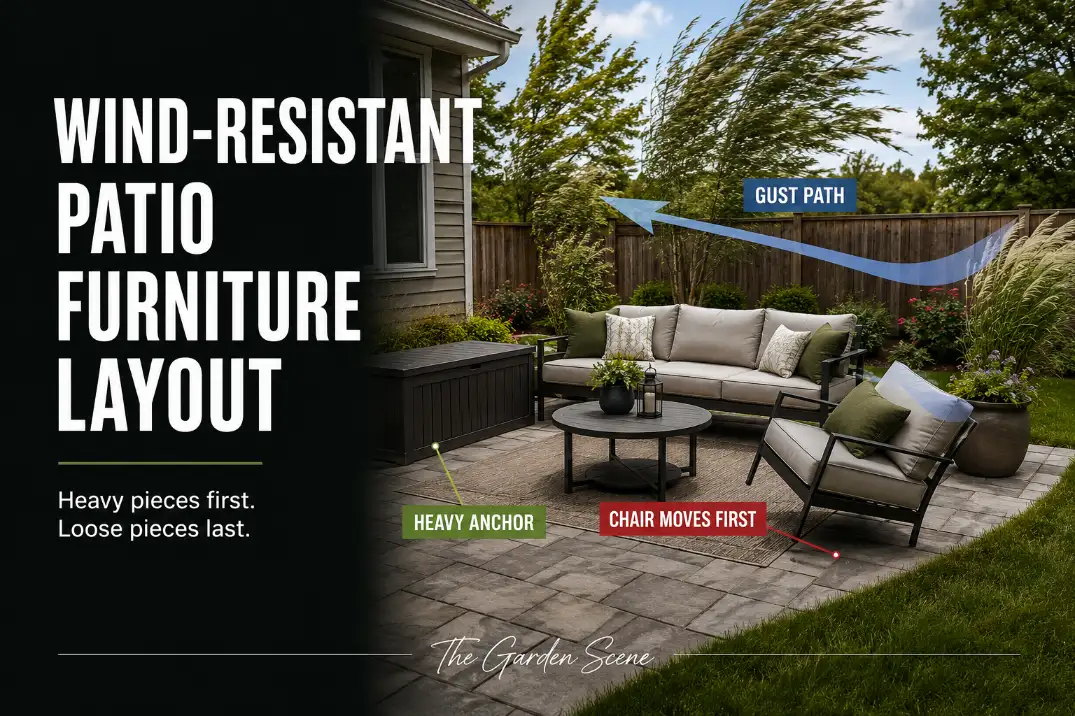
A wind-resistant patio furniture layout starts with placement, not with buying the heaviest set you can find. For everyday backyard wind, the best layout puts low, heavy pieces on the windward side, moves lightweight chairs out of the first wind hit, keeps tall pieces sheltered, and stores loose cushions close enough that people actually use the storage.
The most stable patio furniture layout for wind is not simply the heaviest layout. It is the layout where heavy, low pieces take the first exposure and lightweight pieces sit outside the gust path.
The first warning sign is movement after normal breezy weather, not damage after a storm. If an empty chair slides 2-4 inches after a 15-20 mph afternoon breeze, cushions land on the lawn more than once a week, or an umbrella rocks within 10-15 minutes of wind picking up, the layout is failing before the furniture itself is failing.
Severe wind is different. During wind advisories, storms, or hurricane conditions, layout is not the solution; loose furniture and decor should be secured or brought inside.
Stability Starts With Placement
The strongest wind-resistant patio layouts are built around the first gust hit. That is the edge where air enters the patio before it reaches chairs, tables, umbrellas, planters, and cushions.
Find the first piece wind touches
Stand on the patio during the time of day when movement usually happens. In many U.S. backyards, this is late afternoon, when open lawns, side-yard gaps, and fence openings can make wind feel stronger across the patio surface than it did in the morning. Watch leaves, cushion corners, umbrella fabric, grill smoke, or a loose throw for 2-3 minutes.
You are not trying to identify every possible wind direction. You are trying to find the repeat pattern. If the same chair twists, the same table creeps, or leaves keep collecting in the same diagonal line, that is the patio showing you its gust path.
General spacing still matters. A layout that blocks the back door or squeezes the dining route will not work just because it handles wind. The sizing logic in Patio Furniture Layout by Size is useful here because wind resistance should be added to a usable layout, not used as an excuse to crowd the patio.
Put heavy, low pieces where wind arrives
Once you know the first wind hit, give that position to furniture that can handle it. Low sofas, storage benches, deep lounge chairs, and wide dining tables are more useful than scattered light chairs along the exposed edge.
A 60-80 lb outdoor sofa behaves very differently from a 10-15 lb aluminum chair. The sofa can help define the calmer pocket behind it. The light chair becomes the piece that rotates, scrapes, or ends up against the fence.
Symmetrical layouts often fail at this exact point. A patio can look balanced from the back door and still perform badly because the lightest pieces are sitting in the most exposed positions. Wind does not care whether the furniture forms a neat rectangle. It finds the easiest object first.
Pro Tip: Give the windward position to the lowest, heaviest useful piece before you add screens, weights, or clips.
Light Chairs Move First
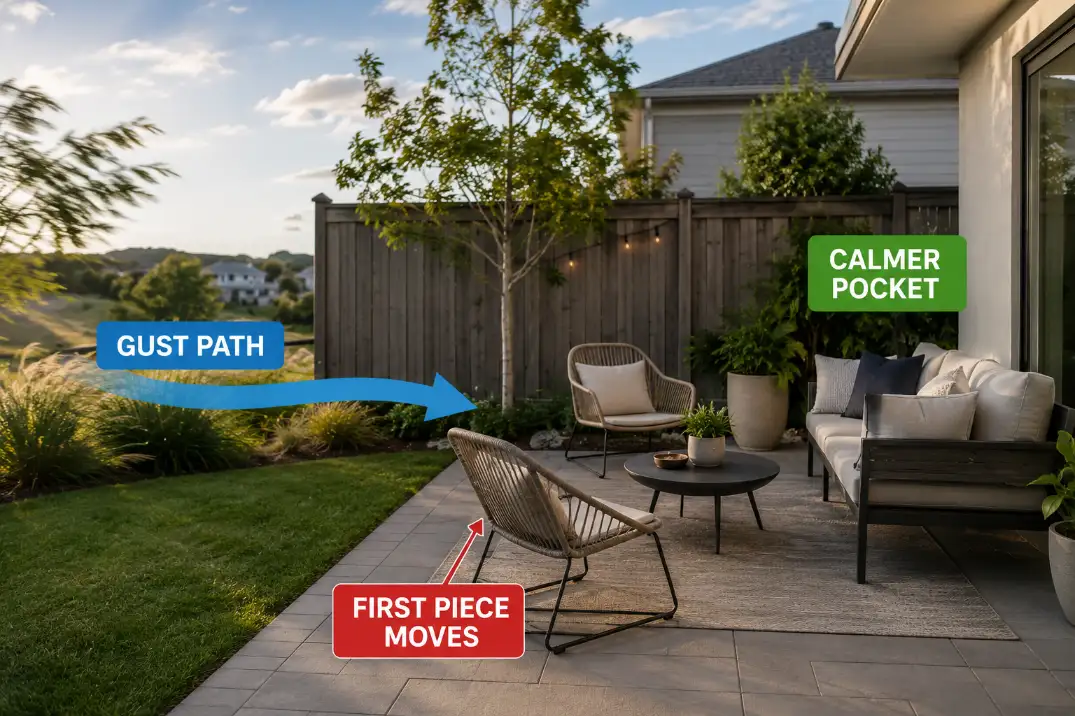
Light chairs are usually the first failure point because they combine low weight, exposed legs, and enough surface area to catch wind. They do not have to blow over to prove the layout is weak. Sliding, rotating, scraping, or repeatedly facing the wrong direction is enough.
Use the empty-chair test
A chair that moves while someone is sitting in it is unusual. A chair that moves when empty is common. That empty-chair behavior is the useful test.
After one breezy afternoon, check whether the chair stayed in place. Movement of less than an inch may be normal on a smooth patio, especially if the chair was slightly bumped. Movement of 2-4 inches, repeated rotation, or one chair always drifting first is a layout signal. It usually means the chair is sitting in the first wind hit.
The fastest fix is not to tie every chair down. First move the lightest chairs 2-3 feet beside the gust path or behind the heavier anchor piece. If that stops the movement, the problem was exposure more than furniture quality.
Surface changes how early movement appears
The same chair can behave differently on different patio surfaces. Smooth concrete and composite decking reveal sliding sooner. Textured pavers may hold chairs slightly better.
Gravel edges can make a chair feel stable at first, then let one leg settle or twist. A patio with even a slight slope can make wind movement look worse because gravity is already helping the chair drift.
That is why the comparison should be made on your actual patio, not in a store. A chair that feels solid indoors or on a showroom floor may still be too light for a smooth slab beside an open lawn.
If wind is paired with a slick, shifting, or uneven surface, the layout may not be the only issue. A patio that moves furniture because the surface is unstable needs a different diagnosis than a stable patio where wind is simply hitting the wrong pieces first.
Corners Can Help or Hurt
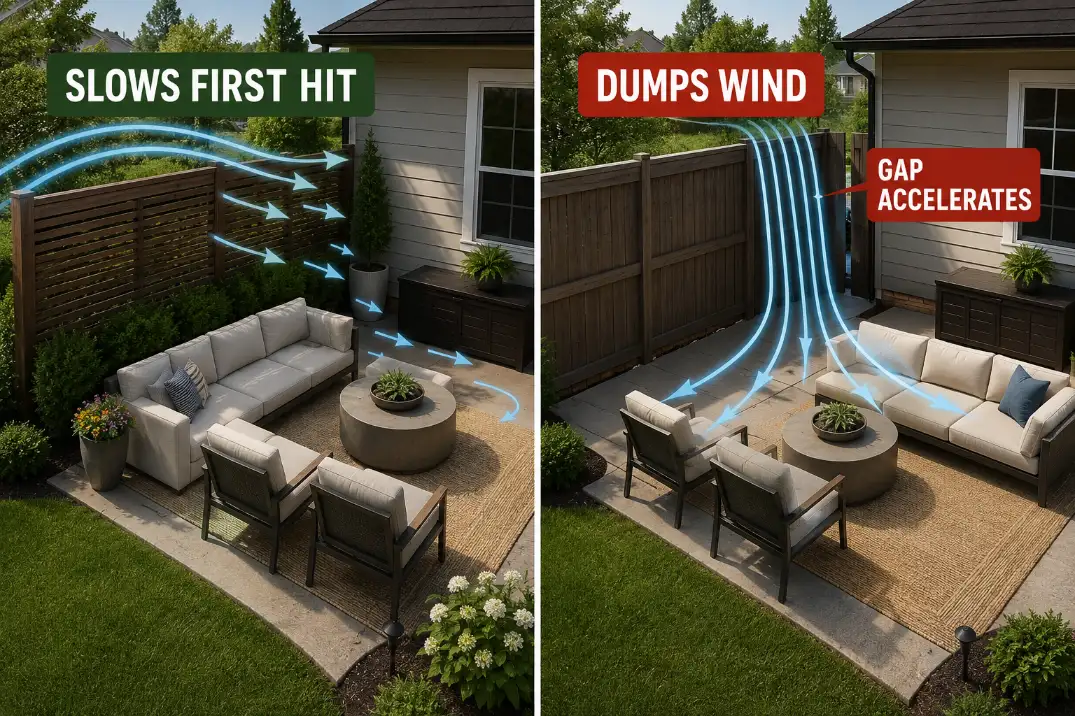
Corners are not automatically safe. A fence corner, house wall, privacy screen, or patio return can calm one spot while accelerating wind through another. The difference is whether the corner softens the first hit or funnels air into the seating area.
A good corner creates a calmer pocket
A useful corner gives the wind something to meet before it reaches the lightest furniture. This might be a low storage bench, a solid but low wall, a dense planting edge, or a semi-open screen. The aim is not to box in the patio. A sealed corner can make wind spill harder around the opening.
The better move is to reduce the first impact so the seating behind it feels calmer. If chairs stop shifting once they move behind a sofa, bench, or screen edge, that corner is helping.
Wind screens can make sense, but only after the layout has identified the real pressure side. If the screen goes on the wrong edge, it may look useful and still leave the gust path untouched. For that next layer, Best Patio Wind Screens is more useful after you know where wind actually enters the patio.
A bad corner dumps wind into the seating
A harmful corner squeezes wind through a narrow opening and releases it straight across the furniture. This can happen beside a gate, between a house wall and fence, around the end of a solid screen, or at the edge of a tall storage cabinet.
The mistake is easy to miss because the patio may look protected. But the wind is being compressed and redirected. If leaves, mulch, or lightweight cushions keep collecting along the same diagonal line, the corner is not blocking wind. It is drawing the path for you.
Keep Tall Pieces Out of Gusts
Tall patio items create more wind trouble than their footprint suggests. Umbrellas, narrow cabinets, privacy panels, plant stands, tall planters, high-back chairs, and shelving can all act like sails when wind hits them broadside.
The umbrella is the first serious boundary
A patio umbrella is not just shade. In wind, it is a large fabric surface held above the patio on a pole. If the fabric snaps, the pole rocks, or the base shifts during a 10-15 minute breezy period, the layout has crossed from comfort problem into safety problem.
A heavier base helps with mild rocking, but it does not make an exposed umbrella safe in strong gusts. This is the fix many people overestimate. They keep adding base weight when the real problem is that the umbrella is sitting in the open wind line.
For daily wind, move the umbrella into a calmer pocket, keep it closed when not in use, or use shade that does not stand broadside in the gust path. If the patio regularly receives 20-30 mph gusts, umbrella placement deserves more caution than chair placement. A chair may scrape. An umbrella can lift, twist, or pull the base with it.
The more detailed umbrella-specific failure patterns in Patio Umbrella Problems in Windy Yards are worth checking when the umbrella is the first thing that moves rather than the chairs.
Tall storage should not become a wind wall
Tall cabinets and shelves look practical because they clean up clutter, but they can make wind behavior worse if they sit at the open edge. A narrow cabinet can rattle, tip, or force wind around its side into the seating area.
Low storage is usually more useful in a windy patio layout. A storage bench can act as both a practical cushion zone and a low anchor along the exposed side. It helps most when it does not block the walking route or create a tight gap that accelerates wind.
Storage for Loose Items
Loose items are not just a housekeeping issue. Cushions, pillows, lightweight covers, throws, small toys, grilling tools, and plastic planters often reveal whether the patio layout can survive everyday backyard wind.
Store what fails between uses
A good wind-resistant layout accepts that some items should not stay loose all day. If pillows move more than once a week, cushions lift after 10 minutes of gusty wind, or a furniture cover balloons every afternoon, those pieces need storage close to the area where they are used.
Storage is not the fix for a bad layout. It is the fix for items that should never be asked to survive the first gust in the first place.
The storage must be convenient. If it takes more than 30 seconds to collect and store loose items, most families stop doing it consistently. That is why a storage solution on the far side of the yard usually fails, even if it has enough capacity.
Many homeowners buy clips, ties, decorative baskets, or heavier pillows, but leave the real storage zone too far away. A low deck box, storage bench, or outdoor-rated cabinet near the seating area often changes daily behavior more than another set of fasteners.
If clutter is also making the patio feel smaller, Reduce Patio Clutter Without Losing Function can help separate useful storage from storage that simply adds another object to the traffic path.
Do not block flow to fight wind
Wind resistance should not make the patio harder to use. Keep at least 30-36 inches of clear walking route between the back door, seating, grill, storage, and yard exit. If a storage bench stabilizes the layout but blocks the route people use every day, it is in the wrong place.
The strongest storage position is close enough for daily use, low enough not to catch wind, and outside the main walkway. That often means placing it along the exposed edge beside the seating group, not in the middle of the patio.
| Loose item | Daily wind signal | Better handling |
|---|---|---|
| Seat cushions | Lift or flip in 10-20 minutes | Store nearby when not in use |
| Throw pillows | Move more than once a week | Reduce quantity or store daily |
| Furniture covers | Balloon or pull loose | Tighten, store, or use fitted covers |
| Small side tables | Skate sideways | Place between heavier pieces |
| Lightweight planters | Tip or rotate | Move to sheltered edge or use heavier containers |
| Toys and small decor | Scatter after breezy afternoons | Use one close storage zone |
A Layout That Survives Daily Wind
A wind-resistant patio layout should follow a specific order. If the order is wrong, the fixes become scattered: one chair gets a weight, one cushion gets a clip, one umbrella gets a heavier base, and the patio still needs resetting after every windy day.
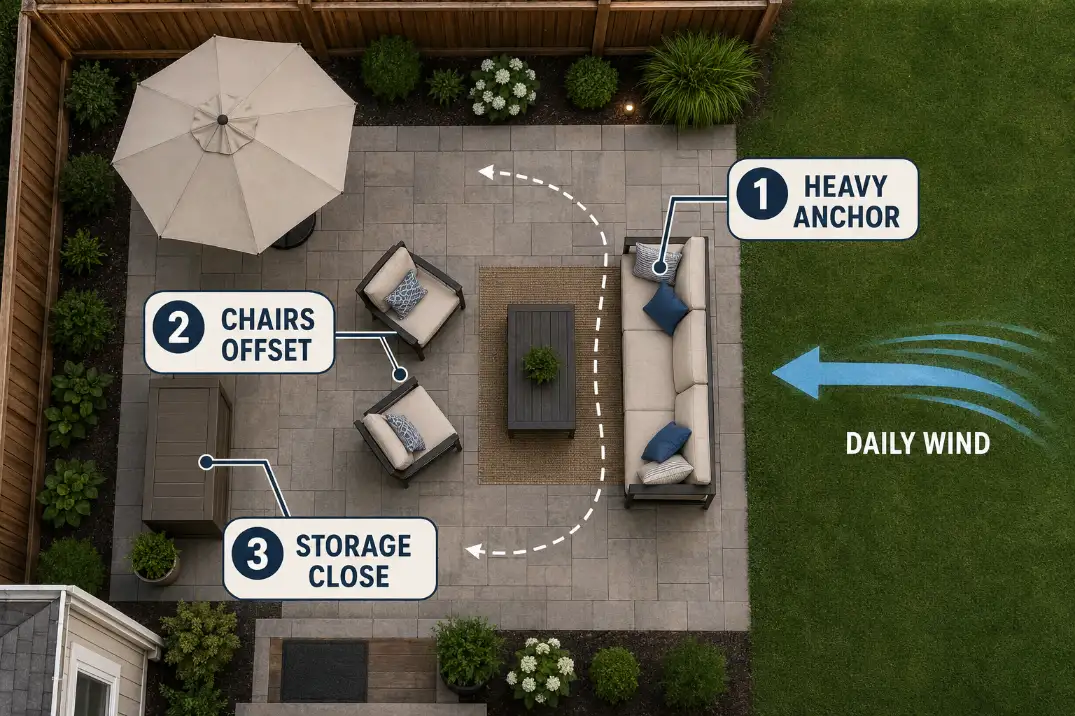
Use the wind-first furniture order
Start with the wind, then place the furniture. The order is simple:
- Find the first gust hit.
- Put the lowest, heaviest useful furniture near that exposure.
- Offset lightweight chairs beside or behind the heavy piece.
- Keep tall pieces close to sheltered edges.
- Store loose items within 30 seconds of the seating zone.
This order works because it fixes the mechanism instead of chasing symptoms. A cushion on the lawn is a symptom. A chair that rotates first is a symptom. The underlying mechanism is exposure: the layout is giving wind the lightest, loosest, tallest objects first.
For patios where wind affects meals more than general seating, Outdoor Dining in a Windy Backyard gives a more specific look at table position, serving shelter, and calmer dining pockets.
Know when layout is no longer enough
Moving chairs and adding nearby storage is enough for many patios. It stops being enough when the same furniture still shifts after being moved out of the first gust path, when tall items rock even near a protected edge, or when wind is being accelerated by the larger yard shape.
That larger shape might be an open slope, a second-story deck, a long side-yard corridor, or a gap between the house and fence. In those cases, furniture layout still matters, but it may need help from screens, planting, lower furniture profiles, or a different seating zone.
The important distinction is daily hassle versus unsafe wind. Daily hassle is the chair that slides, the cushion that lifts, or the table that creeps. Unsafe wind is the condition where umbrellas, tall cabinets, loose decor, and lightweight furniture can become hazards.
At that point, tying one more object down is not a design solution. It is time to close, secure, or remove exposed items.
Choose the calm pocket, not the prettiest center
The best wind-resistant layout is often slightly off-center. It may move seating closer to a fence, tuck chairs beside the house, shift the table away from the open lawn, or leave the most exposed part of the patio as circulation space.
That can feel less balanced in a photo, but it usually performs better in real use. The center of the patio is often the most obvious place to arrange furniture and the least protected place to sit. If the center sits directly in the gust path, do not make it the main seating zone just because it looks symmetrical.
A good layout works for the months you actually use the patio. If the calmer pocket gives you 6-8 months of easier daily use, it is usually better than a centered layout that looks cleaner but scatters chairs every breezy week.
The final test is simple: after a normal breezy afternoon, the light chairs should still be where you left them, cushions should not need a search party, the umbrella should not be rocking open, and the walking route should still feel clear.
A patio does not need to defeat the wind completely. It only needs to stop giving the wind the easiest pieces first.
Once wind shifts from daily hassle to unsecured-object risk, follow National Weather Service guidance instead of relying on furniture placement alone.