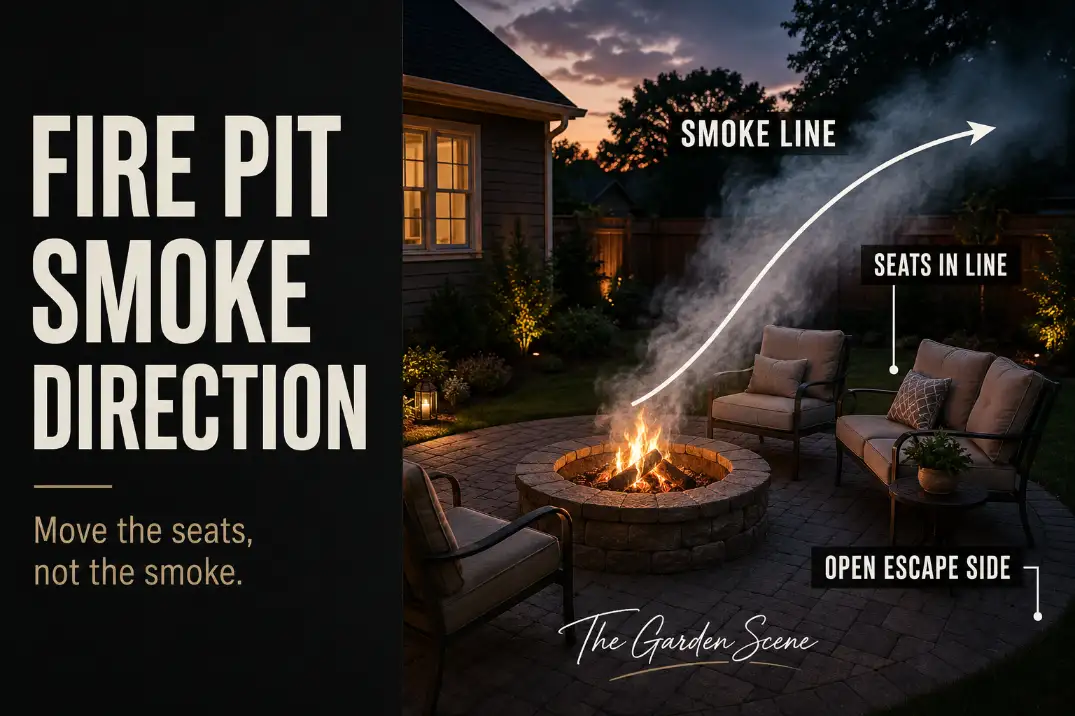
Fire pit smoke usually follows the wind line, not the shape of the seating circle.
The best first fix is to move the smoky-side chairs 2 to 4 feet sideways, leave one 4- to 6-foot escape side open, and avoid adding solid screens until smoke has a clear path out of the space.
If smoke hits the same seats during two separate 10-minute tests, the problem is probably not one unlucky gust.
Damp wood can create more smoke, and a larger flame can make the issue more obvious, but layout decides who gets hit first.
A heat problem feels uneven around the pit. A smoke problem usually follows a path.
Smoke Follows the Wrong Layout
A smoky fire pit often feels unpredictable, but the pattern is usually visible after a few minutes. Smoke moves with the easiest air path. If the pit sits between a fence, wall, hedge, screen, or covered patio edge, the smoke may not rise cleanly. It may roll sideways at face height, especially when the wind is steady rather than gusty.
The first seat hit matters
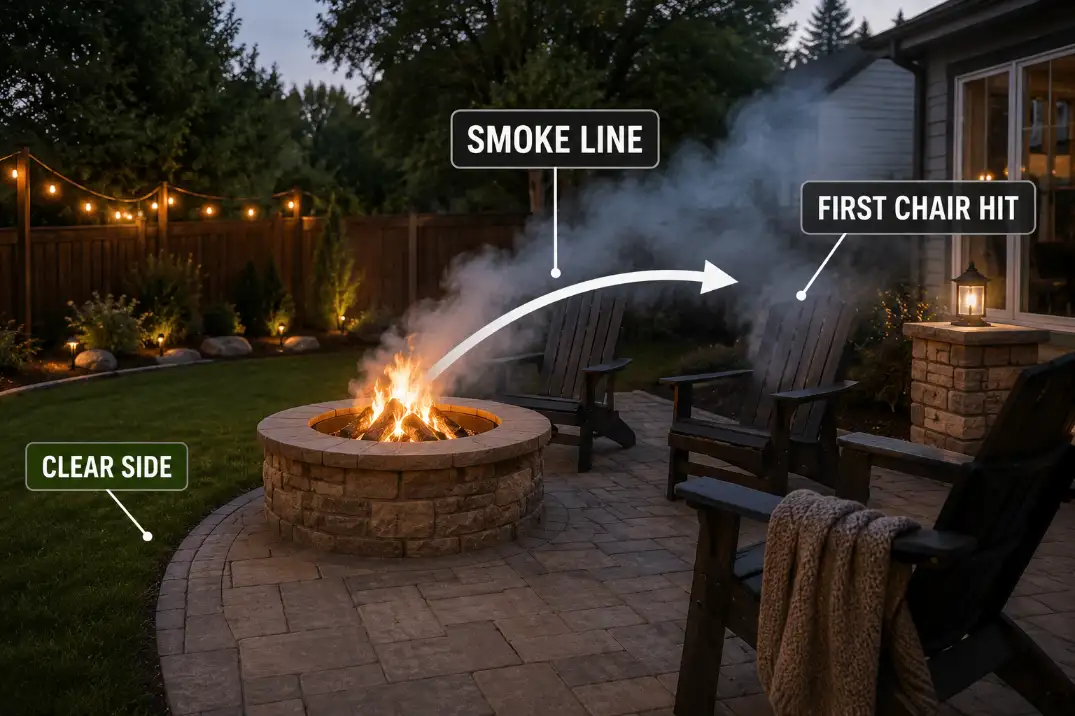
The chair that gets smoke first tells you more than the flame does. If one side of the circle becomes uncomfortable within 3 to 5 minutes while the opposite side stays clear, the fire itself is not failing evenly. The wind line is aimed at the seating.
A healthier setup lets smoke lift and drift away within about 30 to 60 seconds after a light gust. A failing setup holds smoke around people for several minutes because the air has no clean escape route.
Centered is not always comfortable
Many homeowners center the fire pit on the patio because it looks balanced from the house. That is often the mistake.
A centered pit can place chairs in the exact path between the prevailing breeze and the nearest open yard edge.
This is why windy patios often need layout judgment before products. The same logic appears in Windy Patio Layout Ideas, where comfort depends less on symmetry and more on how air actually crosses the usable zone.
Seating Too Close to the Wind Line
The most common smoke mistake is not simply sitting too close to the fire. It is sitting too close to the path smoke wants to take.
Give smoke a side lane
For comfort, the main seating should usually sit slightly off the direct wind path, not straight behind the pit. A shift of 2 to 4 feet can matter more than adding a barrier.
In many small patios, moving chairs only 18 inches changes the look without moving people out of the smoke lane.
Think in two measurements. First, keep seating roughly 4 to 6 feet from the flame edge for comfort and movement.
Second, make sure there is enough total patio depth for a walking lane behind chairs. If guests have to squeeze through the smoky side to sit down or leave, the layout is already too tight.
Angle beats distance alone
A chair 8 feet away but directly downwind may be worse than a chair 6 feet away and angled 30 to 45 degrees off the smoke path.
This is the part people underestimate. Smoke discomfort is often about alignment, not just proximity.
Pro Tip: Before buying a screen, mark the current chair positions with tape or small stones, then move only the smoky-side seats 3 feet sideways for one evening. If the smoke improves, the layout was the fix.
Bad Fuel vs Bad Layout
Bad firewood and bad layout create different smoke patterns. Treating them as the same problem leads to wasted fixes.
Wet wood makes more smoke
Wet, green, or poorly seasoned wood can make any fire pit smokier. If smoke spreads heavily in every direction, burns your eyes from several sides, or keeps pouring from the fire even when the wind is light, fuel quality may be part of the issue.
Seasoned firewood is usually easier to burn cleanly than fresh-cut wood. Smaller, dry pieces also establish a cleaner flame faster than oversized logs.
If the fire smolders for 15 to 20 minutes before it burns steadily, the wood or fire-building method deserves attention.
If you use a moisture meter, wood near 20% moisture is a better target than wood that still feels heavy, cool, or freshly cut.
The wind line decides who gets it
Bad fuel creates more smoke; bad layout sends that smoke to the same seats.
That distinction matters. If one chair group gets hit first even with a small, clean fire, the layout deserves priority. If everyone gets smoke from every direction, improving the fuel and flame may come before moving the pit.
The Fire Pit Needs an Escape Side
A fire pit space should not feel sealed. Smoke needs one obvious exit side where air can carry it away without being pushed back into people.
Keep one side more open than the others
The best fire pit layouts usually have a loose “C” shape rather than a tight circle. That does not mean the space has to look unfinished. It means one side should stay open enough for smoke, people, and heat to move naturally.
A useful target is a 4- to 6-foot open escape side beyond the pit, especially on patios with fences, seat walls, or planting beds nearby. If every side is filled with chairs, screens, planters, or railings, smoke has nowhere generous to go.
This is similar to grill smoke under confined outdoor structures. In Grill Smoke Trapped Under a Covered Patio, the problem is not only smoke production; it is the lack of a clean exit path.
The open side should match real wind
Do not choose the escape side based only on the prettiest view. Watch the space at the time you actually use the fire pit. Evening wind often behaves differently than afternoon wind, especially near fences, houses, and slope changes.
A 10-minute smoke test with a small, controlled fire tells you more than guessing from a weather app. If smoke consistently drifts toward the house, covered patio, or main seating wall, the pit should not be treated as a simple decorative center.
| Fire Pit Signal | More Likely Meaning | Better First Move |
|---|---|---|
| Smoke spreads heavily everywhere | Wood or burn quality is adding smoke | Use dry, seasoned wood before redesigning the layout |
| Smoke always hits one chair group | Seating is in the wind line | Shift seats sideways before adding barriers |
| Smoke hangs under a roof edge | Escape path is blocked above or behind | Open the side, reduce enclosure, or move the pit |
| Smoke worsens after adding a screen | Barrier is trapping airflow | Remove or relocate the screen |
| Smoke clears in under 1 minute | Normal light wind behavior | Adjust seating only if comfort is poor |
| Smoke lingers for 3–5 minutes | Air is recirculating | Change layout before blaming the fire pit |
Screens Can Trap Smoke
Screens feel like the obvious solution because wind is part of the problem. But a screen placed in the wrong spot can make fire pit smoke worse.
Blocking wind is not the same as clearing smoke
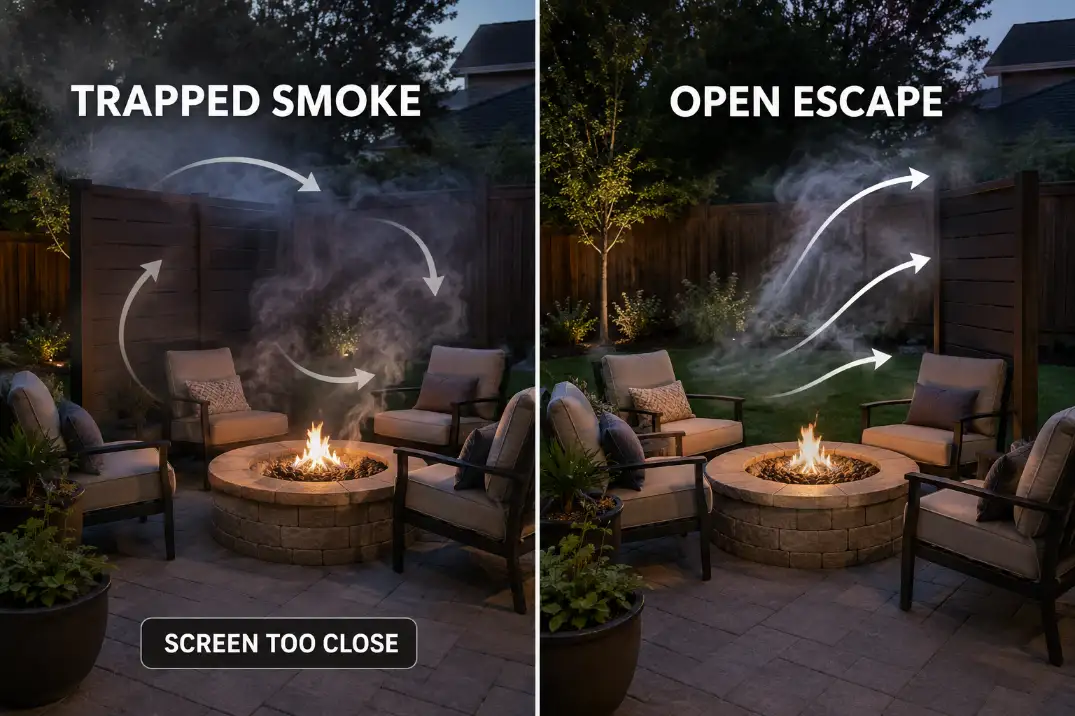
A solid panel can slow the breeze and still trap smoke at sitting height. This is especially common when a screen sits behind the fire pit and another boundary sits across from it. The air hits the screen, curls back, and pushes smoke into the seating pocket.
That is why fire pit screens need more caution than patio wind screens used for dining or lounging. A wind screen can protect a table from gusts, but smoke needs vertical and side clearance.
For broader wind-control decisions, Best Patio Wind Screens is more useful when the goal is comfort without fully sealing the space.
Porous is usually safer than sealed
A semi-open screen, spaced planting, or partial-height barrier is usually less risky than a full solid wall around a fire pit. The goal is not to stop all air. The goal is to soften the strongest wind without killing the smoke’s exit route.
If smoke gets worse within 5 minutes of adding a barrier, the screen is not helping. That is the point where the routine fix stops making sense.
Move Seating Before Adding Barriers
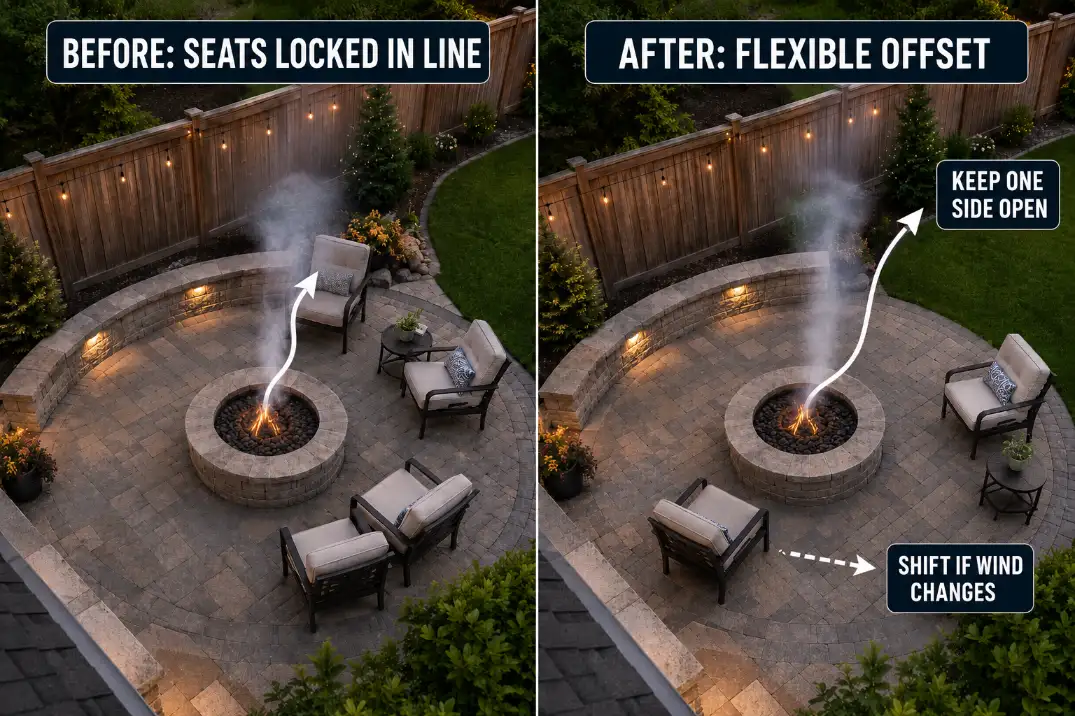
The cheapest useful fire pit fix is usually a seating adjustment, not a new product. Barriers, screens, and taller planters can help only after the seating is out of the direct smoke path.
Start with the smoky seats
Move the chairs that get hit first. Do not redesign the whole patio at once. Shift the smoky side 2 to 4 feet sideways, open one gap in the seating circle, and test again with a small fire for 10 to 15 minutes.
If the smoke now passes through the open side instead of across faces, the fire pit location can probably stay. If smoke still rolls back from a fence, wall, or covered edge, the pit itself may need to move.
Do not overestimate the firewood factor
Dry wood is important, but it will not fix a seat placed in the wrong wind lane. If the same chair gets smoke even with a small, clean fire, the seating position is the more useful fix.
Outdoor cooking spaces face the same pattern. In Wind Ruins Backyard Cooking, the fix is not always stronger equipment; it is often moving the active zone out of the bad air path.
Warm Without Choking the Space
A good fire pit layout should feel warm, open, and easy to leave. If the space becomes a tight ring of chairs, planters, screens, and hard edges, it may look cozy but perform badly.
Keep comfort and safety separate
Smoke comfort and fire safety overlap, but they are not the same decision. A seat can be far enough from flames and still be badly placed for smoke. A screen can make wind feel calmer and still create a smoky pocket.
Keep combustible structures, furniture, and overhead features well away from the fire pit, and leave enough walking clearance that people do not have to pass through the hottest or smokiest side.
A 3-foot walking lane around the active seating edge is a practical minimum; more is better if kids, pets, or guests move through the area.
This also connects with general patio flow. If fire pit seating blocks the main route from the back door, the space will feel worse at night when people are carrying drinks, blankets, or firewood.
The layout lessons in Patio Layouts for Back Door Seating apply here because fire pit comfort depends on movement as much as warmth.
When wind makes the fire pit a no-go
Layout fixes matter only after the fire is legal and safe to use that evening. Some city rules set recreational burning limits around 10 mph, so treat stronger steady wind as a rule-check moment, not just a layout problem.
That does not mean every light breeze is a problem. It means there is a point where moving chairs, adding screens, or changing wood stops being the right question. If wind is strong enough to push sparks, bend flames sideways, or send smoke toward neighboring windows and doors, skip the fire instead of trying to force the patio to behave.
When the pit location is the real problem
Moving chairs can only do so much. If the fire pit sits under a low cover, beside a tall solid fence, in a narrow side-return, or within a boxed-in corner, smoke may keep recirculating no matter where people sit.
At that point, adding another barrier is usually wasted money. The better choice is to relocate the fire pit to a more open edge, switch to a cleaner-burning gas feature if local rules and setup allow, or stop treating that tight area as the fire zone.
A good fire pit does not need perfect wind. It needs enough open space for smoke to leave before people have to.
Quick Smoke Direction Checklist
- Watch the first chair smoke hits during a 10-minute test.
- Move smoky seats 2 to 4 feet sideways before buying screens.
- Leave one 4- to 6-foot escape side open beyond the pit.
- Keep seating roughly 4 to 6 feet from the flame edge, with a walking lane behind chairs.
- Treat smoke that lingers for 3 to 5 minutes as a layout problem, not just a wood problem.
- Use dry, seasoned wood if smoke spreads heavily in every direction.
- Skip the fire when wind pushes flames, sparks, or smoke toward structures or neighbors.
Questions People Usually Ask
Should a fire pit be placed in the center of the seating area?
Not always. Centering looks tidy, but it can put the fire directly between the wind and the main seats. A slightly off-center pit with an open smoke escape side often works better.
Do smokeless fire pits fix wind direction problems?
They can reduce smoke from combustion, but they do not change where wind carries the remaining smoke. If seating is directly downwind, even a cleaner-burning pit can still feel uncomfortable.
Is a screen a good fix for fire pit smoke?
Only if it softens wind without trapping smoke. If a screen creates a corner, blocks the downwind side, or sits too close to the pit, it can make smoke linger longer.
Because smoke comfort also affects air quality, compare your setup with the EPA Backyard Recreational Fires guidance.