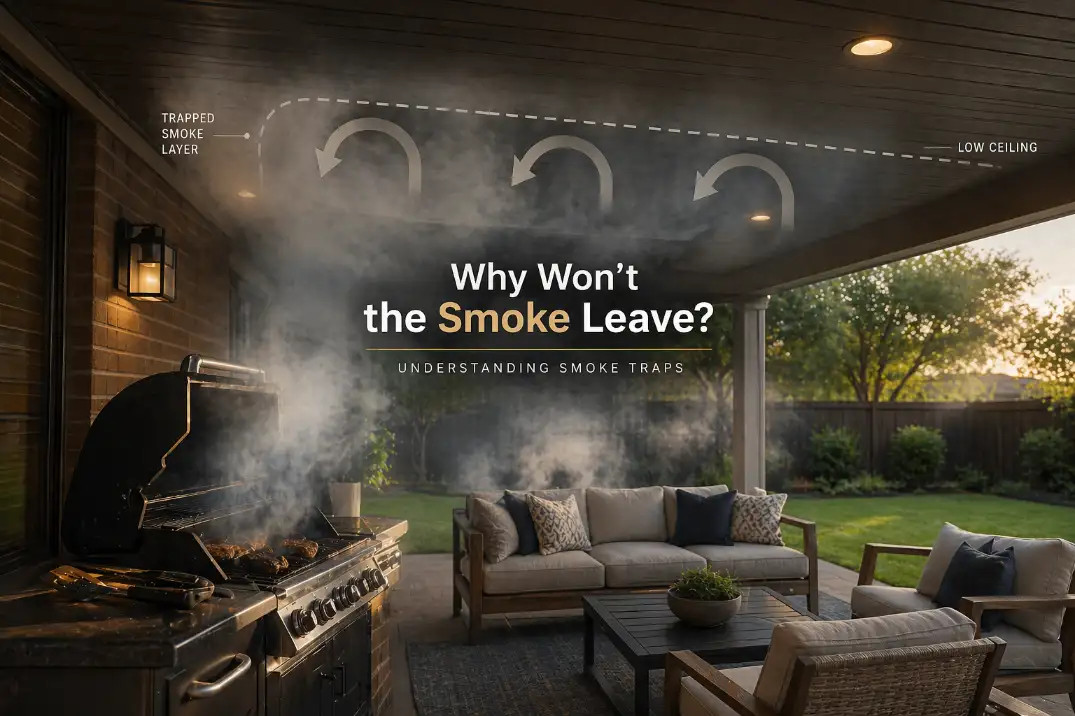
Grill smoke usually gets trapped on a covered patio for one main reason: the grill is placed where smoke can rise but cannot escape. Most covered patio smoke problems come from putting the grill too close to the house, too far under the roof, or inside a partially blocked corner — not from the grill itself.
The first checks are ceiling height, open sides, grill distance from the house wall, and whether smoke clears within 2–3 minutes after the lid opens.
If smoke hangs under the cover for 10 minutes, stains the ceiling, or drifts toward doors and seating, the problem is bigger than a smoky grill.
Smoke is the visible symptom. The underlying issue is trapped heat, grease vapor, soot, and combustion fumes collecting in a semi-enclosed space. Cleaning the grill may reduce smoke volume, but it will not fix a patio layout that blocks the escape path.
The Fast Diagnosis
Smoke should leave, not flatten under the roof
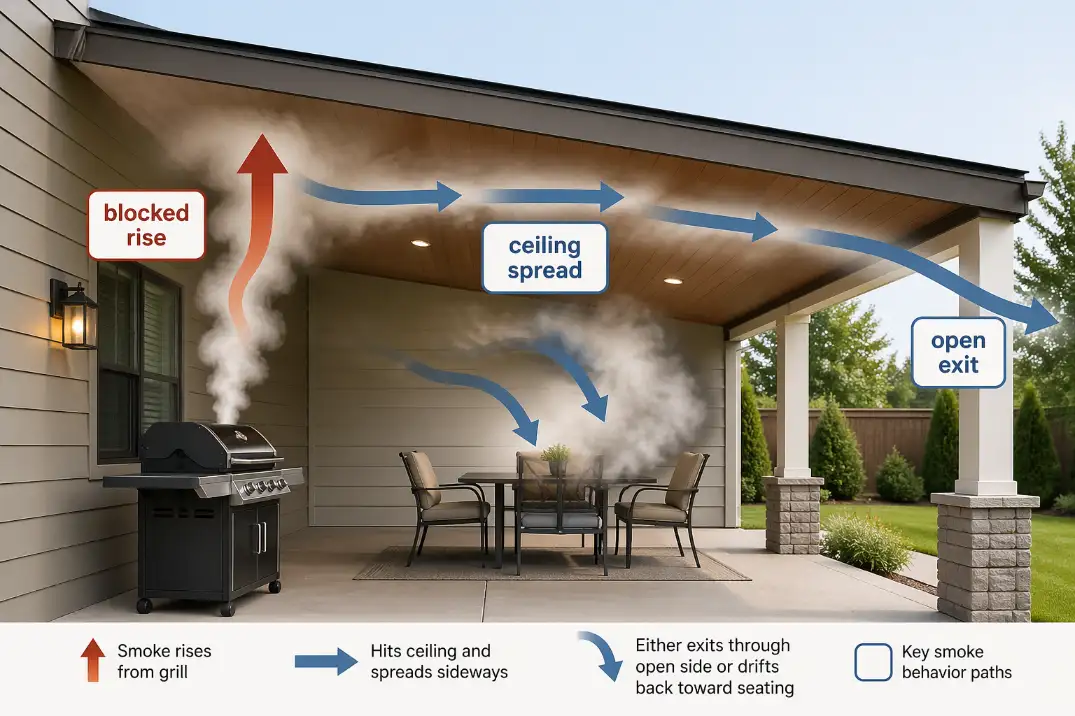
In a healthy setup, smoke rises above the grill, thins out, and moves toward open air. On a covered patio, the roof interrupts that upward path.
If the patio has a low ceiling, solid side walls, privacy screens, roll-down shades, or a grill tucked into a corner, smoke spreads across the ceiling and drops back into the breathing zone.
| What you notice | What it usually means | First move |
|---|---|---|
| Smoke stays visible for 10+ minutes | Poor exhaust path | Move the grill closer to open air |
| Smoke enters the house | Grill is too close to doors or inward airflow | Shift grill away from openings |
| Brown or greasy ceiling film appears | Repeated smoke and heat exposure | Treat it as a placement problem |
| Fan spreads smoke across seating | Wrong airflow direction | Reposition or turn fan off |
| Smoke is worst on still evenings | Patio depends too much on breeze | Improve crossflow or location |
The quick decision rule
If the grill sits under an 8-foot cover, has two or more blocked sides, and is within about 2 feet of a wall, do not start with fans, cleaning, or small tweaks. Move the grill. That setup traps smoke by design.
If the patio has at least one open side and smoke eventually clears but feels slow, start with placement and airflow direction. Moving the grill 3–5 feet toward open air or opening the escape side before cooking is usually more effective than adding more equipment.
If smoke enters the house, stains the ceiling, or leaves a smoky smell after 24 hours, treat it as a layout and safety problem, not a normal grilling annoyance.
If the grill already feels squeezed into a tight cooking zone, the smoke problem is probably part of a larger spacing issue.
A grill needs working room and breathing room, which is why the layout principles in How Much Space a Grill Area Really Needs to Work Well connect directly to smoke control.
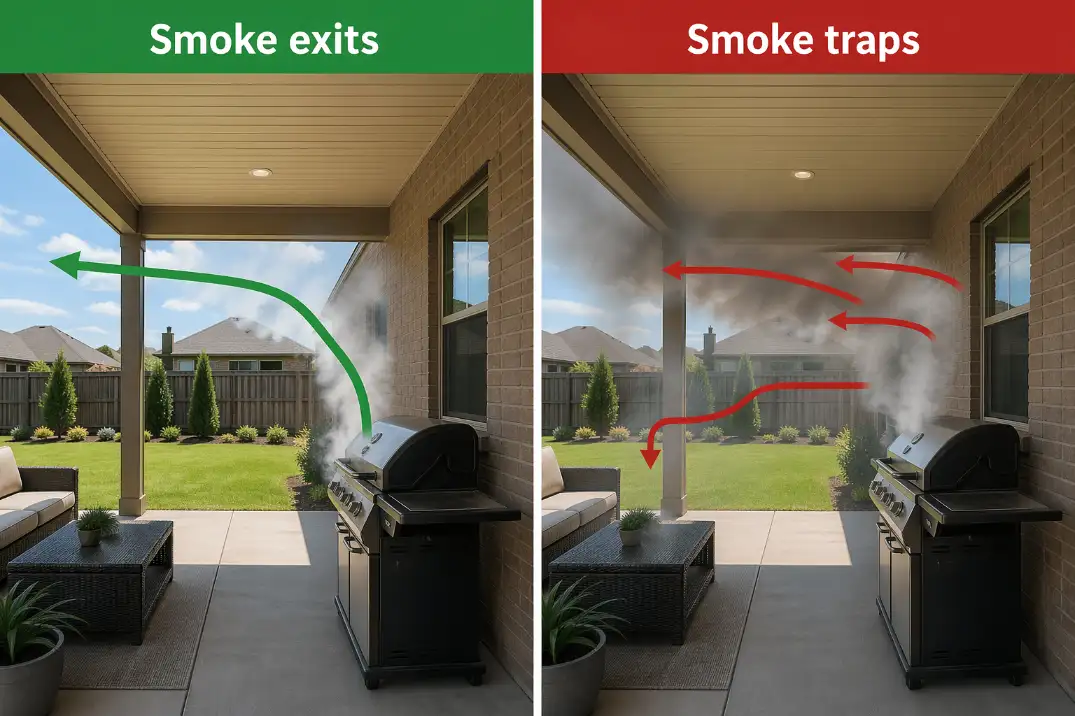
Why Covered Patios Trap Smoke So Easily
The roof breaks the chimney effect
Smoke rises because it is hot. On an open patio, that upward movement usually gives it enough space to dilute. Under a solid patio cover, porch roof, pavilion, or overhang, the smoke hits a ceiling and loses momentum.
An 8-foot cover is much less forgiving than a 10- or 12-foot cover because smoke has less room to rise above head height. Once it cools against the roof plane, it spreads sideways and lingers.
That is why smoke can bother people sitting 6–8 feet away even when the grill itself is not producing unusual smoke.
Open sides matter more than patio size
A large covered patio can still trap smoke if the grill sits against the house with screened or shaded sides around it. A smaller patio can work better if the grill sits near an open edge and smoke can leave without crossing the dining area.
The useful question is not “Is the patio big enough?” It is “Where does the smoke go during the first 30 seconds after the lid opens?”
That point is easy to miss in compact outdoor spaces. When the grill, table, and walking path all compete for the same strip of patio, the most convenient grill location is often the worst smoke location.
The same conflict shows up in Small Patio Grill Placement Near a Dining Area, where a few feet of separation can change how the whole space feels.
Fuel type changes the severity
Not all grills behave the same under a cover.
| Grill type | Smoke pattern under a cover | Biggest concern |
|---|---|---|
| Gas grill | Short bursts from grease and flare-ups | Heat and grease vapor near roof surfaces |
| Charcoal grill | Heavy startup smoke and ash | Soot staining and longer clearing time |
| Pellet grill | Lower but steady smoke stream | Smoke drifting for 2–6 hours |
| Smoker | Continuous smoke by design | Usually poor fit under low covers |
Gas is usually easier to manage because the smoke is tied mostly to drips and flare-ups. Charcoal, pellet grills, and smokers are less forgiving because smoke is part of the cooking process.
What People Usually Misread
They blame the grill before the airflow
A dirty grill can create excess smoke. Grease trays, burner covers, and grates should be cleaned before they become fuel sources. But if smoke always gathers in the same ceiling pocket, the grill is not the main issue.
The symptom is smoke. The mechanism is blocked upward escape.
They assume a fan is automatic ventilation
A fan can help only when it supports the exit path. If it blows across the grill, it can disturb flames, cool the cooking surface, and push smoke into guests. If it blows toward the house, it can pull smoke toward doors and windows.
Pro Tip: Use a fan to guide smoke toward an open patio edge, not across the grill and not toward the house.
They underestimate material damage
Light smoke once or twice is one thing. Repeated exposure is different. Brown stains, sticky residue, lingering odor after 24 hours, softened vinyl nearby, or dark marks above the grill mean heat and grease are collecting where they should not.
Fabric shades, painted ceilings, vinyl soffits, wood beams, and low pergola covers are especially poor places for repeated smoke and heat exposure.
Fixes That Actually Change the Outcome
Move the grill toward open air first
The highest-value fix is usually relocation. Moving the grill 3–5 feet closer to an open patio edge can outperform a fan because it changes the smoke path instead of fighting smoke after it spreads.
The grill should not sit under the lowest, most enclosed part of the cover. It should be placed where smoke can rise, drift briefly, and leave without crossing the table.
This often forces a layout tradeoff. The spot that feels most convenient for cooking may be the spot that traps smoke most aggressively.
In small spaces, that same overlap creates the crowded grill-table problem covered in Why Small Patios Feel Crowded With a Grill, Table, and Seating.
Open the escape side before cooking
Most smoke surges happen when the lid opens. If a patio shade, screen, curtain, or sliding panel is closed at that moment, smoke has nowhere to go.
Before grilling, open the side where smoke should leave. If the patio has roll-down shades, do not close the downwind or open-air side while cooking. A shade that improves comfort can quietly turn the covered patio into a smoke pocket.
Clean the grill, but do not expect cleaning to fix layout
Cleaning still matters. Empty the grease tray before it is more than partly full, scrape heavy grate buildup, preheat for 10–15 minutes, and avoid letting sugary marinades drip over direct high heat.
But cleaning is source control, not ventilation. If a clean, preheated grill still leaves smoke hanging under the roof for 10 minutes, the patio setup is the problem.
When a Vent Hood Makes Sense
Built-in grills need a different standard
A freestanding grill near an open edge can often work without mechanical ventilation. A built-in grill under a solid roof is different. Cabinets, counters, backsplashes, and side walls create a capture problem. Smoke and grease vapor rise in a concentrated column and need a real exhaust path.
An outdoor-rated vent hood makes sense when the grill is fixed under a roof and cannot be moved to open air. A useful rule is that the hood should be wider than the grill, mounted close enough to catch rising smoke, and ducted outdoors.
A decorative hood that does not exhaust outside is not a fix. Outdoor kitchens often fail because ventilation gets treated as an accessory instead of part of the layout.
That is one reason Outdoor Kitchen Mistakes That Waste Backyard Space often become comfort problems after the build is finished.
A hood is not a cure for every covered patio
A hood is usually overkill for a movable grill on an open-sided patio. It is also not a safe workaround for a grill placed under a low combustible ceiling or inside a mostly enclosed porch.
The decision rule is simple: if the grill is movable, improve placement first. If the grill is built in under a solid cover, plan ventilation as part of the installation, not as a late add-on.
When You Should Not Grill There
Some covered patios are simply the wrong place for a grill. Do not treat the setup as normal if the grill sits under a low combustible ceiling, near vinyl siding, beside curtains or fabric shades, inside a mostly enclosed screened room, or close enough to doors that smoke repeatedly enters the house.
Be especially cautious with balconies, townhome patios, apartment patios, and HOA-controlled spaces. Even when smoke seems manageable, the location may still violate property rules or create a fire and fume risk.
If smoke, heat, or fumes have only one weak exit path, the fix is not a stronger fan. The fix is moving the cooking zone.
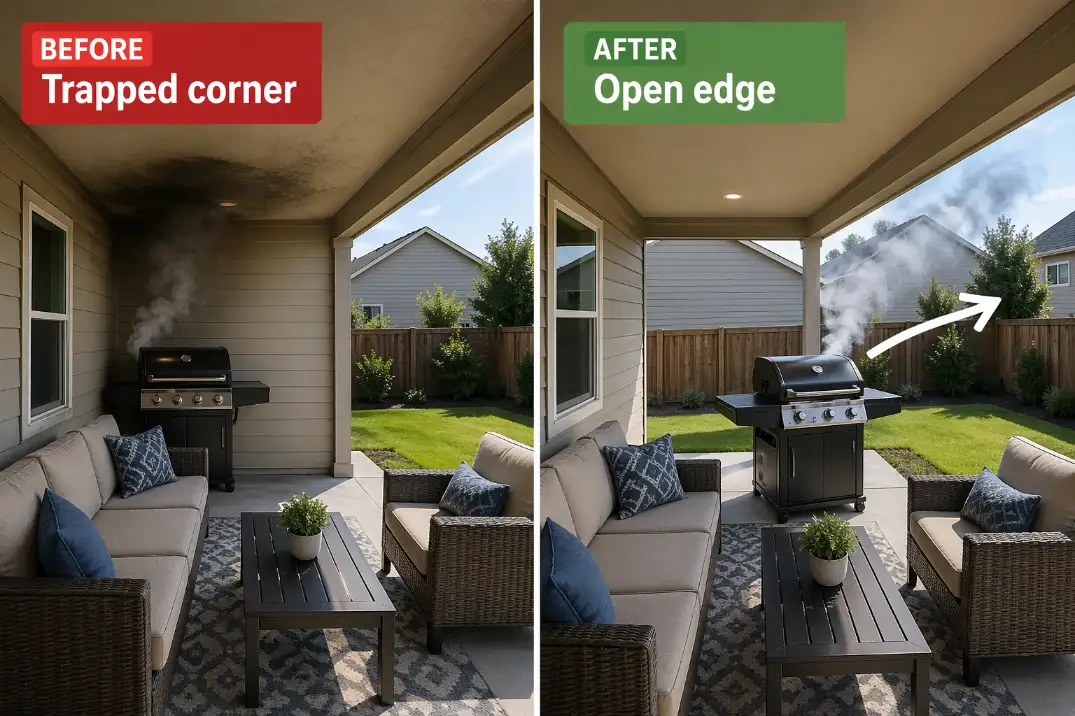
A Better Covered Patio Grill Setup
A better setup gives smoke three things: lift, direction, and distance from people.
Place the grill where smoke rises toward the most open side of the patio. Keep the dining area out of the normal smoke path by at least 6–8 feet when possible.
Avoid placing the grill below low beams, soffits, fabric shades, hanging lights, or decorative ceiling panels. If you use a fan, run it gently enough to guide smoke outward without disrupting the flame.
Pro Tip: Test the grill before hosting by preheating it, opening the lid, and watching the first smoke surge. If smoke crosses the table during that test, it will feel worse during a full meal.
Questions People Usually Ask
Can you grill under a covered patio?
Sometimes, but only when the patio has enough open-air ventilation, safe clearances, and a clear smoke exit. A roof alone is not always the problem. A low roof plus blocked sides is.
Is a gas grill safer under a cover than charcoal?
Usually, gas is easier to manage because it creates less continuous smoke than charcoal or a smoker. But gas still produces heat, grease vapor, flare-ups, and combustion fumes, so it still needs open ventilation and safe placement.
Will a ceiling fan clear grill smoke?
Only if it helps smoke move toward open air. A ceiling fan that stirs smoke under the roof can spread the problem across the entire patio.
Why does the patio smell smoky the next day?
Lingering odor usually means smoke and grease vapor settled onto ceiling surfaces, screens, cushions, or nearby walls. If the smell remains after 24 hours, the patio is not clearing smoke well enough during cooking.
The best fix is not to fight smoke after it collects. Give it a clean route out before it spreads under the cover. A grill near open air, away from low overhead surfaces, and outside the seating path will usually feel cleaner, safer, and more comfortable than the same grill tucked into a convenient corner.
For broader official safety guidance, see the National Fire Protection Association grilling safety page.