
A windy patio usually needs a better layout before it needs more furniture. The quick fix is to find the wind side, turn the most-used seating away from the gust line, and add partial shelter close to the chairs or dining table rather than closing the whole patio.
A 5–8 mph breeze may feel pleasant, but once regular afternoon wind reaches about 12–15 mph, loose napkins, cushions, lightweight chairs, and exposed table settings start showing whether the layout is working.
This is not the same as a shade or privacy problem. Shade comes mostly from above. Privacy blocks a view. Wind comfort depends on the side path of moving air at sitting and dining height.
The best windy patio ideas create one calmer pocket while leaving enough openness for views, airflow, and summer comfort.
Wind Changes How a Patio Feels
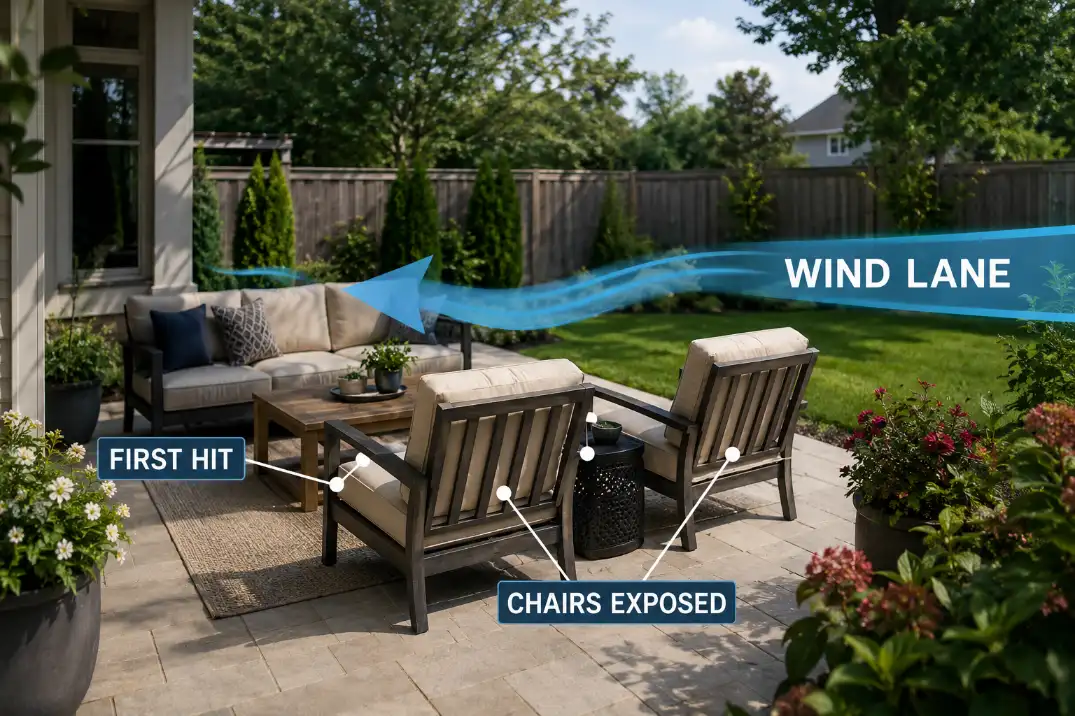
Wind changes a patio by turning open space into a moving path. The mistake is treating the whole yard as windy when the real issue is usually one direct lane crossing the place where people sit, eat, cook, or walk.
The Problem Is Usually the Wind Lane
A blown cushion is only the symptom. The mechanism is often a straight path from a driveway opening, side yard gap, house corner, fence end, open lawn, or neighbor-side break.
When that path crosses chair backs or the center of a dining table, the patio feels restless even if the furniture plan looks balanced.
That is why heavier furniture is rarely the first real solution. It may stop chairs from shifting, but it does not stop cold air from hitting shoulders, table settings from moving, or conversation from feeling exposed.
Corners Make Wind Feel Stronger
House corners and fence ends can make a mild breeze feel sharper. The patio may be calm at 9 a.m. and uncomfortable by 4 p.m. because the afternoon wind direction lines up with an open side.
In many U.S. yards, especially open suburban lots or corner properties, the useful test is not the calmest hour of the day. It is the time people actually want to sit outside.
If cooking sits in the same outdoor room, the issue becomes more specific. A wind lane that only annoys seating can also push smoke, disturb flame control, and make prep space harder to use; that is where Windy Backyard Outdoor Kitchen Mistakes becomes a related layout problem.
The Best Layout Depends on Where Wind Hits
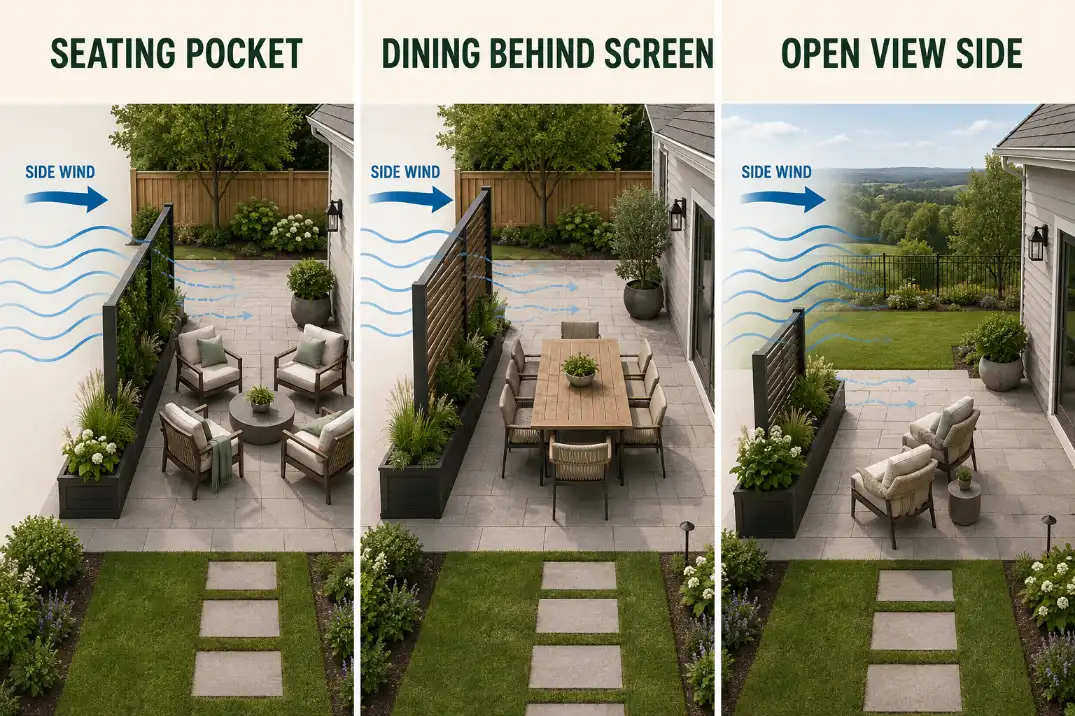
For side wind, place the back of a sectional, bench, or chair group toward the wind side and shelter that edge. For dining wind, move the table behind a partial screen, house corner, or planter line instead of leaving the tabletop in the crosswind.
For a patio with a strong view, protect only the exposed side and keep the view side open.
The most useful windy patio layout is rarely a full enclosure. It is usually a targeted arrangement: seating pocket, protected dining edge, open view side, and clear walking route.
Find the Wind Side First
Before adding screens, trees, curtains, or pergolas, identify the side where wind actually enters the patio. Guessing from the nearest fence is unreliable because wind often enters through a gap rather than across the widest open area.
Use a Short Patio Test
Sit outside for 10–15 minutes during the time you normally use the patio. If the space behaves differently from day to day, repeat the test over 2–3 breezy afternoons before making permanent changes.
Watch lightweight signals: napkins, candle flames, loose cushion edges, leaves, tall grasses, hanging string lights, and smoke from a grill or fire feature.
The question is not simply “Is the yard windy?” The better question is “Does wind cross the place where people sit, eat, or walk?”
Mark the First Hit Point
The first hit point is where wind reaches the patio before it reaches people. It may be the outside corner of a sectional, the back of a dining chair, the side of a lounge pair, or the open end of a covered patio.
That is the point worth protecting first. A screen placed 20 feet away at the fence may soften the yard generally, but it may not calm the chair line if wind reforms around a house corner before reaching the patio.
Seating Needs Shelter
Seating needs shelter at body height, not a windproof wall around the whole patio. The right move is to protect the backs and windward side of the seats people actually use.
Turn the Seating Before Buying More
If a conversation set faces the open wind side, rotate it before adding anything. A sectional back, bench back, or pair of chairs can become the first layer of protection when it faces the wind lane. Then a planter group, low screen, hedge, railing panel, or outdoor storage bench can reinforce that side.
A 30–42 inch high element can help with lower-body comfort. For stronger side wind, a 4–6 foot partial screen may be more useful, especially behind chair backs. The key word is partial. The patio still needs an open side so it does not feel boxed in.
Keep the Route Clear
Shelter should not ruin circulation. Keep about 36 inches for the main walking route from the house to the patio or between seating and the yard. If the screen protects the chairs but pinches the door, stairs, or grill path, the layout has only traded wind discomfort for daily friction.
This is where wind planning overlaps with shade and movement. A patio can be calmer and still fail if the shade structure, seating, and walking path fight each other; the same balance matters in Backyard Layout for Shade, Seating, and Airflow.
Pro Tip: Protect the chair backs first. A small barrier placed directly behind exposed seats often changes comfort more than a larger screen placed along an empty patio edge.
Dining Needs More Protection
Dining is less forgiving than lounge seating. People may tolerate a breezy chair for 20 minutes, but a dinner table needs steadier conditions for plates, drinks, napkins, serving pieces, and conversation.
Move the Table Out of the Crosswind
The weakest dining layout is a table placed broadside across the wind lane. That exposes the tabletop and the chair backs at the same time. If the patio allows it, rotate the table so the narrow side faces the wind.
Better yet, move the table slightly behind a house corner, half screen, planter wall, or outdoor cabinet line.
A shift of even 3–5 feet can change whether wind cuts through the center of the meal or brushes past the outer edge. That small move often matters more than adding decorative tabletop weights or heavier plates.
Do Not Crowd the Chairs
Dining still needs pullback room. Most outdoor dining chairs need about 24–30 inches behind them so people can sit down and stand up without scraping a wall, screen, planter, or railing. If people also pass behind the chairs, the space should be closer to a full walking route.
This is where many windy patio fixes become too tight. A protected table is not successful if the screen makes every chair awkward.
| Patio situation | Most likely wind problem | Better layout move | Weak fix to avoid |
|---|---|---|---|
| Lounge seating | Wind hits chair backs | Turn backs toward wind and add partial shelter | Buying heavier chairs only |
| Dining table | Wind crosses tabletop | Move table behind a side barrier or rotate it | Relying on small decor planters |
| Grill area | Flame and smoke shift | Keep cooking out of the main gust line | Screening too close to heat |
| Entry path | Screen blocks movement | Keep about 36 inches clear | Protecting comfort but killing access |
| Open-view patio | Shelter blocks the best view | Protect one side and leave the view side open | Building a full wall |
Screens Without Closing In
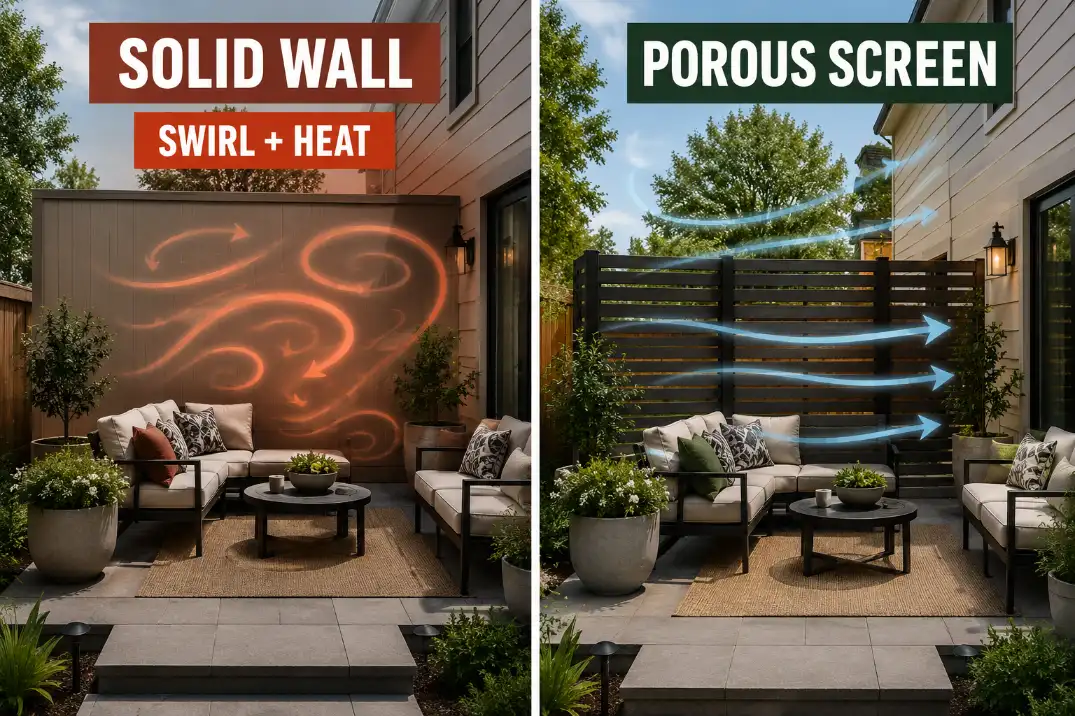
A patio wind screen should slow the direct hit, not turn the outdoor room into a box. The common overcorrection is adding a tall solid barrier that blocks wind in one direction but makes the space hotter, darker, or more turbulent around the ends.
Porous Often Beats Solid
For patio comfort, semi-open screening is often better than a flat solid wall. Slatted panels, layered planting, open trellis sections, staggered planters, and mixed-height shrubs can slow wind while keeping the patio breathable.
A practical target is a screen that feels roughly 40–60 percent open rather than completely blank. This does not mean every patio screen needs a technical density calculation. It means the screen should interrupt the wind lane without behaving like a hard stop that forces air to curl around the edges.
In hot climates such as Arizona or inland California, closing a patio too tightly can make afternoon heat worse. In humid regions such as Florida or the Gulf Coast, too much enclosure can reduce drying after rain and make the space feel heavy.
Place the Screen Near the Use Zone
A screen near the wind side of the seating or dining area usually works harder than a screen placed far away at the fence. For most patios, start within about 2–6 feet of the exposed chairs or table edge. That gives the screen a direct job.
Privacy screens can help, but privacy and wind control are not identical. A screen that blocks a neighbor’s view may sit too far away or too high to calm the seated zone. Wind protection needs the targeted, use-zone thinking that also matters in Patio Privacy Ideas for Secluded Seating.
Calm Enough to Stay Outside
A windy patio does not need to become still. A patio with no air movement can feel worse in summer, especially under a roof or beside heat-reflective walls.
The better target is “calm enough”: seating that feels usable, dining that does not fight the table settings, and screens that soften wind without sealing the space.
Choose the Layout by Situation
The strongest layout is the one that protects the use zone without overbuilding the whole patio.
For a side-wind patio, create a seating pocket with chair backs toward the wind and a planter or partial screen behind them. For a dining patio, move the table behind a windward screen or house corner and keep chair pullback clear.
For a patio with a view, protect the exposed side only and keep the view side open.
For a covered patio, be more careful. Side screening can help, but too much enclosure can trap heat, humidity, smoke, or stale air. That risk is especially important if the patio already has a roof, which is why Covered Patio Ventilation Mistakes is a useful related check.
When Loose Screens Stop Making Sense
Freestanding panels, outdoor curtains, lightweight planters, and movable shade pieces are layout tools, not storm hardware. They make sense when the patio is mildly exposed and you need to soften a regular breeze.
They stop making sense when gusts repeatedly lift cushions, push umbrellas, move panels, or make dining unusable.
If regular gusts are above about 15–20 mph during the hours you want to use the patio, the fix may need to become structural: anchored screens, heavier built-in planters, a pergola with selective side protection, a more sheltered patio zone, or a different use pattern during windy seasons.
Upper-level spaces need extra caution because wind is usually stronger and less interrupted above the yard. If the patio is actually a raised deck or second-story outdoor area, the decision pattern is closer to Upper-Level Deck Layout for Wind, Shade, and Views than to a ground-level patio.
Use This Final Patio Check
- Find the wind side during the time you actually use the patio.
- Protect chair backs before protecting empty edges.
- Keep about 36 inches of clear walking route.
- Give dining chairs about 24–30 inches of pullback room.
- Start screens within about 2–6 feet of the exposed use zone.
- Use porous or offset screening before defaulting to a full solid wall.
- Retest the layout after 2–3 breezy afternoons before building anything permanent.
Questions People Usually Ask
What is the best patio layout for wind?
The best layout places the most-used seating or dining area just behind partial shelter on the windward side. For seating, that often means turning chair backs toward the wind and adding a planter, screen, hedge, or bench behind them.
For dining, it usually means moving the table out of the crosswind instead of trying to weigh everything down.
Are solid patio wind screens better than slatted screens?
Not always. Solid screens can block one direction, but they can also make a small patio feel closed in and cause wind to swirl around the ends. Slatted, planted, or semi-open screens often work better for everyday comfort because they slow wind without removing all airflow.
How tall should a patio wind screen be?
For seated comfort, a 30–42 inch element can help at lower body level, while a 4–6 foot partial screen is more useful for stronger side wind. Height matters less than placement. A modest screen close to the exposed chairs often works better than a taller screen far away at the fence.
A windy patio becomes usable when the layout stops fighting the whole yard and starts protecting the exact place where people sit, eat, and move.
For broader official guidance on how windbreaks slow wind and improve outdoor shelter, see the USDA National Agroforestry Center.