
Outdoor dining noise problems usually start with table placement, not with the lack of a taller fence. If the table sits in a direct line between traffic, pool equipment, a neighbor patio, or a side-yard sound corridor, the meal zone will feel busy even after plants, panels, or water features are added.
The first checks are simple: where the sound enters, which chairs receive it first, and whether moving the table 3 to 6 feet changes the feeling more than adding another object.
A normal outdoor dining area can tolerate some background sound. The problem begins when conversation has to rise after 10 to 15 minutes, chairs closest to the noise edge feel less comfortable, or guests naturally pull inward toward the house wall or planted side.
That is different from a privacy problem. Privacy is about being seen. Dining noise is about whether people can stay at the table without the space constantly asking for attention.
Outdoor dining noise usually improves fastest when the table is moved out of the direct sound path, the exposed chair backs are protected with a partial screen, and any water or soft sound is placed close to the dining edge.
Start with a 3- to 6-foot table move before buying a taller barrier. If the same chairs still feel loud after the move, the problem is no longer general yard noise; it is a fixed listening-side exposure problem.
Dining Needs More Calm
Outdoor dining is less forgiving than lounging because people face each other, talk across a table, and stay in one spot for 30 to 90 minutes. A lounge chair can turn away from a road or fence line. A dining chair usually cannot. Once the table is placed, every seat inherits the same exposure pattern.
The useful test is conversation effort
The clearest signal is not whether the yard is “noisy” in general. It is whether normal conversation still works at the table. If people across a 36- to 42-inch table start repeating themselves, the dining zone is already too exposed. A larger 72-inch table makes this worse because the farthest voices have to cross more open air.
This is why a dining patio beside a busy street, shared fence, or pool equipment corner can feel worse than a lounge area in the same yard. The sound is not just present. It cuts across the social center of the space.
What people misread first
People often blame the table, umbrella, or hard patio surface first. Those can contribute, but they are usually symptoms of exposure, not the underlying mechanism. The more important question is whether sound has a straight route into the chair backs and across the table.
A big umbrella may make the area feel visually complete, but it does very little for lateral noise. A rug may soften chair scrape and foot sound, but it will not fix traffic noise entering from an open edge.
For a broader noise-layering approach beyond dining, Outdoor Noise Buffer Ideas is the closer supporting fix than simply adding more patio decor.
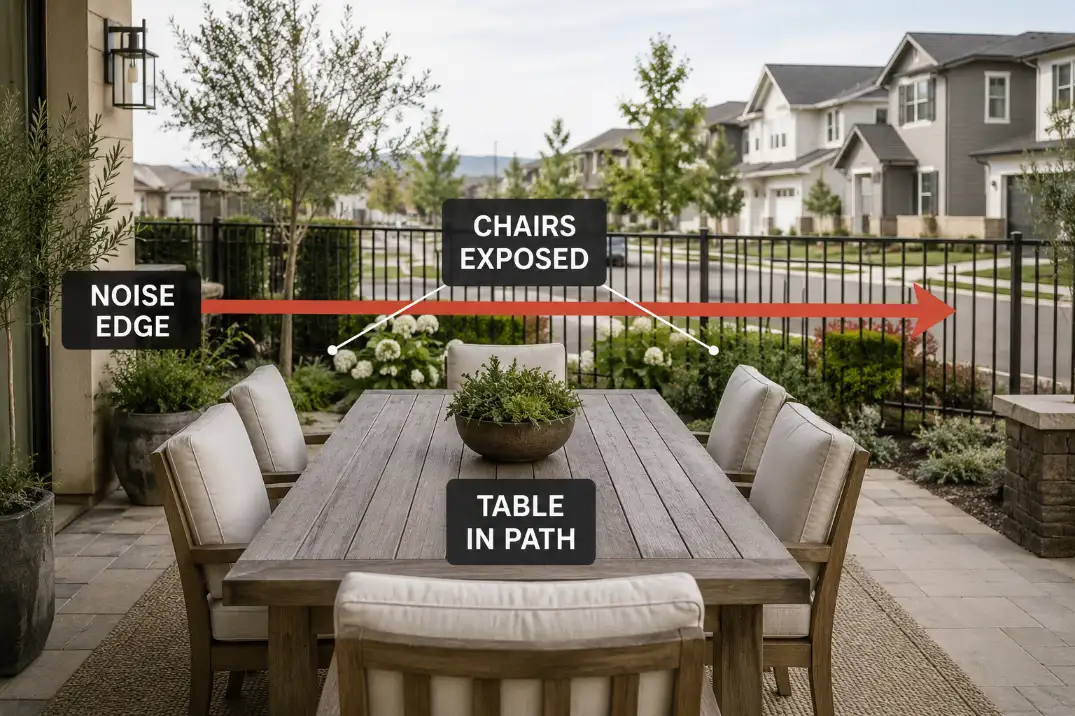
The Table Is Often Too Exposed
If the loudest chairs sit within about 6 feet of the open edge, fix the table’s exposure before shopping for a taller barrier. The common mistake is treating the table as furniture that belongs in the largest open rectangle.
That can make sense for walking clearance, but it often puts the dining zone exactly where sound is most active.
Open edges matter more than open square footage
A 10-by-12-foot patio can dine better than a 16-by-20-foot patio if the smaller patio has one protected side and the larger one leaves the table floating near a street, driveway, or shared fence. For dining comfort, the first 4 to 8 feet around the chairs matter more than the total patio size.
The worst spot is usually not the center of the patio. It is the center of the exposed path: between the house and a fence gap, beside the driveway opening, near the pool equipment corner, or close to the side where neighbors gather.
If the table is within about 6 feet of that active edge, the closest chairs become the weak seats.
The chair-back rule
Outdoor dining noise is usually a seated-listening problem, not a whole-yard problem. Screens work best behind the chairs that receive sound first.
That means the screen usually belongs behind the listening side, not randomly along the prettiest border. A screen placed 8 feet away on the wrong side may improve the view but barely change dining comfort.
This is also where privacy and noise overlap. A patio may need visual seclusion, but dining calm depends on blocking or softening the path that reaches seated ear level, usually about 3 to 4 feet above the patio.
For layouts where the dining area also feels too visible, Patio Privacy Ideas for Secluded Seating connects the visual and comfort sides of the problem without turning the patio into a closed box.
When the patio itself makes sound sharper
Sometimes the table is not only exposed; the patio is also reflecting sound. Bare concrete, large paver fields, smooth walls, metal pergolas, and hard covered ceilings can make voices, traffic, and mechanical hum feel more lively around the meal zone.
That is not the same as the original noise path. It is the patio holding onto sound after it arrives.
This is where people often overestimate one dramatic barrier and underestimate small softening moves.
A nearby planting bed, outdoor rug, slatted screen, fabric shade edge, or textured planter group will not soundproof the space, but it can reduce the hard, sharp feeling that makes a dining patio tiring after 20 minutes.
Move the Meal Zone First
The highest-value fix is often moving the table before buying anything. That sounds too simple, but it is the step people skip because the table already “fits” where it is.
A small move can outperform a large screen
Move the table 3 to 6 feet away from the noise edge and recheck the worst chairs. If the exposed seats feel noticeably calmer, the layout was the main problem. If the space still feels sharp after a 6-foot move, the noise path needs a screen, planting layer, or sound cover.
This test prevents a common waste: adding a decorative screen beside a table that should have been shifted first. A 5-foot panel in the wrong place can look useful while doing less than a 4-foot table move behind an existing hedge, wall, house corner, or planter group.
Pro Tip: Test the table position during the actual problem window, not at noon on a quiet weekday. Dining noise often peaks between 5 p.m. and 8 p.m.
Keep service and walking space intact
Do not solve noise by pinching the patio. Dining chairs need pull-back room. A useful working target is 30 to 36 inches behind chairs for normal movement, and more if that path also connects to a grill, back door, or side yard. If noise control turns every meal into chair shuffling, the fix has failed.
This is especially important on small patios where the dining table, grill, and door swing compete for the same space. If the table also interferes with cooking flow, Small Patio Grill Placement Near a Dining Area is a better companion issue than adding another screen around the table.
| Dining noise source | First fix to test | When that fix is not enough |
|---|---|---|
| Street or driveway noise | Move the table behind a house corner, planter, or partial screen | The same chairs stay loud after a 3- to 6-foot move |
| Neighbor patio voices | Screen behind the exposed chair backs | Voices still cross the table at seated ear level |
| Pool pump or HVAC hum | Move the meal zone away from the equipment side | Steady hum remains obvious after layout changes |
| Hard covered patio echo | Add softer edges before taller barriers | Sound still feels sharp after 20 minutes |
| Open fence gap beside dining | Close or offset the direct path | The gap still lines up with the table center |
Screens Behind the Chairs
A dining screen should not be treated like a wall around the entire patio. The best screen is often the one behind the exposed chair backs, not the tallest screen on the property line.
Partial screens are usually enough
For most outdoor dining noise problems, a partial screen behind the exposed side is more useful than surrounding the whole dining zone. A screen around 4 to 6 feet tall can interrupt seated-level sound and reduce the feeling of exposure without making the patio feel boxed in.
The material matters less than placement. Wood slats, dense planters, mixed shrubs, and freestanding panels can all help if they sit close enough to the dining edge and cover the direct path. A beautiful screen on the far property line may be too distant to change the meal zone.
Do not trap the table
The standard fix stops making sense when the screen begins to make the dining area hotter, tighter, or harder to use. In humid areas such as Florida, enclosing three sides of a dining patio can make evening meals feel sticky even if the sound improves.
In dry, hot places such as Arizona, a solid screen that blocks airflow can make radiant heat linger around the table after sunset.
That is the condition people underestimate: comfort is not only sound. It is sound plus airflow, shade, space, and easy movement.

Sound Cover Without Clutter
Use sound cover only after the table is out of the direct path; otherwise the fountain has to work too hard and becomes another noise source.
Water, planting texture, and soft background sound are finishing layers. They should support the corrected meal zone, not compensate for a table that is still sitting in the loudest line.
Water works when it is close enough
A small fountain across the yard rarely changes dining comfort. A steady water feature within about 6 to 10 feet of the dining edge can soften intermittent road noise, neighbor voices, or mechanical hum better than a distant feature.
The goal is not to overpower the yard. It is to give the ear something steadier to rest on.
Water features mask noise; they do not replace table relocation or a partial barrier when the table sits in the direct sound path.
For choosing the right kind of sound layer, Best Outdoor Water Features for Softening Yard Noise fits this decision better than treating water as decoration.
Avoid fixes that compete with dinner
Some outdoor sound fixes become annoying at the table. A splashy fountain too close to plates, a speaker that needs constant volume changes, or a dense cluster of planters that blocks chair movement can all make the dining area feel busier, not calmer.
A good dining sound layer should pass this test: after 20 minutes, people should stop noticing it. If the feature draws attention every few seconds, it is entertainment, not background comfort.
Pro Tip: If a fountain has to be loud enough to interrupt conversation, the layout still needs a barrier or table move first.
A Quieter Place to Stay Longer
The finished dining zone should not feel sealed off. It should feel like the loudest edge has been moved away from the table.
The calm-side layout
The strongest layout usually has three parts: the table shifted out of the direct path, a partial screen behind the exposed chairs, and a soft sound or planting layer near the noise edge. This lets the dining area stay open while giving the most vulnerable seats protection.
In backyards where the main disturbance comes from a shared fence, the same logic applies: find the listening side first, then protect the chairs, not the whole yard. Backyard Neighbor Noise Solutions is useful when the problem is less about the patio shape and more about where neighbor sound repeatedly enters.
Quick dining noise checklist
- Move the table 3 to 6 feet before adding a new screen.
- Protect the chair backs that face the loudest edge.
- Keep 30 to 36 inches of pull-back and walking space behind chairs.
- Test comfort during the real noisy window, often 5 p.m. to 8 p.m.
- Use water or soft sound within 6 to 10 feet only after the layout is improved.
- Add softer surfaces if a hard patio still feels sharp after 20 minutes.
- Avoid enclosing the table so tightly that airflow, shade, or serving access gets worse.
When a bigger fix is justified
A bigger screen, denser planting, or more permanent barrier makes sense when the table cannot move, the noise source is fixed, and the same chairs stay uncomfortable after smaller changes.
That is common beside a close road, a neighbor’s outdoor dining area, or pool equipment that runs during meals.
But if only one chair feels exposed, do not redesign the whole patio. Fix the weak seat. A targeted planter, offset panel, or table rotation may do more than a full boundary screen.

Questions People Usually Ask
Will a fence solve outdoor dining noise?
A fence can help if it interrupts the direct path between the noise source and seated diners. It disappoints when it is too far away, too low for seated ear level, or placed on a boundary that is not the real noise path.
Is planting enough around an outdoor dining area?
Planting helps most when it adds depth, texture, and a psychological buffer near the exposed side. Thin planting alone rarely fixes a strong traffic or equipment noise problem, but layered planting plus a better table position can make the dining zone feel much calmer.
Should the water feature go beside the table?
Near the table, yes, but not on top of it. A useful water feature is close enough to soften the dining edge and far enough that splashing, glare, or pump sound does not compete with conversation.
For broader official context on how unwanted sound affects daily life, see the EPA noise pollution overview.