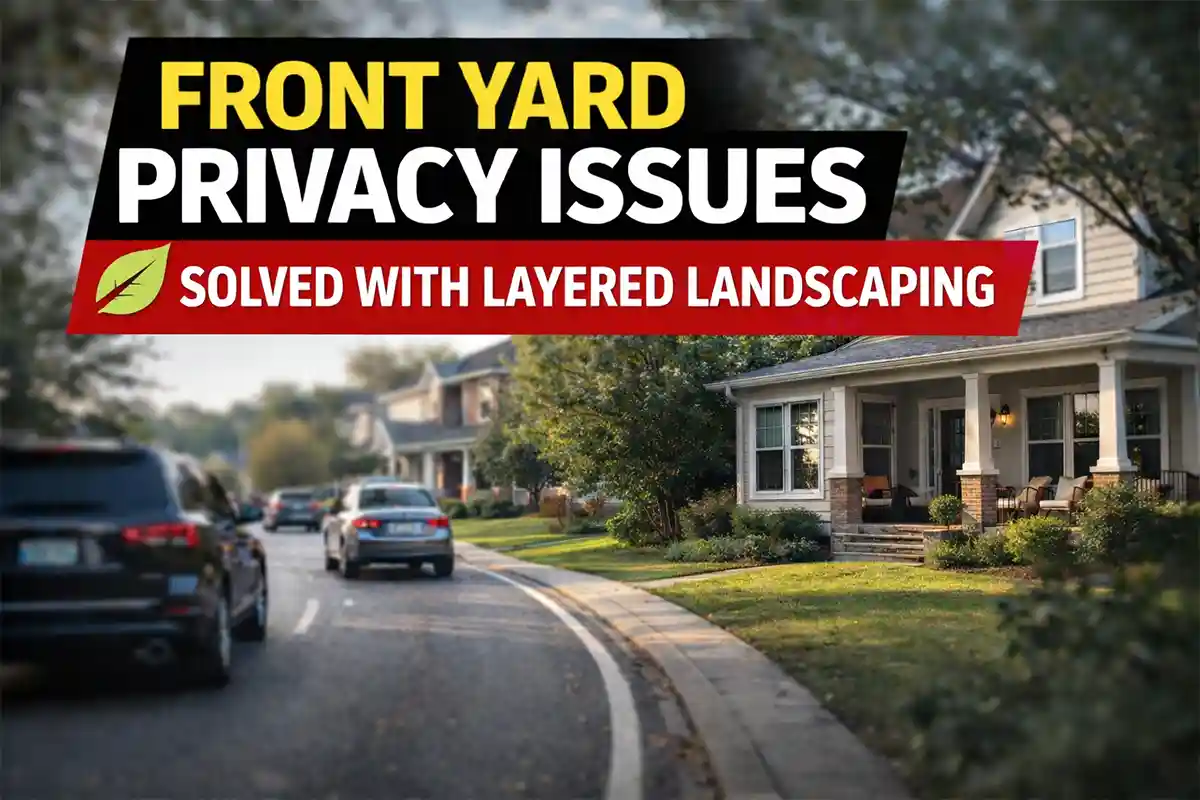
Homes located at the entrance of a neighborhood often experience a level of visibility that most suburban properties never encounter. Every vehicle entering or leaving the street passes directly in front of the house, which naturally increases visual exposure. Drivers slow down to turn, visitors scan house numbers, delivery trucks pause near the entrance, and pedestrians frequently cross the same corner.
In many residential developments, entrance homes receive two to five times more visual traffic than houses located deeper inside the neighborhood. This constant movement creates long sightlines that can extend 100–180 feet from the intersection, allowing drivers to see directly into front yards, porches, and even living room windows.
The most reliable way to reduce this exposure is through layered landscape buffering. Instead of relying on a single hedge or fence, effective privacy designs combine small trees, medium shrubs, and lower planting layers that interrupt sightlines at multiple heights. When properly arranged, these landscape layers can reduce visibility into the yard by 40–70 percent within two to three growing seasons.
Strategically placing these plant layers between 8 and 18 feet from the curb allows homeowners to break the visual corridor created by the street entrance while still maintaining a welcoming front yard.
Why Entrance Homes Lose Privacy
Most suburban streets are designed so that the first home inside the neighborhood becomes a visual focal point. As drivers approach the entrance, their field of view naturally expands toward the inside of the turn. The first house therefore sits directly within the driver’s line of sight.
Unlike interior homes where visibility is broken by other houses, parked vehicles, and street trees, entrance homes face an open visual corridor. In some neighborhoods this corridor can extend more than 150 feet, allowing drivers to see the entire front yard before they even enter the street.
This condition is especially noticeable in developments where the front yard setback is small. When homes sit only 20–30 feet from the curb, the porch and front windows often remain fully visible from the roadway.
Privacy problems like this also appear in other high-exposure front-yard scenarios. For example, houses located near heavy pedestrian paths often experience similar visibility patterns, which are discussed in
How to Create Front Yard Privacy on a Busy Walking Route.
Traffic Behavior at Neighborhood Entrances
Understanding how drivers move through neighborhood entrances explains why these homes receive so much visual attention.
Most residential streets allow speeds of 25–35 mph, but drivers typically slow to 10–15 mph when turning into a subdivision. This reduction in speed increases the amount of time drivers spend looking toward the entrance area.
Several common behaviors amplify this effect:
• Drivers checking for pedestrians or cyclists
• Visitors searching for house numbers
• Delivery trucks stopping near the entrance
• Drivers waiting for oncoming traffic before turning
Because these actions occur directly in front of entrance homes, the yard becomes a temporary observation point for anyone entering the street.
A similar pattern occurs at intersections where traffic slows or pauses before moving forward. Homes facing those intersections experience comparable privacy issues, as explained in
Fixing Front Yard Privacy Issues for Homes Facing Constant Traffic at a Stop Sign or Intersection.
How Sightlines Form at Street Entrances
Privacy challenges at neighborhood entrances are largely the result of sightline geometry.
When a vehicle turns into a residential street, the driver’s line of vision follows a curved path along the inside edge of the road. If the first house sits near that curve, the yard becomes visible from multiple angles.
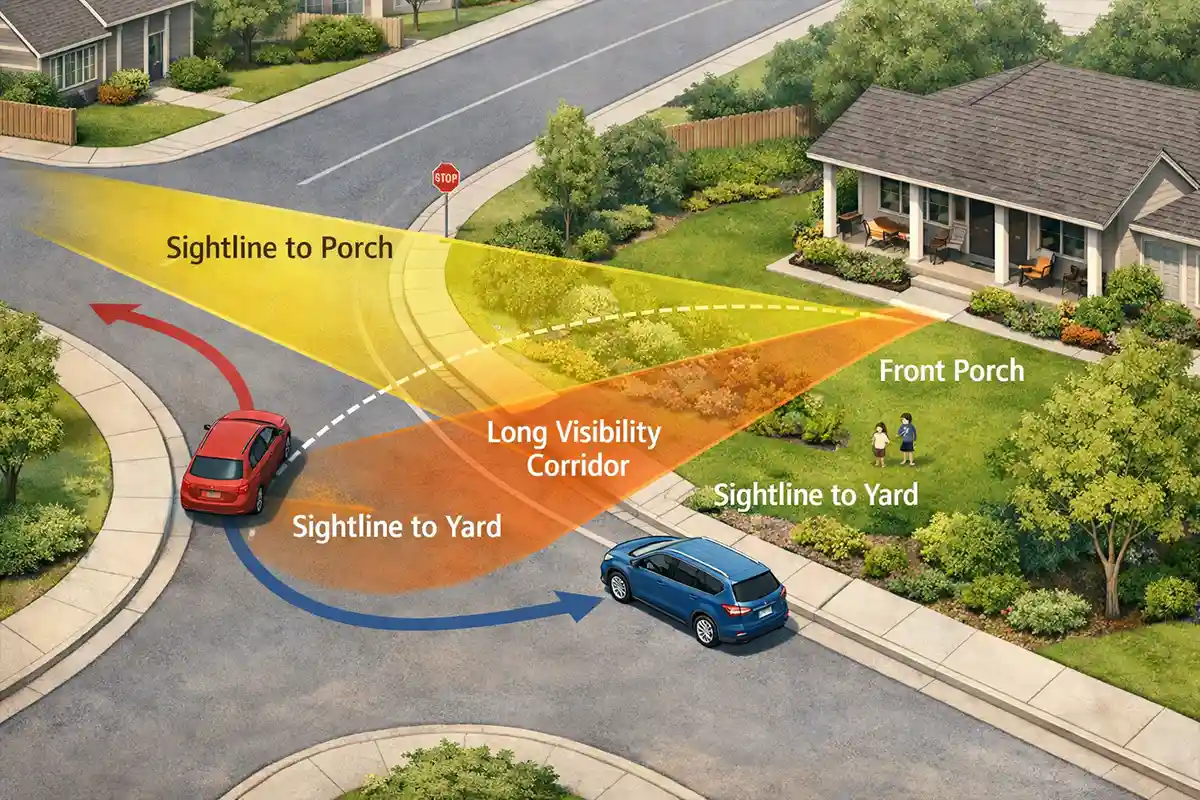
Several geometric factors influence this effect:
| Factor | Impact | Typical Range | Result |
|---|---|---|---|
| Turning angle | Expands viewing corridor | 25–45° | Wider yard visibility |
| Entrance road width | Longer sightlines | 24–36 ft | Drivers see deeper into yard |
| Front yard setback | House closer to road | 20–35 ft | Windows visible from street |
| Landscaping density | Interrupts sightlines | varies | Reduces visual exposure |
Because these elements combine differently in every neighborhood, entrance homes can experience widely varying levels of privacy exposure.
Environmental and Layout Factors That Increase Visibility
The severity of privacy issues at neighborhood entrances often depends on environmental conditions and landscape structure.
In warm regions such as Florida, rapid plant growth can help form dense shrub screens that naturally block sightlines. However, coastal humidity and heavy rainfall may require regular trimming to maintain those screens.
In contrast, dry desert regions like Arizona face the opposite challenge. Drought-tolerant landscapes often use sparse planting layouts, which can leave yards visually exposed unless larger shrubs or small canopy trees are introduced.
Cold northern climates also introduce seasonal changes. Deciduous shrubs may provide strong screening during summer but lose most of their leaves once winter temperatures drop below 32°F, reducing privacy for several months each year.
In addition to climate, several structural factors influence visibility.
| Condition | Visibility Impact | Likelihood |
|---|---|---|
| Wide entrance intersections | High exposure | High |
| Corner lot positioning | Multiple viewing angles | Medium |
| Sparse developer landscaping | Minimal screening | High |
| Low front-yard setback rules | Windows closer to street | Medium |
These conditions often combine with other front-yard privacy problems, such as homes located next to sidewalks or bike lanes. In those cases, the visibility pressure increases even further, similar to situations described in
Front Yard Privacy Problems Near Sidewalks and Bike Lanes.
Diagnostic Checklist for Entrance-Lot Privacy Problems
Use the following checklist to determine whether your property is affected by entrance-related visibility.
• Your home sits within 60–120 feet of the neighborhood entrance
• Vehicles frequently slow or pause in front of the house
• Drivers have a clear view of your porch or windows from the road
• Delivery vehicles stop near the entrance several times per day
• Headlights sweep across your windows at night
• Visitors occasionally turn around or park near your yard
If three or more of these conditions apply, the location of your home is likely creating a structural privacy challenge that requires landscaping adjustments.
Step-by-Step Landscape Privacy Strategy for Entrance Homes
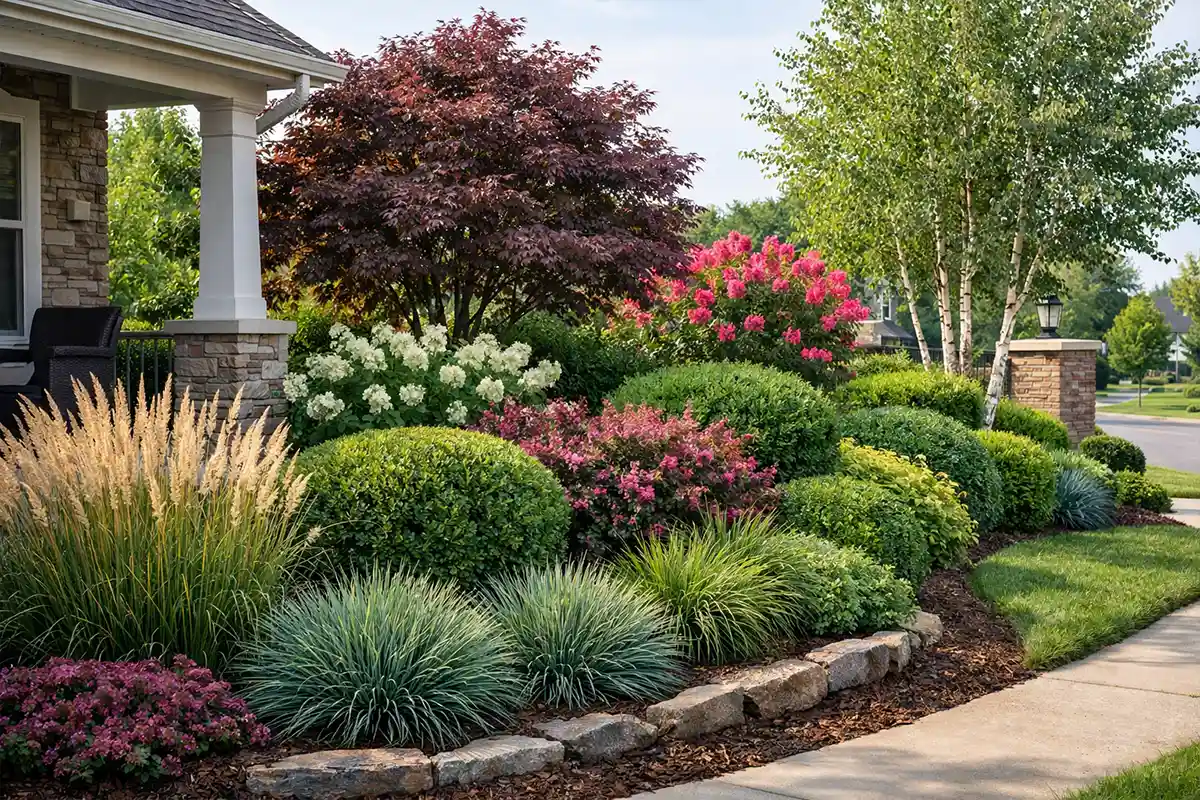
Once you understand why entrance homes experience constant visibility, the next step is building a landscape layout that interrupts those sightlines. The key principle is layered screening. Instead of relying on one hedge or barrier, effective privacy design uses multiple plant heights to break visual lines from different angles.
A practical layout typically includes three planting zones positioned between the street and the house.
Zone 1 — Street Edge Layer (0–10 feet from curb)
Low plantings help disrupt ground-level views without making the yard feel closed off. Ornamental grasses or compact shrubs around 2–3 feet tall work well in this zone.
Zone 2 — Mid-Height Privacy Layer (10–18 feet from curb)
This is the primary screening area. Dense shrubs between 4–6 feet tall reduce direct visibility into the yard while maintaining an open appearance.
Zone 3 — Upper Canopy Layer (15–25 feet from curb)
Small ornamental trees create overhead filtering that blocks views from vehicle angles and second-story sightlines.
Together these layers create a visual barrier system that breaks the corridor created by the entrance street.
Homes located on exposed suburban streets often rely on the same layered planting technique described in
Front Yard Landscaping for Privacy Without Fences.
Recommended Plants for Entrance-Lot Privacy
Plant selection plays a major role in how quickly privacy improves. Ideally, species should grow dense foliage, tolerate local climate conditions, and reach screening height within 3–5 years.
Below are several plant groups commonly used across the United States.
| Plant Type | Typical Height | Climate Suitability | Privacy Benefit |
|---|---|---|---|
| Viburnum varieties | 6–12 ft | Southeast / Midwest | Dense shrub screens |
| Wax Myrtle | 10–15 ft | Coastal & humid climates | Fast evergreen growth |
| Holly (Ilex species) | 8–20 ft | Broad US range | Year-round privacy |
| Serviceberry trees | 15–25 ft | Northern & Midwest | Light canopy screening |
| Crape Myrtle | 12–20 ft | Southern states | Decorative tree canopy |
| Boxwood shrubs | 3–6 ft | Moderate climates | Structured hedge layer |
In humid regions such as Florida or the Gulf Coast, fast-growing shrubs like wax myrtle can form dense privacy barriers in 2–4 growing seasons. In drier climates such as Arizona or inland California, drought-tolerant plants like Texas sage or desert willow may provide better long-term screening with lower irrigation needs.
Plant diversity also improves visual texture and prevents the uniform “hedge wall” effect that many suburban developments discourage.
Solving the Headlight Visibility Problem
Entrance homes often experience another issue that many homeowners do not anticipate: headlight glare. When cars turn into the neighborhood at night, headlights can sweep across the front yard and shine directly into windows.
This occurs because turning vehicles create a temporary light beam aimed toward the inside of the corner. If the first house sits within that angle, the windows may receive direct illumination for several seconds.
Several landscape features help reduce this effect:
• evergreen shrubs positioned 6–10 feet from the curb
• dense ornamental grasses planted in clusters
• small trees placed along the vehicle turning arc
Evergreen species are particularly helpful because they maintain foliage during winter months when headlights are most noticeable.
Headlight exposure is also common in homes facing heavy road traffic, which is explored further in
Fix Front Yard Privacy When Windows Face a Busy Road.
Common Privacy Design Mistakes at Neighborhood Entrances
Many homeowners attempt quick solutions that unintentionally leave large visibility gaps. Entrance homes require more strategic planting because traffic approaches from multiple angles.
| Mistake | Why It Fails | Better Approach |
|---|---|---|
| Single hedge line | Leaves upper sightlines open | Add tree canopy layer |
| Tall fence near curb | Often restricted by HOA rules | Use staggered planting beds |
| Small decorative plants | Too low for screening | Choose shrubs above 4 ft |
| Symmetrical planting | Creates predictable gaps | Use irregular plant clusters |
| Isolated trees | Large open spaces between trunks | Combine shrubs and canopy trees |
These mistakes are similar to broader landscaping design errors that can reduce both privacy and property value. Many of those problems are explained in
Front Yard Landscaping Mistakes That Lower Home Value.
Privacy Buffer Layout Example
A typical entrance-lot privacy layout might include:
• 3–5 medium shrubs per 10 feet of planting bed
• 2–3 ornamental trees across the front yard
• planting depth between 6–10 feet from the sidewalk or curb
• staggered spacing between 4–8 feet depending on species
With proper spacing and irrigation, these layers can reduce visible sightlines into the front yard by approximately 50–70 percent within three growing seasons.
Spacing must account for mature plant width, which commonly ranges between 5 and 12 feet depending on the shrub or tree variety.
Some homes combine these strategies with broader landscape buffers similar to the methods described in
How to Create a Privacy Buffer in a Suburban Yard Step by Step.
Frequently Asked Questions
Are entrance homes always harder to make private?
Not necessarily. Homes within 80–120 feet of the neighborhood entrance typically experience the greatest visibility. Properties further inside the street usually benefit from natural screening created by other houses and street trees.
Do fences solve entrance-lot privacy problems?
Front-yard fences are often restricted to 3–4 feet tall in many suburban communities. Because drivers sit higher than that height, fences rarely block sightlines as effectively as layered landscaping.
How long does privacy landscaping take to work?
Fast-growing shrubs usually reach effective screening height in 18–36 months, although full canopy development may take 3–5 years depending on climate conditions.
Can entrance landscaping improve property value?
Yes. Homes with well-designed front yards often benefit from improved curb appeal and perceived privacy. Research from the University of California Agriculture and Natural Resources notes that layered planting structures can significantly improve both visual comfort and residential landscape function.
Key Takeaway
Homes located at the entrance of a neighborhood naturally attract attention from passing traffic. Drivers slow down, turn toward the street, and often look directly at the first house they encounter. Without landscaping buffers, this positioning can leave front yards fully visible from the road.
The most effective solution is a layered landscape strategy combining shrubs, small trees, and planting depth. By interrupting sightlines at multiple heights and angles, homeowners can dramatically reduce exposure while preserving an attractive and welcoming front yard.