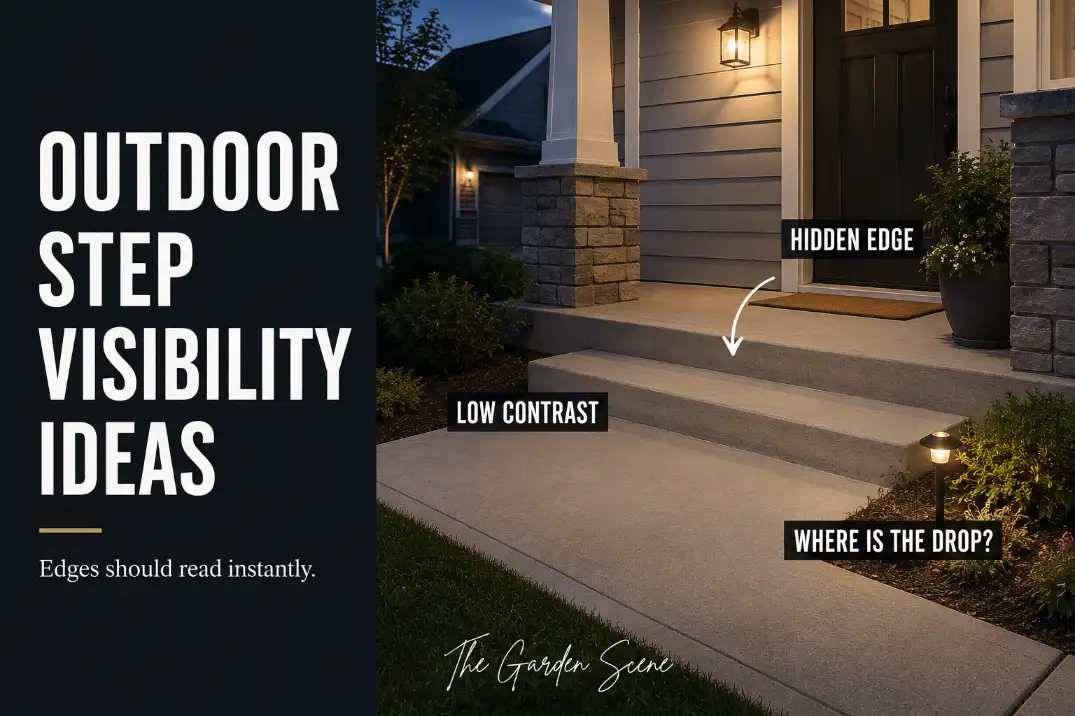
Outdoor step visibility is not mainly about making the whole entry brighter. It is about helping the eye find the level change fast.
The right order is simple: define the step edge, create contrast, aim light across the walking line, then remove anything that hides or confuses the edge.
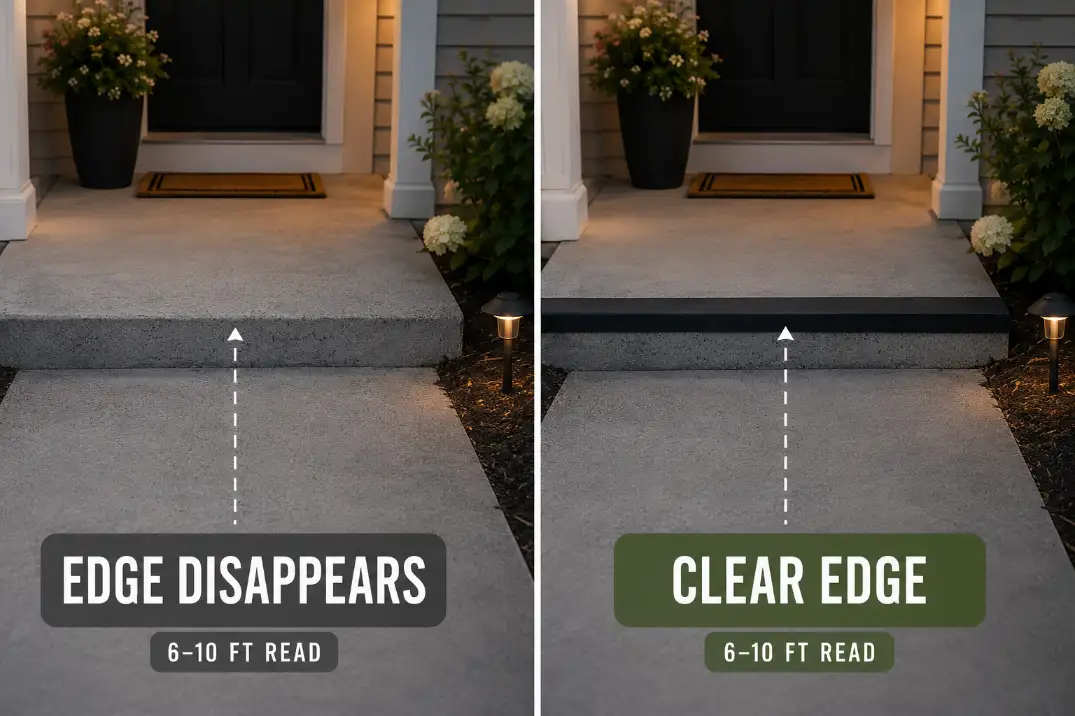
A step should read from 6–10 feet away and make sense within 1–2 seconds. If a visitor slows within 3 feet because the tread, riser, landing, and walkway all blend together, the step is already asking too much.
This is different from a slippery-step problem. A tread can have good grip and still feel unsafe if the edge disappears, especially 30 minutes after sunset or during rain.
More Contrast, Less Guessing
The first visibility upgrade should make the level change obvious before the foot reaches it. In most entries, that means improving the edge line, not repainting everything around it.
The edge matters more than the full tread
The useful visual cue is usually the front 1–2 inches of the step. That is where the foot crosses from one level to another. If that narrow line disappears into matching concrete, dark stone, gray pavers, or porch shade, the eye has to guess where the landing ends.
A lighter strip on a dark tread, a darker nosing on pale concrete, or a textured tread with a defined front edge can all work. The strongest choice depends on the surface already there.
Contrast is not about picking a “safe color.” It is about making the edge stand apart from both the tread and the landing.
If the step is also slick when wet, visibility should not be treated as a separate cosmetic layer. A tread or edge treatment that improves both grip and definition may be more practical, especially on front entries used in rain.
That overlap is where Best Non-Slip Step Treads for Outdoor Entries becomes the more useful next decision.
Matching finishes can make the step worse
One of the most common mistakes is making the porch, walkway, riser, and landing look perfectly continuous. That can feel clean in daylight photos, but it removes the break that helps people read the level change.
The overestimated condition is visual smoothness. The underestimated condition is separation. A slightly stronger edge line usually improves real use more than a perfectly blended entry.
Steps Should Read Fast
A visible step should not require a guest to study the ground. It should announce the level change from the normal approach path and again from the porch when someone is leaving.
Test the step from both directions
Most homeowners check steps while walking toward the front door. That is only half the problem. A person stepping down from the porch may see the first drop from above, with the tread edge partly hidden by shadow, a doormat, or the landing surface.
Use a quick three-second test from both directions. Stand where a delivery driver approaches, then stand on the landing as if leaving the house.
In each position, check whether the first rise, the top tread, and the bottom landing are clear without leaning forward.
For entries used by visitors, packages, and night arrivals, the step is part of the larger front route. If the walkway already has confusing turns, poor lighting, or a hidden landing, Front Walkway Safety for Visitors and Deliveries is a better way to think about the whole arrival sequence instead of only the porch step.
Better edge light beats brighter general light
A brighter porch light can still fail if it sits behind the person and throws the step face into shadow. Small path lights can also miss the point if they illuminate mulch and plants while leaving the tread edge dim.
The better target is a soft wash across the walking line and the step edge. Low glare matters. A light that creates a sharp shadow across the tread may make the entry look brighter while making the actual edge harder to interpret.
Pro Tip: Check the step in full daylight, at dusk, and after the porch light turns on. A step that reads well at noon can disappear once shadows move across the landing.
Edges Need Clear Definition
The step edge is the decision line. It deserves more visual priority than the center of the tread, the planter beside it, or the porch decoration behind it.
Use one continuous cue
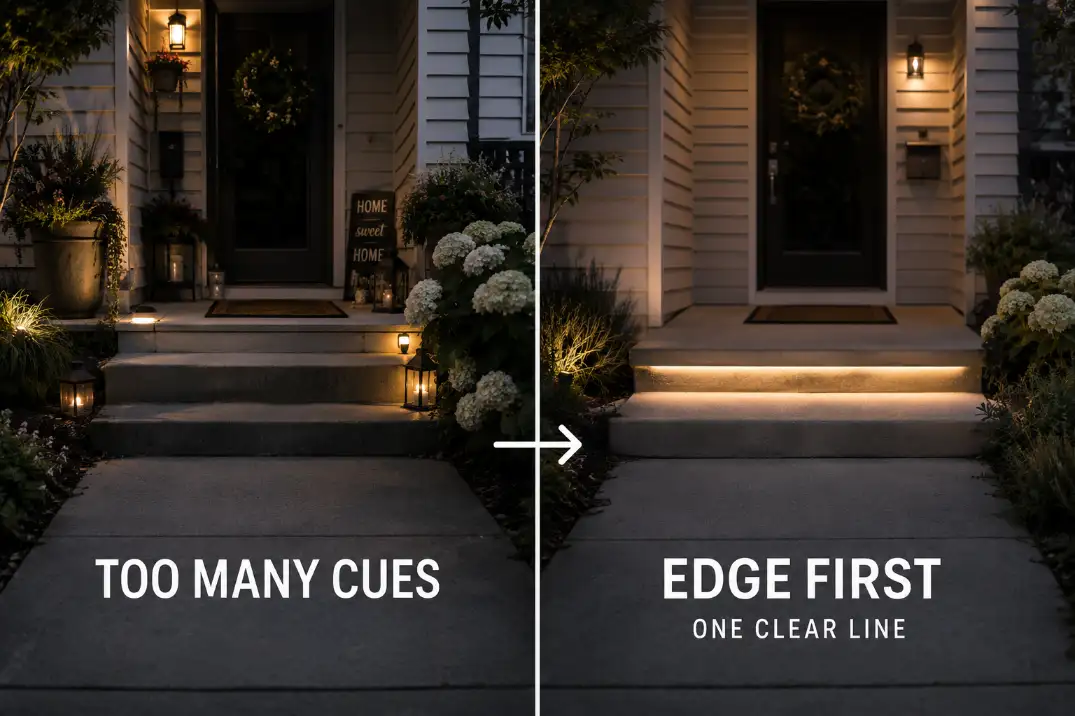
A single continuous cue is easier to read than several decorative cues competing at once. A clean contrast strip, a defined nosing, or a clear material break at the edge is usually stronger than a busy pattern spread across the whole tread.
Large patterns can create visual noise, especially when wet leaves, tree shadows, or reflected porch light break them up.
The healthier condition is a simple edge that stays visible. The failing condition is a broken or camouflaged line where the eye cannot tell whether it is seeing a shadow, a joint, a stain, or the actual drop.
| Step condition | What the eye sees | Better fix |
|---|---|---|
| Matching concrete tread and landing | One flat gray plane | Add edge contrast or a defined nosing |
| Dark stone under porch shade | A shadowed block | Add low-glare side lighting and a lighter edge |
| Patterned tile on riser and tread | Visual noise | Simplify the tread edge first |
| Wet pavers after rain | Reflections and dark patches | Use texture plus a clear front edge |
| Mulch beside the bottom step | The line blends into the bed | Pull mulch back and expose the step shape |
Know when visibility is no longer the main issue
Contrast cannot fix a damaged step edge. If the nosing is chipped, loose, uneven, or crumbling by more than about 1/4 inch, the problem is no longer just visual. The foot is also meeting an unreliable edge.
At that point, repair comes before marking. Painting over a broken front line may make the step easier to see, but it does not make the step feel predictable underfoot.
Plants Can Hide the Line
Plants do not have to block the whole step to create a visibility problem. Hiding one corner, one side edge, or the bottom riser can be enough to make the level change harder to read.
Keep the step read zone open
Low grasses, spreading groundcovers, and full planters often look harmless because the center of the step remains open. The issue is the edge, not the center.
If foliage hides the side corner where the step begins, the person approaching from the driveway or sidewalk loses an important cue.
Keep planting at least 6–12 inches back from the step edge where possible. If the plant flops after rain, needs frequent trimming, or sends stems across the corner every few weeks in summer, treat it as a visibility problem, not just a maintenance problem.
For older adults, the tolerance is lower because balance recovery may be slower once foot placement is wrong.
The same principle shows up in Safe Garden Paths for Seniors That Feel Stable, where clear edges and predictable walking lines matter more than decorative softness.
Framing is not the same as guidance
Two planters can make a front entry look finished, but they do not automatically make the step easier to use. If both containers are dark, close to the edge, or casting shadows across the landing, they may frame the entry while hiding the level change.
The fix is often smaller than removal. Lift the lower foliage, trim the bottom 4–6 inches, or move the container back until the step edge stays visible from the approach path.
Surface Changes Matter
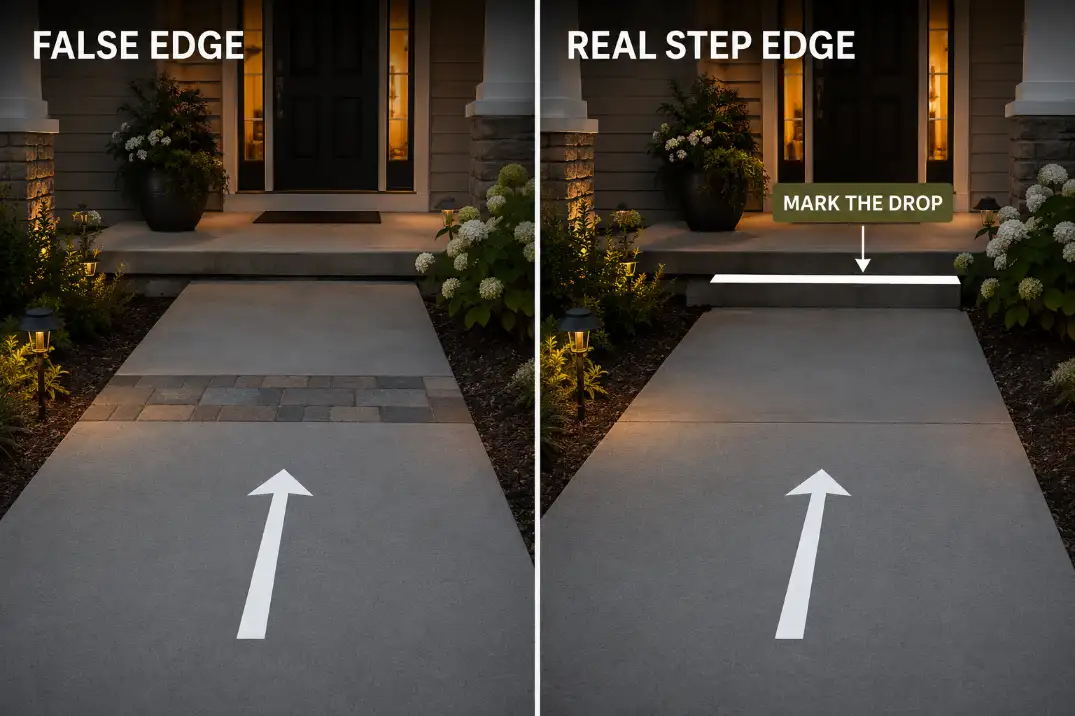
A surface change helps only when it marks the real level change. If it marks the wrong spot, it creates a false edge.
Avoid the false-edge problem
A walkway that changes from concrete to brick exactly at the step can help the eye understand the transition. But a border, mat, paver band, or decorative joint placed 18–24 inches before the actual step can pull attention to the wrong line.
That is the surface-change trap. The visitor notices a line, but it is not the line they need for foot placement. This can be worse than a plain entry because the eye has already “decided” where the change happens.
Surface contrast should reinforce the step edge, not compete with it. If the most visible line in the entry is not the actual level change, the layout is giving the wrong instruction.
Wet surfaces change the reading
A dry step and a wet step can look like different materials. Wet concrete darkens. Dark pavers may reflect porch light. Pale stone can lose its edge under glare.
In freezing northern states, thin snow, salt residue, or freeze-thaw staining can flatten the contrast between tread and riser.
A useful test is to check the entry 15–30 minutes after rain starts and again while the surface is drying. If the step reads clearly when dry but disappears when wet, the issue is not the whole design. It is contrast under moisture, glare, and reflection.
Steps that sit near slopes, path lights, or walkway transitions need the surface and lighting cues to agree.
Path Lighting for Steps, Slopes, and Walkways is especially relevant when the step is part of a longer route instead of a simple front porch.
Safer Without Looking Institutional
A safer step does not have to look like a warning zone. The strongest entries usually use one clear cue, not five loud ones.
Choose the cue that solves the real failure
If the tread blends into the landing, add contrast. If the riser disappears at night, adjust lighting. If plants hide the corner, clear the edge. If the surface is both slick and visually flat, choose a treatment that adds texture and definition.
The routine fix that often wastes time is adding decorative lights or planters before fixing the edge itself. Those additions may make the entry look more intentional, but they do not necessarily make the level change easier to read.
For front doors that feel difficult beyond the step itself, Front Entry Usability Ideas can help connect step visibility with landing space, package drop zones, door swing, and the route from driveway to porch.
Use this short visibility check
Before choosing paint, lights, treads, or planting changes, check the step as a walking decision:
- Can the step edge be read from 6–10 feet away?
- Does it read from both directions, approaching and leaving?
- Is the walking line visible 30 minutes after sunset?
- Does glare create a shadow line instead of an edge line?
- Does the edge remain clear when the step is wet?
- Are plants, mulch, and containers at least 6–12 inches away from the visual edge?
- Is the nosing physically even, with no loose or broken section?
If two or more answers are no, treat the problem as a visibility system, not a decoration problem. Start with the edge, then lighting, then plant and surface interference.
Questions People Usually Ask
What color makes outdoor steps easiest to see?
The best color is the one that contrasts with the step surface already there. On pale concrete, a darker edge may read better. On dark stone or shaded wood, a lighter edge usually works better. The color matters less than the visible break.
Are solar lights enough for step visibility?
Sometimes, but only if they light the step edge instead of only the planting bed. Many small solar lights create bright dots beside the walkway while the tread line stays dim.
Test them after a cloudy day, because weak charging can reduce useful light at the exact time the step needs it.
Should every outdoor step have a tread strip?
No. A tread strip makes sense when the step is slippery, visually flat, or often wet. If the surface already has good texture and the only problem is poor edge definition, a simpler contrast treatment may look cleaner and work just as well.
What is the first fix to try?
Make the real step edge readable first. Then adjust lighting and clear the edge zone around it. Do not start with a full redesign unless the step is uneven, draining poorly, or physically uncomfortable to use.
Because step visibility is ultimately about how quickly the eye finds a level change, broader accessibility guidance is available in the 2010 ADA Standards for Accessible Design.